Artificial Lift Selection
Description
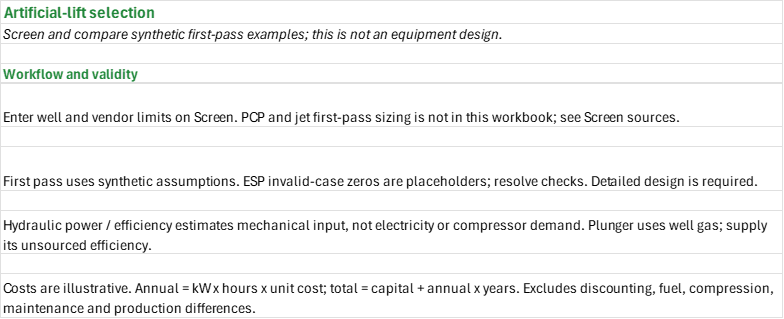
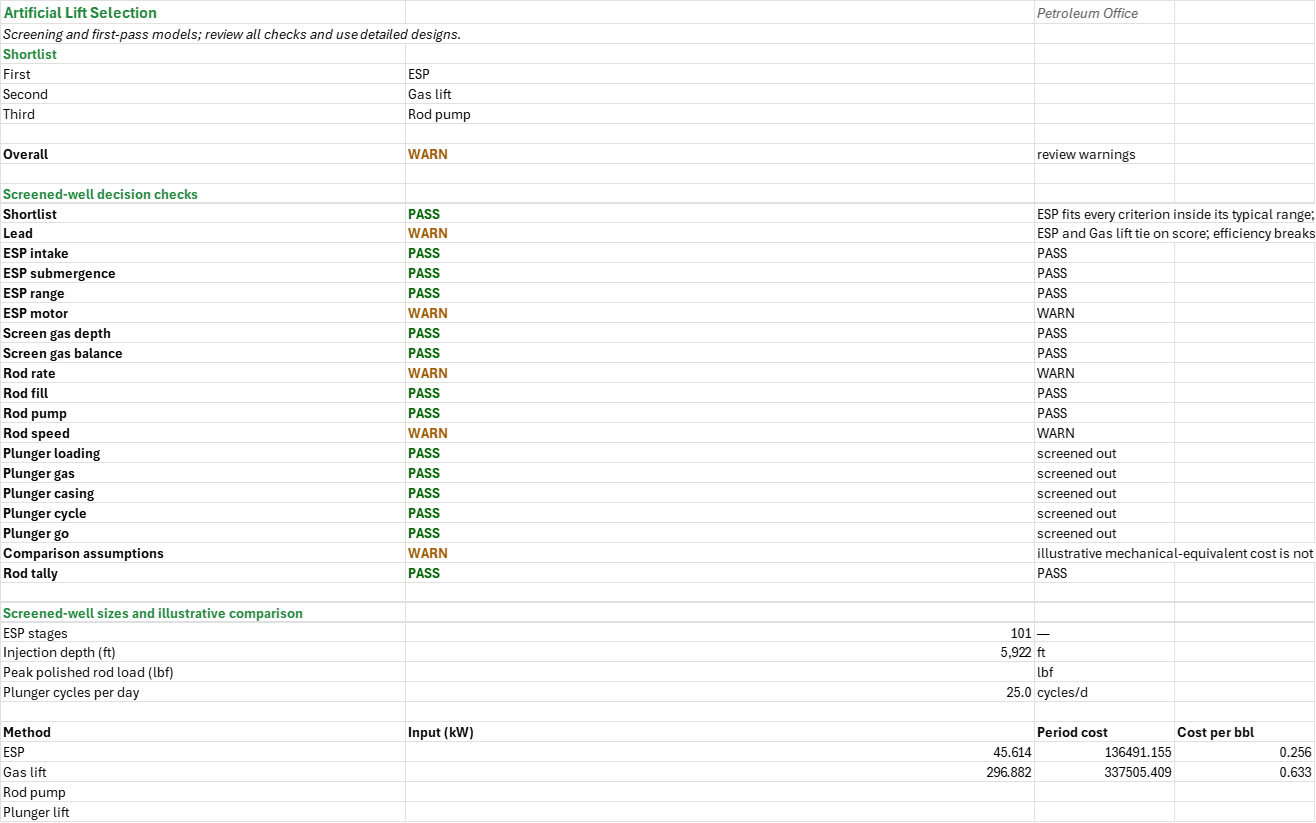
Which artificial-lift method fits this well, and what would the leading ones take? You enter the liquid rate, lift depth, temperature, deviation, gas-liquid ratio, sand and the power on site; the workbook scores six methods against editable typical and maximum ranges and sizes ESP, gas lift, rod pump and plunger lift to a first pass. You read off the ranked shortlist with each method's reasons, the headline sizes, and an illustrative power and cost comparison. The input values are synthetic, not equipment specifications or field measurements.
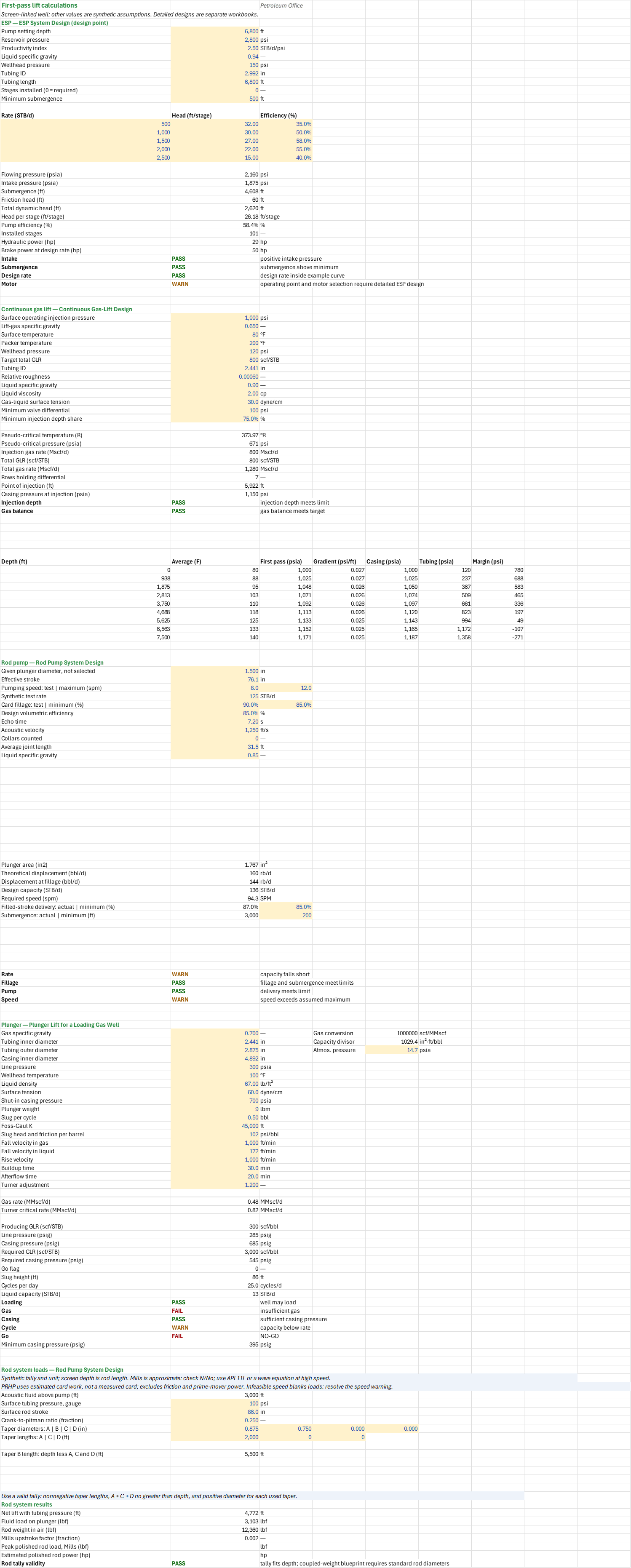
How to use it: Enter the well and the power available on the Screen sheet, and replace the method limits in its table with verified ranges for your equipment. On the First pass sheet, replace the example pump curve and the gas-lift, rod-pump and plunger assumptions with the well's own; the ESP's invalid-case zeros are placeholders, so resolve its checks. On the Comparison sheet, set the operating hours, period, unit cost, capital and each method's system efficiency; plunger lift needs your own efficiency. The Summary gathers the shortlist, the headline sizes, the comparison and every check.
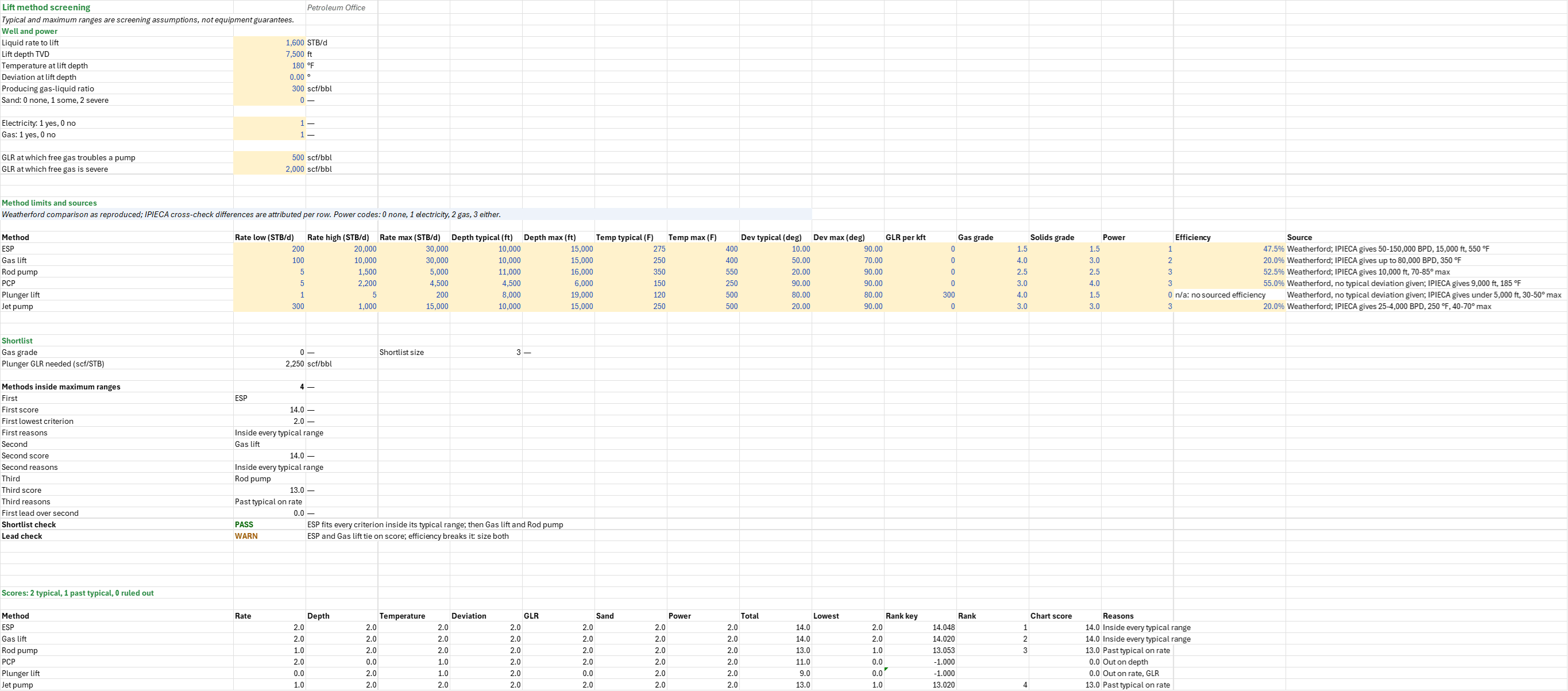
Method: The screen gives each method seven scores (rate, depth, temperature, deviation, GLR, sand and power) from its typical and maximum ranges: 2 inside the typical range, 1 past it, 0 outside the maximum. A zero rules a method out. Survivors rank by total score, with efficiency as a tie-break. The first pass uses the screened well and explicit additional inputs to estimate each covered method's headline sizing values; the corresponding blueprints and detailed workbooks keep the full design workflows.
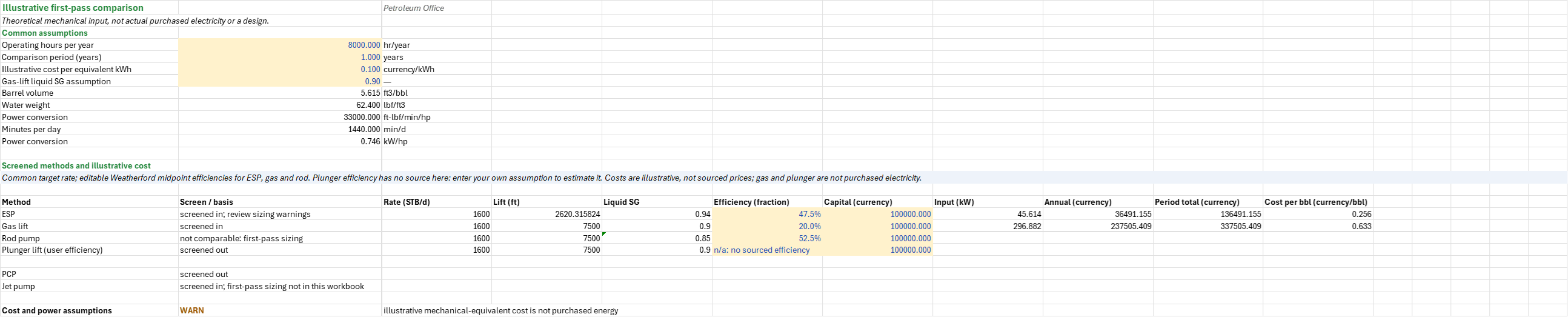
The comparison estimates theoretical mechanical input as liquid hydraulic power divided by an editable system efficiency; it is not a measurement or purchased electrical power. All four methods use the screen's target rate; ESP lifts against its target-rate TDH, the others against the assumed lift depth. Annual illustrative equivalent cost is mechanical kW times assumed annual operating hours times an illustrative unit cost; the period total adds assumed capital. Cost per barrel divides the period total by the target rate times operating days and years. No discounting, maintenance, fuel conversion or production difference is modelled. All unit and capital costs are illustrative editable assumptions, not a sourced price list. The Weatherford system-efficiency midpoints from the screening blueprint are starting assumptions, not vendor guarantees. Plunger lift has no published efficiency in that source; it shows as n/a until you supply a positive efficiency.
Example: At 1600 STB/d, 7500 ft TVD, 180 F and 300 scf/STB with no sand and both power sources available, ESP and gas lift score 14, followed by rod pump at 13. Jet pump also passes the screen. The synthetic first-pass sizing is not automatically a feasible selection.
Validity
This is screening, not final equipment design. Replace well data, vendor curves and limits with verified inputs. ESP invalid-case placeholders are not valid designs; resolve its checks. Gas-lift compressor electricity cannot be inferred from liquid hydraulic power. Plunger lift uses well gas: the screening source gives no plunger efficiency, so without a positive user assumption it is marked not comparable. PCP and jet pump, when screened in, are not sized: the workbook has no first-pass sizing for them; refer to their method limits and row sources on the Screen sheet. Rod displacement is not a complete rod-string, load, gearbox or power design. The detailed designs are the ESP System Design (po.wb.esp.design), Continuous Gas-Lift Design (po.wb.gl.continuous-design) and Rod Pump System Design (po.wb.rp.rod-pump-design) workbooks; use the plunger-lift blueprint po.bp.vfp.plunger.lift for a detailed plunger case. The add-in has no function for the ESP optimum frequency or for the Gibbs rod-pump dynamometer card and its diagnosis. Compare with measurements and vendor analyses.
References
po.bp.well-perf.lift.selection,po.bp.esp.operating.point,po.bp.gl.injection.pressure,po.bp.rp.pump.sizing,po.bp.rp.system.design,po.bp.vfp.plunger.lift.- Weatherford artificial-lift comparison as reproduced in the source blueprint's cited public slide deck; IPIECA (2023), "Artificial lift", used as a cross-check with differences attributed per row.
Inputs
| Input | Unit | Default | Name |
|---|---|---|---|
| Liquid rate to lift | STB/d | 1600 | LSS_Q |
| Lift depth TVD | ft | 7500 | LSS_D |
| Temperature at lift depth | F | 180 | LSS_T |
| Deviation at lift depth | deg | 0 | LSS_Dev |
| Producing gas-liquid ratio | scf/STB | 300 | LSS_GLR |
| Sand: 0 none, 1 some, 2 severe | — | 0 | LSS_Sand |
| Electricity: 1 yes, 0 no | — | 1 | LSS_Elec |
| Gas: 1 yes, 0 no | — | 1 | LSS_Gas |
| Operating hours per year | hr/year | 8000 | LSC_Hours |
| Comparison period | years | 1 | LSC_Years |
| Illustrative cost per equivalent kWh | currency/kWh | 0.1 | LSC_UnitCost |
| Efficiency (fraction): ESP, gas lift, rod pump, plunger lift | — | 0.475, 0.2, 0.525; plunger lift unavailable unless you supply it | LSC_Eff1 through LSC_Eff4 |
| Given plunger diameter, not selected | in | 1.5 | LSR_Dp |
| Effective stroke | in | 76.1 | LSR_Sp |
| Pumping speed: test | spm | 8 | LSR_N |
| Maximum assumed speed | spm | 12 | LSR_MaxN |
Sheets
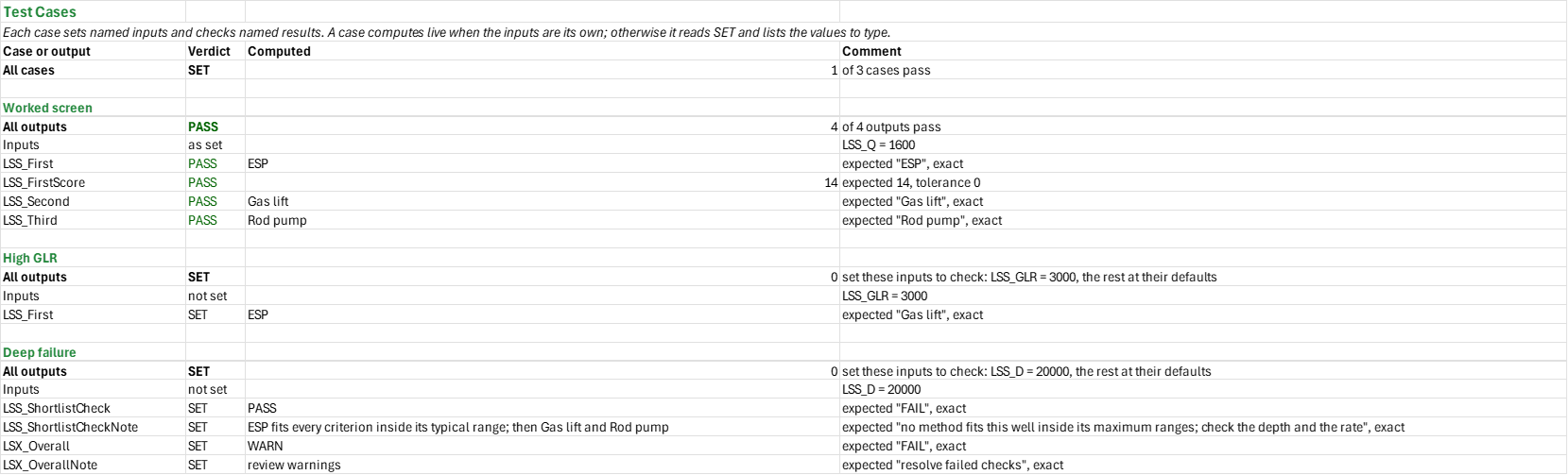
Guide— the workflow and the limits of a screening workbook.Screen— the well and power on site, the six methods' typical and maximum ranges with their sources, the seven scores per method, and the ranked shortlist with each method's reasons.First pass— first-pass ESP design point, continuous gas-lift injection depth, rod-pump displacement and rod system, and plunger-lift loading, feasibility and cycle, all on the screened well.Comparison— theoretical mechanical input, annual and period cost and cost per barrel for ESP, gas lift, rod pump and plunger lift on common, illustrative assumptions.Summary— the shortlist, the headline sizes, the comparison and every check under one verdict.Test Cases— the worked example and other cases, with expected and computed results.
Functions used
Names (201)
| Name | Refers to | Comment |
|---|---|---|
PO.PE.Loading.TurnerRateLAMBDA |
=LAMBDA(p, t, sg_g, tubing_id, sigma, rho_l, factor, IF(OR(p<=0, t<=-459.67, sg_g<=0, tubing_id<=0, sigma<=0, rho_l<=0, factor<=0), NA(), LET(tr, t+459.67, z, PO.PVT.Z.ByDAK(p/PO.PVT.Ppc.BySutton(sg_g), tr/PO.PVT.Tpc.BySutton(sg_g)), rho_g, PO.PVT.Rho.Gas.ByDefinition(p, tr, sg_g, z)*62.428, IF(rho_l<=rho_g, NA(), 3.06*p*factor*1.593*sigma^0.25*(rho_l-rho_g)^0.25/rho_g^0.5*PI()*tubing_id^2/576/(tr*z))))) |
Turner critical gas rate to unload liquid, MMscf/d: p (psia) and t (°F) where it is read, usually the wellhead, gas gravity sg_g, tubing_id (in), the liquid's sigma (dyne/cm) and rho_l (lb/ft³), and factor (1.2 Turner, 1 Coleman). |
PO.PE.Plunger.CycleLAMBDA |
=LAMBDA(depth, liquid_ht, v_gas, v_liq, v_rise, buildup, afterflow, slug, output, IF(OR(depth<=0, liquid_ht<0, liquid_ht>depth, v_gas<=0, v_liq<=0, v_rise<=0, buildup<0, afterflow<0, slug<0), NA(), LET(fall, (depth-liquid_ht)/v_gas+liquid_ht/v_liq, rise, depth/v_rise, cyc, MAX(fall, buildup)+rise+afterflow, IF(output="Fall", fall, IF(output="Rise", rise, IF(output="Cycle", cyc, IF(output="Cycles", 1440/cyc, IF(output="Liquid", slug*1440/cyc, NA())))))))) |
Plunger cycle, minutes: output "Fall", "Rise", "Cycle" (shut-in as the longer of fall and buildup, plus rise and afterflow), "Cycles" per day, or "Liquid" (bbl/d, slug × cycles). Depths in ft, velocities in ft/min, times in min. |
PO.PE.Plunger.FeasibilityLAMBDA |
=LAMBDA(depth, tubing_id, tubing_od, casing_id, plunger_wt, pt, slug, k, plhf, glr, pc, output, IF(OR(depth<=0, tubing_id<=0, tubing_od<tubing_id, casing_id<=tubing_od, plunger_wt<0, pt<0, slug<=0, k<=0, plhf<=0, glr<0, pc<0), NA(), LET(at, PI()*tubing_id^2/4, aa, PI()*(casing_id^2-tubing_od^2)/4, pcmin, (plunger_wt/at+pt+plhf*slug)*(1+depth/k), pcmax, pcmin*(aa+at)/aa, glrmin, 0.4*depth, IF(output="PcMin", pcmin, IF(output="PcMax", pcmax, IF(output="GLRMin", glrmin, IF(output="Go", (glr>=glrmin)*(pc>=pcmax), NA()))))))) |
Foss-Gaul plunger lift check: output "PcMin" or "PcMax" casing pressure (psi), "GLRMin" (scf/bbl, 400 per 1,000 ft) or "Go" (1 when glr and pc meet them). K (ft) and plhf (psi/bbl) are the tubing's Foss-Gaul constants. |
PO.RP.Fluidlevel.EchoLAMBDA |
=LAMBDA(t_echo, v_acoustic, joints, joint_len, pump_depth, output, IF(OR(t_echo<=0, pump_depth<=0, joints<0, AND(joints>0, joint_len<=0), AND(joints=0, v_acoustic<=0)), NA(), LET(level, IF(joints>0, joints*joint_len, v_acoustic*t_echo/2), IF(output="Level", level, IF(output="Submergence", pump_depth-level, IF(output="Velocity", 2*level/t_echo, NA())))))) |
Annulus fluid level from an acoustic shot: v·t/2, or joints × joint length when joints > 0; output "Level" (ft from surface), "Submergence" (pump depth − level, ft) or "Velocity" (implied, ft/s). |
LRS_CH |
'First pass'!$B$169 |
Crank-to-pitman ratio (fraction) |
LRS_DiaA |
'First pass'!$B$170 |
Taper diameters: A | B | C | D (in) (in) |
LRS_DiaB |
'First pass'!$C$170 |
Taper B diameter, in |
LRS_DiaC |
'First pass'!$D$170 |
Taper C diameter, in |
LRS_DiaD |
'First pass'!$E$170 |
Taper D diameter, in |
LRS_Hsub |
'First pass'!$B$166 |
Acoustic fluid above pump (ft), ft |
LRS_Inputs |
'First pass'!$B$166:$E$173 |
Rod system assumptions; taper B fills the screened depth |
LRS_LenA |
'First pass'!$B$171 |
Taper lengths: A | C | D (ft) (ft) |
LRS_LenC |
'First pass'!$C$171 |
Taper C length, ft |
LRS_LenD |
'First pass'!$D$171 |
Taper D length, ft |
LRS_PPRL |
'First pass'!$B$184 |
Peak polished rod load, Mills (lbf), lbf |
LRS_PRHP |
'First pass'!$B$185 |
Estimated polished rod power (hp), hp |
LRS_Ptf |
'First pass'!$B$167 |
Surface tubing pressure, gauge (psi) |
LRS_Results |
'First pass'!$B$180:$B$185 |
Mills peak load and estimated polished rod power |
LRS_S |
'First pass'!$B$168 |
Surface rod stroke (in) |
LRS_TallyCheck |
'First pass'!$B$186 |
Rod tally validity verdict |
LRS_TallyCheckNote |
'First pass'!$C$186 |
Rod tally validity comment |
LSC_Annual3 |
Comparison!$I$20 |
Illustrative annual equivalent cost |
LSC_CostCheck |
Comparison!$B$26 |
Cost and power assumptions verdict |
LSC_CostCheckNote |
Comparison!$C$26 |
Cost and power assumptions comment |
LSC_Eff1 |
Comparison!$F$18 |
Editable efficiency assumption |
LSC_Eff2 |
Comparison!$F$19 |
Editable efficiency assumption |
LSC_Eff3 |
Comparison!$F$20 |
Editable efficiency assumption |
LSC_Eff4 |
Comparison!$F$21 |
Editable efficiency assumption |
LSC_GasSG |
Comparison!$B$7 |
Gas-lift liquid SG assumption (water = 1) |
LSC_Hours |
Comparison!$B$4 |
Operating hours per year (hr/year) |
LSC_Inputs |
Comparison!$B$4:$B$7 |
User assumptions, not a price list |
LSC_Jet |
Comparison!$B$24 |
Jet pump |
LSC_Pcp |
Comparison!$B$23 |
PCP |
LSC_PerBbl1 |
Comparison!$K$18 |
Illustrative period cost per produced barrel |
LSC_PerBbl2 |
Comparison!$K$19 |
Illustrative period cost per produced barrel |
LSC_PerBbl3 |
Comparison!$K$20 |
Illustrative period cost per produced barrel |
LSC_PerBbl4 |
Comparison!$K$21 |
Illustrative period cost per produced barrel |
LSC_Power1 |
Comparison!$H$18 |
Theoretical mechanical input kW |
LSC_Power2 |
Comparison!$H$19 |
Theoretical mechanical input kW |
LSC_Power3 |
Comparison!$H$20 |
Theoretical mechanical input kW |
LSC_Power4 |
Comparison!$H$21 |
Theoretical mechanical input kW |
LSC_Results |
Comparison!$B$23:$B$26 |
Unsupported methods and assumptions verdict |
LSC_Table |
Comparison!$A$18:$K$21 |
Illustrative estimates, not purchased energy |
LSC_Total1 |
Comparison!$J$18 |
Illustrative period total |
LSC_Total2 |
Comparison!$J$19 |
Illustrative period total |
LSC_Total3 |
Comparison!$J$20 |
Illustrative period total |
LSC_Total4 |
Comparison!$J$21 |
Illustrative period total |
LSC_UnitCost |
Comparison!$B$6 |
Illustrative cost per equivalent kWh (currency/kWh) |
LSC_Years |
Comparison!$B$5 |
Comparison period (years) (years) |
LSE_BHP |
'First pass'!$B$30 |
Brake power at design rate (hp), hp |
LSE_Dpump |
'First pass'!$B$4 |
Pump setting depth (ft) |
LSE_Inputs |
'First pass'!$B$4:$B$12 |
ESP assumptions |
LSE_IntakeCheck |
'First pass'!$B$31 |
Intake verdict |
LSE_IntakeCheckNote |
'First pass'!$C$31 |
Intake comment |
LSE_MinSubm |
'First pass'!$B$12 |
Minimum submergence (ft) |
LSE_MotorCheck |
'First pass'!$B$34 |
Motor verdict |
LSE_MotorCheckNote |
'First pass'!$C$34 |
Motor comment |
LSE_N |
'First pass'!$B$28 |
Installed stages |
LSE_PI |
'First pass'!$B$6 |
Productivity index (STB/d/psi) |
LSE_Pr |
'First pass'!$B$5 |
Reservoir pressure (psi) |
LSE_PumpData |
'First pass'!$A$15:$C$19 |
Example pump curve; replace with vendor data |
LSE_RangeCheck |
'First pass'!$B$33 |
Design rate verdict |
LSE_RangeCheckNote |
'First pass'!$C$33 |
Design rate comment |
LSE_Results |
'First pass'!$B$21:$B$34 |
ESP design point and checks |
LSE_SG |
'First pass'!$B$7 |
Liquid specific gravity (water = 1) |
LSE_StagesSet |
'First pass'!$B$11 |
Stages installed (0 = required) (stages) |
LSE_SubmCheck |
'First pass'!$B$32 |
Submergence verdict |
LSE_SubmCheckNote |
'First pass'!$C$32 |
Submergence comment |
LSE_TDH |
'First pass'!$B$25 |
Total dynamic head (ft), ft |
LSE_TubID |
'First pass'!$B$9 |
Tubing ID (in) |
LSE_TubL |
'First pass'!$B$10 |
Tubing length (ft) |
LSE_WHP |
'First pass'!$B$8 |
Wellhead pressure (psi) |
LSI_BalanceCheck |
'First pass'!$B$61 |
Gas balance verdict |
LSI_BalanceCheckNote |
'First pass'!$C$61 |
Gas balance comment |
LSI_DepthCheck |
'First pass'!$B$60 |
Injection depth verdict |
LSI_DepthCheckNote |
'First pass'!$C$60 |
Injection depth comment |
LSI_GLRt |
'First pass'!$B$43 |
Target total GLR (scf/STB) |
LSI_ID |
'First pass'!$B$44 |
Tubing ID (in) |
LSI_IFT |
'First pass'!$B$48 |
Gas-liquid surface tension (dyne/cm) |
LSI_Inputs |
'First pass'!$B$38:$B$50 |
Gas-lift assumptions |
LSI_POI |
'First pass'!$B$58 |
Point of injection (ft), ft |
LSI_PcPOI |
'First pass'!$B$59 |
Casing pressure at injection (psia), psi |
LSI_PoiMin |
'First pass'!$B$50 |
Minimum injection depth share (%) |
LSI_Ps |
'First pass'!$B$38 |
Surface operating injection pressure (psi) |
LSI_Pwh |
'First pass'!$B$42 |
Wellhead pressure (psi) |
LSI_Qgi |
'First pass'!$B$54 |
Injection gas rate (Mscf/d), Mscf/d |
LSI_Results |
'First pass'!$B$52:$B$61 |
Gas injection results and checks |
LSI_Rough |
'First pass'!$B$45 |
Relative roughness |
LSI_SG |
'First pass'!$B$39 |
Lift-gas specific gravity (air = 1) |
LSI_SGl |
'First pass'!$B$46 |
Liquid specific gravity (water = 1) |
LSI_Tb |
'First pass'!$B$41 |
Packer temperature (°F) |
LSI_Ts |
'First pass'!$B$40 |
Surface temperature (°F) |
LSI_Ul |
'First pass'!$B$47 |
Liquid viscosity (cp) |
LSI_dPmin |
'First pass'!$B$49 |
Minimum valve differential (psi) |
LSPC_Afterflow |
'First pass'!$B$140 |
Afterflow time (min) |
LSPC_Buildup |
'First pass'!$B$139 |
Buildup time (min) |
LSPC_Capacity |
'First pass'!$E$124 |
Tubing capacity divisor; source: po.bp.vfp.plunger.lift |
LSPC_CasingCheck |
'First pass'!$B$157 |
Casing verdict |
LSPC_CasingCheckNote |
'First pass'!$C$157 |
Casing comment |
LSPC_CsgID |
'First pass'!$B$126 |
Casing inner diameter (in) |
LSPC_CycleCheck |
'First pass'!$B$158 |
Cycle verdict |
LSPC_CycleCheckNote |
'First pass'!$C$158 |
Cycle comment |
LSPC_Cycles |
'First pass'!$B$153 |
Cycles per day, cycles/d |
LSPC_GLR |
'First pass'!$B$146 |
Producing GLR (scf/STB), scf/bbl |
LSPC_GLRMin |
'First pass'!$B$149 |
Required GLR (scf/STB), scf/bbl |
LSPC_GasCheck |
'First pass'!$B$156 |
Gas verdict |
LSPC_GasCheckNote |
'First pass'!$C$156 |
Gas comment |
LSPC_GoCheck |
'First pass'!$B$159 |
Go verdict |
LSPC_GoCheckNote |
'First pass'!$C$159 |
Go comment |
LSPC_ID |
'First pass'!$B$124 |
Tubing inner diameter (in) |
LSPC_IFT |
'First pass'!$B$130 |
Surface tension (dyne/cm) |
LSPC_Inputs |
'First pass'!$B$123:$B$141 |
Plunger and cycle assumptions |
LSPC_K |
'First pass'!$B$134 |
Foss-Gaul K (ft) |
LSPC_Lift |
'First pass'!$B$154 |
Liquid capacity (STB/d), STB/d |
LSPC_LoadCheck |
'First pass'!$B$155 |
Loading verdict |
LSPC_LoadCheckNote |
'First pass'!$C$155 |
Loading comment |
LSPC_OD |
'First pass'!$B$125 |
Tubing outer diameter (in) |
LSPC_PLHF |
'First pass'!$B$135 |
Slug head and friction per barrel (psi/bbl) |
LSPC_Patm |
'First pass'!$E$125 |
Atmospheric pressure, psia |
LSPC_PcMax |
'First pass'!$B$150 |
Required casing pressure (psig), psig |
LSPC_Pline |
'First pass'!$B$127 |
Line pressure (psia) |
LSPC_QcT |
'First pass'!$B$144 |
Turner critical rate (MMscf/d), MMscf/d |
LSPC_Results |
'First pass'!$B$143:$B$159 |
Loading, feasibility and cycle |
LSPC_RhoL |
'First pass'!$B$129 |
Liquid density (lb/ft³) |
LSPC_SGg |
'First pass'!$B$123 |
Gas specific gravity (air = 1) |
LSPC_SICP |
'First pass'!$B$131 |
Shut-in casing pressure (psia) |
LSPC_ScfPerMM |
'First pass'!$E$123 |
Standard cubic feet per million standard cubic feet |
LSPC_Slug |
'First pass'!$B$133 |
Slug per cycle (bbl) |
LSPC_TurnerF |
'First pass'!$B$141 |
Turner adjustment |
LSPC_Twh |
'First pass'!$B$128 |
Wellhead temperature (°F) |
LSPC_Vgas |
'First pass'!$B$136 |
Fall velocity in gas (ft/min) |
LSPC_Vliq |
'First pass'!$B$137 |
Fall velocity in liquid (ft/min) |
LSPC_Vrise |
'First pass'!$B$138 |
Rise velocity (ft/min) |
LSPC_Wp |
'First pass'!$B$132 |
Plunger weight (lbm) |
LSR_Cap |
'First pass'!$B$106 |
Design capacity (STB/d), STB/d |
LSR_Check |
'First pass'!$B$116 |
Rate verdict |
LSR_CheckNote |
'First pass'!$C$116 |
Rate comment |
LSR_Dp |
'First pass'!$B$80 |
Given plunger diameter, not selected (in) |
LSR_Echo |
'First pass'!$B$86 |
Echo time (s) |
LSR_Ev |
'First pass'!$B$85 |
Design volumetric efficiency (%) |
LSR_Fill |
'First pass'!$B$84 |
Card fillage: test | minimum (%) (%) |
LSR_FillCheck |
'First pass'!$B$117 |
Fillage verdict |
LSR_FillCheckNote |
'First pass'!$C$117 |
Fillage comment |
LSR_FillMin |
'First pass'!$C$84 |
Minimum fillage, % |
LSR_Inputs |
'First pass'!$B$80:$C$90 |
Pump and test assumptions |
LSR_JointLen |
'First pass'!$B$89 |
Average joint length (ft) |
LSR_Joints |
'First pass'!$B$88 |
Collars counted |
LSR_MaxN |
'First pass'!$C$82 |
Maximum assumed speed, SPM |
LSR_N |
'First pass'!$B$82 |
Pumping speed: test | maximum (spm) (SPM) |
LSR_Nreq |
'First pass'!$B$107 |
Required speed (spm), SPM |
LSR_PumpCheck |
'First pass'!$B$118 |
Pump verdict |
LSR_PumpCheckNote |
'First pass'!$C$118 |
Pump comment |
LSR_Qa |
'First pass'!$B$83 |
Synthetic test rate (STB/d) |
LSR_Results |
'First pass'!$B$103:$B$119 |
Pump sizing and system-design loads |
LSR_SG |
'First pass'!$B$90 |
Liquid specific gravity (water = 1) |
LSR_SlipMin |
'First pass'!$C$108 |
Minimum delivered share, % |
LSR_Sp |
'First pass'!$B$81 |
Effective stroke (in) |
LSR_SpeedCheck |
'First pass'!$B$119 |
Speed verdict |
LSR_SpeedCheckNote |
'First pass'!$C$119 |
Speed comment |
LSR_SubMin |
'First pass'!$C$109 |
Minimum submergence, ft |
LSR_Vac |
'First pass'!$B$87 |
Acoustic velocity (ft/s) |
LSS_Count |
Screen!$B$34 |
Methods inside maximum ranges |
LSS_D |
Screen!$B$5 |
Lift depth TVD (ft) |
LSS_Dev |
Screen!$B$7 |
Deviation at lift depth (°) |
LSS_Elec |
Screen!$B$11 |
Electricity: 1 yes, 0 no |
LSS_First |
Screen!$B$35 |
First |
LSS_FirstLowest |
Screen!$B$37 |
First lowest criterion |
LSS_FirstScore |
Screen!$B$36 |
First score |
LSS_FirstWhy |
Screen!$B$38 |
First reasons |
LSS_GLR |
Screen!$B$8 |
Producing gas-liquid ratio (scf/bbl) |
LSS_Gas |
Screen!$B$12 |
Gas: 1 yes, 0 no |
LSS_GasGrade |
Screen!$B$31 |
Gas grade |
LSS_GlrPlunger |
Screen!$B$32 |
Plunger GLR needed (scf/STB), scf/bbl |
LSS_GlrSevere |
Screen!$B$15 |
GLR at which free gas is severe (scf/bbl) |
LSS_GlrSome |
Screen!$B$14 |
GLR at which free gas troubles a pump (scf/bbl) |
LSS_Inputs |
Screen!$B$4:$B$15 |
Well and screening assumptions |
LSS_Lead |
Screen!$B$45 |
First lead over second |
LSS_LeadCheck |
Screen!$B$47 |
Lead check verdict |
LSS_LeadCheckNote |
Screen!$C$47 |
Lead check comment |
LSS_Limits |
Screen!$A$22:$P$27 |
Screening limits and sources |
LSS_Q |
Screen!$B$4 |
Liquid rate to lift (STB/d) |
LSS_Results |
Screen!$B$31:$B$47 |
Shortlist and checks |
LSS_Sand |
Screen!$B$9 |
Sand: 0 none, 1 some, 2 severe |
LSS_Scores |
Screen!$A$55:$N$60 |
Scores, rankings and reasons |
LSS_Second |
Screen!$B$39 |
Second |
LSS_SecondScore |
Screen!$B$40 |
Second score |
LSS_SecondWhy |
Screen!$B$41 |
Second reasons |
LSS_ShortlistCheck |
Screen!$B$46 |
Shortlist check verdict |
LSS_ShortlistCheckNote |
Screen!$C$46 |
Shortlist check comment |
LSS_ShortlistSize |
Screen!$E$31 |
Number of shortlisted methods |
LSS_T |
Screen!$B$6 |
Temperature at lift depth (°F) |
LSS_Third |
Screen!$B$42 |
Third |
LSS_ThirdScore |
Screen!$B$43 |
Third score |
LSS_ThirdWhy |
Screen!$B$44 |
Third reasons |
LSX_Checks |
Summary!$B$11:$B$29 |
Screened-well checks |
LSX_First |
Summary!$B$4 |
First |
LSX_Overall |
Summary!$B$8 |
Overall verdict |
LSX_OverallNote |
Summary!$C$8 |
Overall comment |
LSX_Results |
Summary!$B$4:$B$8 |
Screening and overall verdict |
LSX_Second |
Summary!$B$5 |
Second |
LSX_Third |
Summary!$B$6 |
Third |
Details
| Opens in | Needs the Petroleum Office add-in: its PO functions show #NAME? without it once Excel recalculates. Needs Microsoft 365 or Excel 2024: it uses functions Excel 2016 doesn't have, such as named LAMBDAs, which show #NAME? there. |
| File | LiftSelection.xlsx, 43 KB |
| Category | Production |
| For agents and tools | Descriptor (.md) |