Oil Material Balance
Description
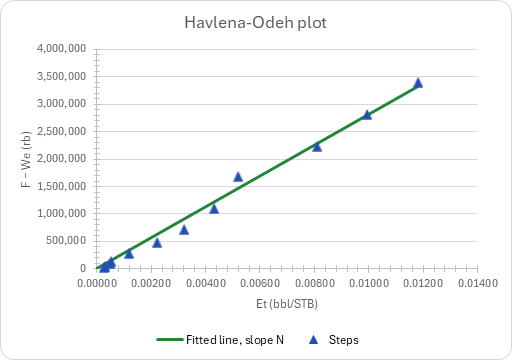
How much oil is in place, what drives the reservoir, and how much will it recover below the bubble point? You enter the initial PVT and one row a pressure survey (pressure, Np, Gp, Wp, Winj, We, Bo, Rs, Bg), the rock compressibility, an aquifer and the forecast's fluid and relative permeability. You read off the OOIP with its R2, the Havlena-Odeh and Campbell plots, the drive indices, which aquifer model gives a flat OOIP, and the oil and gas recovered from Pb to abandonment. Field units.
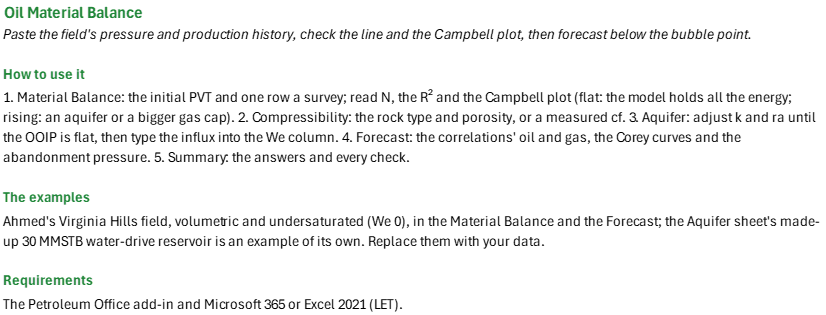
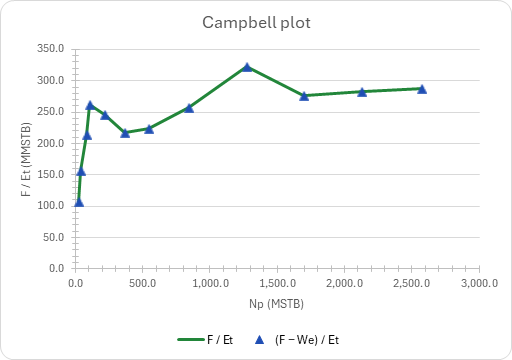
How to use it: On the Material Balance sheet, type volumetric-average pressures, cumulatives and the PVT at each pressure (below Pb, Gp, Rs and Bg too), then read N, the R2 and the Campbell plot: flat, the model holds all the energy; rising, an aquifer or a bigger gas cap. On the Compressibility sheet pick the rock type and porosity, or type a core-measured cf. For a water drive, replace the Aquifer history with the field's, adjust k and ra until the OOIP is flat, and type the matched influx into the We column of the Material Balance. On the Forecast sheet, paste lab PVT over the table and fit the Corey end points to core or the GOR history. The Summary gathers the answers and every check.
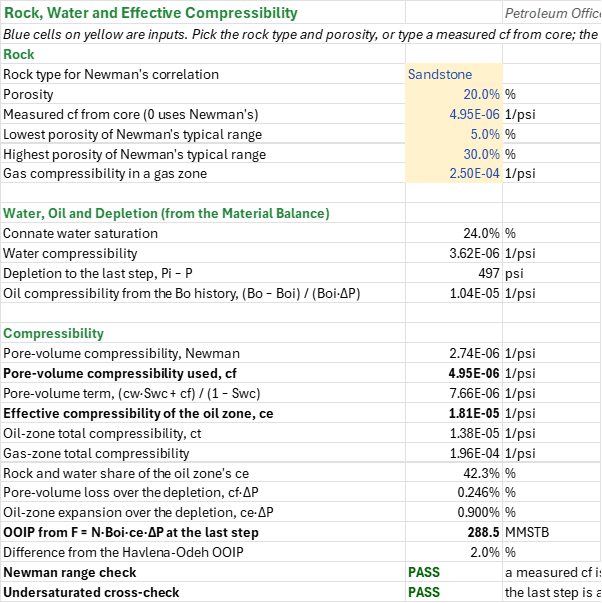
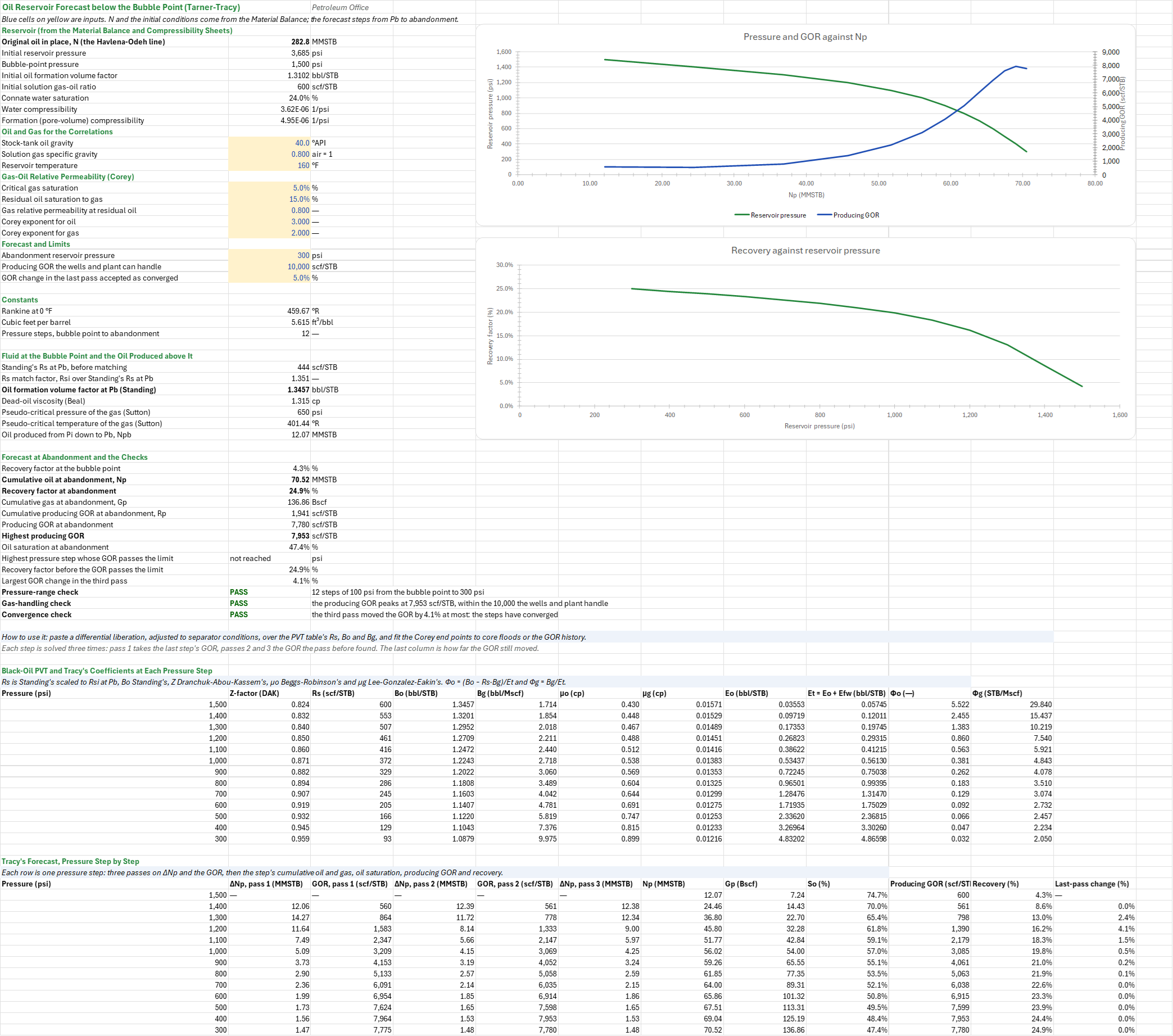
Method: F = Np[Bo + (Rp - Rs)Bg] + (Wp - Winj)Bw; Eo, Eg, Efw = (1 + m)Boi(cw Swc + cf)/(1 - Swc) dP and Et = Eo + m Eg + Efw; N = sum((F - We)Et)/sum(Et^2), the slope of F - We against Et through the origin, with R2 about that line, and the depletion, gas-cap, water and compaction drive indices (DDI, GDI, WDI, CDI) at every step. cf is Newman's for the rock type unless one is measured, and Efw takes it; co = (Bo - Boi)/(Boi dP), ce = co + (cw Swc + cf)/(1 - Swc), and ct follows; F/(Boi ce dP) at the last step is the undersaturated OOIP, the Campbell plot's last point and a cross-check on the line. Fetkovich steps Wei/pi (pa - p)(1 - exp(-J pi dt/Wei)); van Everdingen-Hurst superposes Dake's averaged steps on a bounded aquifer; both run over one boundary-pressure history, each step's OOIP is (F - We)/Et, set against the OOIP with no influx, and the spread is (max - min)/mean. The forecast is Tracy's form of Tarner's method from Pb to abandonment on the material balance's OOIP, three explicit passes a step: dNp = (N - Np Phio - Gp Phig)/(Phio + R Phig), the GOR from Corey curves and the PVT from Standing, DAK, Beggs-Robinson and Lee-Gonzalez-Eakin.
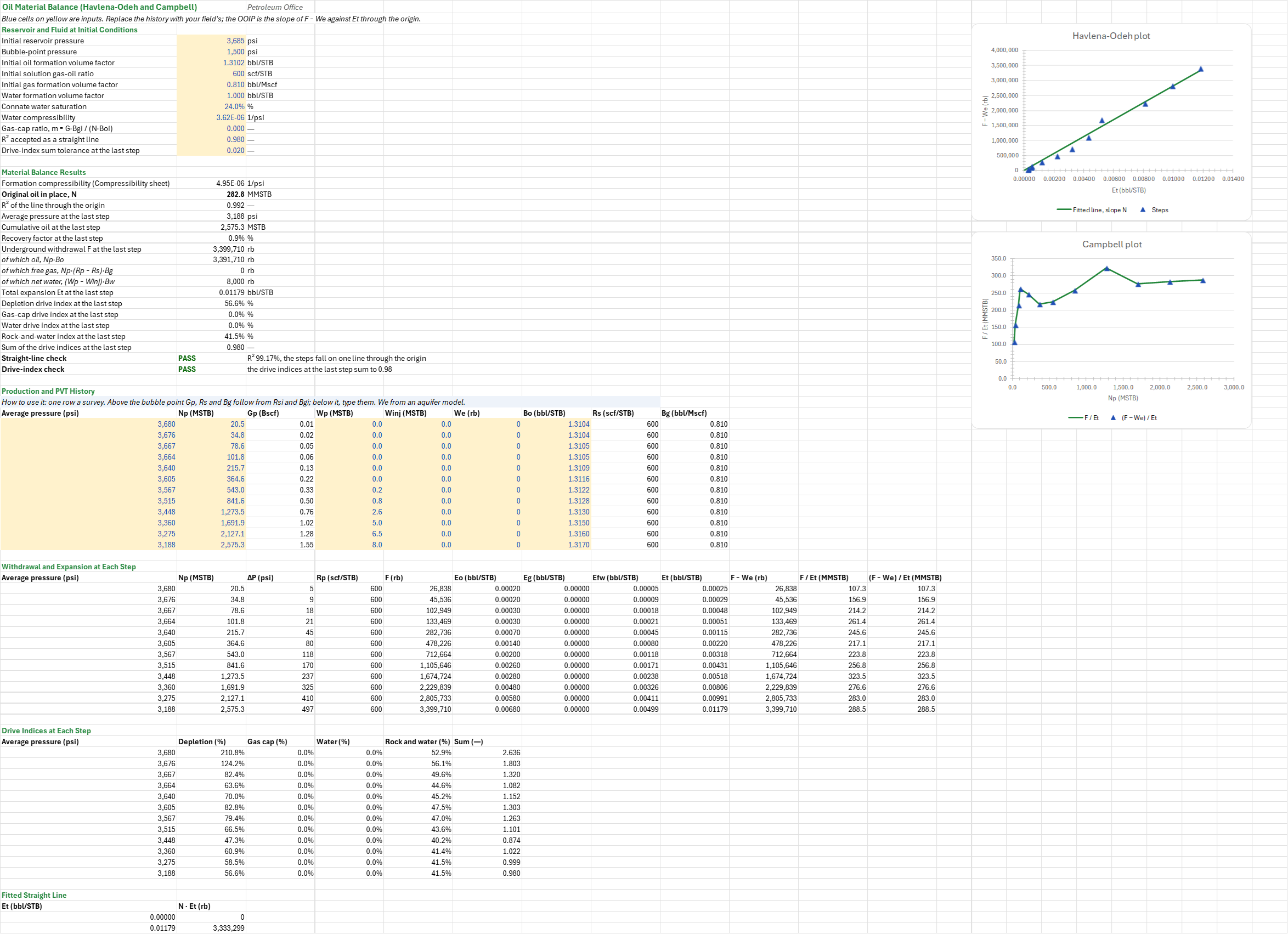
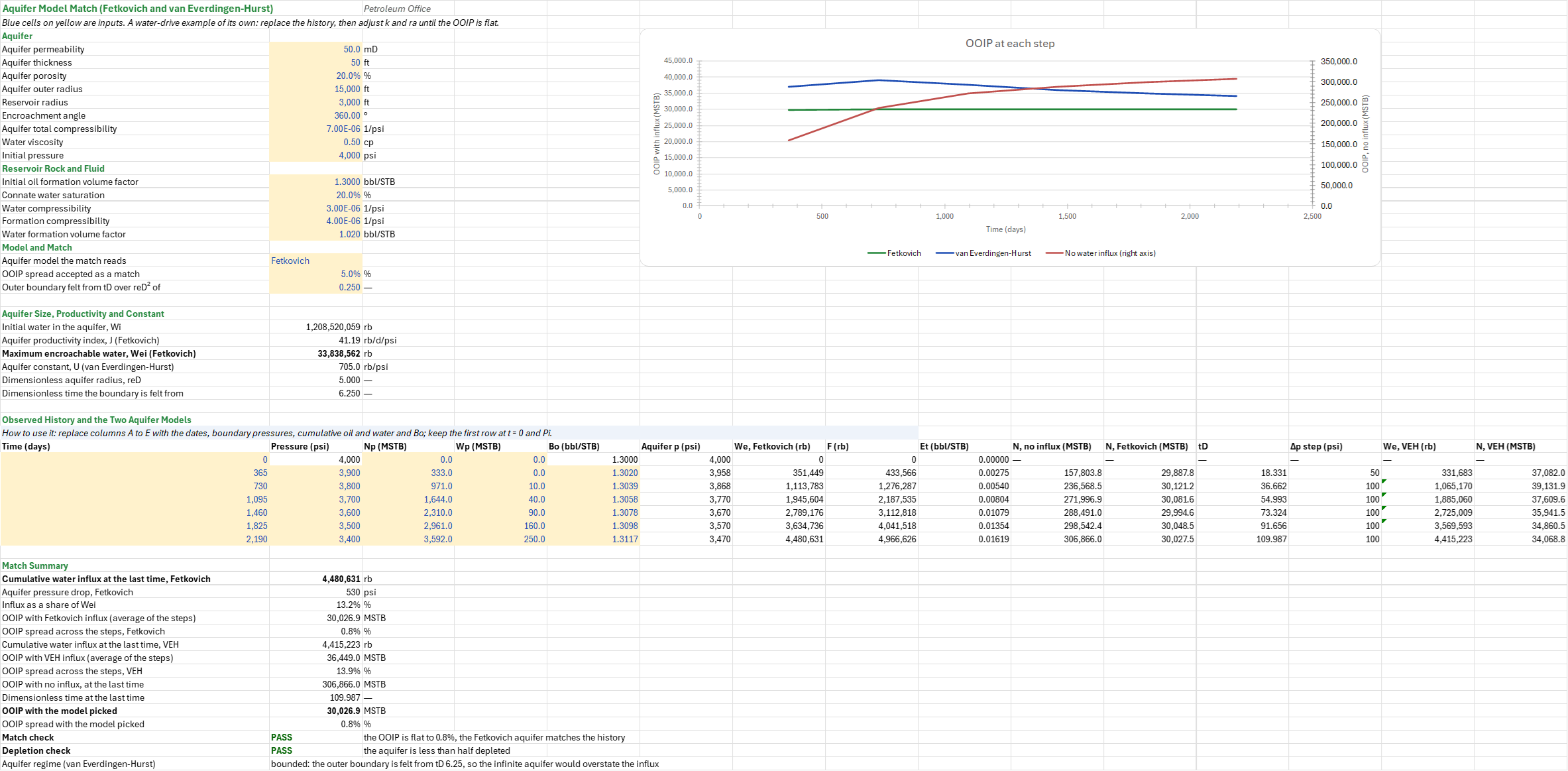
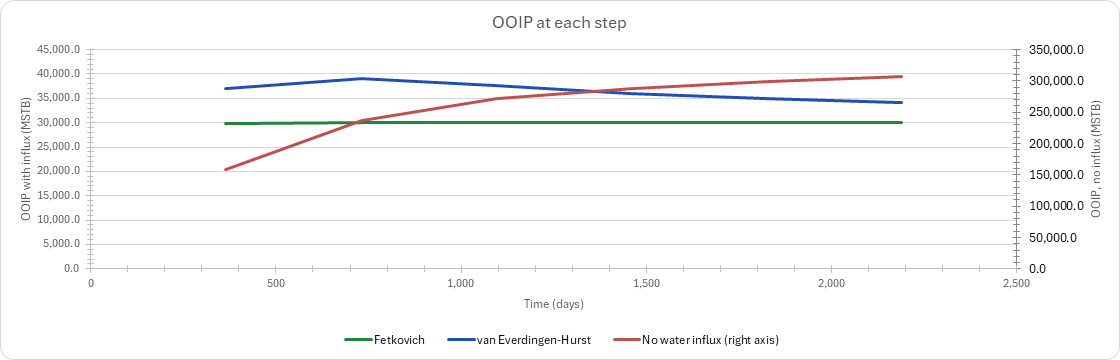
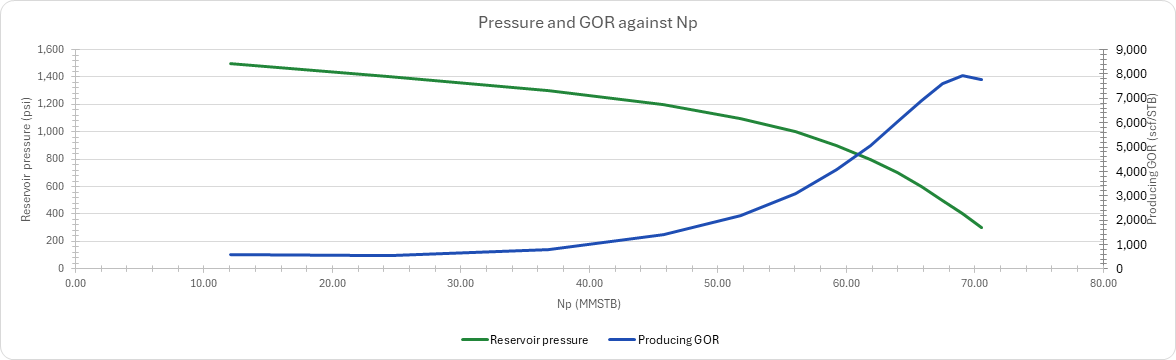
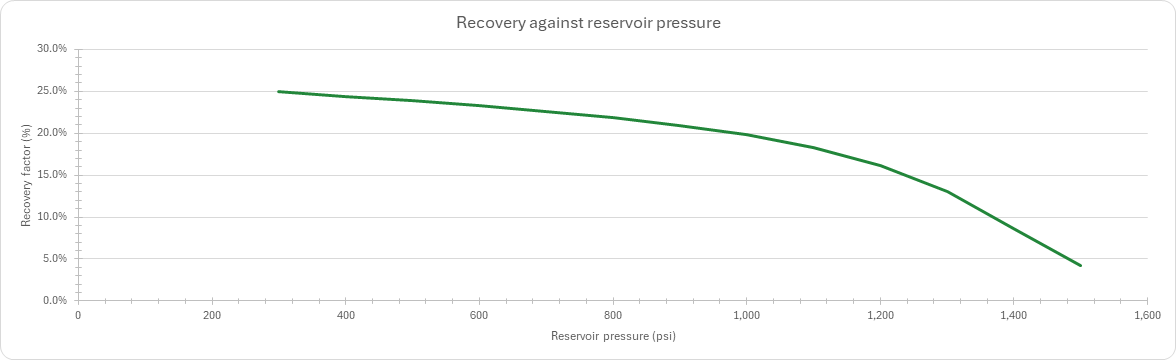
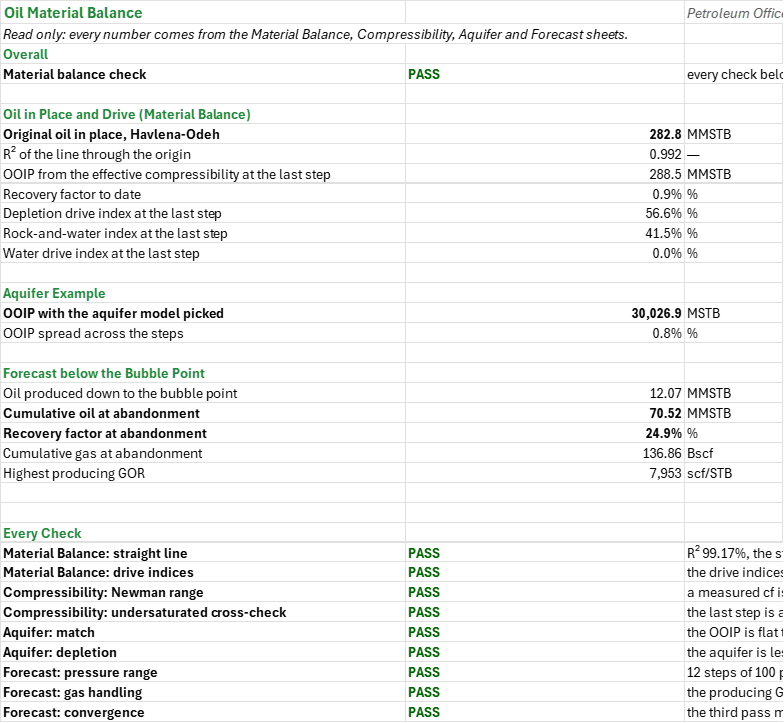
Example: Ahmed's Virginia Hills field, volumetric and undersaturated (3,685 psi, Pb 1,500 psi, Boi 1.3102 bbl/STB, Swc 24 %, cw 3.62E-06 and measured cf 4.95E-06 1/psi; Rsi 600 and Bgi 0.81 from the reference black oil cancel above Pb): twelve surveys to 3,188 psi and 2,575 MSTB. F is 3.400 MMrb and Et 0.01179 at the last step; N = 282.8 MMSTB with R2 0.992; depletion drives 56.6 % and rock and water 41.5 %, summing to 0.98. co is 1.044E-05, ce 1.81E-05, and the undersaturated form reads 288.5 MMSTB, 2.0 % above the line. The Aquifer sheet's made-up 30 MMSTB reservoir on a 360 degree aquifer (50 mD, 50 ft, 3,000 to 15,000 ft): Wei 33.8 MMbbl, J 41.2 bbl/D/psi; Fetkovich gives 4.48 MMbbl in six years and 30,027 MSTB flat to 0.8 %, where with no influx F/Et climbs from 158 to 307 MMSTB; van Everdingen-Hurst (U 705 rb/psi, reD 5) gives 4.42 MMbbl and 36,449 MSTB drifting 13.9 %. The forecast gives 12.07 MMSTB to Pb and 70.52 MMSTB, 24.9 %, and 136.9 Bscf at 300 psi; the GOR peaks at 7,953 scf/STB, and the third pass moves it 4.1 % at most.
Validity
A tank model with one average pressure a survey. A rising Campbell plot means energy the model lacks (an aquifer, or a gas cap larger than m); early steps with a small pressure drop carry the most error. ce holds only above Pb. Fetkovich neglects the transient period; van Everdingen-Hurst assumes radial flow and short steps. The Aquifer sheet is its own example, and its We is typed into the Material Balance by hand. The forecast takes no gas cap, influx or segregation, gives oil against pressure, not time, and its krg/kro is the weakest input. Alternatives: the F/Eo against Eg/Eo form for an unknown gas cap, Carter-Tracy influx, Muskat's forecast, a black-oil simulation.
References
- Havlena, D. and Odeh, A.S. (1963). The Material Balance as an Equation of a Straight Line. JPT 15(8), 896–900.
- Ahmed, T. (2006). Reservoir Engineering Handbook, 3rd ed. Gulf Professional Publishing, Ch. 4, 11 and 15.
- Dake, L.P. (1978). Fundamentals of Reservoir Engineering. Elsevier, Ch. 3 and 9.
- Fetkovich, M.J. (1971). A Simplified Approach to Water Influx Calculations — Finite Aquifer Systems. JPT 23(7), 814–828.
- van Everdingen, A.F. and Hurst, W. (1949). The Application of the Laplace Transformation to Flow Problems in Reservoirs. Trans. AIME 186, 305–324.
- Newman, G.H. (1973). Pore-Volume Compressibility of Consolidated, Friable, and Unconsolidated Reservoir Rocks Under Hydrostatic Loading. JPT 25(2), 129–134.
- Tracy, G.W. (1955). Simplified Form of the Material Balance Equation. Trans. AIME 204, 243–246.
Inputs
| Input | Unit | Default | Name |
|---|---|---|---|
| Initial reservoir pressure, bubble-point pressure, initial oil FVF, initial solution GOR, initial gas FVF, water FVF | psi, bbl/STB, scf/STB, bbl/Mscf | 3685, 1500, 1.3102, 600, 0.81, 1 | MBH_Pi, MBH_Pb, MBH_Boi, MBH_Rsi, MBH_Bgi, MBH_Bw |
| Connate water saturation, water compressibility, gas-cap ratio m, R² accepted as a straight line, drive-index sum tolerance | —, 1/psi | 0.24, 3.62E-06, 0, 0.98, 0.02 | MBH_Swc, MBH_cw, MBH_m, MBH_R2Min, MBH_SumTol |
| Survey history: average pressure, Np, Gp, Wp, Winj, We, Bo, Rs, Bg | — | 12 surveys | MBH_History |
| Rock type for Newman's correlation (list), porosity, measured cf from core (0 uses Newman's) | —, 1/psi | Sandstone, 0.2, 4.95E-06 | RCK_Rock, RCK_phi, RCK_cfMeasured |
| Aquifer permeability, thickness, porosity, outer radius, reservoir radius, encroachment angle, aquifer total compressibility, water viscosity, initial pressure | mD, ft, °, 1/psi, cp, psi | 50, 50, 0.2, 15000, 3000, 360, 7E-06, 0.5, 4000 | AQF_k, AQF_h, AQF_phi, AQF_ra, AQF_rr, AQF_theta, AQF_ct, AQF_Uw, AQF_Pi |
| Aquifer model the match reads (list), OOIP spread accepted as a match | — | Fetkovich, 0.05 | AQF_Model, AQF_SpreadMax |
| Stock-tank oil gravity, solution gas specific gravity, reservoir temperature | °API, —, °F | 40, 0.8, 160 | TTF_API, TTF_GasSG, TTF_T |
| Critical gas saturation, residual oil saturation to gas, gas relative permeability at residual oil, Corey exponents for oil and gas | — | 0.05, 0.15, 0.8, 3, 2 | TTF_Sgc, TTF_Sorg, TTF_KrgMax, TTF_NoExp, TTF_NgExp |
| Abandonment reservoir pressure, producing GOR the wells and plant can handle, GOR change accepted as converged | psi, scf/STB | 300, 10000, 0.05 | TTF_Pab, TTF_GorMax, TTF_MoveTol |
Sheets
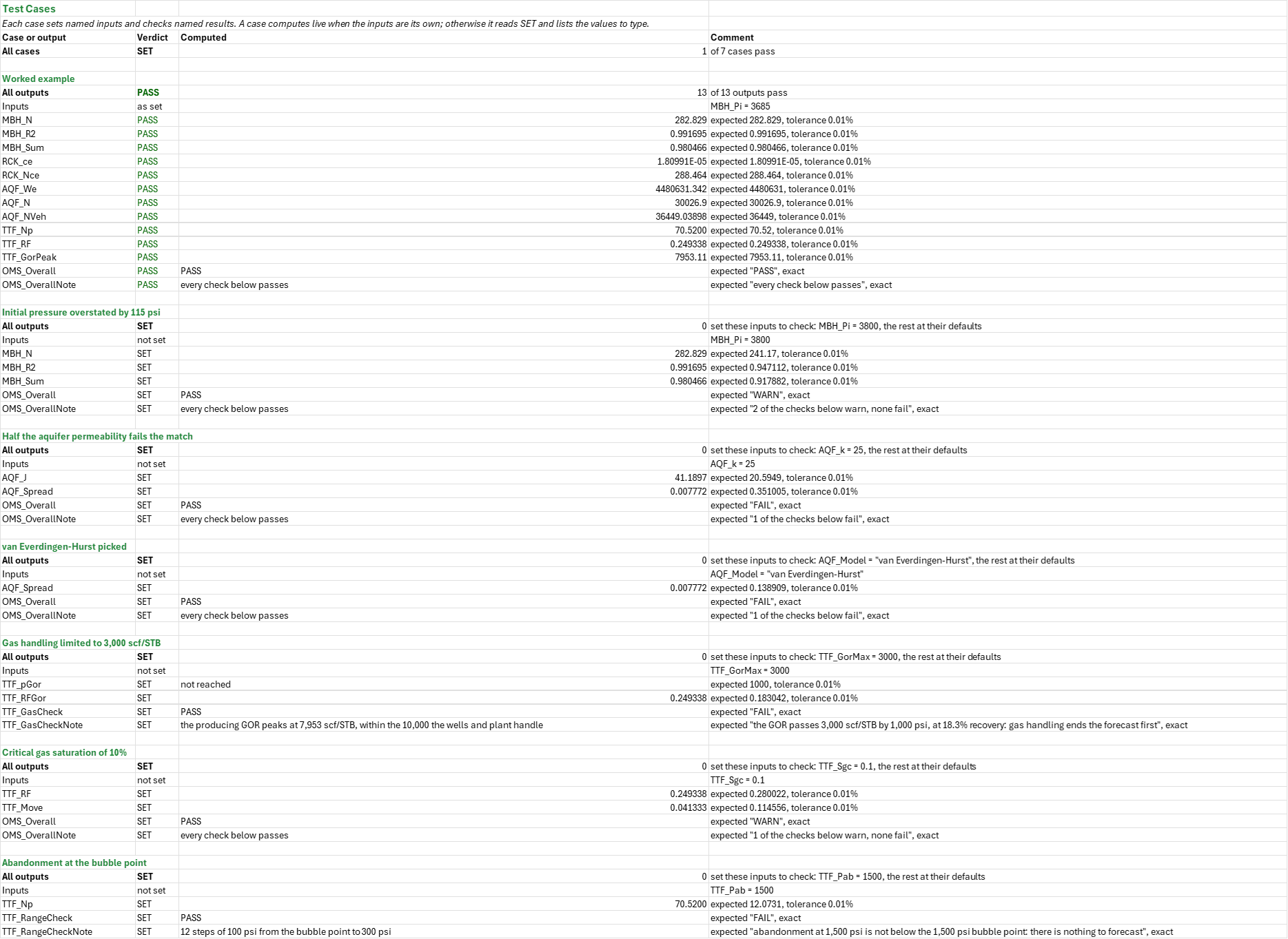
Guide— what the workbook answers, the order to work through its sheets and the examples it carries.Material Balance— the initial PVT and one row a survey, F and Eo, Eg, Efw and Et on every step, the OOIP as the slope of F - We against Et through the origin with its R2, the Havlena-Odeh and Campbell plots, and the drive indices at every step.Compressibility— Newman's cf for the rock type picked from a list, or a measured one, which Efw takes; co from the Bo history, ce, ct and the undersaturated OOIP cross-check.Aquifer— a Fetkovich and a van Everdingen-Hurst aquifer over one boundary-pressure history, the OOIP each implies at every step against none, and the model picked from a list checked for a flat OOIP.Forecast— Tracy's form of Tarner's method from Pb to abandonment on the material balance's OOIP, three passes a step, with pressure, GOR and recovery.Summary— the answers and every check under one verdict.Test Cases— the worked example and other cases, with expected and computed results.
Five charts: the Havlena-Odeh and Campbell plots, the OOIP at each step for no influx, Fetkovich and van Everdingen-Hurst, and the forecast's pressure and GOR against Np and recovery against pressure.
Functions used
Names (184)
| Name | Refers to | Comment |
|---|---|---|
AQF_Aquifer_Results |
Aquifer!$B$25:$B$30 |
Fetkovich's Wi, J and Wei, and van Everdingen-Hurst's U, reD and the tD the boundary is felt from |
AQF_Boi |
Aquifer!$B$14 |
Initial oil formation volume factor, bbl/STB |
AQF_Bw |
Aquifer!$B$18 |
Water formation volume factor, bbl/STB |
AQF_DepletionCheck |
Aquifer!$B$57 |
Depletion check verdict |
AQF_DepletionCheckNote |
Aquifer!$C$57 |
Depletion check comment |
AQF_History |
Aquifer!$A$35:$E$41 |
Observed history: time, boundary pressure, cumulative oil and water, Bo |
AQF_Inputs |
Aquifer!$B$4:$B$22 |
The aquifer's geometry and properties, the reservoir's rock and fluid, the model, the match tolerance and the boundary criterion |
AQF_J |
Aquifer!$B$26 |
Aquifer productivity index, J (Fetkovich), rb/d/psi |
AQF_MatchCheck |
Aquifer!$B$56 |
Match check verdict |
AQF_MatchCheckNote |
Aquifer!$C$56 |
Match check comment |
AQF_Model |
Aquifer!$B$20 |
Aquifer model the match reads |
AQF_N |
Aquifer!$B$54 |
OOIP with the model picked, MSTB |
AQF_NFet |
Aquifer!$B$47 |
OOIP with Fetkovich influx (average of the steps), MSTB |
AQF_NVeh |
Aquifer!$B$50 |
OOIP with VEH influx (average of the steps), MSTB |
AQF_Nno |
Aquifer!$B$52 |
OOIP with no influx, at the last time, MSTB |
AQF_Pi |
Aquifer!$B$12 |
Initial pressure, psi |
AQF_Regime |
Aquifer!$B$58 |
Aquifer regime (van Everdingen-Hurst) |
AQF_Results |
Aquifer!$B$44:$B$58 |
Influx and depletion, each model's OOIP and spread, the picked model's, the checks and the regime |
AQF_Spread |
Aquifer!$B$55 |
OOIP spread with the model picked, % |
AQF_SpreadFet |
Aquifer!$B$48 |
OOIP spread across the steps, Fetkovich, % |
AQF_SpreadMax |
Aquifer!$B$21 |
OOIP spread accepted as a match, % |
AQF_SpreadVeh |
Aquifer!$B$51 |
OOIP spread across the steps, VEH, % |
AQF_Swi |
Aquifer!$B$15 |
Connate water saturation, % |
AQF_U |
Aquifer!$B$28 |
Aquifer constant, U (van Everdingen-Hurst), rb/psi |
AQF_Uw |
Aquifer!$B$11 |
Water viscosity, cp |
AQF_We |
Aquifer!$B$44 |
Cumulative water influx at the last time, Fetkovich, rb |
AQF_WeFrac |
Aquifer!$B$46 |
Influx as a share of Wei, % |
AQF_WeVeh |
Aquifer!$B$49 |
Cumulative water influx at the last time, VEH, rb |
AQF_Wei |
Aquifer!$B$27 |
Maximum encroachable water, Wei (Fetkovich), rb |
AQF_Wi |
Aquifer!$B$25 |
Initial water in the aquifer, Wi, rb |
AQF_cf |
Aquifer!$B$17 |
Formation compressibility, 1/psi |
AQF_ct |
Aquifer!$B$10 |
Aquifer total compressibility, 1/psi |
AQF_cw |
Aquifer!$B$16 |
Water compressibility, 1/psi |
AQF_dPa |
Aquifer!$B$45 |
Aquifer pressure drop, Fetkovich, psi |
AQF_h |
Aquifer!$B$5 |
Aquifer thickness, ft |
AQF_k |
Aquifer!$B$4 |
Aquifer permeability, mD |
AQF_phi |
Aquifer!$B$6 |
Aquifer porosity, % |
AQF_ra |
Aquifer!$B$7 |
Aquifer outer radius, ft |
AQF_reD |
Aquifer!$B$29 |
Dimensionless aquifer radius, reD |
AQF_rr |
Aquifer!$B$8 |
Reservoir radius, ft |
AQF_tDb |
Aquifer!$B$30 |
Dimensionless time the boundary is felt from |
AQF_tDfrac |
Aquifer!$B$22 |
Outer boundary felt from tD over reD² of |
AQF_tDmax |
Aquifer!$B$53 |
Dimensionless time at the last time |
AQF_theta |
Aquifer!$B$9 |
Encroachment angle, ° |
MBH_Bgi |
'Material Balance'!$B$8 |
Initial gas formation volume factor, bbl/Mscf |
MBH_Boi |
'Material Balance'!$B$6 |
Initial oil formation volume factor, bbl/STB |
MBH_Bw |
'Material Balance'!$B$9 |
Water formation volume factor, bbl/STB |
MBH_CDI |
'Material Balance'!$B$31 |
Rock-and-water index at the last step, % |
MBH_Campbell |
'Material Balance'!$B$54:$L$65 |
F / Et and (F − We) / Et against Np, the Campbell plot |
MBH_Curve |
'Material Balance'!$I$54:$J$65 |
F − We against Et at each step, the Havlena-Odeh straight line |
MBH_DDI |
'Material Balance'!$B$28 |
Depletion drive index at the last step, % |
MBH_DriveCheck |
'Material Balance'!$B$34 |
Drive-index check verdict |
MBH_DriveCheckNote |
'Material Balance'!$C$34 |
Drive-index check comment |
MBH_Drives |
'Material Balance'!$A$69:$F$80 |
Each step's depletion, gas-cap, water and rock-and-water drive indices against N, and their sum |
MBH_Et |
'Material Balance'!$B$27 |
Total expansion Et at the last step, bbl/STB |
MBH_F |
'Material Balance'!$B$23 |
Underground withdrawal F at the last step, rb |
MBH_F_Gas |
'Material Balance'!$B$25 |
of which free gas, Np·(Rp − Rs)·Bg, rb |
MBH_F_Oil |
'Material Balance'!$B$24 |
of which oil, Np·Bo, rb |
MBH_F_Water |
'Material Balance'!$B$26 |
of which net water, (Wp − Winj)·Bw, rb |
MBH_GDI |
'Material Balance'!$B$29 |
Gas-cap drive index at the last step, % |
MBH_History |
'Material Balance'!$A$39:$I$50 |
Pressure steps: average pressure, cumulative oil, gas, water produced and injected, water influx, and the PVT |
MBH_Inputs |
'Material Balance'!$B$4:$B$14 |
Initial pressure and PVT, water and its compressibility, the gas-cap ratio and the check limits |
MBH_LineCheck |
'Material Balance'!$B$33 |
Straight-line check verdict |
MBH_LineCheckNote |
'Material Balance'!$C$33 |
Straight-line check comment |
MBH_N |
'Material Balance'!$B$18 |
Original oil in place, N, MMSTB |
MBH_Np |
'Material Balance'!$B$21 |
Cumulative oil at the last step, MSTB |
MBH_Pb |
'Material Balance'!$B$5 |
Bubble-point pressure, psi |
MBH_Pi |
'Material Balance'!$B$4 |
Initial reservoir pressure, psi |
MBH_Plast |
'Material Balance'!$B$20 |
Average pressure at the last step, psi |
MBH_R2 |
'Material Balance'!$B$19 |
R² of the line through the origin |
MBH_R2Min |
'Material Balance'!$B$13 |
R² accepted as a straight line |
MBH_RF |
'Material Balance'!$B$22 |
Recovery factor at the last step, % |
MBH_Results |
'Material Balance'!$B$17:$B$34 |
cf, the OOIP and its fit, the last step's withdrawal and expansion, its drive indices and the checks |
MBH_Rsi |
'Material Balance'!$B$7 |
Initial solution gas-oil ratio, scf/STB |
MBH_Sum |
'Material Balance'!$B$32 |
Sum of the drive indices at the last step |
MBH_SumTol |
'Material Balance'!$B$14 |
Drive-index sum tolerance at the last step |
MBH_Swc |
'Material Balance'!$B$10 |
Connate water saturation, % |
MBH_Terms |
'Material Balance'!$A$54:$L$65 |
Each step's withdrawal F, the expansion terms Eo, Eg, Efw and Et, F − We, and the Campbell ratios |
MBH_WDI |
'Material Balance'!$B$30 |
Water drive index at the last step, % |
MBH_cf |
'Material Balance'!$B$17 |
Formation compressibility (Compressibility sheet), 1/psi |
MBH_cw |
'Material Balance'!$B$11 |
Water compressibility, 1/psi |
MBH_m |
'Material Balance'!$B$12 |
Gas-cap ratio, m = G·Bgi / (N·Boi) |
OMS_AqN |
Summary!$B$16 |
OOIP with the aquifer model picked, MSTB |
OMS_AqSpread |
Summary!$B$17 |
OOIP spread across the steps, % |
OMS_Aquifer_Results |
Summary!$B$16:$B$17 |
The water-drive example's OOIP with the aquifer model picked, and its spread |
OMS_Balance_Results |
Summary!$B$7:$B$13 |
The OOIP, its fit and its ce cross-check, recovery to date and the drive indices at the last step |
OMS_CDI |
Summary!$B$12 |
Rock-and-water index at the last step, % |
OMS_Checks |
Summary!$B$28:$B$36 |
Every check of the workbook, read from its sheet |
OMS_DDI |
Summary!$B$11 |
Depletion drive index at the last step, % |
OMS_Forecast_Results |
Summary!$B$20:$B$24 |
Oil to the bubble point, oil, recovery and gas at abandonment, and the peak GOR |
OMS_GorPeak |
Summary!$B$24 |
Highest producing GOR, scf/STB |
OMS_Gp |
Summary!$B$23 |
Cumulative gas at abandonment, Bscf |
OMS_N |
Summary!$B$7 |
Original oil in place, Havlena-Odeh, MMSTB |
OMS_Nce |
Summary!$B$9 |
OOIP from the effective compressibility at the last step, MMSTB |
OMS_Np |
Summary!$B$21 |
Cumulative oil at abandonment, MMSTB |
OMS_Npb |
Summary!$B$20 |
Oil produced down to the bubble point, MMSTB |
OMS_Overall |
Summary!$B$4 |
Material balance check verdict |
OMS_OverallNote |
Summary!$C$4 |
Material balance check comment |
OMS_R2 |
Summary!$B$8 |
R² of the line through the origin |
OMS_RF |
Summary!$B$10 |
Recovery factor to date, % |
OMS_RFab |
Summary!$B$22 |
Recovery factor at abandonment, % |
OMS_Verdict |
Summary!$B$4 |
One verdict over every check of the workbook |
OMS_VerdictNote |
Summary!$C$4 |
One verdict over every check of the workbook comment |
OMS_WDI |
Summary!$B$13 |
Water drive index at the last step, % |
RCK_CeCheck |
Compressibility!$B$30 |
Undersaturated cross-check verdict |
RCK_CeCheckNote |
Compressibility!$C$30 |
Undersaturated cross-check comment |
RCK_Inputs |
Compressibility!$B$4:$B$9 |
Rock type, porosity and a measured cf, Newman's porosity range and a gas zone's gas compressibility |
RCK_Linked |
Compressibility!$B$12:$B$15 |
Swc, cw and the depletion from the Material Balance sheet, and co from its Bo history |
RCK_Nce |
Compressibility!$B$27 |
OOIP from F = N·Boi·ce·ΔP at the last step, MMSTB |
RCK_NceDiff |
Compressibility!$B$28 |
Difference from the Havlena-Odeh OOIP, % |
RCK_NewmanCheck |
Compressibility!$B$29 |
Newman range check verdict |
RCK_NewmanCheckNote |
Compressibility!$C$29 |
Newman range check comment |
RCK_PhiMax |
Compressibility!$B$8 |
Highest porosity of Newman's typical range, % |
RCK_PhiMin |
Compressibility!$B$7 |
Lowest porosity of Newman's typical range, % |
RCK_Results |
Compressibility!$B$18:$B$30 |
Newman's and the used cf, the pore-volume term, ce and ct, the depletion's volume changes, the OOIP from ce and the checks |
RCK_Rock |
Compressibility!$B$4 |
Rock type for Newman's correlation |
RCK_RockShare |
Compressibility!$B$24 |
Rock and water share of the oil zone's ce, % |
RCK_Swc |
Compressibility!$B$12 |
Connate water saturation, % |
RCK_ce |
Compressibility!$B$21 |
Effective compressibility of the oil zone, ce, 1/psi |
RCK_cf |
Compressibility!$B$19 |
Pore-volume compressibility used, cf, 1/psi |
RCK_cfMeasured |
Compressibility!$B$6 |
Measured cf from core (0 uses Newman's), 1/psi |
RCK_cfNewman |
Compressibility!$B$18 |
Pore-volume compressibility, Newman, 1/psi |
RCK_cg |
Compressibility!$B$9 |
Gas compressibility in a gas zone, 1/psi |
RCK_co |
Compressibility!$B$15 |
Oil compressibility from the Bo history, (Bo − Boi) / (Boi·ΔP), 1/psi |
RCK_cpv |
Compressibility!$B$20 |
Pore-volume term, (cw·Swc + cf) / (1 − Swc), 1/psi |
RCK_ctGas |
Compressibility!$B$23 |
Gas-zone total compressibility, 1/psi |
RCK_ctOil |
Compressibility!$B$22 |
Oil-zone total compressibility, ct, 1/psi |
RCK_cw |
Compressibility!$B$13 |
Water compressibility, 1/psi |
RCK_dP |
Compressibility!$B$14 |
Depletion to the last step, Pi − P, psi |
RCK_dVo |
Compressibility!$B$26 |
Oil-zone expansion over the depletion, ce·ΔP, % |
RCK_dVp |
Compressibility!$B$25 |
Pore-volume loss over the depletion, cf·ΔP, % |
RCK_phi |
Compressibility!$B$5 |
Porosity, % |
TTF_API |
Forecast!$B$13 |
Stock-tank oil gravity, °API |
TTF_Bob |
Forecast!$B$35 |
Oil formation volume factor at Pb (Standing), bbl/STB |
TTF_Boi |
Forecast!$B$7 |
Initial oil formation volume factor, bbl/STB |
TTF_CfPerBbl |
Forecast!$B$29 |
Cubic feet per barrel, ft³/bbl |
TTF_Forecast |
Forecast!$A$80:$L$92 |
Each step's three passes on ΔNp and the GOR, its Np, Gp, So, producing GOR, recovery and the last pass's GOR change |
TTF_GasCheck |
Forecast!$B$54 |
Gas-handling check verdict |
TTF_GasCheckNote |
Forecast!$C$54 |
Gas-handling check comment |
TTF_GasSG |
Forecast!$B$14 |
Solution gas specific gravity, air = 1 |
TTF_GorAb |
Forecast!$B$47 |
Producing GOR at abandonment, scf/STB |
TTF_GorMax |
Forecast!$B$24 |
Producing GOR the wells and plant can handle, scf/STB |
TTF_GorPeak |
Forecast!$B$48 |
Highest producing GOR, scf/STB |
TTF_Gp |
Forecast!$B$45 |
Cumulative gas at abandonment, Gp, Bscf |
TTF_Initial_Results |
Forecast!$B$33:$B$39 |
Standing's Rs at Pb and the match factor, Bob, the dead-oil viscosity, the gas's pseudo-criticals and the oil produced above Pb |
TTF_Inputs |
Forecast!$B$13:$B$25 |
The oil and gas for the correlations, the Corey curves, the abandonment pressure and the check limits |
TTF_KrgMax |
Forecast!$B$19 |
Gas relative permeability at residual oil |
TTF_Move |
Forecast!$B$52 |
Largest GOR change in the third pass, % |
TTF_MoveTol |
Forecast!$B$25 |
GOR change in the last pass accepted as converged, % |
TTF_N |
Forecast!$B$4 |
Original oil in place, N (the Havlena-Odeh line), MMSTB |
TTF_NgExp |
Forecast!$B$21 |
Corey exponent for gas |
TTF_NoExp |
Forecast!$B$20 |
Corey exponent for oil |
TTF_Np |
Forecast!$B$43 |
Cumulative oil at abandonment, Np, MMSTB |
TTF_Npb |
Forecast!$B$39 |
Oil produced from Pi down to Pb, Npb, MMSTB |
TTF_Pab |
Forecast!$B$23 |
Abandonment reservoir pressure, psi |
TTF_PassCheck |
Forecast!$B$55 |
Convergence check verdict |
TTF_PassCheckNote |
Forecast!$C$55 |
Convergence check comment |
TTF_Pb |
Forecast!$B$6 |
Bubble-point pressure, psi |
TTF_Pi |
Forecast!$B$5 |
Initial reservoir pressure, psi |
TTF_Ppc |
Forecast!$B$37 |
Pseudo-critical pressure of the gas (Sutton), psi |
TTF_Pvt |
Forecast!$A$63:$K$75 |
Each step's pressure, Z, Rs, Bo, Bg, oil and gas viscosity, Eo, Et and Tracy's Φo and Φg |
TTF_R0 |
Forecast!$B$28 |
Rankine at 0 °F, °R |
TTF_RF |
Forecast!$B$44 |
Recovery factor at abandonment, % |
TTF_RFGor |
Forecast!$B$51 |
Recovery factor before the GOR passes the limit, % |
TTF_RFb |
Forecast!$B$42 |
Recovery factor at the bubble point, % |
TTF_RangeCheck |
Forecast!$B$53 |
Pressure-range check verdict |
TTF_RangeCheckNote |
Forecast!$C$53 |
Pressure-range check comment |
TTF_Reservoir |
Forecast!$B$4:$B$11 |
The OOIP, initial conditions, Swc and the compressibilities, from the other sheets |
TTF_Results |
Forecast!$B$42:$B$55 |
Recovery at Pb and at abandonment, Np, Gp, Rp, the GOR at abandonment and its peak, So, the GOR limit and the three checks |
TTF_Rp |
Forecast!$B$46 |
Cumulative producing GOR at abandonment, Rp, scf/STB |
TTF_RsFactor |
Forecast!$B$34 |
Rs match factor, Rsi over Standing's Rs at Pb |
TTF_RsStd |
Forecast!$B$33 |
Standing's Rs at Pb, before matching, scf/STB |
TTF_Rsi |
Forecast!$B$8 |
Initial solution gas-oil ratio, scf/STB |
TTF_Sgc |
Forecast!$B$17 |
Critical gas saturation, % |
TTF_SoAb |
Forecast!$B$49 |
Oil saturation at abandonment, % |
TTF_Sorg |
Forecast!$B$18 |
Residual oil saturation to gas, % |
TTF_Steps |
Forecast!$B$30 |
Pressure steps, bubble point to abandonment |
TTF_Swc |
Forecast!$B$9 |
Connate water saturation, % |
TTF_T |
Forecast!$B$15 |
Reservoir temperature, °F |
TTF_Tpc |
Forecast!$B$38 |
Pseudo-critical temperature of the gas (Sutton), °R |
TTF_Uod |
Forecast!$B$36 |
Dead-oil viscosity (Beal), cp |
TTF_cf |
Forecast!$B$11 |
Formation (pore-volume) compressibility, 1/psi |
TTF_cw |
Forecast!$B$10 |
Water compressibility, 1/psi |
TTF_pGor |
Forecast!$B$50 |
Highest pressure step whose GOR passes the limit, psi |
Details
| Opens in | Needs the Petroleum Office add-in: its PO functions show #NAME? without it once Excel recalculates. Needs Microsoft 365 or Excel 2024: it uses functions Excel 2016 doesn't have, such as named LAMBDAs, which show #NAME? there. |
| File | OilMaterialBalance.xlsx, 82 KB |
| Category | Reservoir |
| For agents and tools | Descriptor (.md) |