SCAL Relative Permeability and Capillary Pressure Tables
Description
Which relative permeability and capillary pressure curves should the simulator get for this rock? You enter the core plugs' endpoints and lab kr points, the drainage Pc parameters, and the plugs for J scaling. You read off fitted Corey exponents and endpoints with their misses, Corey, Honarpour and Ibrahim-Koederitz curves side by side, drainage Pc and a rock-type J curve, a three-phase Stone check, and copy-ready SWOF and SGOF tables. Pc in psi, k in mD, IFT in dyne/cm, angles in degrees; saturations and kr as fractions.
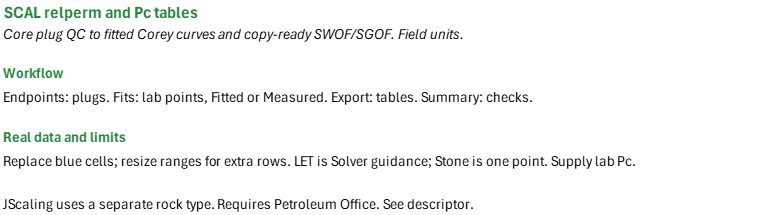
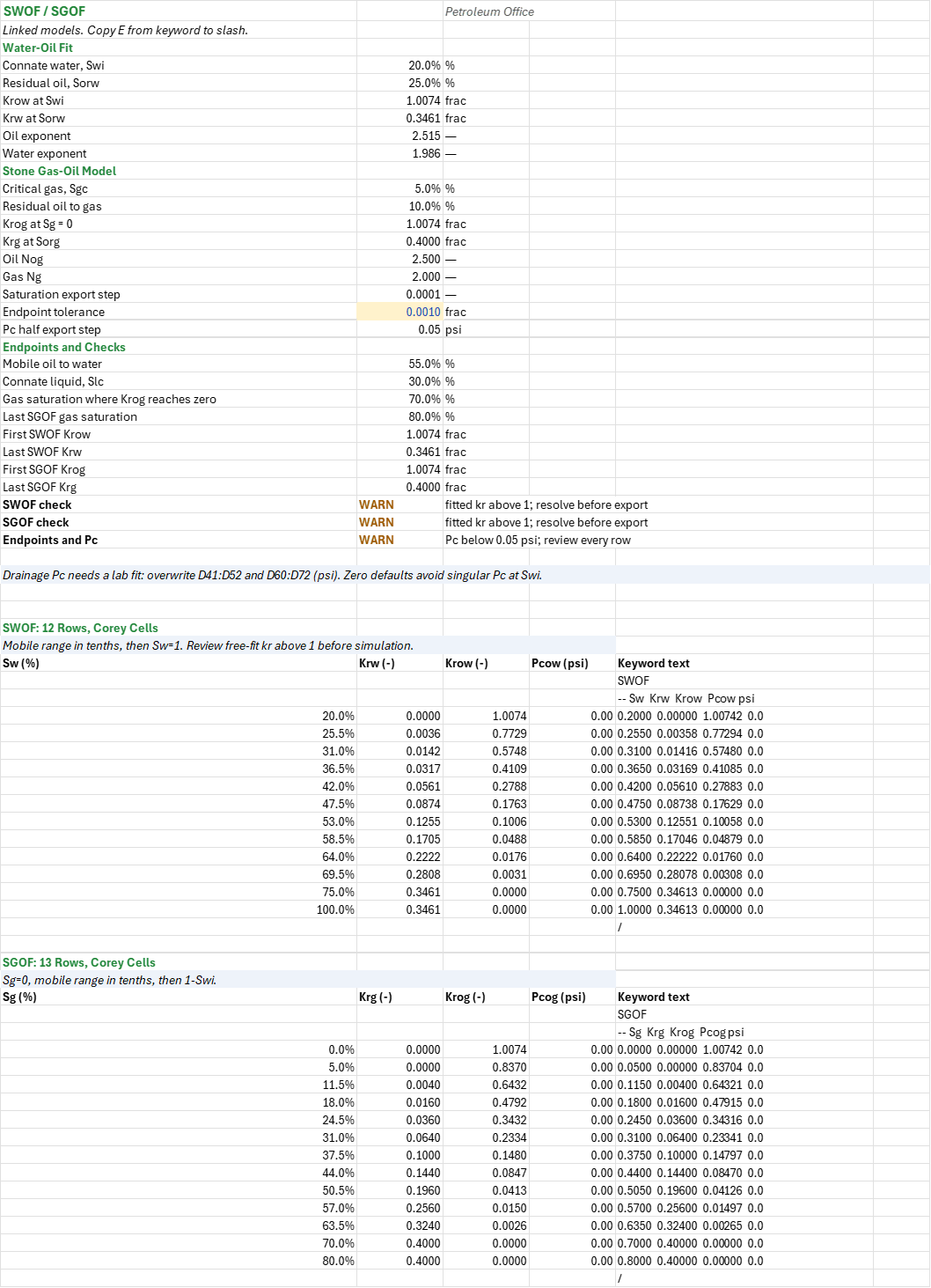
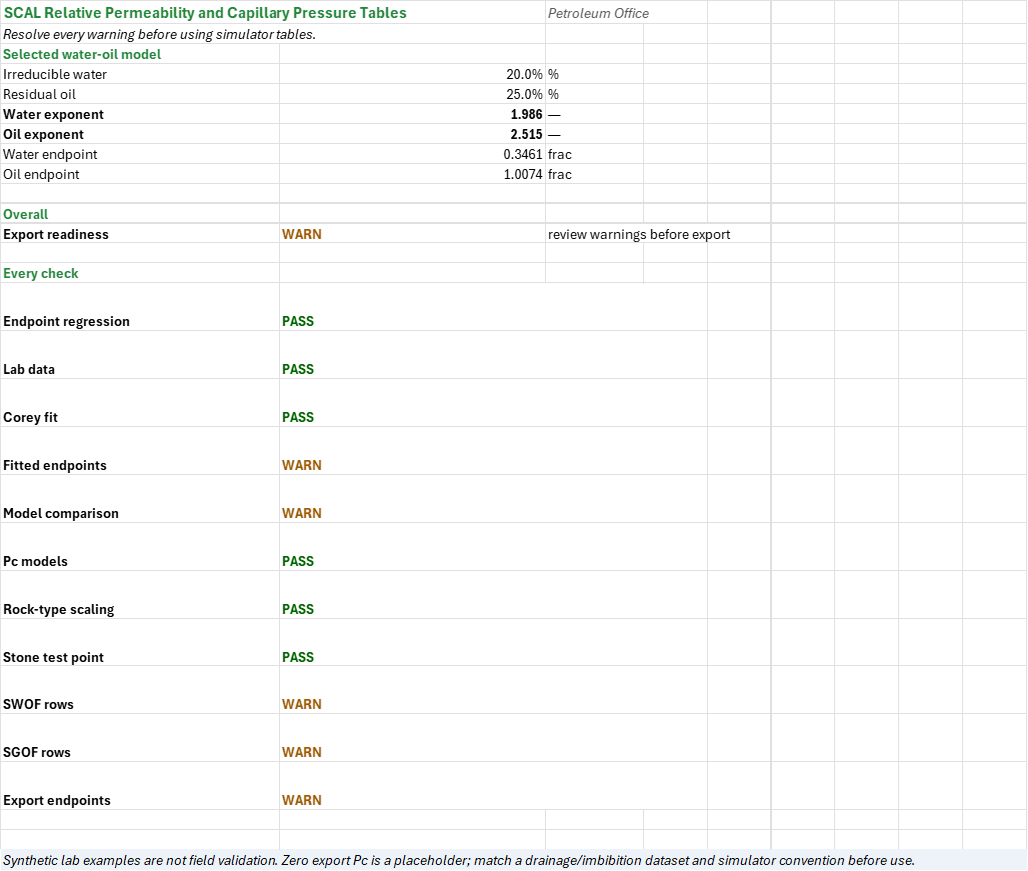
How to use it: Replace the blue cells with the lab report and resize the dependent ranges if you add rows. On the Endpoints sheet enter the plugs' endpoints and the lab points; on the Fits sheet paste positive kr inside the mobile saturation range, inspect the residuals, and choose Fitted or Measured endpoints from the list (choose Measured if the free fit is implausible). The Models, Stone and Export sheets follow the selected fit. For an LET fit, run a constrained Solver on the log residuals, starting L at the Corey exponent and E = T = 1, with L >= 1, E > 0 and T >= 0.5. Fit Pc to lab data. The JScaling plugs must share one facies and the lab fluids; never merge that rock with the relative permeability rock. On the Export sheet copy column E from the keyword through the slash, and replace the zero Pc in D41:D52 and D60:D72 with validated psi; Pc below 0.05 psi keeps a warning. The Summary is last and holds every check.
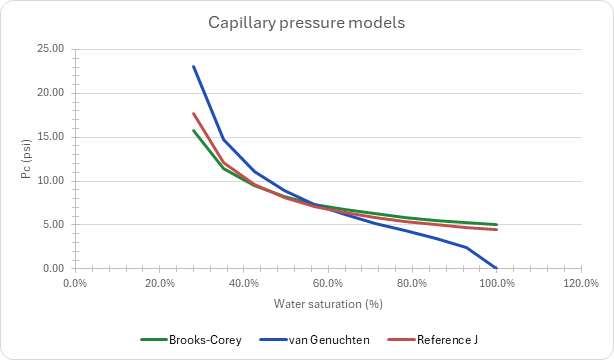
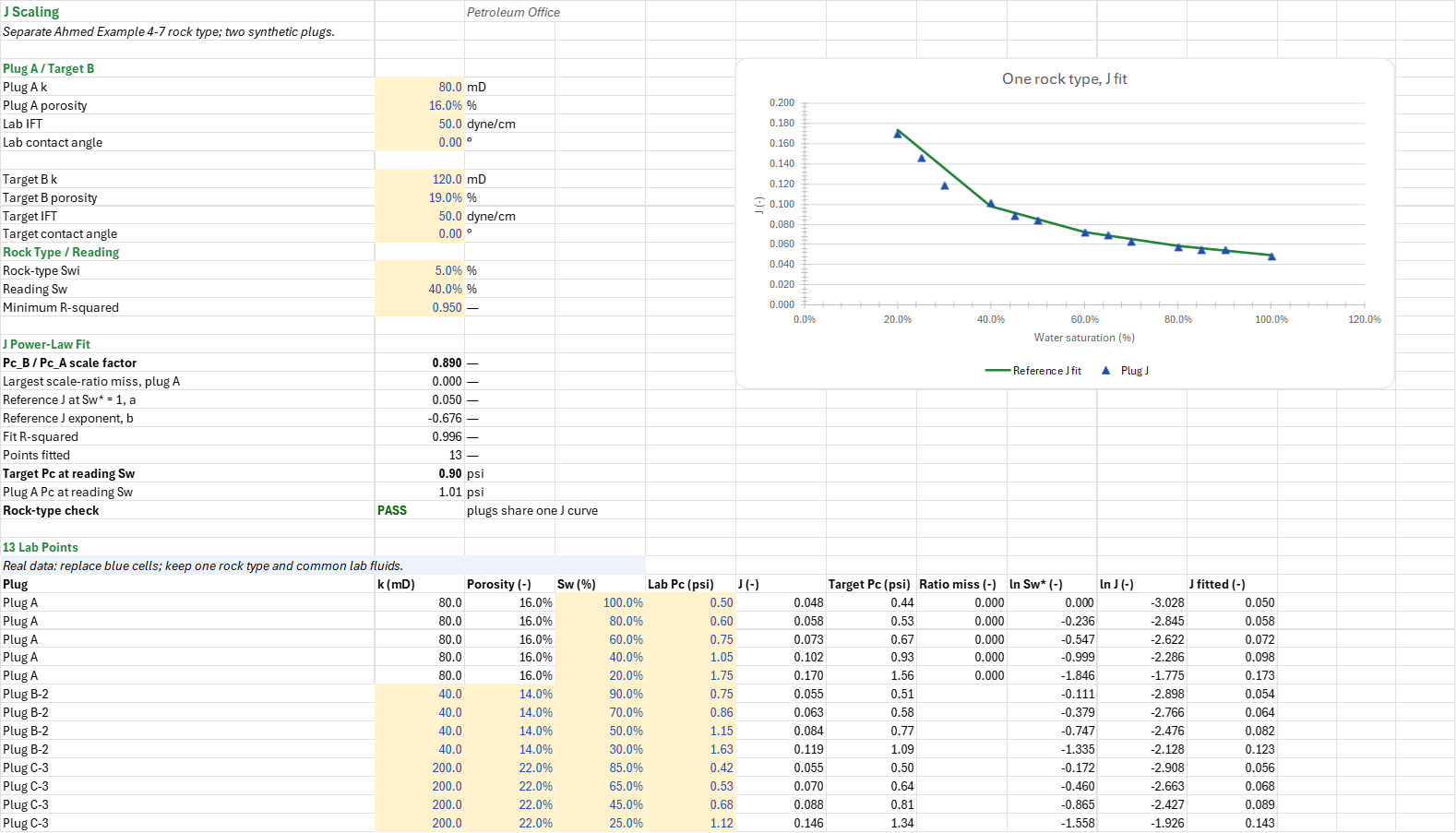
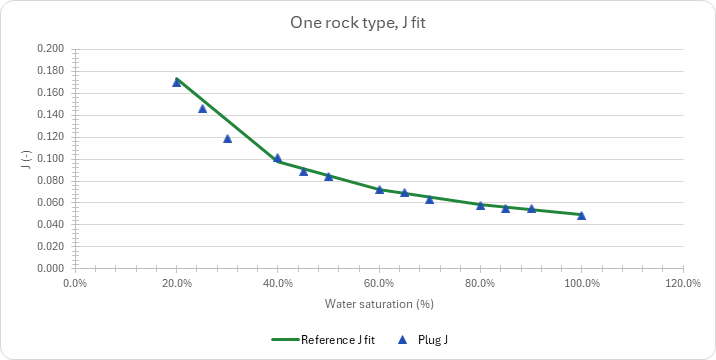
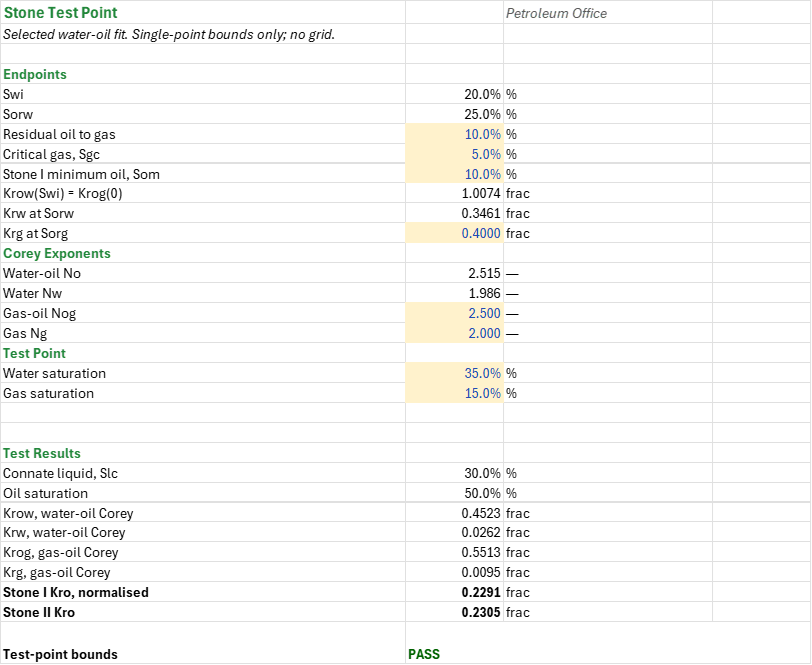
Method: Sw* = (Sw - Swi)/(1 - Swi - Sorw). A linear regression (LINEST) of ln(kr) against ln(Sw*) or ln(1 - Sw*) gives the Corey exponents and intercepts; the constrained fits honour the measured endpoints. RMS error, average absolute relative error (AARE) and endpoint mismatch qualify the fit. The free-fit log R² is shown separately; the selected model's log R² is 1 minus the log-residual sum of squares over the total log variance, and drives the fit check. Free-endpoint Corey curves are computed directly so a fitted endpoint above one is kept; no endpoint is clipped. The Pc parameters are independent drainage inputs (Brooks-Corey, van Genuchten and a reference J curve). J = 0.2166 Pc sqrt(k/phi)/(sigma cos(theta)); a log regression of J against (Sw - Swi)/(1 - Swi) gives the rock type's power curve J = a ((Sw - Swi)/(1 - Swi))^b. Both Stone models use normalized saturations; Stone II assumes a unit oil endpoint and is scaled back to the selected oil endpoint. Pc is exported as text to 0.1 psi, and the closing rows of each table hold the endpoint kr.
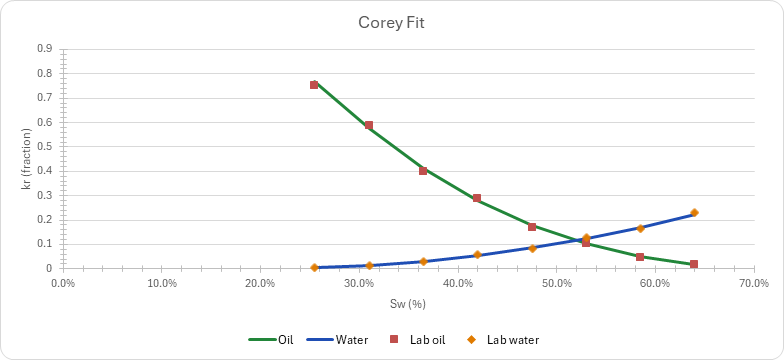
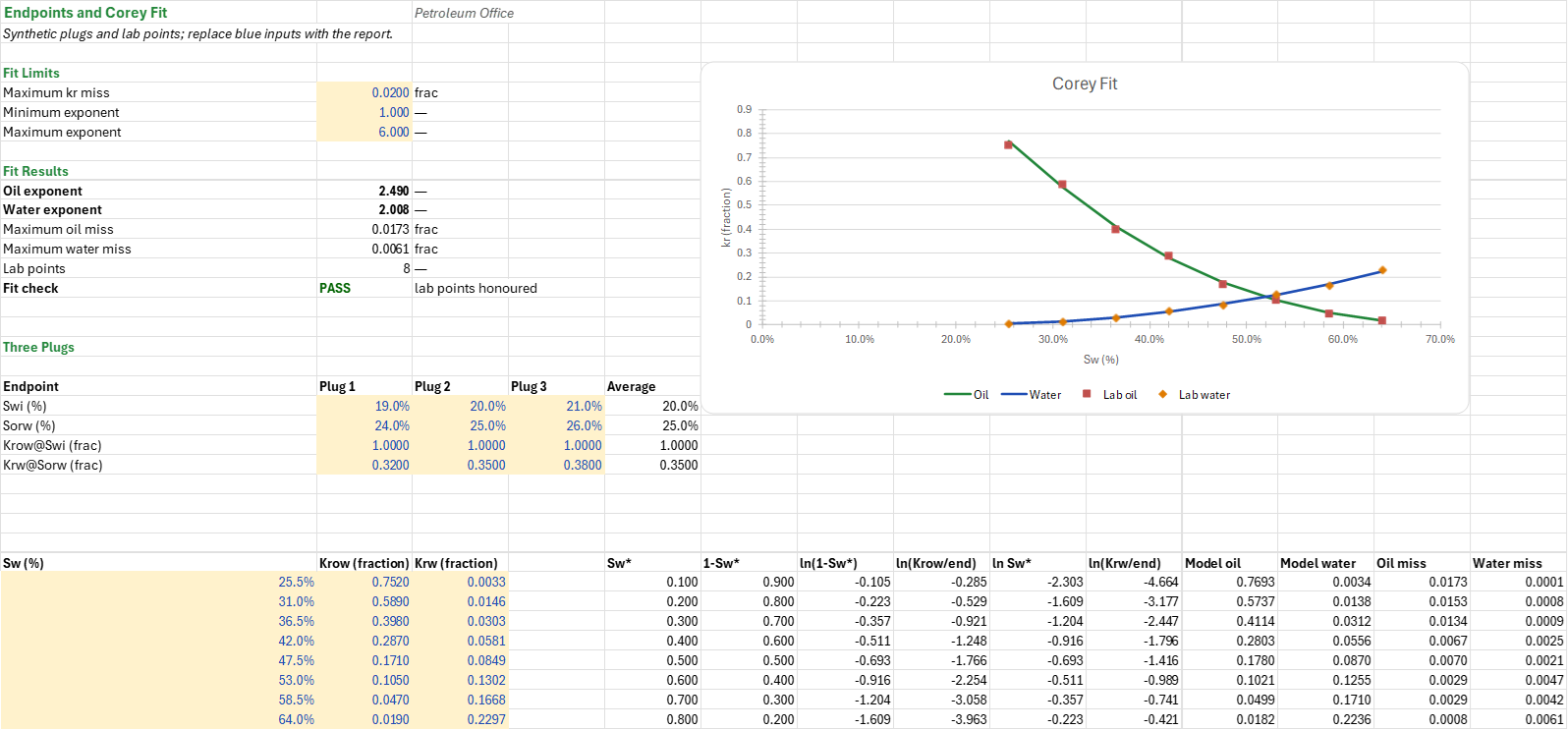
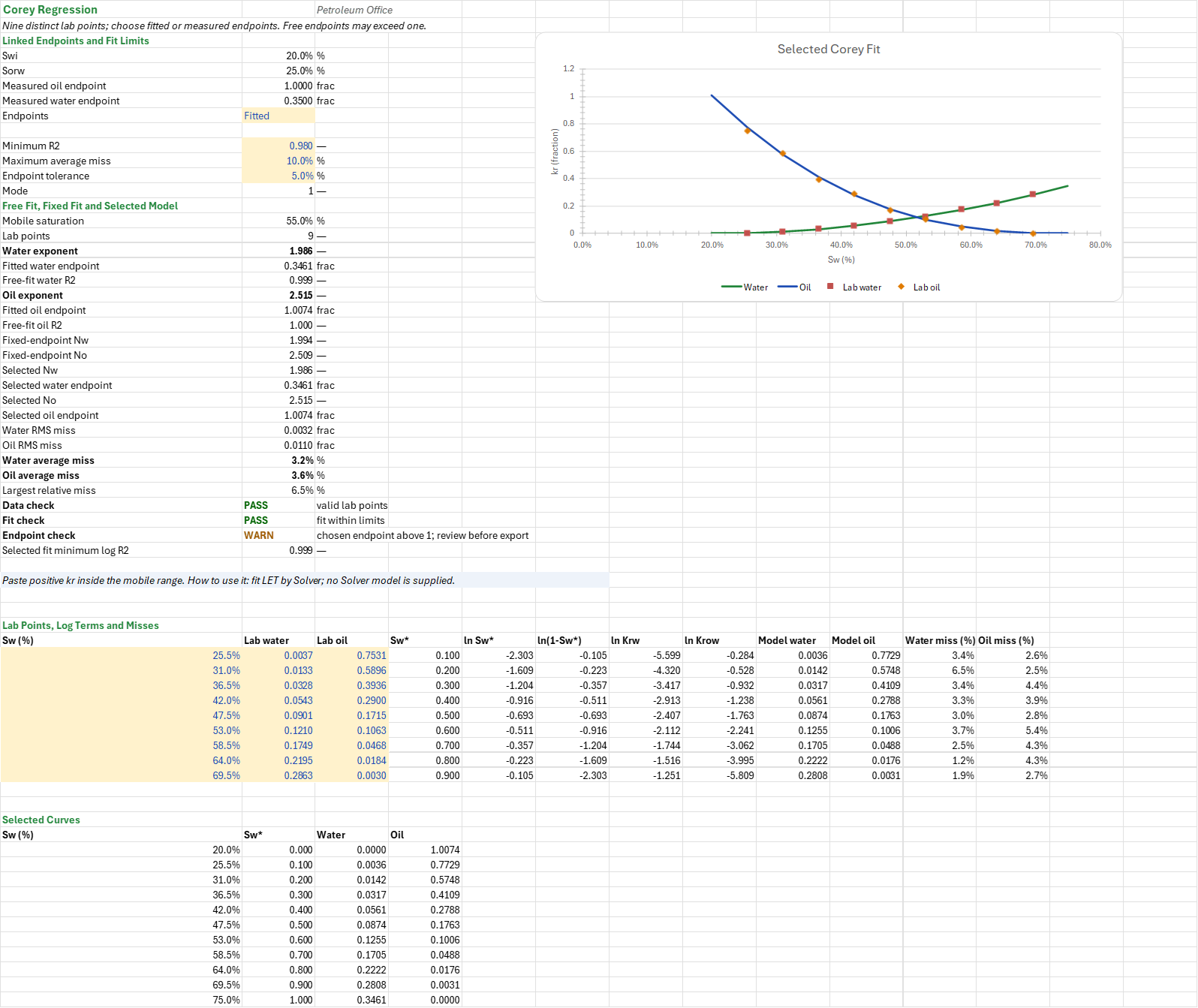
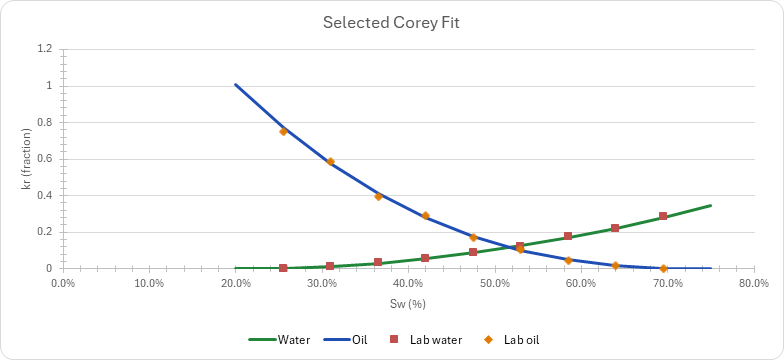
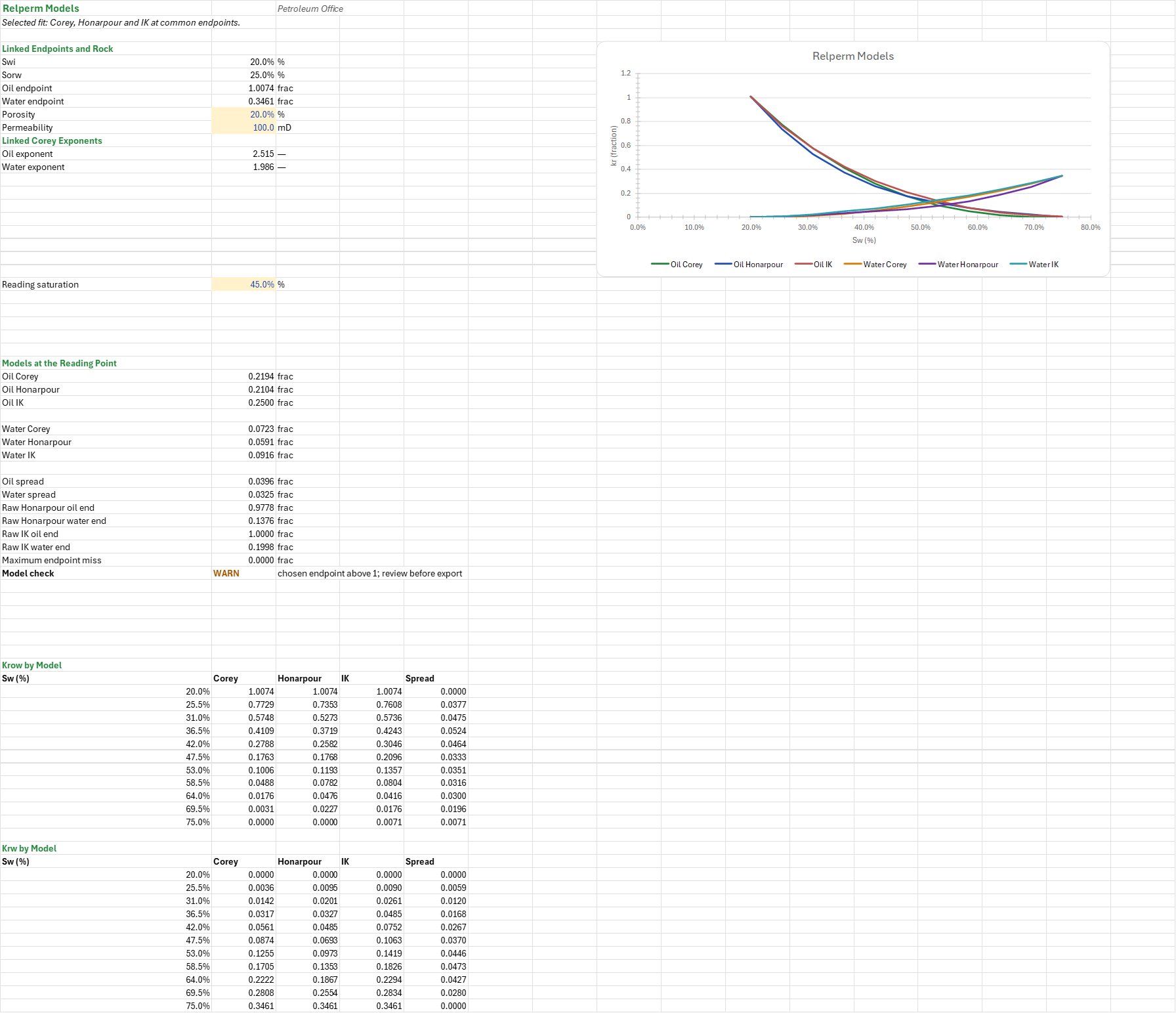
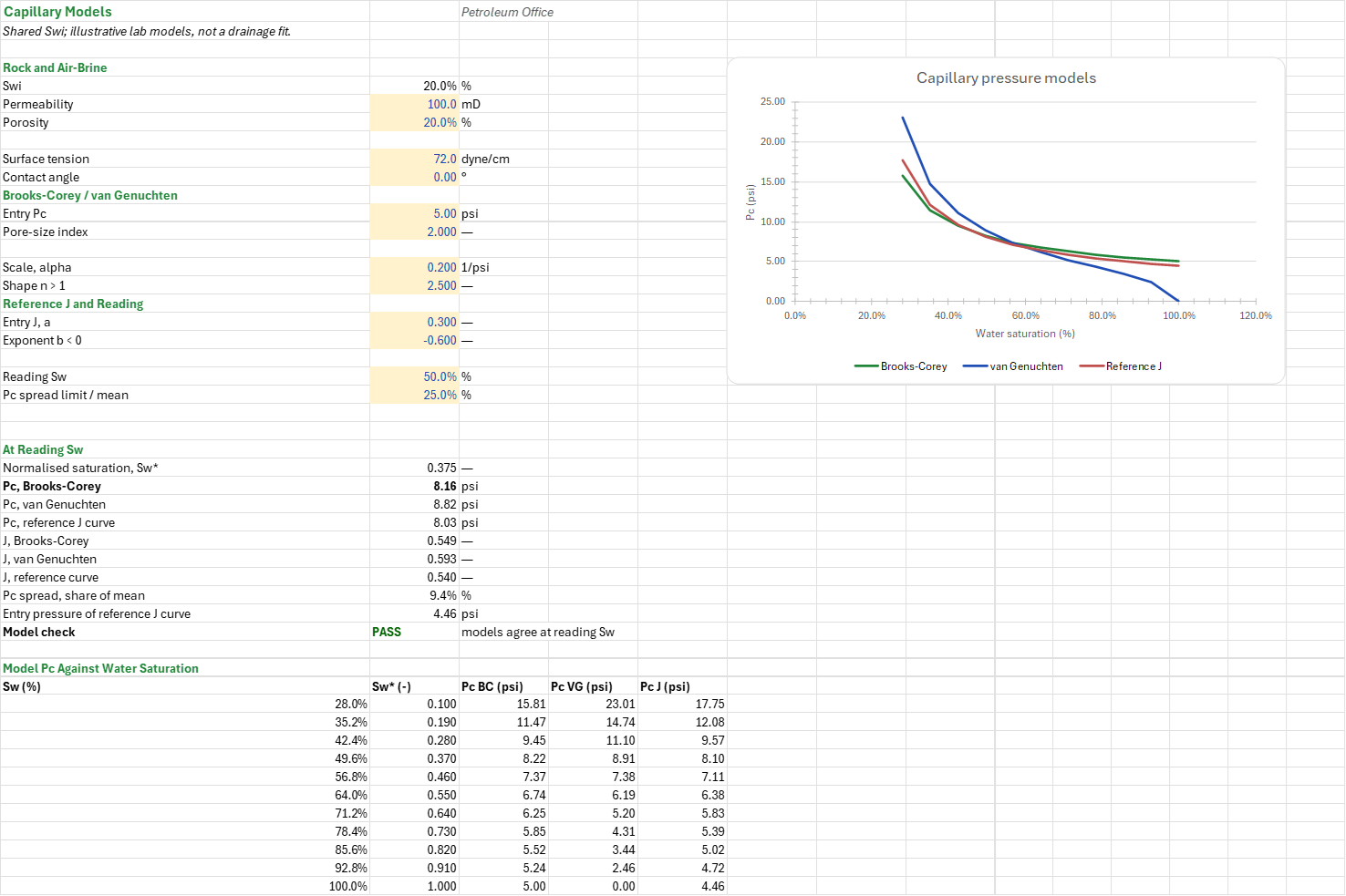
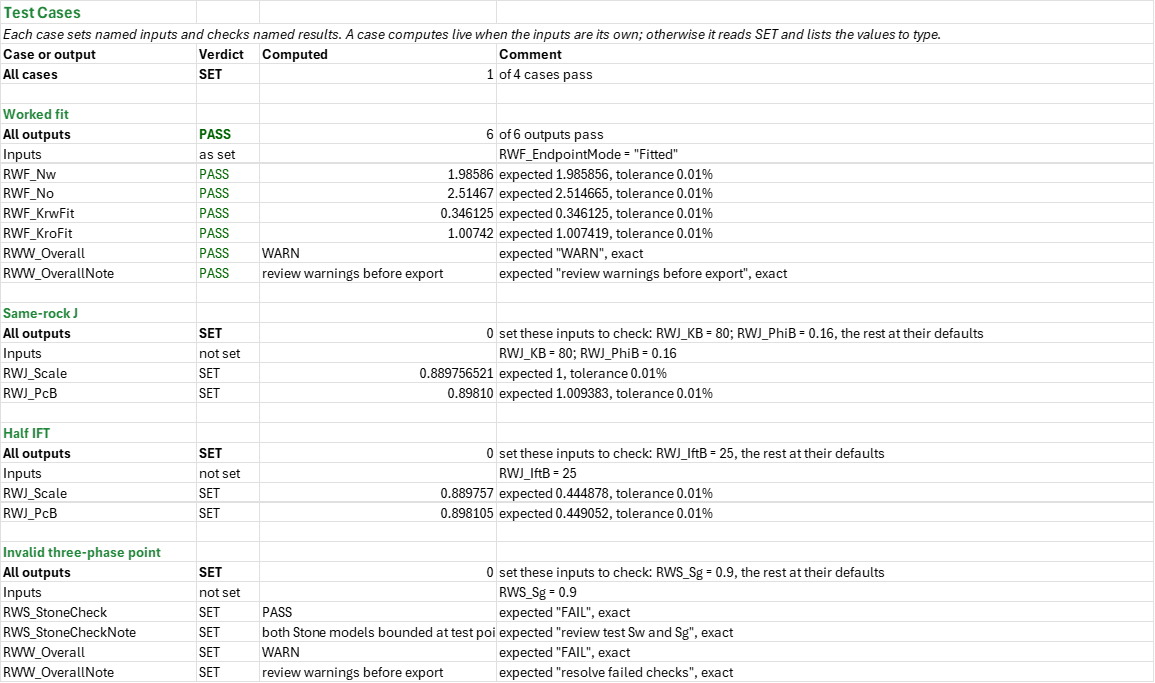
Example: The relative permeability rock is synthetic: Swi = 0.2, Sorw = 0.25, Sorg = 0.1, Sgc = 0.05, Krow = 1, Krw = 0.35, Krg = 0.4, No = Nog = 2.5, Nw = Ng = 2, k = 100 mD, phi = 0.2. Three plugs and eight lab points give No = 2.489902 and Nw = 2.008058. A separate nine-point example gives a free fit of Nw = 1.985856, No = 2.514665, Krw = 0.346125 and Krow = 1.007419; the slopes at measured endpoints are 1.993793 and 2.509396. Krow above one warns. The capillary defaults Pd = 5 psi, lambda = 2, alpha = 0.2/psi, n = 2.5, Ja = 0.3, Jb = -0.6, IFT = 72 and theta = 0 give Pc = 8.164966, 8.815883 and 8.033323 psi (Brooks-Corey, van Genuchten, reference J) at Sw = 0.5. J scaling uses a different rock type, Ahmed's Example 4-7: reference k = 80 mD, phi = 0.16, IFT = 50, theta = 0; target k = 120 mD, phi = 0.19, same fluids. Five Ahmed and eight synthetic points fit a = 0.049759, b = -0.676458, R² = 0.996133, with Swi = 0.05 assumed. The analytic scale sqrt(800.19/(1200.16)) = 0.889757 gives Pc = 0.898105 psi at Sw = 0.4. Every value agrees with an independent calculation on the same inputs to 1e-9; the rounded book J is not an exact match. At Sw = 0.35 and Sg = 0.15 Stone gives So = 0.5, KroI = 0.229097 and KroII = 0.230540. The export has 12 SWOF and 13 SGOF rows, ending at Sg = 0.8 and Krg = 0.4.
Validity
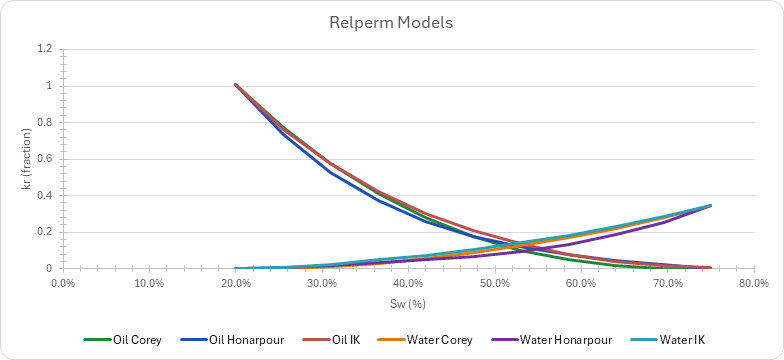
No JBN or end-effect correction. Corey can miss mixed-wet and carbonate curve shapes, and the log regression weighs low kr heavily. J scaling needs one facies. Drainage only: no hysteresis, SATNUM regions or endpoint scaling. Stone checks one point, not a grid or a calibration. Ibrahim-Koederitz Krow stays nonzero at 1 - Sorw (0.0071 on this example); the common-endpoint check covers Krow at Swi and Krw at 1 - Sorw only. A free-fit kr above one is a warning; an invalid typed gas kr fails. Zero Sorw, Sorg or Sgc and saturation steps below 0.0001 fail, because the fixed-size exported rows would duplicate after rounding; remove duplicate rows by hand outside the workbook. Alternatives: constrained LET, Thomeer Pc and family-II SWFN/SGFN/SOF3 tables; full Stone grids. The workbook does not fit a saturation-height model; the add-in has no function for it.
References
- Leverett, M.C. (1941). Capillary Behavior in Porous Solids. Trans. AIME 142, 152-169.
- Corey, A.T. (1954). The Interrelation Between Gas and Oil Relative Permeabilities. Producers Monthly 19(1), 38-41.
- Brooks, R.H. and Corey, A.T. (1964). Hydraulic Properties of Porous Media. Hydrology Paper 3, Colorado State University.
- Stone, H.L. (1970). Probability Model for Estimating Three-Phase Relative Permeability. JPT 22(2), 214-218. SPE-2116-PA.
- Stone, H.L. (1973). Estimation of Three-Phase Relative Permeability and Residual Oil Data. J. Can. Pet. Tech. 12(4), 53-61.
- van Genuchten, M.Th. (1980). A Closed-form Equation for Predicting the Hydraulic Conductivity of Unsaturated Soils. Soil Sci. Soc. Am. J. 44(5), 892-898.
- Honarpour, M., Koederitz, L. and Harvey, A.H. (1986). Relative Permeability of Petroleum Reservoirs. CRC Press.
- Ahmed, T. Reservoir Engineering Handbook. Gulf Professional Publishing, Example 4-7 (J-function data).
- ECLIPSE and OPM Flow reference manuals: SWOF and SGOF keyword conventions.
Inputs
| Input | Unit | Default | Name |
|---|---|---|---|
| Maximum kr miss (Endpoints) | fraction | 0.02 | RWE_Tol |
| Minimum exponent | — | 1 | RWE_NMin |
| Maximum exponent | — | 6 | RWE_NMax |
| Endpoints, Fitted or Measured (from a list) | — | Fitted | RWF_EndpointMode |
| Minimum R2 | — | 0.98 | RWF_R2Min |
| Maximum average miss | fraction | 0.10 | RWF_AareMax |
| Endpoint tolerance (Fits) | fraction | 0.05 | RWF_EndTol |
| Porosity, permeability (Models) | fraction, mD | 0.2, 100 | RWM_Phi, RWM_K |
| Reading saturation (Models) | fraction | 0.45 | RWM_Sw |
| Permeability, porosity (Capillary) | mD, fraction | 100, 0.2 | RWC_K, RWC_Phi |
| Surface tension | dyne/cm | 72 | RWC_Ift |
| Contact angle | degrees | 0 | RWC_Theta |
| Entry Pc | psi | 5 | RWC_Pd |
| Pore-size index | — | 2 | RWC_Lambda |
| Scale, alpha | 1/psi | 0.2 | RWC_Alpha |
| Shape n > 1 | — | 2.5 | RWC_N |
| Entry J, a | — | 0.3 | RWC_Ja |
| Exponent b < 0 | — | -0.6 | RWC_Jb |
| Reading Sw (Capillary) | fraction | 0.5 | RWC_Sw |
| Pc spread limit / mean | fraction | 0.25 | RWC_SpreadMax |
| Plug A k, Plug A porosity | mD, fraction | 80, 0.16 | RWJ_KA, RWJ_PhiA |
| Lab IFT, lab contact angle | dyne/cm, degrees | 50, 0 | RWJ_IftA, RWJ_ThetaA |
| Target B k, Target B porosity | mD, fraction | 120, 0.19 | RWJ_KB, RWJ_PhiB |
| Target IFT, target contact angle | dyne/cm, degrees | 50, 0 | RWJ_IftB, RWJ_ThetaB |
| Rock-type Swi | fraction | 0.05 | RWJ_Swi |
| Reading Sw (JScaling) | fraction | 0.4 | RWJ_Sw |
| Minimum R-squared (JScaling) | — | 0.95 | RWJ_R2Min |
| Residual oil to gas | fraction | 0.1 | RWS_Sorg |
| Critical gas, Sgc | fraction | 0.05 | RWS_Sgc |
| Stone I minimum oil, Som | fraction | 0.1 | RWS_Som |
| Krg at Sorg | fraction | 0.4 | RWS_KrgEnd |
| Gas-oil Nog, gas Ng | — | 2.5, 2 | RWS_Nog, RWS_Ng |
| Water saturation, gas saturation (Stone test point) | fraction | 0.35, 0.15 | RWS_Sw, RWS_Sg |
| Endpoint tolerance (Export) | fraction | 0.001 | RWX_KrTol |
Sheets
Guide— what the workbook answers, the order of its sheets, and the real-data notes and limits.Endpoints— three plugs' endpoints and their averages, eight lab points, the Corey fit at the measured endpoints with each point's miss, and the fit check; chart of the Corey fit over the lab points.Fits— a separate nine-point example: free and fixed-endpoint Corey regressions, the Fitted or Measured endpoint choice, log R², RMS, AARE and endpoint misses, and the selected curves; chart of the selected Corey fit over the lab points.Models— Corey, Honarpour and Ibrahim-Koederitz at the selected fit's common endpoints, read at one saturation and tabulated for oil and water; chart of the three models.Capillary— Brooks-Corey, van Genuchten and reference-J drainage Pc on the shared Swi, read at one saturation with their spread; chart of Pc against water saturation.JScaling— a separate rock type (Ahmed's Example 4-7 plus synthetic plugs): 13 lab points, the J power-law fit and the Pc scaled from plug A to target B; chart of the J fit over the plug points.Stone— Stone I and Stone II oil relative permeability at one three-phase test point, from the selected water-oil fit and the gas-oil endpoints.Export— the linked water-oil and gas-oil models, endpoint checks, and copy-ready SWOF (12 rows) and SGOF (13 rows) keywords.Summary— the selected water-oil model and every check under one export-readiness verdict.Test Cases— the worked example and other cases, with expected and computed results.
Functions used
Names (217)
| Name | Refers to | Comment |
|---|---|---|
RWC_Alpha |
Capillary!$B$15 |
Scale, alpha, 1/psi |
RWC_Curve |
Capillary!$A$39:$E$49 |
Eleven points, Sw* from 0.1 to 1; no singular Swi point |
RWC_Ift |
Capillary!$B$9 |
Surface tension, dyne/cm |
RWC_Inputs |
Capillary!$B$5:$B$22 |
Rock, fluids and models |
RWC_JBC |
Capillary!$B$30 |
J, Brooks-Corey |
RWC_JVG |
Capillary!$B$31 |
J, van Genuchten |
RWC_Ja |
Capillary!$B$18 |
Entry J, a |
RWC_Jb |
Capillary!$B$19 |
Exponent b < 0 |
RWC_Jref |
Capillary!$B$32 |
J, reference curve |
RWC_K |
Capillary!$B$6 |
Permeability, mD |
RWC_Lambda |
Capillary!$B$13 |
Pore-size index |
RWC_ModelCheck |
Capillary!$B$35 |
Model check verdict |
RWC_ModelCheckNote |
Capillary!$C$35 |
Model check comment |
RWC_N |
Capillary!$B$16 |
Shape n > 1 |
RWC_PcBC |
Capillary!$B$27 |
Pc, Brooks-Corey, psi |
RWC_PcJ |
Capillary!$B$29 |
Pc, reference J curve, psi |
RWC_PcVG |
Capillary!$B$28 |
Pc, van Genuchten, psi |
RWC_Pd |
Capillary!$B$12 |
Entry Pc, psi |
RWC_PdJ |
Capillary!$B$34 |
Entry pressure of reference J curve, psi |
RWC_Phi |
Capillary!$B$7 |
Porosity, % |
RWC_Results |
Capillary!$B$26:$B$35 |
Three model Pc and J values, spread and check |
RWC_Snorm |
Capillary!$B$26 |
Normalised saturation, Sw* |
RWC_Spread |
Capillary!$B$33 |
Pc spread, share of mean, % |
RWC_SpreadMax |
Capillary!$B$22 |
Pc spread limit / mean, % |
RWC_Sw |
Capillary!$B$21 |
Reading Sw, % |
RWC_Swi |
Capillary!$B$5 |
Swi, % |
RWC_Theta |
Capillary!$B$10 |
Contact angle, ° |
RWE_FitCheck |
Endpoints!$B$15 |
Fit check verdict |
RWE_FitCheckNote |
Endpoints!$C$15 |
Fit check comment |
RWE_KroEnd |
Endpoints!$E$23 |
Plug average |
RWE_KrwEnd |
Endpoints!$E$24 |
Plug average |
RWE_MissKrow |
Endpoints!$B$12 |
Maximum oil miss, frac |
RWE_MissKrw |
Endpoints!$B$13 |
Maximum water miss, frac |
RWE_NMax |
Endpoints!$B$7 |
Maximum exponent |
RWE_NMin |
Endpoints!$B$6 |
Minimum exponent |
RWE_No |
Endpoints!$B$10 |
Oil exponent |
RWE_Nw |
Endpoints!$B$11 |
Water exponent |
RWE_Points |
Endpoints!$B$14 |
Lab points |
RWE_Results |
Endpoints!$B$10:$B$15 |
Corey fit and check |
RWE_Sorw |
Endpoints!$E$22 |
Plug average |
RWE_Swi |
Endpoints!$E$21 |
Plug average |
RWE_Tol |
Endpoints!$B$5 |
Maximum kr miss, frac |
RWF_AareMax |
Fits!$B$11 |
Maximum average miss, % |
RWF_AareO |
Fits!$B$32 |
Oil average miss, % |
RWF_AareW |
Fits!$B$31 |
Water average miss, % |
RWF_DataCheck |
Fits!$B$34 |
Data check verdict |
RWF_DataCheckNote |
Fits!$C$34 |
Data check comment |
RWF_EndCheck |
Fits!$B$36 |
Endpoint check verdict |
RWF_EndCheckNote |
Fits!$C$36 |
Endpoint check comment |
RWF_EndTol |
Fits!$B$12 |
Endpoint tolerance, % |
RWF_EndpointMode |
Fits!$B$8 |
Endpoints |
RWF_FitCheck |
Fits!$B$35 |
Fit check verdict |
RWF_FitCheckNote |
Fits!$C$35 |
Fit check comment |
RWF_KroEnd |
Fits!$B$6 |
Measured oil endpoint, frac |
RWF_KroFit |
Fits!$B$21 |
Fitted oil endpoint, frac |
RWF_KroMod |
Fits!$J$44:$J$52 |
KroMod |
RWF_Krow |
Fits!$C$44:$C$52 |
Krow |
RWF_Krw |
Fits!$B$44:$B$52 |
Krw |
RWF_KrwEnd |
Fits!$B$7 |
Measured water endpoint, frac |
RWF_KrwFit |
Fits!$B$18 |
Fitted water endpoint, frac |
RWF_KrwMod |
Fits!$I$44:$I$52 |
KrwMod |
RWF_Ln1S |
Fits!$F$44:$F$52 |
Ln1S |
RWF_LnKrow |
Fits!$H$44:$H$52 |
LnKrow |
RWF_LnKrw |
Fits!$G$44:$G$52 |
LnKrw |
RWF_LnS |
Fits!$E$44:$E$52 |
LnS |
RWF_MaxMiss |
Fits!$B$33 |
Largest relative miss, % |
RWF_MissO |
Fits!$L$44:$L$52 |
MissO |
RWF_MissW |
Fits!$K$44:$K$52 |
MissW |
RWF_Mobile |
Fits!$B$15 |
Mobile saturation, % |
RWF_Mode |
Fits!$B$13 |
Mode |
RWF_NPts |
Fits!$B$16 |
Lab points |
RWF_No |
Fits!$B$20 |
Oil exponent |
RWF_NoFix |
Fits!$B$24 |
Fixed-endpoint No |
RWF_Nw |
Fits!$B$17 |
Water exponent |
RWF_NwFix |
Fits!$B$23 |
Fixed-endpoint Nw |
RWF_R2Min |
Fits!$B$10 |
Minimum R2 |
RWF_R2o |
Fits!$B$22 |
Free-fit oil R2 |
RWF_R2w |
Fits!$B$19 |
Free-fit water R2 |
RWF_Results |
Fits!$B$15:$B$37 |
Fits, selected model, errors and checks |
RWF_RmseO |
Fits!$B$30 |
Oil RMS miss, frac |
RWF_RmseW |
Fits!$B$29 |
Water RMS miss, frac |
RWF_SelectedR2 |
Fits!$B$37 |
Selected fit minimum log R2 |
RWF_Sorw |
Fits!$B$5 |
Sorw, % |
RWF_Sw |
Fits!$A$44:$A$52 |
Sw |
RWF_Swi |
Fits!$B$4 |
Swi, % |
RWF_UseKro |
Fits!$B$28 |
Selected oil endpoint, frac |
RWF_UseKrw |
Fits!$B$26 |
Selected water endpoint, frac |
RWF_UseNo |
Fits!$B$27 |
Selected No |
RWF_UseNw |
Fits!$B$25 |
Selected Nw |
RWJ_FitData |
JScaling!$A$33:$K$45 |
5 Ahmed + 8 synthetic points |
RWJ_IftA |
JScaling!$B$7 |
Lab IFT, dyne/cm |
RWJ_IftB |
JScaling!$B$12 |
Target IFT, dyne/cm |
RWJ_Inputs |
JScaling!$B$5:$B$17 |
Plug, target and reading |
RWJ_Ja |
JScaling!$B$22 |
Reference J at Sw* = 1, a |
RWJ_Jb |
JScaling!$B$23 |
Reference J exponent, b |
RWJ_KA |
JScaling!$B$5 |
Plug A k, mD |
RWJ_KB |
JScaling!$B$10 |
Target B k, mD |
RWJ_PcA |
JScaling!$B$27 |
Plug A Pc at reading Sw, psi |
RWJ_PcB |
JScaling!$B$26 |
Target Pc at reading Sw, psi |
RWJ_PhiA |
JScaling!$B$6 |
Plug A porosity, % |
RWJ_PhiB |
JScaling!$B$11 |
Target B porosity, % |
RWJ_Points |
JScaling!$B$25 |
Points fitted |
RWJ_R2 |
JScaling!$B$24 |
Fit R-squared |
RWJ_R2Min |
JScaling!$B$17 |
Minimum R-squared |
RWJ_RatioMiss |
JScaling!$B$21 |
Largest scale-ratio miss, plug A |
RWJ_Results |
JScaling!$B$20:$B$28 |
J fit and scaling |
RWJ_RockCheck |
JScaling!$B$28 |
Rock-type check verdict |
RWJ_RockCheckNote |
JScaling!$C$28 |
Rock-type check comment |
RWJ_Scale |
JScaling!$B$20 |
Pc_B / Pc_A scale factor |
RWJ_Sw |
JScaling!$B$16 |
Reading Sw, % |
RWJ_Swi |
JScaling!$B$15 |
Rock-type Swi, % |
RWJ_ThetaA |
JScaling!$B$8 |
Lab contact angle, ° |
RWJ_ThetaB |
JScaling!$B$13 |
Target contact angle, ° |
RWM_EndMiss |
Models!$B$43 |
Maximum endpoint miss, frac |
RWM_HonKroRaw |
Models!$B$39 |
Raw Honarpour oil end, frac |
RWM_HonKrwRaw |
Models!$B$40 |
Raw Honarpour water end, frac |
RWM_IkKroRaw |
Models!$B$41 |
Raw IK oil end, frac |
RWM_IkKrwRaw |
Models!$B$42 |
Raw IK water end, frac |
RWM_K |
Models!$B$10 |
Permeability, mD |
RWM_KroEnd |
Models!$B$7 |
Oil endpoint, frac |
RWM_KrowCorey |
Models!$B$29 |
Oil Corey, frac |
RWM_KrowHonarpour |
Models!$B$30 |
Oil Honarpour, frac |
RWM_KrowIK |
Models!$B$31 |
Oil IK, frac |
RWM_KrwCorey |
Models!$B$33 |
Water Corey, frac |
RWM_KrwEnd |
Models!$B$8 |
Water endpoint, frac |
RWM_KrwHonarpour |
Models!$B$34 |
Water Honarpour, frac |
RWM_KrwIK |
Models!$B$35 |
Water IK, frac |
RWM_ModelCheck |
Models!$B$44 |
Model check verdict |
RWM_ModelCheckNote |
Models!$C$44 |
Model check comment |
RWM_No |
Models!$B$12 |
Oil exponent |
RWM_Nw |
Models!$B$13 |
Water exponent |
RWM_Phi |
Models!$B$9 |
Porosity, % |
RWM_Results |
Models!$B$29:$B$44 |
Readings, spread, raw endpoints and check |
RWM_Sorw |
Models!$B$6 |
Sorw, % |
RWM_SpreadKrow |
Models!$B$37 |
Oil spread, frac |
RWM_SpreadKrw |
Models!$B$38 |
Water spread, frac |
RWM_Sw |
Models!$B$22 |
Reading saturation, % |
RWM_Swi |
Models!$B$5 |
Swi, % |
RWS_Inputs |
Stone!$B$5:$B$20 |
Models and test point |
RWS_Krg |
Stone!$B$29 |
Krg, gas-oil Corey, frac |
RWS_KrgEnd |
Stone!$B$12 |
Krg at Sorg, frac |
RWS_KroI |
Stone!$B$30 |
Stone I Kro, normalised, frac |
RWS_KroII |
Stone!$B$31 |
Stone II Kro, frac |
RWS_Krog |
Stone!$B$28 |
Krog, gas-oil Corey, frac |
RWS_Krow |
Stone!$B$26 |
Krow, water-oil Corey, frac |
RWS_KrowEnd |
Stone!$B$10 |
Krow(Swi) = Krog(0), frac |
RWS_Krw |
Stone!$B$27 |
Krw, water-oil Corey, frac |
RWS_KrwEnd |
Stone!$B$11 |
Krw at Sorw, frac |
RWS_Ng |
Stone!$B$17 |
Gas Ng |
RWS_No |
Stone!$B$14 |
Water-oil No |
RWS_Nog |
Stone!$B$16 |
Gas-oil Nog |
RWS_Nw |
Stone!$B$15 |
Water Nw |
RWS_Results |
Stone!$B$24:$B$32 |
Test-point kr and bounds |
RWS_Sg |
Stone!$B$20 |
Gas saturation, % |
RWS_Sgc |
Stone!$B$8 |
Critical gas, Sgc, % |
RWS_Slc |
Stone!$B$24 |
Connate liquid, Slc, % |
RWS_So |
Stone!$B$25 |
Oil saturation, % |
RWS_Som |
Stone!$B$9 |
Stone I minimum oil, Som, % |
RWS_Sorg |
Stone!$B$7 |
Residual oil to gas, % |
RWS_Sorw |
Stone!$B$6 |
Sorw, % |
RWS_StoneCheck |
Stone!$B$32 |
Test-point bounds verdict |
RWS_StoneCheckNote |
Stone!$C$32 |
Test-point bounds comment |
RWS_Sw |
Stone!$B$19 |
Water saturation, % |
RWS_Swi |
Stone!$B$5 |
Swi, % |
RWW_Checks |
Summary!$B$15:$B$25 |
All analysis checks |
RWW_Kro |
Summary!$B$9 |
Oil endpoint, frac |
RWW_Krw |
Summary!$B$8 |
Water endpoint, frac |
RWW_No |
Summary!$B$7 |
Oil exponent |
RWW_Nw |
Summary!$B$6 |
Water exponent |
RWW_Overall |
Summary!$B$12 |
Export readiness verdict |
RWW_OverallNote |
Summary!$C$12 |
Export readiness comment |
RWW_Results |
Summary!$B$4:$B$12 |
Headlines and verdict |
RWW_Sorw |
Summary!$B$5 |
Residual oil, % |
RWW_Swi |
Summary!$B$4 |
Irreducible water, % |
RWX_EndCheck |
Export!$B$31 |
Endpoints and Pc verdict |
RWX_EndCheckNote |
Export!$C$31 |
Endpoints and Pc comment |
RWX_Inputs |
Export!$B$4:$B$19 |
Linked models and tolerance |
RWX_KrTol |
Export!$B$18 |
Endpoint tolerance, frac |
RWX_KrgEnd |
Export!$B$14 |
Krg at Sorg, frac |
RWX_KrgMax |
Export!$B$28 |
Last SGOF Krg, frac |
RWX_KroEnd |
Export!$B$6 |
Krow at Swi, frac |
RWX_KrogEnd |
Export!$B$13 |
Krog at Sg = 0, frac |
RWX_KrogFirst |
Export!$B$27 |
First SGOF Krog, frac |
RWX_KrowFirst |
Export!$B$25 |
First SWOF Krow, frac |
RWX_KrwEnd |
Export!$B$7 |
Krw at Sorw, frac |
RWX_KrwMax |
Export!$B$26 |
Last SWOF Krw, frac |
RWX_Mobile |
Export!$B$21 |
Mobile oil to water, % |
RWX_Ng |
Export!$B$16 |
Gas Ng |
RWX_No |
Export!$B$8 |
Oil exponent |
RWX_Nog |
Export!$B$15 |
Oil Nog |
RWX_Nw |
Export!$B$9 |
Water exponent |
RWX_PcHalfStep |
Export!$B$19 |
Pc half export step, psi |
RWX_Results |
Export!$B$21:$B$31 |
Endpoints and checks |
RWX_SatStep |
Export!$B$17 |
Saturation export step |
RWX_SgLast |
Export!$B$24 |
Last SGOF gas saturation, % |
RWX_SgMax |
Export!$B$23 |
Gas saturation where Krog reaches zero, % |
RWX_Sgc |
Export!$B$11 |
Critical gas, Sgc, % |
RWX_SgofCheck |
Export!$B$30 |
SGOF check verdict |
RWX_SgofCheckNote |
Export!$C$30 |
SGOF check comment |
RWX_SgofData |
Export!$A$60:$E$72 |
13 SGOF rows |
RWX_SgofKrg |
Export!$B$60:$B$72 |
SGOF Krg |
RWX_SgofKrog |
Export!$C$60:$C$72 |
SGOF Krog |
RWX_SgofMid |
Export!$E$66 |
SGOF mobile midpoint line |
RWX_SgofSg |
Export!$A$60:$A$72 |
SGOF Sg |
RWX_SgofText |
Export!$E$58:$E$73 |
Copy-ready SGOF keyword |
RWX_Slc |
Export!$B$22 |
Connate liquid, Slc, % |
RWX_Sorg |
Export!$B$12 |
Residual oil to gas, % |
RWX_Sorw |
Export!$B$5 |
Residual oil, Sorw, % |
RWX_Swi |
Export!$B$4 |
Connate water, Swi, % |
RWX_SwofCheck |
Export!$B$29 |
SWOF check verdict |
RWX_SwofCheckNote |
Export!$C$29 |
SWOF check comment |
RWX_SwofData |
Export!$A$41:$E$52 |
12 SWOF rows |
RWX_SwofKrow |
Export!$C$41:$C$52 |
SWOF Krow |
RWX_SwofKrw |
Export!$B$41:$B$52 |
SWOF Krw |
RWX_SwofMid |
Export!$E$46 |
SWOF mobile midpoint line |
RWX_SwofSw |
Export!$A$41:$A$52 |
SWOF Sw |
RWX_SwofText |
Export!$E$39:$E$53 |
Copy-ready SWOF keyword |
Details
| Opens in | Needs the Petroleum Office add-in: its PO functions show #NAME? without it once Excel recalculates. |
| File | RelPermPcTables.xlsx, 74 KB |
| Category | Reservoir |
| For agents and tools | Descriptor (.md) |