Probabilistic Volumetrics
Description
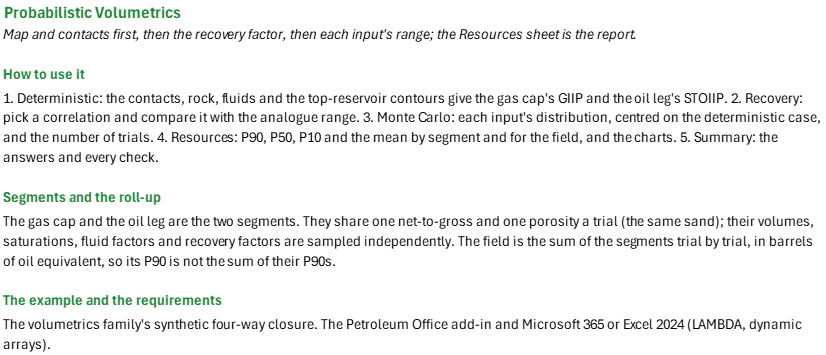
How much oil and gas does a closure with a gas cap and an oil leg hold, and what range belongs in a resource report? You enter a top-reservoir depth-area table, the gas-oil and oil-water contacts, the rock, fluid and recovery inputs, and a spread for each of ten uncertain inputs. You read off STOIIP, GIIP and the recoverable volumes per segment and for the field, as a deterministic case and as mean, P90, P50 and P10, in field units.
How to use it: The field is synthetic. Paste your contours, crest first, and set the contacts from pressure gradients, the rock from petrophysics and the gas from a separator test. Pick the recovery-factor correlation for your drive and check it against the analogue range. Set each spread from the field's own range (maps, logs, PVT, analogues), give any extra input its own multiplier and offset, and run n = 1,000 for a final report. Read the field's recoverable P90, P50 and P10 on the Resources sheet, and the roll-up there to see how far the summed segment percentiles are from the field's.
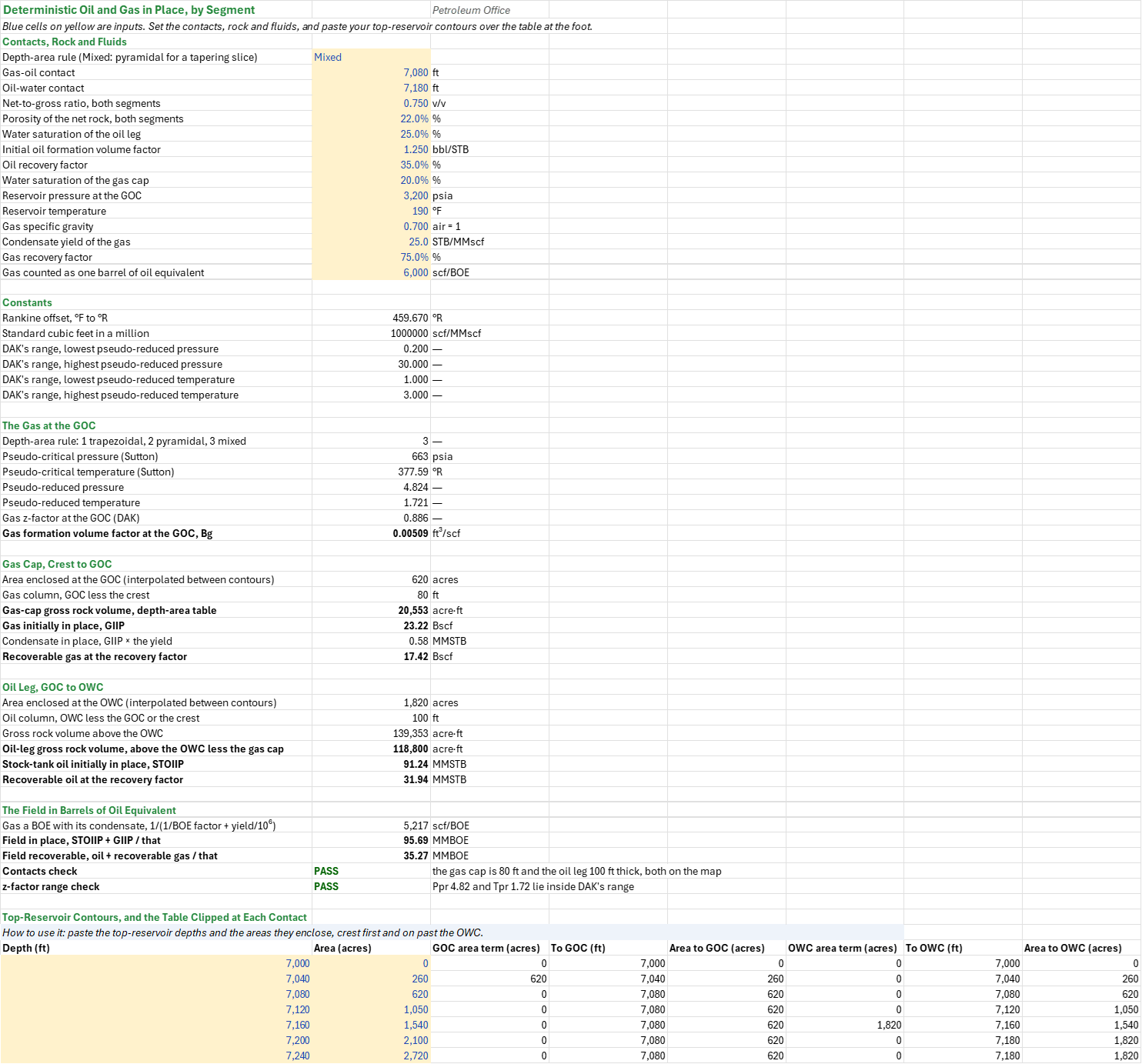
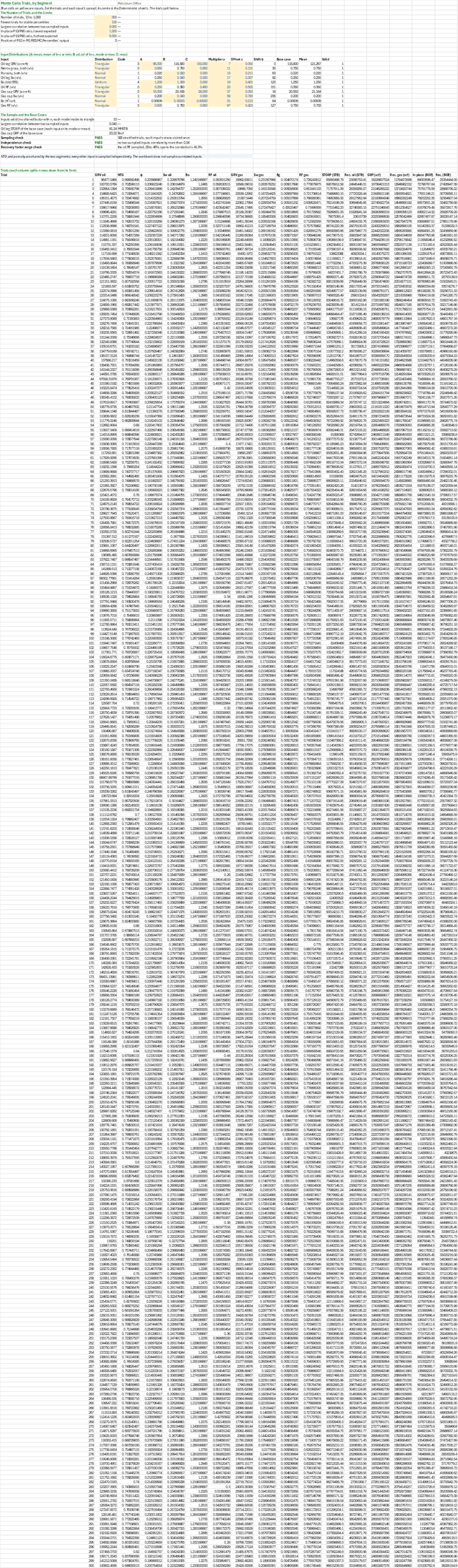
Method: The gas cap's gross rock volume is the depth-area table integrated from the crest to the GOC, and the oil leg's is the volume above the OWC less the gas cap's, each contact's area interpolated between contours. Bg = 0.02827 z T/P, with z from Dranchuk-Abou-Kassem on Sutton's pseudo-critical properties. GIIP = 43560 GRV NTG phi (1 - Sw)/Bg and STOIIP = 7758 GRV NTG phi (1 - Sw)/Bo; recoverable = in place x RF, with the oil RF from the Arps or Guthrie-Greenberger analogue correlations. A BOE of gas is 1/(1/6000 + CGR/10^6) scf, its condensate included. Each input column is a Latin-hypercube lattice, one value per stratum, shuffled by its own multiplier and offset. Trial i's STOIIP, GIIP and recoverable volumes follow, and the field is oil + gas/BOE factor, trial by trial. P90, P50 and P10 are percentiles of the trials, P90 the low case. The roll-up sums the trials, not the percentiles: percentiles do not add, means do, and the sheet shows both. Dependence: the two segments share one NTG and one porosity per trial (the same sand, fully dependent); every other input, the two GRVs included, is sampled independently.
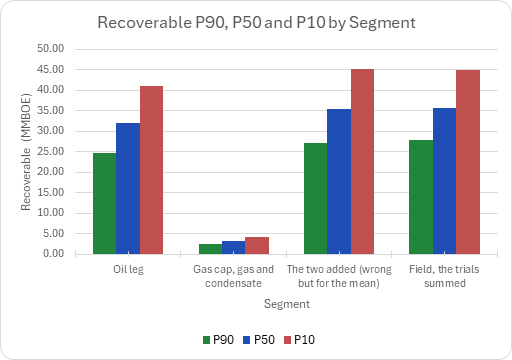
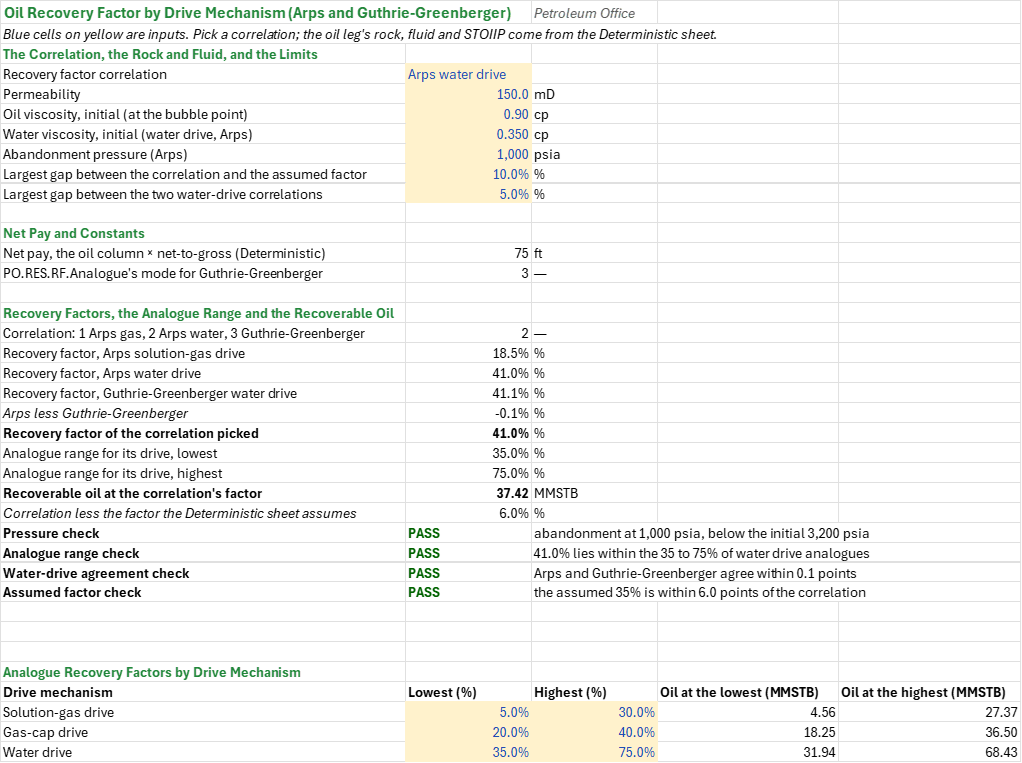
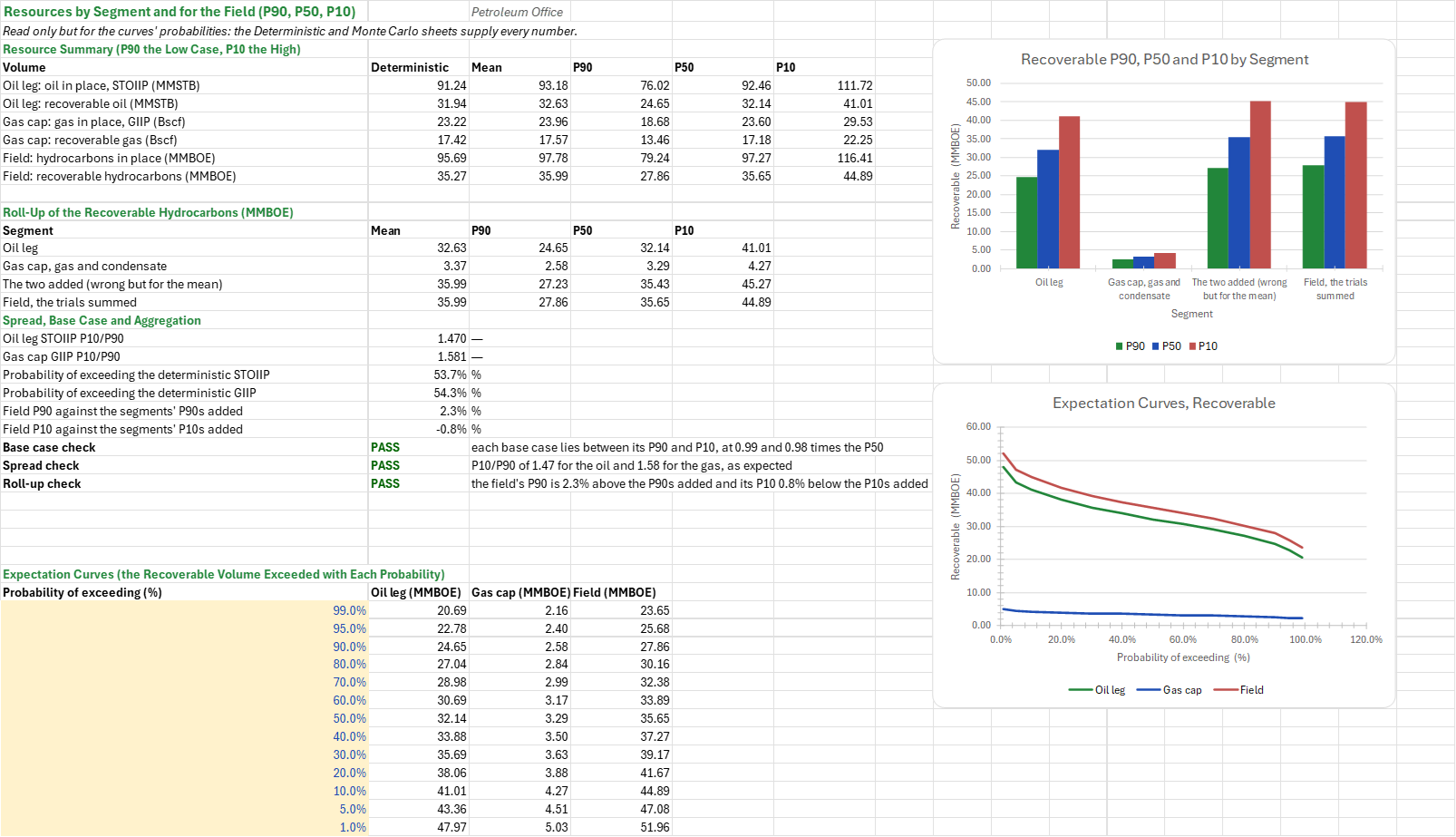
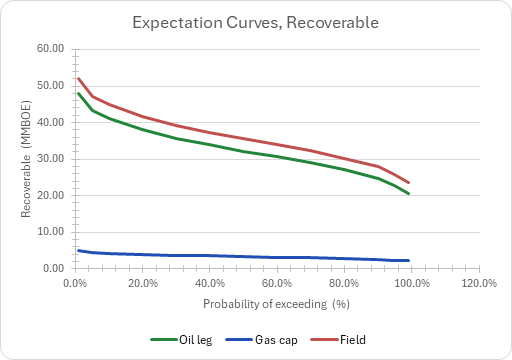
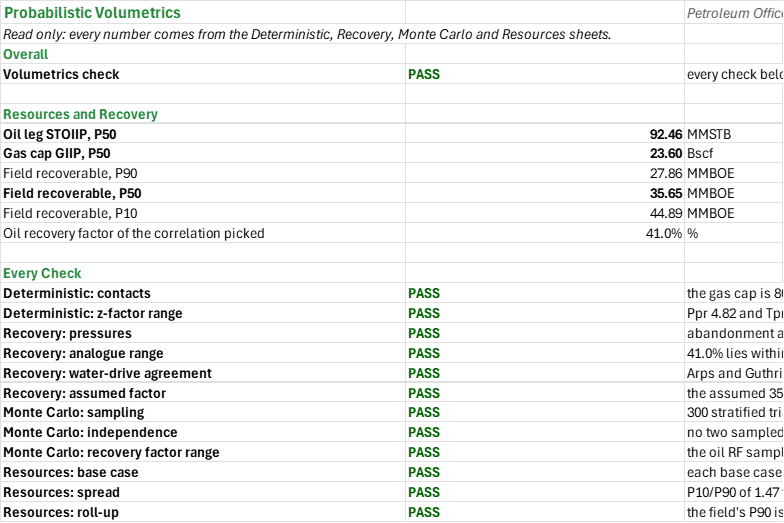
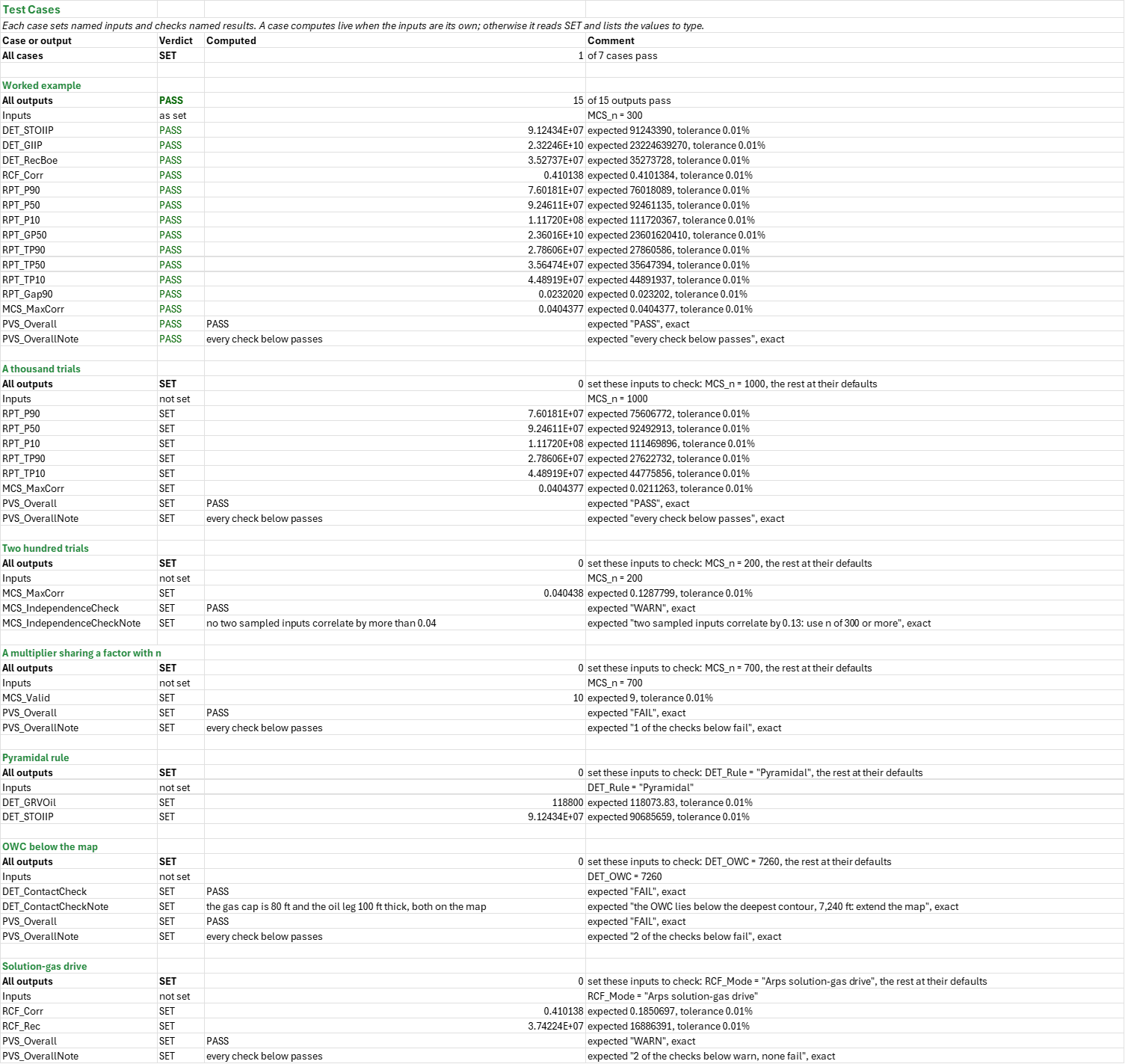
Example: The volumetrics family's synthetic four-way closure (crest 7,000 ft, GOC 7,080 ft, OWC 7,180 ft; 75% net, 22% porosity). Gas cap: 20,553 acre-ft, z 0.886, Bg 0.005089 ft3/scf, GIIP 23.22 Bscf, 0.58 MMSTB of condensate and 17.42 Bscf recoverable at 75%. Oil leg: 118,800 acre-ft, STOIIP 91.24 MMSTB and 31.94 MMSTB recoverable at 35%. The field holds 95.69 MMBOE in place and 35.27 MMBOE recoverable at 5,217 scf/BOE. Arps water drive gives an oil recovery factor of 41.0% (Guthrie-Greenberger 41.1%, inside the 35 to 75% of water-drive analogues), 37.42 MMSTB. At n = 300 the STOIIP P90, P50 and P10 are 76.02, 92.46 and 111.72 MMSTB, the same as the Monte Carlo volumetrics blueprint on these inputs, and the GIIP's are 18.68, 23.60 and 29.53 Bscf. The field's recoverable P90, P50 and P10 are 27.86, 35.65 and 44.89 MMBOE; the segments' P90s added give 27.23 and their P10s 45.27, so the field's P90 is 2.3% higher and its P10 0.8% lower than the sums. The largest correlation between two of the ten sampled columns is 0.040, within the 0.05 allowed, and the case is consistent throughout. At n = 1,000 the STOIIP percentiles move by under 0.6% and the field's recoverable P90 and P10 are 27.62 and 44.78 MMBOE. At n = 200 the columns correlate by 0.13, so the inputs are no longer independent; at n = 700, which 7 divides, a multiplier shares a factor with n, its strata are no longer each visited once, and the sheet rejects the sample. Solution-gas drive gives 18.5%, well short of the assumed 35%, and the sheet warns. An OWC at 7,260 ft lies below the deepest contour (7,240 ft) and the sheet asks for a longer map.
Validity
A volumetric estimate is as good as its map, contacts and averages; the top map alone bounds the rock only when the reservoir is thicker than the hydrocarbon column, and Bg is taken at the GOC for the whole gas cap. The recovery-factor correlations are regressions on sandstone fields: a starting value against analogues, not a forecast; gas-cap drive has none. The sample is a fixed lattice, not a random draw: repeated runs are identical, the tails are cut at the outer strata, and below n = 300 the ten columns correlate by more than 0.05 (0.13 at 200), so the inputs stop being independent. The segments share NTG and porosity but nothing else: positive dependence (GRV with GRV through the depth conversion, porosity with Sw) widens the field's range, so this run understates it. The workbook does not sample correlated inputs: the stratified sampler draws each input on its own, and the add-in has no function for correlated sampling. The BOE factor is a reporting convention, and recoverable volumes are resources, not reserves, until a development plan supports them (SPE-PRMS). The blueprints' area x thickness cross-check and permeability sensitivity are left to them. Alternatives: a full uncertainty run on a geological model, or correlated Monte Carlo outside the workbook.
References
- Society of Petroleum Engineers (2018). Petroleum Resources Management System (PRMS), revised June 2018, sections 4.2 and 4.3 (probabilistic methods and aggregation).
- Murtha, J.A. (1994). Incorporating Historical Data into Monte Carlo Simulation. SPE Computer Applications 6(2), SPE-26245-PA.
- McKay, M.D., Beckman, R.J. and Conover, W.J. (1979). A Comparison of Three Methods for Selecting Values of Input Variables in the Analysis of Output from a Computer Code. Technometrics 21(2), 239-245.
- Craft, B.C. and Hawkins, M.F. (1991). Applied Petroleum Reservoir Engineering, 2nd ed., revised by Terry, R.E. Prentice Hall, ch. 1.
- Arps, J.J. et al. (1967). A Statistical Study of Recovery Efficiency. API Bulletin D14.
Inputs
| Input | Unit | Default | Name |
|---|---|---|---|
| Depth-area rule (Trapezoidal, Pyramidal or Mixed, from a list) | — | Mixed | DET_Rule |
| Gas-oil contact | ft | 7080 | DET_GOC |
| Oil-water contact | ft | 7180 | DET_OWC |
| Net-to-gross ratio, both segments | fraction | 0.75 | DET_NTG |
| Porosity of the net rock, both segments | fraction | 0.22 | DET_Phi |
| Water saturation of the oil leg | fraction | 0.25 | DET_SwOil |
| Initial oil formation volume factor | bbl/STB | 1.25 | DET_Bo |
| Oil recovery factor | % | 35 | DET_RFOil |
| Water saturation of the gas cap | fraction | 0.2 | DET_SwGas |
| Reservoir pressure at the GOC | psia | 3200 | DET_P |
| Reservoir temperature | °F | 190 | DET_T |
| Gas specific gravity | air = 1 | 0.7 | DET_SG |
| Condensate yield of the gas | STB/MMscf | 25 | DET_CGR |
| Gas recovery factor | % | 75 | DET_RFGas |
| Gas counted as one barrel of oil equivalent | scf/BOE | 6000 | DET_BoeScf |
| Contour table: depth and area enclosed | ft, acres | 7 contours | — |
| Recovery factor correlation (Arps solution-gas drive, Arps water drive or Guthrie-Greenberger, from a list) | — | Arps water drive | RCF_Mode |
| Permeability | mD | 150 | RCF_K |
| Oil viscosity, initial (at the bubble point) | cp | 0.9 | RCF_Muo |
| Water viscosity, initial (water drive, Arps) | cp | 0.35 | RCF_Muw |
| Abandonment pressure (Arps) | psia | 1000 | RCF_Pa |
| Largest gap between the correlation and the assumed factor | % | 10 | RCF_Tol |
| Largest gap between the two water-drive correlations | % | 5 | RCF_AgreeTol |
| Number of trials, 10 to 1,000 | — | 300 | MCS_n |
| Fewest trials for stable percentiles | — | 100 | MCS_NMin |
| Largest correlation between two sampled inputs | — | 0.05 | MCS_CorrMax |
| In-place P10/P90 ratio, lowest expected | — | 1.2 | MCS_RatioMin |
| In-place P10/P90 ratio, highest expected | — | 5 | MCS_RatioMax |
| Distribution table: ten inputs, each with a distribution (list), spread, multiplier and offset | — | centred on the Deterministic sheet | — |
Sheets
Guide— what the workbook does, where the inputs are and how the sheets connect.Deterministic— one top-reservoir depth-area table clipped at each contact, Bg at the GOC, GIIP, condensate, STOIIP, the recoverable volumes and the field in barrels of oil equivalent.Recovery— the oil recovery factor from Arps or Guthrie-Greenberger, picked from a list, against the analogue range for its drive.Monte Carlo— ten inputs sampled by a reproducible stratified sampler, centred on the deterministic case.Resources— mean, P90, P50 and P10 by segment and for the field, the roll-up, the expectation curves and a P90/P50/P10 chart.Summary— the answers and every check under one verdict.Test Cases— the worked example and other cases, with expected and computed results.
Two charts: recoverable P90, P50 and P10 by segment, and the expectation curves.
Functions used
Names (159)
| Name | Refers to | Comment |
|---|---|---|
PO.RES.MC.PercentilesLAMBDA |
=LAMBDA(X, HSTACK(PERCENTILE.INC(X, 0.1), PERCENTILE.INC(X, 0.5), PERCENTILE.INC(X, 0.9), AVERAGE(X))) |
P90, P50, P10 (petroleum convention: P90 the low case, exceeded 90% of the time) and the mean of a column of outcomes; linear interpolation as PERCENTILE.INC. |
PO.RES.MC.SampleLAMBDA |
=LAMBDA(Dist, Dist_A, Dist_B, Dist_C, n, Mult, Shift, IF(GCD(Mult, n)<>1, NA(), LET(u, (MOD(Mult*(SEQUENCE(n)-1)+Shift, n)+0.5)/n, IF(Dist=1, NORM.INV(u, Dist_A, Dist_B), IF(Dist=2, LOGNORM.INV(u, Dist_A, Dist_B), IF(Dist=3, IF(u<(Dist_B-Dist_A)/(Dist_C-Dist_A), Dist_A+SQRT(u*(Dist_C-Dist_A)*(Dist_B-Dist_A)), Dist_C-SQRT((1-u)*(Dist_C-Dist_A)*(Dist_C-Dist_B))), IF(Dist=4, Dist_A+u*(Dist_B-Dist_A), NA()))))))) |
Deterministic stratified (Latin-hypercube) sample of n values: Dist 1 normal, 2 lognormal, 3 triangular, 4 uniform; strata shuffled by MOD(Mult*(i-1)+Shift, n). Inputs independent. |
PO.RES.RF.AnalogueLAMBDA |
=LAMBDA(Mode, Phi, Sw, Bo, k, Mu_o, Mu_w, P_ref, P_a, H, IF(Mode=1, 0.41815*(Phi*(1-Sw)/Bo)^0.1611*(k/1000/Mu_o)^0.0979*Sw^0.3722*(P_ref/P_a)^0.1741, IF(Mode=2, 0.54898*(Phi*(1-Sw)/Bo)^0.0422*(k/1000*Mu_w/Mu_o)^0.077*Sw^(-0.1903)*(P_ref/P_a)^(-0.2159), IF(Mode=3, 0.2719*LOG10(k)+0.25569*Sw-0.1355*LOG10(Mu_o)-1.538*Phi-0.00035*H+0.11403, NA())))) |
Oil recovery factor (fraction) from analogue correlations: Mode 1 Arps (API 1967) solution-gas drive, 2 Arps water drive, 3 Guthrie-Greenberger (1955) water drive. k in mD. |
PO.RES.Vol.GIIPLAMBDA |
=LAMBDA(GRV, NTG, Phi, Sw, Bg, 43560*GRV*NTG*Phi*(1-Sw)/Bg) |
Gas initially in place, scf: 43560 x GRV (acre-ft) x NTG x porosity x (1 - Sw) / Bg (rcf/scf). |
PO.RES.Vol.GRVLAMBDA |
=LAMBDA(Area, H, Factor, IF(OR(Factor<=0, Factor>1), NA(), Area*H*Factor)) |
Gross rock volume, acre-ft: area (acres) x gross thickness (ft) x a geometric factor (1 for a slab, below 1 for a dome or wedge). |
PO.RES.Vol.GRV.DepthAreaLAMBDA |
=LAMBDA(Depth, Area, Mode, LET(i, SEQUENCE(ROWS(Depth)), shift, --(i=TRANSPOSE(i)+1), d_prev, MMULT(shift, Depth), a_prev, MMULT(shift, Area), dh, ABS(Depth-d_prev)*(i>1), trap, dh*(Area+a_prev)/2, pyr, dh*(Area+a_prev+SQRT(Area*a_prev))/3, lo, (Area+a_prev-ABS(Area-a_prev))/2, hi, (Area+a_prev+ABS(Area-a_prev))/2, IF(Mode=1, SUM(trap), IF(Mode=2, SUM(pyr), IF(Mode=3, SUM(IF(lo<=0.5*hi, pyr, trap)), NA()))))) |
Gross rock volume, acre-ft, from a depth-area (or isopach) table: Mode 1 trapezoid, 2 pyramidal frustum, 3 pyramidal where the smaller area is at most half the larger, trapezoid otherwise. |
PO.RES.Vol.RecoverableLAMBDA |
=LAMBDA(InPlace, RF, IF(OR(RF<0, RF>1), NA(), InPlace*RF)) |
Recoverable volume: a volume in place (STOIIP or GIIP, any unit) x a recovery factor between 0 and 1; same unit as the volume in place. |
PO.RES.Vol.STOIIPLAMBDA |
=LAMBDA(GRV, NTG, Phi, Sw, Bo, 7758*GRV*NTG*Phi*(1-Sw)/Bo) |
Stock-tank oil initially in place, STB: 7758 x GRV (acre-ft) x NTG x porosity x (1 - Sw) / Bo (rb/STB). |
DET_AGOC |
Deterministic!$B$38 |
Area enclosed at the GOC (interpolated between contours), acres |
DET_AOWC |
Deterministic!$B$46 |
Area enclosed at the OWC (interpolated between contours), acres |
DET_Bg |
Deterministic!$B$35 |
Gas formation volume factor at the GOC, Bg, ft³/scf |
DET_Bo |
Deterministic!$B$10 |
Initial oil formation volume factor, bbl/STB |
DET_BoeScf |
Deterministic!$B$18 |
Gas counted as one barrel of oil equivalent, scf/BOE |
DET_CGR |
Deterministic!$B$16 |
Condensate yield of the gas, STB/MMscf |
DET_ColumnGas |
Deterministic!$B$39 |
Gas column, GOC less the crest, ft |
DET_ColumnOil |
Deterministic!$B$47 |
Oil column, OWC less the GOC or the crest, ft |
DET_Cond |
Deterministic!$B$42 |
Condensate in place, GIIP × the yield, MMSTB |
DET_ContactCheck |
Deterministic!$B$57 |
Contacts check verdict |
DET_ContactCheckNote |
Deterministic!$C$57 |
Contacts check comment |
DET_Contours |
Deterministic!$A$63:$H$69 |
Each contour's depth and the area it encloses, then the GOC's and the OWC's area terms and the table clipped at each |
DET_GIIP |
Deterministic!$B$41 |
Gas initially in place, GIIP, Bscf |
DET_GOC |
Deterministic!$B$5 |
Gas-oil contact, ft |
DET_GRVGas |
Deterministic!$B$40 |
Gas-cap gross rock volume, depth-area table, acre·ft |
DET_GRVOil |
Deterministic!$B$49 |
Oil-leg gross rock volume, above the OWC less the gas cap, acre·ft |
DET_GRVOwc |
Deterministic!$B$48 |
Gross rock volume above the OWC, acre·ft |
DET_HCIIP |
Deterministic!$B$55 |
Field in place, STOIIP + GIIP / that, MMBOE |
DET_Inputs |
Deterministic!$B$4:$B$18 |
The depth-area rule, the contacts, net-to-gross and porosity, each segment's water saturation and recovery factor, Bo, the gas at the GOC, its condensate yield and the oil-equivalent factor |
DET_Mega |
Deterministic!$B$22 |
Standard cubic feet in a million, scf/MMscf |
DET_NTG |
Deterministic!$B$7 |
Net-to-gross ratio, both segments, v/v |
DET_OWC |
Deterministic!$B$6 |
Oil-water contact, ft |
DET_P |
Deterministic!$B$13 |
Reservoir pressure at the GOC, psia |
DET_Phi |
Deterministic!$B$8 |
Porosity of the net rock, both segments, % |
DET_Ppc |
Deterministic!$B$30 |
Pseudo-critical pressure (Sutton), psia |
DET_Ppr |
Deterministic!$B$32 |
Pseudo-reduced pressure |
DET_PprMax |
Deterministic!$B$24 |
DAK's range, highest pseudo-reduced pressure |
DET_PprMin |
Deterministic!$B$23 |
DAK's range, lowest pseudo-reduced pressure |
DET_R0 |
Deterministic!$B$21 |
Rankine offset, °F to °R, °R |
DET_RFGas |
Deterministic!$B$17 |
Gas recovery factor, % |
DET_RFOil |
Deterministic!$B$11 |
Oil recovery factor, % |
DET_RecBoe |
Deterministic!$B$56 |
Field recoverable, oil + recoverable gas / that, MMBOE |
DET_RecGas |
Deterministic!$B$43 |
Recoverable gas at the recovery factor, Bscf |
DET_RecOil |
Deterministic!$B$51 |
Recoverable oil at the recovery factor, MMSTB |
DET_Results |
Deterministic!$B$29:$B$58 |
The rule's code, Bg at the GOC, each segment's area, column, gross rock volume, in place and recoverable volumes, the field in barrels of oil equivalent, and two checks |
DET_Rule |
Deterministic!$B$4 |
Depth-area rule (Mixed: pyramidal for a tapering slice) |
DET_RuleCode |
Deterministic!$B$29 |
Depth-area rule: 1 trapezoidal, 2 pyramidal, 3 mixed |
DET_SG |
Deterministic!$B$15 |
Gas specific gravity, air = 1 |
DET_STOIIP |
Deterministic!$B$50 |
Stock-tank oil initially in place, STOIIP, MMSTB |
DET_ScfPerBoe |
Deterministic!$B$54 |
Gas a BOE with its condensate, 1/(1/BOE factor + yield/10⁶), scf/BOE |
DET_SwGas |
Deterministic!$B$12 |
Water saturation of the gas cap, % |
DET_SwOil |
Deterministic!$B$9 |
Water saturation of the oil leg, % |
DET_T |
Deterministic!$B$14 |
Reservoir temperature, °F |
DET_Tpc |
Deterministic!$B$31 |
Pseudo-critical temperature (Sutton), °R |
DET_Tpr |
Deterministic!$B$33 |
Pseudo-reduced temperature |
DET_TprMax |
Deterministic!$B$26 |
DAK's range, highest pseudo-reduced temperature |
DET_TprMin |
Deterministic!$B$25 |
DAK's range, lowest pseudo-reduced temperature |
DET_Z |
Deterministic!$B$34 |
Gas z-factor at the GOC (DAK) |
DET_ZCheck |
Deterministic!$B$58 |
z-factor range check verdict |
DET_ZCheckNote |
Deterministic!$C$58 |
z-factor range check comment |
MCS_Base |
'Monte Carlo'!$B$28 |
Oil leg STOIIP of the base case (each input at its mode or mean), MMSTB |
MCS_CorrMax |
'Monte Carlo'!$B$6 |
Largest correlation between two sampled inputs |
MCS_Distributions |
'Monte Carlo'!$A$14:$L$23 |
Each input's distribution and code, A, B, C, permutation multiplier and offset, then its shift, base case, mean and validity |
MCS_GBase |
'Monte Carlo'!$B$29 |
Gas cap GIIP of the base case, Bscf |
MCS_IndependenceCheck |
'Monte Carlo'!$B$31 |
Independence check verdict |
MCS_IndependenceCheckNote |
'Monte Carlo'!$C$31 |
Independence check comment |
MCS_Inputs |
'Monte Carlo'!$B$4:$B$8 |
The number of trials, the fewest for stable percentiles, the largest input correlation, and the range of P10/P90 ratios expected |
MCS_MaxCorr |
'Monte Carlo'!$B$27 |
Largest correlation between two sampled inputs |
MCS_NMin |
'Monte Carlo'!$B$5 |
Fewest trials for stable percentiles |
MCS_P10Pos |
'Monte Carlo'!$B$9 |
Position of P10 in PO.RES.MC.Percentiles' output |
MCS_RFCheck |
'Monte Carlo'!$B$32 |
Recovery factor range check verdict |
MCS_RFCheckNote |
'Monte Carlo'!$C$32 |
Recovery factor range check comment |
MCS_RatioMax |
'Monte Carlo'!$B$8 |
In-place P10/P90 ratio, highest expected |
MCS_RatioMin |
'Monte Carlo'!$B$7 |
In-place P10/P90 ratio, lowest expected |
MCS_Results |
'Monte Carlo'!$B$26:$B$32 |
The inputs valid, the largest correlation between sampled inputs, the base cases and three checks |
MCS_SampleCheck |
'Monte Carlo'!$B$30 |
Sampling check verdict |
MCS_SampleCheckNote |
'Monte Carlo'!$C$30 |
Sampling check comment |
MCS_Valid |
'Monte Carlo'!$B$26 |
Inputs valid (no shared factor with n, each mode inside its triangle) |
MCS_n |
'Monte Carlo'!$B$4 |
Number of trials, 10 to 1,000 |
PVS_Checks |
Summary!$B$15:$B$26 |
Every check of the workbook, read from its sheet |
PVS_GP50 |
Summary!$B$8 |
Gas cap GIIP, P50, Bscf |
PVS_Overall |
Summary!$B$4 |
Volumetrics check verdict |
PVS_OverallNote |
Summary!$C$4 |
Volumetrics check comment |
PVS_P50 |
Summary!$B$7 |
Oil leg STOIIP, P50, MMSTB |
PVS_RFCorr |
Summary!$B$12 |
Oil recovery factor of the correlation picked, % |
PVS_Resource_Results |
Summary!$B$7:$B$12 |
STOIIP and GIIP at P50, the field's recoverable P90, P50 and P10, and the correlated oil recovery factor |
PVS_TP10 |
Summary!$B$11 |
Field recoverable, P10, MMBOE |
PVS_TP50 |
Summary!$B$10 |
Field recoverable, P50, MMBOE |
PVS_TP90 |
Summary!$B$9 |
Field recoverable, P90, MMBOE |
PVS_Verdict |
Summary!$B$4 |
One verdict over every check of the workbook |
PVS_VerdictNote |
Summary!$C$4 |
One verdict over every check of the workbook comment |
RCF_AgreeTol |
Recovery!$B$10 |
Largest gap between the two water-drive correlations, % |
RCF_AgreementCheck |
Recovery!$B$29 |
Water-drive agreement check verdict |
RCF_AgreementCheckNote |
Recovery!$C$29 |
Water-drive agreement check comment |
RCF_Analogues |
Recovery!$A$36:$E$38 |
Each drive mechanism's lowest and highest analogue recovery factor, and the recoverable oil at each |
RCF_AssumedCheck |
Recovery!$B$30 |
Assumed factor check verdict |
RCF_AssumedCheckNote |
Recovery!$C$30 |
Assumed factor check comment |
RCF_Code |
Recovery!$B$17 |
Correlation: 1 Arps gas, 2 Arps water, 3 Guthrie-Greenberger |
RCF_Corr |
Recovery!$B$22 |
Recovery factor of the correlation picked, % |
RCF_Gap |
Recovery!$B$26 |
Correlation less the factor the Deterministic sheet assumes, % |
RCF_Gg |
Recovery!$B$20 |
Recovery factor, Guthrie-Greenberger water drive, % |
RCF_H |
Recovery!$B$13 |
Net pay, the oil column × net-to-gross (Deterministic), ft |
RCF_High |
Recovery!$B$24 |
Analogue range for its drive, highest, % |
RCF_Inputs |
Recovery!$B$4:$B$10 |
The correlation, permeability, viscosities, abandonment pressure and the check limits |
RCF_K |
Recovery!$B$5 |
Permeability, mD |
RCF_Low |
Recovery!$B$23 |
Analogue range for its drive, lowest, % |
RCF_Mode |
Recovery!$B$4 |
Recovery factor correlation |
RCF_ModeGG |
Recovery!$B$14 |
PO.RES.RF.Analogue's mode for Guthrie-Greenberger |
RCF_Muo |
Recovery!$B$6 |
Oil viscosity, initial (at the bubble point), cp |
RCF_Muw |
Recovery!$B$7 |
Water viscosity, initial (water drive, Arps), cp |
RCF_Pa |
Recovery!$B$8 |
Abandonment pressure (Arps), psia |
RCF_PressureCheck |
Recovery!$B$27 |
Pressure check verdict |
RCF_PressureCheckNote |
Recovery!$C$27 |
Pressure check comment |
RCF_RangeCheck |
Recovery!$B$28 |
Analogue range check verdict |
RCF_RangeCheckNote |
Recovery!$C$28 |
Analogue range check comment |
RCF_Rec |
Recovery!$B$25 |
Recoverable oil at the correlation's factor, MMSTB |
RCF_Results |
Recovery!$B$17:$B$30 |
The correlation's code, the three recovery factors and the water-drive gap, the one picked, its drive's analogue range, the recoverable oil, the gap to the assumed factor and four checks |
RCF_Sgd |
Recovery!$B$18 |
Recovery factor, Arps solution-gas drive, % |
RCF_Tol |
Recovery!$B$9 |
Largest gap between the correlation and the assumed factor, % |
RCF_Wd |
Recovery!$B$19 |
Recovery factor, Arps water drive, % |
RCF_WdGap |
Recovery!$B$21 |
Arps less Guthrie-Greenberger, % |
RPT_BaseCheck |
Resources!$B$25 |
Base case check verdict |
RPT_BaseCheckNote |
Resources!$C$25 |
Base case check comment |
RPT_Curve |
Resources!$A$34:$D$46 |
Probabilities of exceeding, and the recoverable oil equivalent of each segment and of the field exceeded with each |
RPT_GMean |
Resources!$C$7 |
Gas cap: gas in place, GIIP, Mean |
RPT_GP10 |
Resources!$F$7 |
Gas cap: gas in place, GIIP, P10 |
RPT_GP50 |
Resources!$E$7 |
Gas cap: gas in place, GIIP, P50 |
RPT_GP90 |
Resources!$D$7 |
Gas cap: gas in place, GIIP, P90 |
RPT_GPBase |
Resources!$B$22 |
Probability of exceeding the deterministic GIIP, % |
RPT_GRatio |
Resources!$B$20 |
Gas cap GIIP P10/P90 |
RPT_GRecMean |
Resources!$C$8 |
Gas cap: recoverable gas, Mean |
RPT_GRecP10 |
Resources!$F$8 |
Gas cap: recoverable gas, P10 |
RPT_GRecP50 |
Resources!$E$8 |
Gas cap: recoverable gas, P50 |
RPT_GRecP90 |
Resources!$D$8 |
Gas cap: recoverable gas, P90 |
RPT_Gap10 |
Resources!$B$24 |
Field P10 against the segments' P10s added, % |
RPT_Gap90 |
Resources!$B$23 |
Field P90 against the segments' P90s added, % |
RPT_HMean |
Resources!$C$9 |
Field: hydrocarbons in place, Mean |
RPT_HP10 |
Resources!$F$9 |
Field: hydrocarbons in place, P10 |
RPT_HP50 |
Resources!$E$9 |
Field: hydrocarbons in place, P50 |
RPT_HP90 |
Resources!$D$9 |
Field: hydrocarbons in place, P90 |
RPT_Mean |
Resources!$C$5 |
Oil leg: oil in place, STOIIP, Mean |
RPT_P10 |
Resources!$F$5 |
Oil leg: oil in place, STOIIP, P10 |
RPT_P50 |
Resources!$E$5 |
Oil leg: oil in place, STOIIP, P50 |
RPT_P90 |
Resources!$D$5 |
Oil leg: oil in place, STOIIP, P90 |
RPT_PBase |
Resources!$B$21 |
Probability of exceeding the deterministic STOIIP, % |
RPT_Ratio |
Resources!$B$19 |
Oil leg STOIIP P10/P90 |
RPT_RecMean |
Resources!$C$6 |
Oil leg: recoverable oil, Mean |
RPT_RecP10 |
Resources!$F$6 |
Oil leg: recoverable oil, P10 |
RPT_RecP50 |
Resources!$E$6 |
Oil leg: recoverable oil, P50 |
RPT_RecP90 |
Resources!$D$6 |
Oil leg: recoverable oil, P90 |
RPT_Report |
Resources!$A$5:$F$10 |
Each segment's oil or gas in place and recoverable, and the field's in barrels of oil equivalent: deterministic, mean, P90, P50 and P10 |
RPT_Results |
Resources!$B$19:$B$27 |
The P10/P90 spreads, the chance of beating the deterministic STOIIP and GIIP, the field's P90 and P10 against the segments' added, and three checks |
RPT_RollUp |
Resources!$A$14:$E$17 |
The recoverable oil equivalent of each segment, their percentiles added, and the field's from the trials summed: mean, P90, P50 and P10 |
RPT_RollUpCheck |
Resources!$B$27 |
Roll-up check verdict |
RPT_RollUpCheckNote |
Resources!$C$27 |
Roll-up check comment |
RPT_SpreadCheck |
Resources!$B$26 |
Spread check verdict |
RPT_SpreadCheckNote |
Resources!$C$26 |
Spread check comment |
RPT_TMean |
Resources!$C$10 |
Field: recoverable hydrocarbons, Mean |
RPT_TP10 |
Resources!$F$10 |
Field: recoverable hydrocarbons, P10 |
RPT_TP50 |
Resources!$E$10 |
Field: recoverable hydrocarbons, P50 |
RPT_TP90 |
Resources!$D$10 |
Field: recoverable hydrocarbons, P90 |
Details
| Opens in | Needs the Petroleum Office add-in: its PO functions show #NAME? without it once Excel recalculates. Needs Microsoft 365 or Excel 2024: it uses functions Excel 2016 doesn't have, such as named LAMBDAs, which show #NAME? there. |
| File | ProbabilisticVolumetrics.xlsx, 144 KB |
| Category | Reservoir |
| For agents and tools | Descriptor (.md) |