Hydrate Inhibitor Dosing for Methanol and MEG
Doses methanol or MEG to keep a gas line out of hydrates at its coldest point, including the methanol lost to the gas.
Flow Assurance 67 rows × 4 columns
Use this blueprint
How to use this blueprint
- In Excel, go to the Petroleum Office ribbon tab and click Blueprint Manager
- Search for Hydrate Inhibitor Dosing for Methanol and MEG
- Click on the blueprint to preview
- Click Insert to place it into your worksheet. Modify the input values to match your data.
Requires the Petroleum Office add-in for Excel.
Description
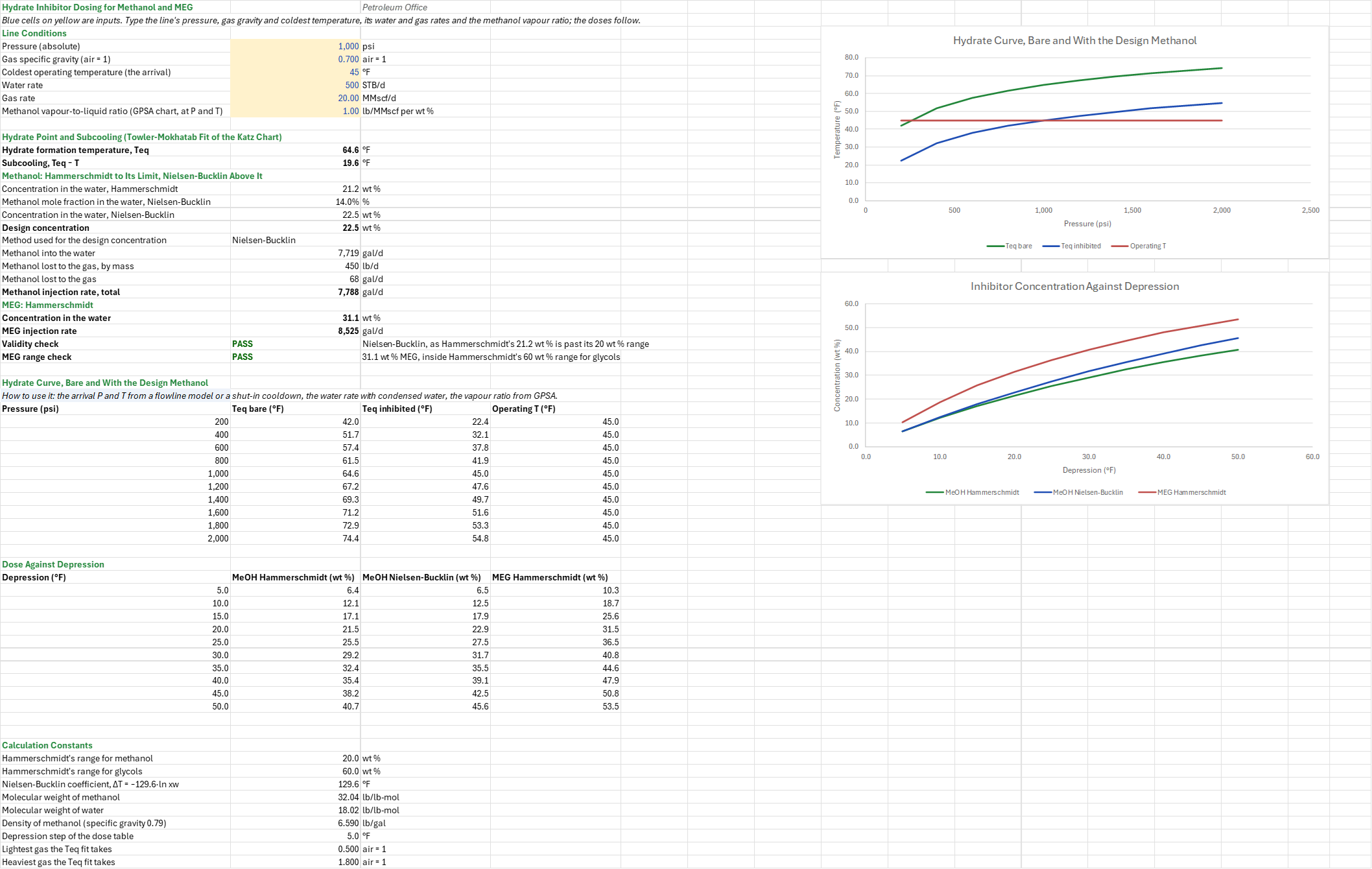
How much methanol or MEG keeps a gas line out of hydrates at its coldest point? You enter the line pressure, the gas gravity, the coldest operating temperature, the water and gas rates, and the methanol vapour ratio. You read off the hydrate point, the subcooling, the methanol concentration and injection rate including what the gas carries off, and the MEG concentration and rate. With no subcooling the doses are zero.
Parameters:
- Line: the absolute pressure
HIN_P, the gas gravityHIN_SGand the coldest operating temperatureHIN_Top(the arrival, or the cooled-down line after a shut-in) - Rates: the water rate
HIN_Qwin bbl/d and the gas rateHIN_Qgin MMscf/d - Methanol vapour ratio
HIN_Ratio: the pounds of methanol each MMscf of gas carries per weight percent of methanol in the water, read from GPSA's chart at the line's pressure and temperature
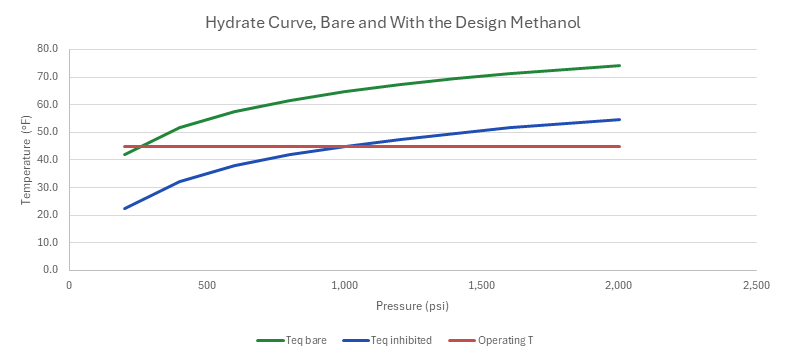
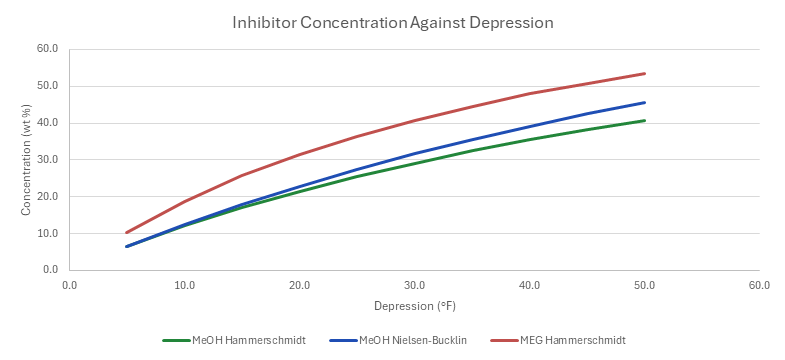
How to use it: Take the arrival pressure and temperature from the flowline model, or the cooled-down temperature for a shut-in; include the condensed water in the water rate; and read the vapour ratio from GPSA's chart at those conditions. To dose with a design margin, lower the operating temperature by it. The sheet doses methanol by Hammerschmidt while that stays inside its range and by Nielsen-Bucklin past it, adds the methanol the gas carries off, and doses MEG by Hammerschmidt. Two charts show the hydrate curve with and without the design methanol against the operating temperature, and the concentration each method asks for as the depression grows.
Method: The hydrate point is Towler and Mokhatab's (2005) fit of the Katz gas-gravity chart: T = 13.47·ln p + 34.27·ln γ − 1.675·ln p·ln γ − 20.35, p in psia and T in °F. The subcooling is Teq − T, the depression the inhibitor must give. Hammerschmidt (1939), ΔT = K·W/(M·(100 − W)), gives the methanol (K = 2,335, M = 32.04) and MEG (K = 2,700, M = 62.07) weight percent in the water. Past 20 wt % of methanol the sheet takes Nielsen and Bucklin's (1983) ΔT = −129.6·ln xw instead, xw being the water's mole fraction in the inhibited water, and turns the methanol's mole fraction back into a weight percent. The design concentration sets the methanol that goes into the water, with methanol's gravity taken as 0.79. The methanol lost to the gas is the vapour ratio times the design weight percent times the gas rate, in lb/d, and 6.59 lb/gal turns it into gallons. MEG's rate is the MEG injection rate at its concentration; its loss to the gas is negligible.
Example: The default case is the flow-assurance family's reference flowline at its arrival: a 6-in subsea tieback at 1,000 psia carrying 20 MMscf/d of a 0.7 gravity gas with 3 % CO2 and 500 ppm H2S, 1,000 STB/d of the reference black oil and 500 bbl/d of water, entering at 150 °F and arriving at 45 °F. The CO2 corrosion, erosional velocity and integrated screen sheets start from the same line. The vapour ratio of 1.0 is the sheet's round value for about 1,000 psia and 45 °F.
At 1,000 psia the 0.7 gravity gas forms hydrates below 64.6 °F, so at 45 °F the line is 19.6 °F subcooled. Hammerschmidt asks 21.2 wt % methanol, just past its 20 wt % range, so the sheet takes Nielsen-Bucklin's 22.5 wt % (a methanol mole fraction of 0.140). That is 7,719 gal/d into the 500 bbl/d of water and 68 gal/d (450 lb/d) carried off by the 20 MMscf/d of gas, 7,788 gal/d in all. MEG needs 31.1 wt %, 8,525 gal/d.
Functions used
PO.FA.Hydrate.TeqCalculates the hydrate formation temperature of a sweet gas with free water from its gravity (Towler-Mokhatab 2005 fit of the Katz chart; no N2, CO2, H2S or inhibitor correction). At 1,000 psia, gravity 0.8: 67.6 degF vs 66 degF on Ahmed's chart, [degF].PO.FA.Hydrate.dTsubCalculates subcooling (hydrate formation temp minus operating temp), [deltaF].PO.FA.Hydrate.Conc.MeOHCalculates required methanol concentration for target temperature depression, by weight, [%].PO.FA.Hydrate.Qinj.MeOHCalculates methanol injection rate required, [gal/day].PO.FA.Hydrate.Conc.MEGCalculates required MEG concentration for target temperature depression, by weight, [%].PO.FA.Hydrate.Qinj.MEGCalculates MEG injection rate required, [gal/day].
Names it defines (36)
| Name | Refers to | Comment |
|---|---|---|
HIN_P |
$B$4 |
Pressure (absolute), psi |
HIN_SG |
$B$5 |
Gas specific gravity (air = 1), air = 1 |
HIN_Top |
$B$6 |
Coldest operating temperature (the arrival), °F |
HIN_Qw |
$B$7 |
Water rate, STB/d |
HIN_Qg |
$B$8 |
Gas rate, MMscf/d |
HIN_Ratio |
$B$9 |
Methanol vapour-to-liquid ratio (GPSA chart, at P and T), lb/MMscf per wt % |
HIN_Inputs |
$B$4:$B$9 |
The pressure, the gas's gravity, the coldest operating temperature, the water and gas rates, and the methanol vapour-to-liquid ratio read at the line's pressure and temperature |
HIN_Teq |
$B$12 |
Hydrate formation temperature, Teq, °F |
HIN_dTsub |
$B$13 |
Subcooling, Teq − T, °F |
HIN_MeOH |
$B$15 |
Concentration in the water, Hammerschmidt, wt % |
HIN_xMeOH |
$B$16 |
Methanol mole fraction in the water, Nielsen-Bucklin, % |
HIN_MeOHNB |
$B$17 |
Concentration in the water, Nielsen-Bucklin, wt % |
HIN_MeOHDesign |
$B$18 |
Design concentration, wt % |
HIN_Method |
$B$19 |
Method used for the design concentration |
HIN_MeOHRate |
$B$20 |
Methanol into the water, gal/d |
HIN_MeOHVapMass |
$B$21 |
Methanol lost to the gas, by mass, lb/d |
HIN_MeOHVap |
$B$22 |
Methanol lost to the gas, gal/d |
HIN_MeOHTotal |
$B$23 |
Methanol injection rate, total, gal/d |
HIN_MEG |
$B$25 |
Concentration in the water, wt % |
HIN_MEGRate |
$B$26 |
MEG injection rate, gal/d |
HIN_Check |
$B$27 |
Validity check verdict |
HIN_CheckNote |
$C$27 |
Validity check comment |
HIN_MEGCheck |
$B$28 |
MEG range check verdict |
HIN_MEGCheckNote |
$C$28 |
MEG range check comment |
HIN_Results |
$B$12:$B$28 |
The hydrate point and subcooling, the methanol concentration by Hammerschmidt and Nielsen-Bucklin, the design concentration and its method, the methanol into the water and lost to the gas, the MEG concentration and rate, and the two checks |
HIN_Curve |
$A$33:$D$42 |
Pressure from a fifth of the line's to twice it, and the hydrate temperature with no inhibitor and with the design methanol, against the operating temperature |
HIN_Profile |
$A$46:$D$55 |
Hydrate depression in steps, and the methanol and MEG concentrations that give it by Hammerschmidt and Nielsen-Bucklin |
HIN_HamMax |
$B$59 |
Hammerschmidt's range for methanol, wt % |
HIN_MEGMax |
$B$60 |
Hammerschmidt's range for glycols, wt % |
HIN_NB |
$B$61 |
Nielsen-Bucklin coefficient, ΔT = −129.6·ln xw, °F |
HIN_MwMeOH |
$B$62 |
Molecular weight of methanol, lb/lb-mol |
HIN_MwW |
$B$63 |
Molecular weight of water, lb/lb-mol |
HIN_RhoMeOH |
$B$64 |
Density of methanol (specific gravity 0.79), lb/gal |
HIN_Step |
$B$65 |
Depression step of the dose table, °F |
HIN_SGMin |
$B$66 |
Lightest gas the Teq fit takes, air = 1 |
HIN_SGMax |
$B$67 |
Heaviest gas the Teq fit takes, air = 1 |
Details
| Inserts | 67 rows × 4 columns |
| Category | Flow Assurance |
| For agents and tools | Descriptor (.md) |
| Tags | hydrate · methanol · MEG · inhibitor · flow-assurance · Hammerschmidt · Nielsen-Bucklin · Towler-Mokhatab · vapour-loss |
Need a custom calculation? Request a blueprint