Erosional Velocity of a Multiphase Line (API RP 14E)
Checks whether a multiphase line flows faster than the API RP 14E erosional velocity and gives the smallest bore that stays below it.
Flow Assurance 69 rows × 6 columns
Use this blueprint
How to use this blueprint
- In Excel, go to the Petroleum Office ribbon tab and click Blueprint Manager
- Search for Erosional Velocity of a Multiphase Line (API RP 14E)
- Click on the blueprint to preview
- Click Insert to place it into your worksheet. Modify the input values to match your data.
Requires the Petroleum Office add-in for Excel.
Description
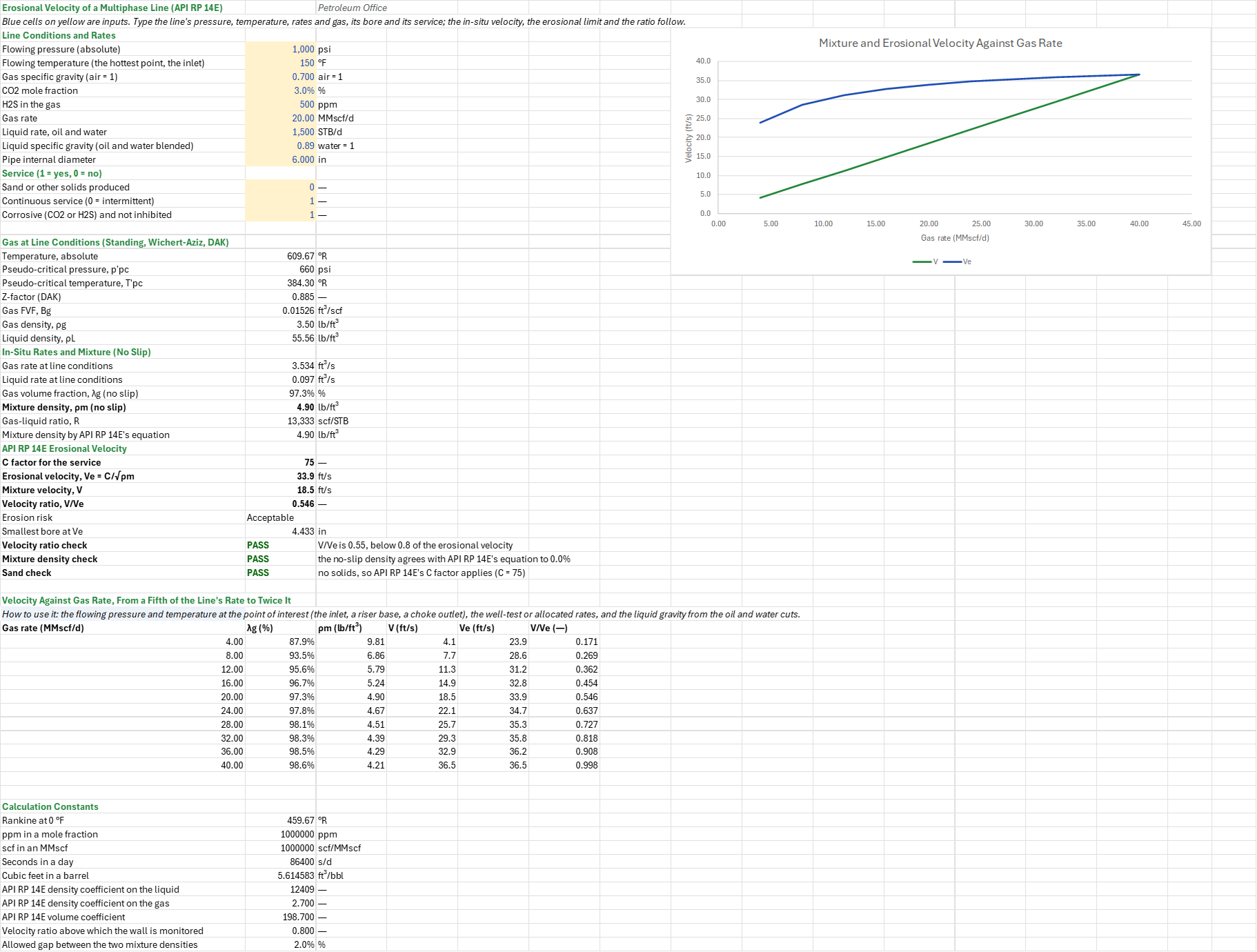
Is a multiphase line flowing too fast? You enter the line's flowing pressure, temperature and bore, the gas's gravity, CO2 and H2S, the gas and liquid rates, the liquid's gravity, and whether the service has sand, is continuous and is corrosive. You read off the no-slip mixture density and velocity, API RP 14E's erosional velocity for the service's C factor, the velocity ratio and its risk class, and the smallest bore that keeps the line below the erosional velocity.
Parameters:
- Line: the flowing absolute pressure
ERO_Pand temperatureERO_Tat the point of interest, and the boreERO_ID - Gas: the gravity
ERO_SG, the CO2 mole fractionERO_CO2and the H2SERO_H2Sin ppm, and the gas rateERO_Qgin MMscf/d - Liquid: the oil-and-water rate
ERO_QLin bbl/d and its blended specific gravityERO_SGL - Service (1 = yes, 0 = no): sand or other solids
ERO_Sand, continuous serviceERO_Cont, and a corrosive (CO2 or H2S) fluid without inhibitionERO_Corr
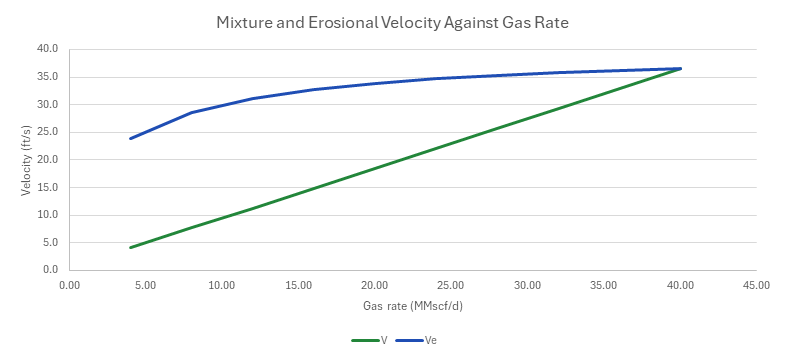
How to use it: Take the flowing pressure and temperature at the point being checked (the inlet, a riser base, a choke outlet), the well-test or allocated rates, and the liquid gravity from the oil and water cuts; say whether the wells make sand. Read the velocity ratio against 0.8 and 1: below 0.8 passes, from 0.8 to 1 means monitoring the wall at bends and tees, and 1 or more needs a larger bore or a lower rate. The sheet also checks the no-slip mixture density against API RP 14E's own equation, and warns when the wells make sand. A table and a chart show the mixture and erosional velocities as the gas rate runs from a fifth of the line's to twice it, with the liquid held.
Method: The gas is taken to line conditions as the PVT sheets do: Standing's pseudo-criticals with the Wichert-Aziz correction for the CO2 and H2S, the Dranchuk-Abou-Kassem (DAK) Z, Bg in ft³/scf, and ρg from the gas-density definition, converted from g/cm³ by water's standard density. The in-situ rates are Qg·10⁶·Bg/86,400 and QL·5.6146/86,400 ft³/s, the no-slip gas fraction is λg = Qg/(Qg + QL), and ρm = ρL·(1 − λg) + ρg·λg. API RP 14E writes the same density as ρm = (12,409·S1·P + 2.7·R·S·P)/(198.7·P + R·T·Z), R the gas-liquid ratio in scf/bbl, which the sheet computes as a check. The C factor is 100 for clean continuous service, 75 with solids, 25 more for intermittent service and 25 less for a corrosive fluid. The erosional velocity is Ve = C/√ρm, the mixture velocity V = (Qg + QL)/A, then the ratio V/Ve and its class, and the smallest bore at Ve.
Example: The default case is the flow-assurance family's reference flowline at its inlet, where it is hottest and fastest: a 6-in subsea tieback at 1,000 psia carrying 20 MMscf/d of a 0.7 gravity gas with 3 % CO2 and 500 ppm H2S, 1,000 STB/d of the reference black oil and 500 bbl/d of water, entering at 150 °F and arriving at 45 °F. The liquid's 0.89 gravity is the volume blend of the 40.7 °API oil and a 1.03 brine. The hydrate, CO2 corrosion and integrated screen sheets start from the same line.
At 1,000 psia and 150 °F the gas's p′pc and T′pc are 660.4 psia and 384.3 °R, Z = 0.8854, Bg = 0.01527 ft³/scf and ρg = 3.50 lb/ft³. The 20 MMscf/d is 3.53 ft³/s in the line and the 1,500 bbl/d of liquid 0.097 ft³/s, so λg = 97.3 % and ρm = 4.90 lb/ft³; API RP 14E's equation gives 4.90 too (0.01 % apart). The corrosive, solids-free continuous service takes C = 75, so Ve = 33.9 ft/s. The mixture moves at 18.5 ft/s, a ratio of 0.55, "Acceptable"; a 4.43-in bore would be the smallest at Ve. The chart puts the limit at about 40 MMscf/d in this line.
Functions used
PO.PVT.Ppc.ByStanding.SourCalculates pseudo-critical pressure of sour gas using Standing correlation with Wichert-Aziz correction, [psi].PO.PVT.Tpc.ByStanding.SourCalculates pseudo-critical temperature of sour gas using Standing correlation with Wichert-Aziz correction, [degR].PO.PVT.Z.ByDAKCalculates gas compressibility factor (Z) using Dranchuk and Abou-Kassem (1975) equation of state, [dimensionless].PO.PVT.Bg.ByDefinitionCalculates gas formation volume factor, [rcf/scf].PO.PVT.Rho.Gas.ByDefinitionCalculates gas density, [g/cm3].PO.PVT.Rho.Wat.StnWater density at standard conditions, [lb/ft3].PO.FA.Erosion.RhoMixCalculates gas-liquid mixture density, [lb/ft3].PO.FA.Erosion.CFactorReturns recommended C factor based on service conditions, [dimensionless].PO.FA.Erosion.VeCalculates erosional velocity limit using API RP 14E, [ft/s].PO.FA.Erosion.VmixCalculates mixture velocity in pipe, [ft/s].PO.FA.Erosion.RatioCalculates erosion ratio (V/Ve). Values >1.0 indicate erosion risk, [dimensionless].PO.FA.Erosion.RiskReturns erosion risk classification (Low/Medium/High/Critical).PO.FA.Erosion.DminCalculates minimum pipe diameter to avoid erosion, [in].
Names it defines (50)
| Name | Refers to | Comment |
|---|---|---|
ERO_P |
$B$4 |
Flowing pressure (absolute), psi |
ERO_T |
$B$5 |
Flowing temperature (the hottest point, the inlet), °F |
ERO_SG |
$B$6 |
Gas specific gravity (air = 1), air = 1 |
ERO_CO2 |
$B$7 |
CO2 mole fraction, % |
ERO_H2S |
$B$8 |
H2S in the gas, ppm |
ERO_Qg |
$B$9 |
Gas rate, MMscf/d |
ERO_QL |
$B$10 |
Liquid rate, oil and water, STB/d |
ERO_SGL |
$B$11 |
Liquid specific gravity (oil and water blended), water = 1 |
ERO_ID |
$B$12 |
Pipe internal diameter, in |
ERO_Sand |
$B$14 |
Sand or other solids produced |
ERO_Cont |
$B$15 |
Continuous service (0 = intermittent) |
ERO_Corr |
$B$16 |
Corrosive (CO2 or H2S) and not inhibited |
ERO_Inputs |
$B$4:$B$16 |
The flowing pressure and temperature, the gas's gravity, CO2 and H2S, the gas and liquid rates and the liquid's gravity, the pipe's bore, and whether the service has sand, is continuous and is corrosive |
ERO_TR |
$B$19 |
Temperature, absolute, °R |
ERO_Ppc |
$B$20 |
Pseudo-critical pressure, p′pc, psi |
ERO_Tpc |
$B$21 |
Pseudo-critical temperature, T′pc, °R |
ERO_Z |
$B$22 |
Z-factor (DAK) |
ERO_Bg |
$B$23 |
Gas FVF, Bg, ft³/scf |
ERO_RhoG |
$B$24 |
Gas density, ρg, lb/ft³ |
ERO_RhoL |
$B$25 |
Liquid density, ρL, lb/ft³ |
ERO_QgIs |
$B$27 |
Gas rate at line conditions, ft³/s |
ERO_QLIs |
$B$28 |
Liquid rate at line conditions, ft³/s |
ERO_Lambda |
$B$29 |
Gas volume fraction, λg (no slip), % |
ERO_RhoM |
$B$30 |
Mixture density, ρm (no slip), lb/ft³ |
ERO_GLR |
$B$31 |
Gas-liquid ratio, R, scf/STB |
ERO_RhoM14E |
$B$32 |
Mixture density by API RP 14E's equation, lb/ft³ |
ERO_C |
$B$34 |
C factor for the service |
ERO_Ve |
$B$35 |
Erosional velocity, Ve = C/√ρm, ft/s |
ERO_V |
$B$36 |
Mixture velocity, V, ft/s |
ERO_Ratio |
$B$37 |
Velocity ratio, V/Ve |
ERO_Risk |
$B$38 |
Erosion risk |
ERO_Dmin |
$B$39 |
Smallest bore at Ve, in |
ERO_RatioCheck |
$B$40 |
Velocity ratio check verdict |
ERO_RatioCheckNote |
$C$40 |
Velocity ratio check comment |
ERO_DensityCheck |
$B$41 |
Mixture density check verdict |
ERO_DensityCheckNote |
$C$41 |
Mixture density check comment |
ERO_SandCheck |
$B$42 |
Sand check verdict |
ERO_SandCheckNote |
$C$42 |
Sand check comment |
ERO_Results |
$B$19:$B$42 |
The gas at line conditions, the in-situ rates and mixture density by both routes, the C factor, the erosional and mixture velocities, their ratio, the risk class, the smallest bore and the three checks |
ERO_Curve |
$A$47:$F$56 |
Gas rate from a fifth of the line's rate to twice it, with the liquid held, and the gas fraction, mixture density, mixture and erosional velocities and their ratio at each |
ERO_R0 |
$B$60 |
Rankine at 0 °F, °R |
ERO_Ppm |
$B$61 |
ppm in a mole fraction, ppm |
ERO_Scf |
$B$62 |
scf in an MMscf, scf/MMscf |
ERO_Sec |
$B$63 |
Seconds in a day, s/d |
ERO_Ft3Bbl |
$B$64 |
Cubic feet in a barrel, ft³/bbl |
ERO_A14E |
$B$65 |
API RP 14E density coefficient on the liquid |
ERO_B14E |
$B$66 |
API RP 14E density coefficient on the gas |
ERO_C14E |
$B$67 |
API RP 14E volume coefficient |
ERO_Watch |
$B$68 |
Velocity ratio above which the wall is monitored |
ERO_Tol |
$B$69 |
Allowed gap between the two mixture densities, % |
Details
| Inserts | 69 rows × 6 columns |
| Category | Flow Assurance |
| For agents and tools | Descriptor (.md) |
| Tags | erosion · API-14E · erosional-velocity · velocity · flow-assurance · pipe-sizing · multiphase · sand |
Need a custom calculation? Request a blueprint