CO2 Corrosion and Material Selection
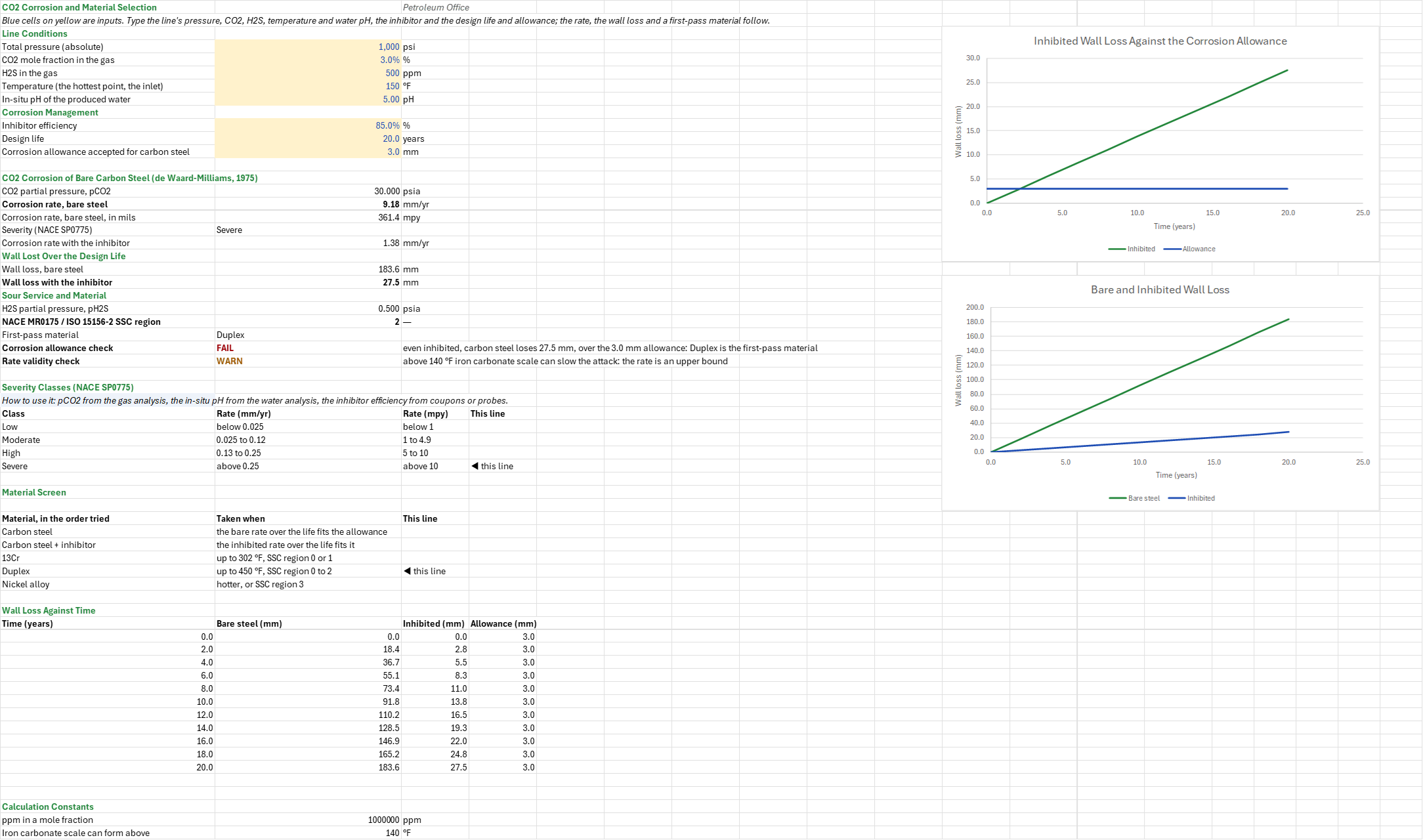
Estimates CO2 corrosion rate and wall loss over the design life with and without inhibitor, places the line in a sour region and picks a material.
Flow Assurance 64 rows × 4 columnsMicrosoft 365
Use this blueprint
How to use this blueprint
- In Excel, go to the Petroleum Office ribbon tab and click Blueprint Manager
- Search for CO2 Corrosion and Material Selection
- Click on the blueprint to preview
- Click Insert to place it into your worksheet. Modify the input values to match your data.
Requires the Petroleum Office add-in for Excel. Needs Microsoft 365 or Excel 2024: it uses functions Excel 2016 doesn't have (LAMBDA and LET), which show #NAME? there.
Description
How fast does CO2 corrode a carbon-steel line, how much wall does it take over the design life with and without an inhibitor, how sour is the line, and which material would a first pass choose? You enter the pressure, the CO2 and H2S in the gas, the hottest temperature, the water's in-situ pH, the inhibitor efficiency, the design life and the corrosion allowance. You read off the bare and inhibited rates, the severity, the wall lost against the allowance, the sour region and the material.
Parameters:
- Line: the total absolute pressure
COR_P, the CO2 mole fractionCOR_yCO2, the H2SCOR_H2Sin ppm, the temperature at the hottest pointCOR_Tand the water's in-situ pHCOR_pH - Corrosion management: the inhibitor efficiency
COR_Eff, the design lifeCOR_Lifein years and the corrosion allowanceCOR_CAmaxin mm accepted for carbon steel
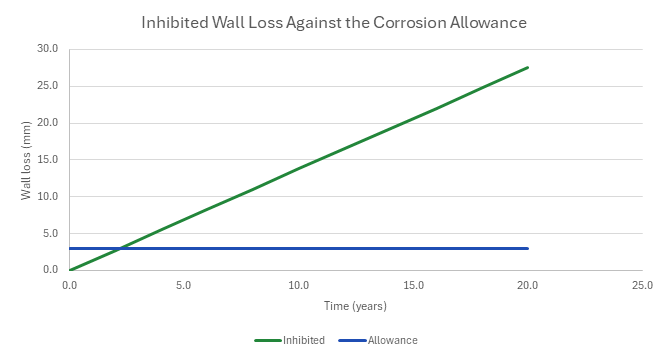
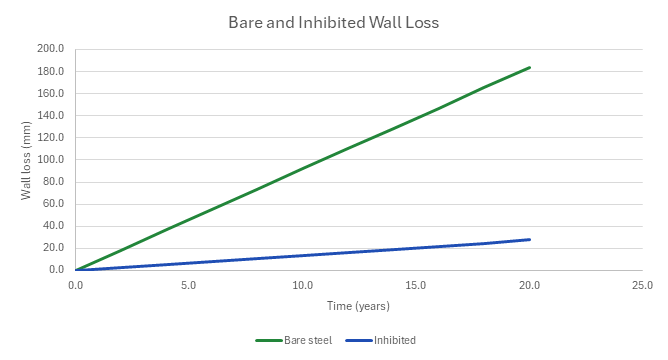
How to use it: Take pCO2 from the gas analysis at the operating pressure, the in-situ pH from the water analysis at line conditions (ISO 15156-2 Annex D shows how), and the inhibitor efficiency the field's coupons or probes demonstrate. Use the temperature at the hottest point, the inlet. Read the allowance check, the sour region and the material the screen chooses. A table marks the line's NACE SP0775 severity class, another the material, and two charts show the wall loss against time.
Method: The sheet computes the de Waard-Milliams rate of bare steel, its NACE SP0775 severity, the inhibited rate, and the wall lost over the life against the corrosion allowance; it takes the H2S partial pressure to the NACE MR0175 / ISO 15156-2 region at the water's in-situ pH, and screens carbon steel, inhibited carbon steel, 13Cr, duplex and a nickel alloy in that order.
- CO2 rate: pCO2 = y·P. The de Waard-Milliams (1975) rate of bare carbon steel is log₁₀ CR = 5.8 − 1,710/T + 0.67·log₁₀ pCO2, T in K and pCO2 in bar, in mm/yr, shown in mpy too. NACE SP0775 classes it: low below 0.025 mm/yr, moderate to 0.12, high to 0.25, severe above.
- Inhibitor and wall loss: the inhibited rate is CR·(1 − efficiency), and the wall lost is the rate times the life.
- Sour region: pH2S = y·P, and the sulfide stress cracking (SSC) region is read from ISO 15156-2 Figure 1.
- Material: the screen takes carbon steel when its bare loss fits the allowance, inhibited carbon steel when its inhibited loss does, else 13Cr up to 302 °F in regions 0 and 1, duplex up to 450 °F up to region 2, and a nickel alloy beyond.
Example: The default case is the flow-assurance family's reference flowline at its inlet: a 6-in subsea tieback at 1,000 psia carrying 20 MMscf/d of a 0.7 gravity gas with 3 % CO2 and 500 ppm H2S, 1,000 STB/d of the reference black oil and 500 bbl/d of water, entering at 150 °F and arriving at 45 °F, with water at pH 5.0. The hydrate, erosion and integrated sheets start from the same line. The 85 % inhibitor, the 20-year life and NORSOK M-001's normal 3 mm allowance are the sheet's choices.
3 % CO2 at 1,000 psia is 30 psia of CO2 (2.07 bar). At 150 °F (338.7 K) de Waard-Milliams gives 9.18 mm/yr (361 mpy), severe. An 85 % efficient inhibitor brings it to 1.38 mm/yr, but over 20 years that is still 27.5 mm of wall, against 184 mm bare and a 3 mm allowance, so the allowance check fails. 500 ppm H2S is 0.50 psia of H2S, region 2 at pH 5.0 (just below the region 1 line, pH 5.04 at that pressure), so 13Cr, allowed only in regions 0 and 1, is passed over and the screen chooses duplex. The line is above 140 °F, where iron carbonate scale can slow the attack, so the rate is flagged as an upper bound.
Functions used
PO.FA.Corrosion.Pp.CO2Calculates CO2 partial pressure from total pressure and mole fraction, [psi].PO.FA.Corrosion.CR.CO2Calculates CO2 corrosion rate using de Waard-Milliams correlation, [mm/yr].PO.UnitConverterConverts value from one unit to another.PO.FA.Corrosion.SeverityReturns corrosion severity classification (Low/Medium/High/Severe).PO.FA.Corrosion.CR.InhCalculates inhibited corrosion rate, [mm/yr].PO.FA.Corrosion.CACalculates required corrosion allowance, [mm].
Names it defines (32)
| Name | Refers to | Comment |
|---|---|---|
PO.HSE.Sour.PartialPressure |
=LAMBDA(y_h2s, p, IF(OR(y_h2s<0, y_h2s>1, p<0), NA(), y_h2s*p)) |
H2S partial pressure in a gas, pH2S = y·P (ISO 15156-2 Annex C), in the unit of the total absolute pressure given: psia in, psia out. |
PO.FA.Corrosion.H2S.Region |
=LAMBDA(p_h2s, ph, IF(OR(p_h2s<0, ph<0, ph>14), NA(), IF(p_h2s<0.05, 0, LET(kpa, p_h2s*6.894757, lg, LOG10(kpa), severe, IF(kpa<1, 3.5, IF(kpa<=100, 3.5+lg, 5.5)), mild, IF(kpa<=100, 4.5+lg, 6.5), IF(ph<severe, 3, IF(ph<mild, 2, 1)))))) |
NACE MR0175 / ISO 15156-2 Figure 1 SSC severity region of carbon and low-alloy steel, 0 to 3, from the H2S partial pressure (psia) and the in-situ pH. |
PO.CO.Mat.CO2Material |
=LAMBDA(cr, cr_inh, t, region, life, ca_max, IF(OR(cr<0, cr_inh<0, cr_inh>cr, life<=0, ca_max<0, region<0, region>3), NA(), IF(cr*life<=ca_max, "Carbon steel", IF(cr_inh*life<=ca_max, "Carbon steel + inhibitor", IF(AND(t<=302, region<=1), "13Cr", IF(AND(t<=450, region<=2), "Duplex", "Nickel alloy")))))) |
First-pass CO2-service material: "Carbon steel", "Carbon steel + inhibitor", "13Cr", "Duplex" or "Nickel alloy", from the bare and inhibited rates (mm/yr), T (degF), the ISO 15156-2 region, the life (years) and the allowance (mm). |
COR_P |
$B$4 |
Total pressure (absolute), psi |
COR_yCO2 |
$B$5 |
CO2 mole fraction in the gas, % |
COR_H2S |
$B$6 |
H2S in the gas, ppm |
COR_T |
$B$7 |
Temperature (the hottest point, the inlet), °F |
COR_pH |
$B$8 |
In-situ pH of the produced water, pH |
COR_Eff |
$B$10 |
Inhibitor efficiency, % |
COR_Life |
$B$11 |
Design life, years |
COR_CAmax |
$B$12 |
Corrosion allowance accepted for carbon steel, mm |
COR_Inputs |
$B$4:$B$12 |
The total pressure, the gas's CO2 and H2S, the temperature and the water's in-situ pH, the inhibitor's efficiency, the design life and the corrosion allowance |
COR_PpCO2 |
$B$15 |
CO2 partial pressure, pCO2, psia |
COR_CR |
$B$16 |
Corrosion rate, bare steel, mm/yr |
COR_CRmpy |
$B$17 |
Corrosion rate, bare steel, in mils, mpy |
COR_Severity |
$B$18 |
Severity (NACE SP0775) |
COR_CRInh |
$B$19 |
Corrosion rate with the inhibitor, mm/yr |
COR_CA |
$B$21 |
Wall loss, bare steel, mm |
COR_CAInh |
$B$22 |
Wall loss with the inhibitor, mm |
COR_PpH2S |
$B$24 |
H2S partial pressure, pH2S, psia |
COR_Region |
$B$25 |
NACE MR0175 / ISO 15156-2 SSC region |
COR_Material |
$B$26 |
First-pass material |
COR_CACheck |
$B$27 |
Corrosion allowance check verdict |
COR_CACheckNote |
$C$27 |
Corrosion allowance check comment |
COR_RateCheck |
$B$28 |
Rate validity check verdict |
COR_RateCheckNote |
$C$28 |
Rate validity check comment |
COR_Results |
$B$15:$B$28 |
The CO2 partial pressure, the bare and inhibited rates and the severity, the wall lost over the life both ways, the H2S partial pressure, the SSC region, the first-pass material and the two checks |
COR_SeverityClasses |
$A$33:$D$36 |
NACE SP0775's four classes of a general corrosion rate, in mm/yr and mpy, with this line's marked |
COR_MaterialScreen |
$A$41:$C$45 |
The five materials the screen tries in turn, when each is taken, and this line's |
COR_Curve |
$A$49:$D$59 |
Time from 0 to the design life in tenths, and the wall bare and inhibited carbon steel lose by then, against the allowance |
COR_Ppm |
$B$63 |
ppm in a mole fraction, ppm |
COR_TScale |
$B$64 |
Iron carbonate scale can form above, °F |
Details
| Inserts | 64 rows × 4 columns |
| Category | Flow Assurance |
| For agents and tools | Descriptor (.md) |
| Tags | corrosion · CO2 · de-Waard · flow-assurance · carbon-steel · corrosion-allowance · NACE · sour-service · material-selection |
Need a custom calculation? Request a blueprint