ESP Cable Sizing and Voltage Drop
Sizes an ESP power cable by voltage drop and power loss at temperature and gives the surface voltage the transformer must supply.
Electric Submersible Pump 36 rows × 7 columns
Use this blueprint
How to use this blueprint
- In Excel, go to the Petroleum Office ribbon tab and click Blueprint Manager
- Search for ESP Cable Sizing and Voltage Drop
- Click on the blueprint to preview
- Click Insert to place it into your worksheet. Modify the input values to match your data.
Requires the Petroleum Office add-in for Excel.
Description
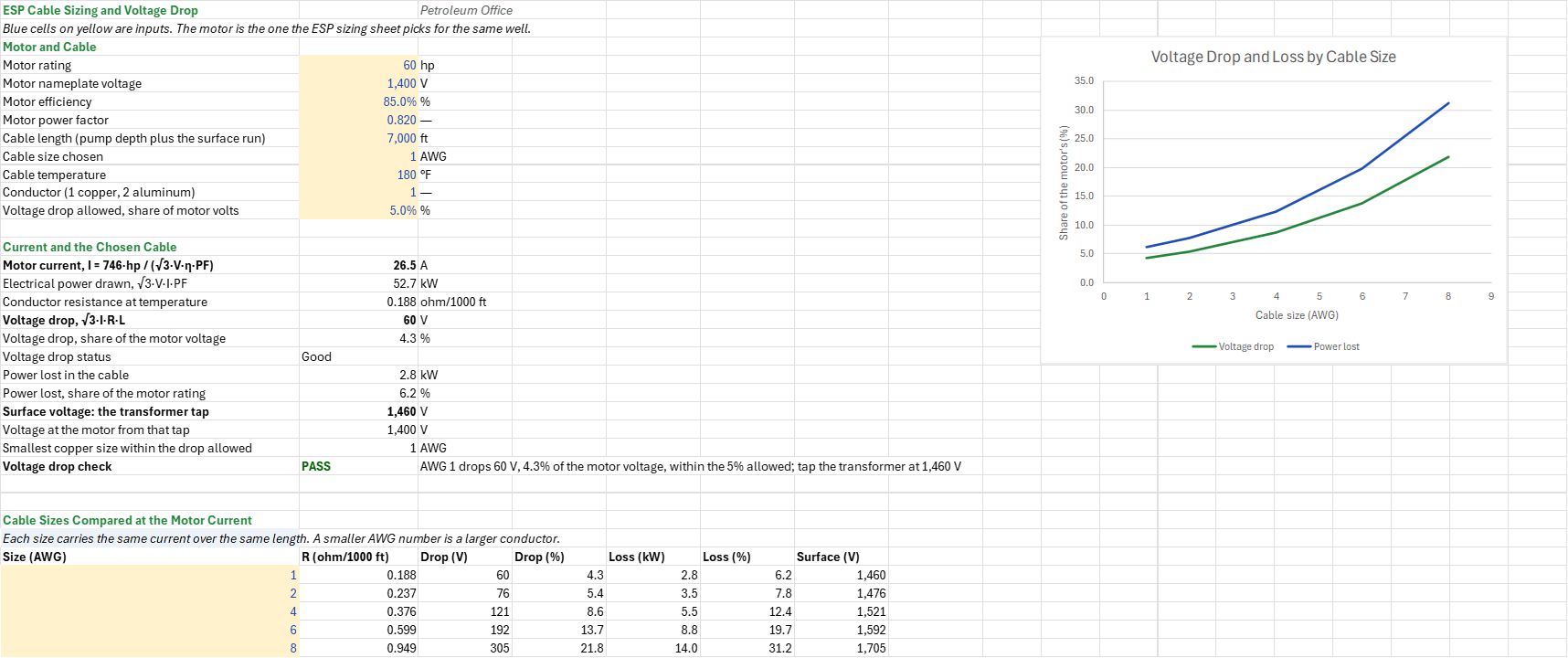
What size of power cable does an ESP need, and what voltage must the transformer supply? You enter the motor's rating, nameplate voltage, efficiency and power factor, the cable's length, size, temperature and metal, and the voltage drop allowed. You read off the motor current, the cable's voltage drop and power loss at temperature, the surface voltage to tap the transformer at, and the smallest copper size that keeps the drop within the limit.
Parameters:
- Motor: rating, nameplate voltage, efficiency and power factor (
CA_HP,CA_V,CA_MotorEff,CA_PF) - Cable: length (
CA_L), the size chosen (CA_AWG), the conductor temperature (CA_T) and the metal (CA_Material, 1 copper or 2 aluminum) - Limit: the voltage drop allowed, as a share of the motor voltage (
CA_MaxDrop)
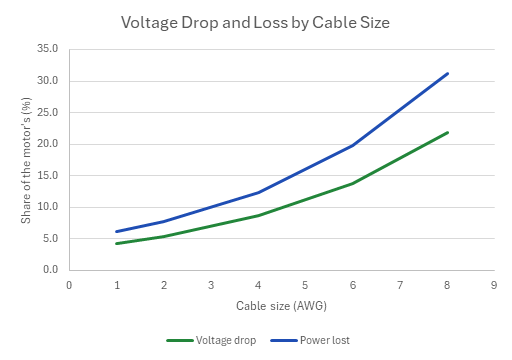
How to use it: Type the motor's nameplate data and the cable run (pump depth plus the surface run to the junction box). The conductor temperature is the well temperature at the motor or higher; a hot well raises the resistance. Read the check: it passes when the chosen size's drop is within the limit, and otherwise names the smallest size that meets it. A table compares AWG 1 to 8 at the same current and length, and a chart draws the drop and the loss against the size.
Method: The motor current is I = 746·hp/(√3·V·η·PF), so it follows the motor rather than being typed in, and the electrical power drawn is √3·V·I·PF. The conductor resistance at temperature comes from the cable resistance table for the size and metal. The three-phase voltage drop is √3·I·R·L and the loss is 3·I²·R·L, each also as a share of the motor's voltage or rating. The transformer tap is the motor voltage plus the drop, and the voltage at the motor from that tap is the tap less the drop. The smallest copper size is the first whose drop stays within the limit. The check passes when the chosen size's drop is within it.
Example: The motor is the one the ESP Sizing and Operating Point sheet picks for the same well: 60 hp at 1,400 V, 85 % efficient with a power factor of 0.82. The current is 746·60/(√3·1,400·0.85·0.82) = 26.5 A, drawing 52.7 kW. Over 7,000 ft of AWG 1 copper at 180 °F (0.188 ohm/1000 ft) the drop is √3·26.5·0.188·7 = 60.3 V. That is 4.3 % of the motor voltage, within the 5 % allowed. The loss is 2.77 kW (6.2 % of the rating), and the transformer is tapped at 1,460 V. The table shows AWG 2 at 5.4 % and AWG 4 at 8.6 %, so AWG 1 is the smallest size that meets the limit.
Functions used
PO.ESP.Motor.AmpsCalculates motor current draw (3-phase), [A].PO.ESP.Motor.PowerKWCalculates motor power consumption (3-phase), [kW].PO.ESP.Cable.ResistanceReturns cable resistance at temperature, [ohm/1000 ft].PO.ESP.Cable.VdropCalculates voltage drop in ESP cable (3-phase), [V].PO.ESP.Cable.Vdrop.PctCalculates voltage drop as percentage, [%].PO.ESP.Cable.Vdrop.StatusReturns voltage drop status.PO.ESP.Cable.PowerLossCalculates power loss in cable, [kW].PO.ESP.Cable.PowerLoss.PctCalculates power loss as percentage of motor power, [%].PO.ESP.Cable.VsurfaceCalculates required surface voltage, [V].PO.ESP.Cable.VmotorCalculates voltage at motor terminals, [V].PO.ESP.Cable.MinSizeDetermines minimum cable size for voltage drop limit, [AWG].
Names it defines (25)
| Name | Refers to | Comment |
|---|---|---|
CA_HP |
$B$4 |
Motor rating, hp |
CA_V |
$B$5 |
Motor nameplate voltage, V |
CA_MotorEff |
$B$6 |
Motor efficiency, % |
CA_PF |
$B$7 |
Motor power factor |
CA_L |
$B$8 |
Cable length (pump depth plus the surface run), ft |
CA_AWG |
$B$9 |
Cable size chosen, AWG |
CA_T |
$B$10 |
Cable temperature, °F |
CA_Material |
$B$11 |
Conductor (1 copper, 2 aluminum) |
CA_MaxDrop |
$B$12 |
Voltage drop allowed, share of motor volts, % |
CA_Inputs |
$B$4:$B$12 |
The motor's electrical data, the cable's length, size, temperature and metal, and the drop allowed |
CA_I |
$B$15 |
Motor current, I = 746·hp / (√3·V·η·PF), A |
CA_kW |
$B$16 |
Electrical power drawn, √3·V·I·PF, kW |
CA_R |
$B$17 |
Conductor resistance at temperature, ohm/1000 ft |
CA_Vdrop |
$B$18 |
Voltage drop, √3·I·R·L, V |
CA_VdropPct |
$B$19 |
Voltage drop, share of the motor voltage, % |
CA_Status |
$B$20 |
Voltage drop status |
CA_Ploss |
$B$21 |
Power lost in the cable, kW |
CA_PlossPct |
$B$22 |
Power lost, share of the motor rating, % |
CA_Vsurf |
$B$23 |
Surface voltage: the transformer tap, V |
CA_Vmotor |
$B$24 |
Voltage at the motor from that tap, V |
CA_MinAWG |
$B$25 |
Smallest copper size within the drop allowed, AWG |
CA_Check |
$B$26 |
Voltage drop check verdict |
CA_CheckNote |
$C$26 |
Voltage drop check comment |
CA_Results |
$B$15:$B$26 |
The current, the cable's resistance, drop and loss, the transformer tap, the smallest size, and the check |
CA_Curve |
$A$32:$F$36 |
Voltage Drop and Loss by Cable Size |
Details
| Inserts | 36 rows × 7 columns |
| Category | Electric Submersible Pump |
| For agents and tools | Descriptor (.md) |
| Tags | ESP · cable · cable-sizing · voltage-drop · awg · electrical · amperage |
Need a custom calculation? Request a blueprint