Scale Tendency by Oddo-Tomson
Description
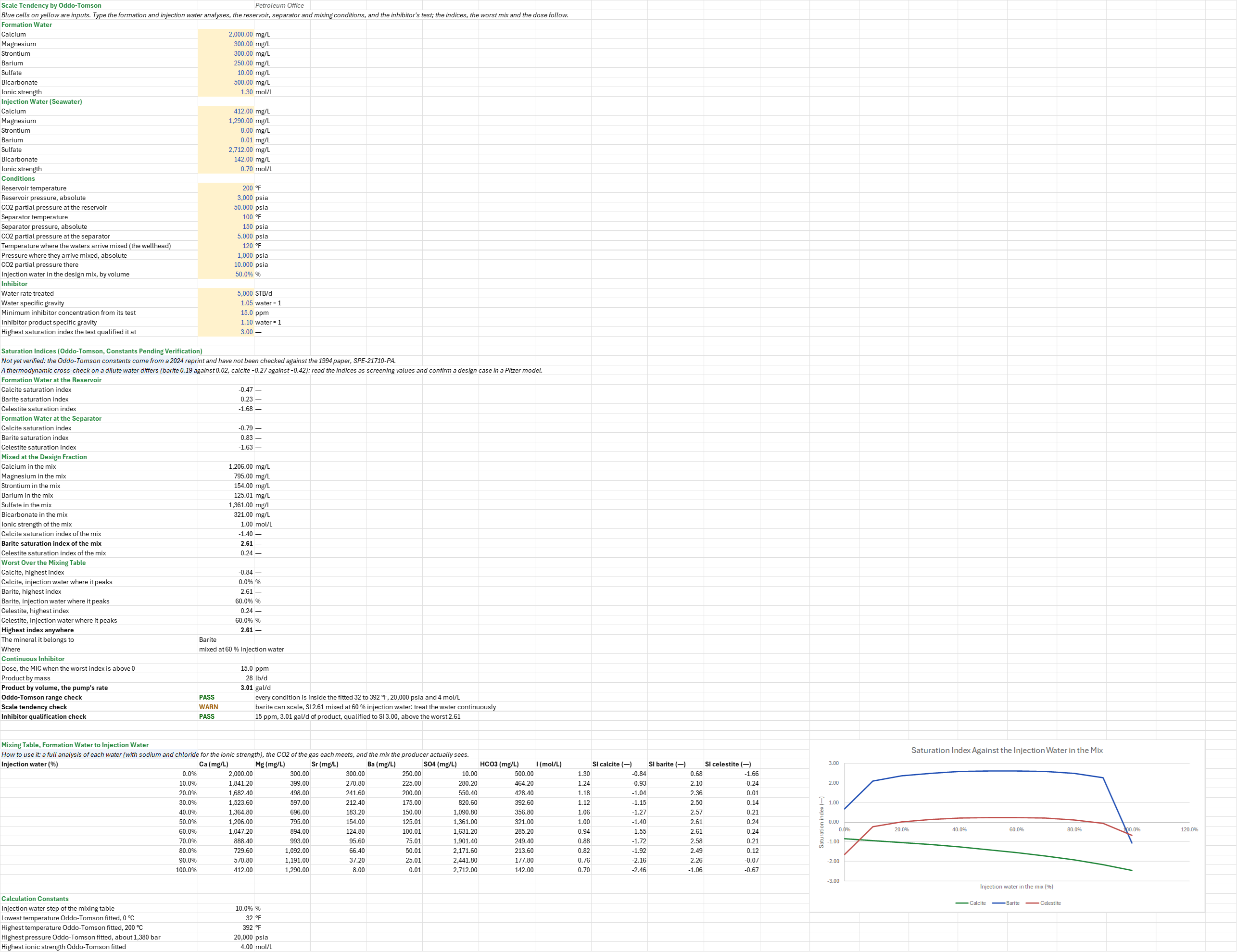
Will a produced water lay down calcite, barite or celestite, where, and what does it take to treat it? You enter the formation and injection waters' analyses, the temperature, pressure and CO2 at the reservoir, the separator and where the waters mix, the design mix, and the inhibitor's test data. You read off Oddo and Tomson's saturation indices at each point and across mixes from 0 to 100 % injection water, the mineral and place that govern, and the continuous inhibitor dose.
Parameters:
- Formation water: calcium
SCT_CaF, magnesiumSCT_MgF, strontiumSCT_SrF, bariumSCT_BaF, sulfateSCT_SO4Fand bicarbonateSCT_HCO3Fin mg/L, and the ionic strengthSCT_IonFin mol/L - Injection water: the same ions
SCT_CaItoSCT_HCO3Iand its ionic strengthSCT_IonI - Conditions: the temperature, pressure and CO2 partial pressure at the reservoir (
SCT_TRes,SCT_PRes,SCT_CO2Res), at the separator (SCT_TSurf,SCT_PSurf,SCT_CO2Surf) and where the waters arrive mixed (SCT_TMix,SCT_PMix,SCT_CO2Mix), and the injection water's share of the design mixSCT_Frac - Inhibitor: the water rate
SCT_Qw, its gravitySCT_SGw, the minimum inhibitor concentrationSCT_MICfrom the inhibitor's test, the product's gravitySCT_SGi, and the highest index the test qualified it atSCT_SIQual
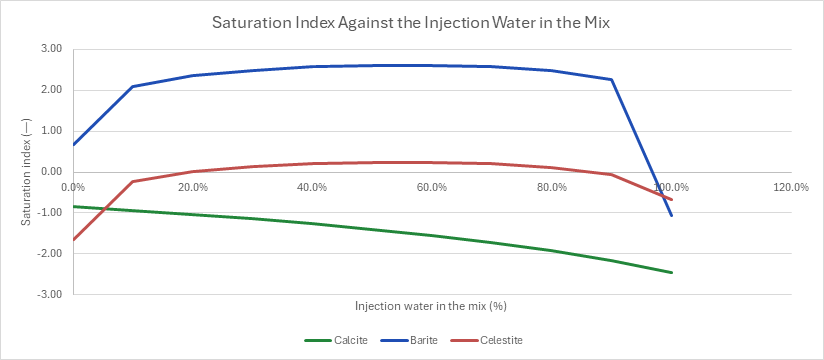
How to use it: Use a full analysis of each water, with sodium, potassium, chloride and the rest, to compute the ionic strength, ½·Σ ci·zi² in mol/L. Take each condition's CO2 partial pressure from the gas the water is in contact with there (the total pressure times the gas's CO2 mole fraction). Set the design mix from the seawater fraction the producer shows, and take the MIC and its index from the inhibitor's qualification test on the worst mix. The highest index anywhere says which mineral governs and where; it gates the dose, and the sheet checks it against the index the inhibitor was qualified at. A chart draws the three indices across the mixing table. A callout above the indices says that the constants have not been checked against Oddo and Tomson's paper (see Validity). The sheet is a scaling screen without a geochemical model.
Method:
- Saturation index. Oddo and Tomson's index is the log of the ion product over a conditional solubility product fitted in temperature (°F), pressure (psia) and ionic strength, so no activity coefficients are needed. Calcite's comes from the bicarbonate and the CO2 partial pressure. Barite's and celestite's use the free sulfate left after the calcium, magnesium, strontium and barium sulfate ion pairs. One call per mineral and condition.
- Mixing. Each ion, and the ionic strength, mixes by volume: c = (1 − f)·cF + f·cI, f the injection water's share and cF, cI the formation and injection waters' values. The design mix is one row of results; the mixing table steps f from 0 to 1 by 0.1, with the indices of each mix at the mixing conditions.
- Worst case. The highest index of each mineral over the table, and the share of injection water where it peaks; the highest index anywhere (reservoir, separator, design mix and table), its mineral, and where it is.
- Dose. The MIC when the worst index is above 0 and nothing when it is not; the product's mass rate is the water's mass rate times the dose, and its volume rate that mass at the product's gravity.
- Checks.
- Oddo-Tomson range: every temperature within 32 to 392 °F, every pressure within 20,000 psia and both ionic strengths within 4 mol/L, the ranges the constants were fitted over.
- Scale tendency: a warning when any index is above 0.
- Inhibitor qualification: the worst index at or under the index the MIC was qualified at.
Example: The default case is the Oddo-Tomson LAMBDA's own worked example: a barium- and strontium-rich formation water (Ca 2,000, Mg 300, Sr 300, Ba 250, SO4 10 and HCO3 500 mg/L, ionic strength 1.3 mol/L) and seawater (Ca 412, Mg 1,290, Sr 8, Ba 0.01, SO4 2,712 and HCO3 142 mg/L, ionic strength 0.7 mol/L, so a half-and-half mix is at the LAMBDA's 1.0). The reservoir is at 200 °F and 3,000 psia under 50 psia of CO2, the separator at 100 °F and 150 psia under 5 psia, and the waters arrive mixed at the wellhead at 120 °F and 1,000 psia under 10 psia. The design mix is half seawater. The well makes 5,000 bbl/d of 1.05 gravity water, treated with a 1.1 gravity product that qualified at 15 ppm on a water at an index of 3, the dose LAMBDA's example.
At the reservoir the formation water is undersaturated in calcite (SI −0.45) and celestite (−1.68), and just supersaturated in barite (0.23), though it holds only 10 mg/L of sulfate. At the separator, colder, barite rises to 0.83, while calcite falls to −0.77: the lower temperature makes calcite more soluble, which outweighs the CO2 lost. Mixed half and half with seawater (Ca 1,206, Mg 795, Sr 154, Ba 125.005, SO4 1,361 and HCO3 321 mg/L, ionic strength 1.0 mol/L), barite's index jumps to 2.61 and celestite's turns positive (0.24), while calcite's falls to −1.39. Over the table barite peaks at 2.614 at 60 % seawater, celestite at 0.243 at the same mix, and calcite is highest in the unmixed water (−0.82). So barite at 60 % seawater governs. The 15 ppm dose is 27.6 lb/d, 3.01 gal/d of product, and the inhibitor's qualification at an index of 3 covers the 2.61. With a sulfate-removal plant taking the seawater's sulfate to 40 mg/L, barite peaks at 0.89 in the half-and-half mix.
Functions used
None: the blueprint calculates with Excel's own functions.
Names (74)
| Name | Refers to | Comment |
|---|---|---|
PO.FA.Scale.SI.OddoTomsonLAMBDA |
=LAMBDA(mineral, t, p, ionic, ca, mg, sr, ba, sulfate, bicarb, p_co2, LET(ok, IF(mineral="Calcite", AND(ca>0, bicarb>0, p_co2>0), IF(mineral="Barite", AND(ba>0, sulfate>0), IF(mineral="Celestite", AND(sr>0, sulfate>0), FALSE))), IF(OR(NOT(ok), p<0, ionic<0, ca<0, mg<0, sr<0, ba<0, sulfate<0, bicarb<0, p_co2<0), NA(), LET(mca, ca/40078, mmg, mg/24305, msr, sr/87620, mba, ba/137327, mso, sulfate/96060, mhc, bicarb/61017, ri, SQRT(ionic), kst, 10^(1.86+0.0045*t-0.0000012*t^2+0.000107*p-2.38*ri+0.58*ionic-0.0013*ri*t), bq, 1+kst*(mca+mmg+msr+mba-mso), fso, (SQRT(bq^2+4*kst*mso)-bq)/(2*kst), den, 1+kst*fso, IF(mineral="Calcite", LOG10((mca+(mca<=0))*(mhc+(mhc<=0))^2)-LOG10(p_co2+(p_co2<=0))+5.85+0.01519*t-0.00000164*t^2-0.0000527*p-3.334*ri+1.431*ionic, IF(mineral="Barite", LOG10((mba+(mba<=0))*(fso+(fso<=0))/den)+10.03-0.0048*t+0.0000114*t^2-0.000048*p-2.62*ri+0.891*ionic-0.002*ri*t, LOG10((msr+(msr<=0))*(fso+(fso<=0))/den)+6.11+0.002*t+0.0000064*t^2-0.000046*p-1.89*ri+0.67*ionic-0.0019*ri*t)))))) |
Oddo-Tomson saturation index of "Calcite", "Barite" or "Celestite" at t (°F), p (psia) and ionic strength (mol/L), from Ca, Mg, Sr, Ba, sulfate and bicarbonate in mg/L and the CO2 partial pressure p_co2 (psia). SI > 0 is supersaturated. |
PO.FA.Scale.MixRatioLAMBDA |
=LAMBDA(formation, injection, fraction, IF(OR(fraction<0, fraction>1), NA(), formation*(1-fraction)+injection*fraction)) |
Ion concentrations of a formation and injection water mixture: formation*(1 − fraction) + injection*fraction, fraction the injection water's volume fraction (0 to 1). A row of ions and a column of fractions give the mixing table. |
PO.FA.Scale.InhibitorDoseLAMBDA |
=LAMBDA(si, mic, qw, sg_w, sg_i, output, IF(OR(mic<0, qw<0, sg_w<=0, sg_i<=0), NA(), LET(dose, (si>0)*mic, mass, qw*350.51*sg_w*dose/1000000, IF(output="Dose", dose, IF(output="Mass", mass, IF(output="Volume", mass/(8.3454*sg_i), NA())))))) |
Continuous scale-inhibitor dose: "Dose" ppm (the qualified MIC when si > 0, else 0), "Mass" lb/d or "Volume" gal/d of product, for qw bbl/d of water of gravity sg_w and a product of gravity sg_i. |
SCT_CaF |
$B$4 |
Calcium, mg/L |
SCT_MgF |
$B$5 |
Magnesium, mg/L |
SCT_SrF |
$B$6 |
Strontium, mg/L |
SCT_BaF |
$B$7 |
Barium, mg/L |
SCT_SO4F |
$B$8 |
Sulfate, mg/L |
SCT_HCO3F |
$B$9 |
Bicarbonate, mg/L |
SCT_IonF |
$B$10 |
Ionic strength, mol/L |
SCT_CaI |
$B$12 |
Calcium, mg/L |
SCT_MgI |
$B$13 |
Magnesium, mg/L |
SCT_SrI |
$B$14 |
Strontium, mg/L |
SCT_BaI |
$B$15 |
Barium, mg/L |
SCT_SO4I |
$B$16 |
Sulfate, mg/L |
SCT_HCO3I |
$B$17 |
Bicarbonate, mg/L |
SCT_IonI |
$B$18 |
Ionic strength, mol/L |
SCT_TRes |
$B$20 |
Reservoir temperature, °F |
SCT_PRes |
$B$21 |
Reservoir pressure, absolute, psia |
SCT_CO2Res |
$B$22 |
CO2 partial pressure at the reservoir, psia |
SCT_TSurf |
$B$23 |
Separator temperature, °F |
SCT_PSurf |
$B$24 |
Separator pressure, absolute, psia |
SCT_CO2Surf |
$B$25 |
CO2 partial pressure at the separator, psia |
SCT_TMix |
$B$26 |
Temperature where the waters arrive mixed (the wellhead), °F |
SCT_PMix |
$B$27 |
Pressure where they arrive mixed, absolute, psia |
SCT_CO2Mix |
$B$28 |
CO2 partial pressure there, psia |
SCT_Frac |
$B$29 |
Injection water in the design mix, by volume, % |
SCT_Qw |
$B$31 |
Water rate treated, STB/d |
SCT_SGw |
$B$32 |
Water specific gravity, water = 1 |
SCT_MIC |
$B$33 |
Minimum inhibitor concentration from its test, ppm |
SCT_SGi |
$B$34 |
Inhibitor product specific gravity, water = 1 |
SCT_SIQual |
$B$35 |
Highest saturation index the test qualified it at |
SCT_Inputs |
$B$4:$B$35 |
Formation and injection water analyses (Ca, Mg, Sr, Ba, SO4, HCO3, ionic strength), reservoir, separator and mixing temperatures, pressures and CO2 partial pressures, the design mix, and the inhibitor's water rate, gravities, MIC and qualified index |
SCT_CalRes |
$B$41 |
Calcite saturation index |
SCT_BarRes |
$B$42 |
Barite saturation index |
SCT_CelRes |
$B$43 |
Celestite saturation index |
SCT_CalSurf |
$B$45 |
Calcite saturation index |
SCT_BarSurf |
$B$46 |
Barite saturation index |
SCT_CelSurf |
$B$47 |
Celestite saturation index |
SCT_CaM |
$B$49 |
Calcium in the mix, mg/L |
SCT_MgM |
$B$50 |
Magnesium in the mix, mg/L |
SCT_SrM |
$B$51 |
Strontium in the mix, mg/L |
SCT_BaM |
$B$52 |
Barium in the mix, mg/L |
SCT_SO4M |
$B$53 |
Sulfate in the mix, mg/L |
SCT_HCO3M |
$B$54 |
Bicarbonate in the mix, mg/L |
SCT_IonM |
$B$55 |
Ionic strength of the mix, mol/L |
SCT_CalMix |
$B$56 |
Calcite saturation index of the mix |
SCT_BarMix |
$B$57 |
Barite saturation index of the mix |
SCT_CelMix |
$B$58 |
Celestite saturation index of the mix |
SCT_CalMax |
$B$60 |
Calcite, highest index |
SCT_CalMaxFrac |
$B$61 |
Calcite, injection water where it peaks, % |
SCT_BarMax |
$B$62 |
Barite, highest index |
SCT_BarMaxFrac |
$B$63 |
Barite, injection water where it peaks, % |
SCT_CelMax |
$B$64 |
Celestite, highest index |
SCT_CelMaxFrac |
$B$65 |
Celestite, injection water where it peaks, % |
SCT_SIMax |
$B$66 |
Highest index anywhere |
SCT_Mineral |
$B$67 |
The mineral it belongs to |
SCT_Where |
$B$68 |
Where |
SCT_Dose |
$B$70 |
Dose, the MIC when the worst index is above 0, ppm |
SCT_Mass |
$B$71 |
Product by mass, lb/d |
SCT_Volume |
$B$72 |
Product by volume, the pump's rate, gal/d |
SCT_RangeCheck |
$B$73 |
Oddo-Tomson range check verdict |
SCT_RangeCheckNote |
$C$73 |
Oddo-Tomson range check comment |
SCT_TendencyCheck |
$B$74 |
Scale tendency check verdict |
SCT_TendencyCheckNote |
$C$74 |
Scale tendency check comment |
SCT_DoseCheck |
$B$75 |
Inhibitor qualification check verdict |
SCT_DoseCheckNote |
$C$75 |
Inhibitor qualification check comment |
SCT_Results |
$B$41:$B$75 |
Calcite, barite and celestite indices of the formation water at reservoir and separator, the design mix's ions and indices, each mineral's worst index over the mixing table and where it peaks, the worst anywhere, inhibitor dose and rates, three checks |
SCT_Curve |
$A$81:$K$91 |
The injection water's share of the mix in steps, the mixed ions and ionic strength, and the calcite, barite and celestite indices at the mixing conditions |
SCT_Step |
$B$95 |
Injection water step of the mixing table, % |
SCT_TMin |
$B$96 |
Lowest temperature Oddo-Tomson fitted, 0 °C, °F |
SCT_TMax |
$B$97 |
Highest temperature Oddo-Tomson fitted, 200 °C, °F |
SCT_PMax |
$B$98 |
Highest pressure Oddo-Tomson fitted, about 1,380 bar, psia |
SCT_IMax |
$B$99 |
Highest ionic strength Oddo-Tomson fitted, mol/L |
Details
| Inserts | 99 rows × 11 columns |
| Category | Flow Assurance |
| For agents and tools | Descriptor (.md) |