Separator Sizing by Souders-Brown and Retention Time
Description
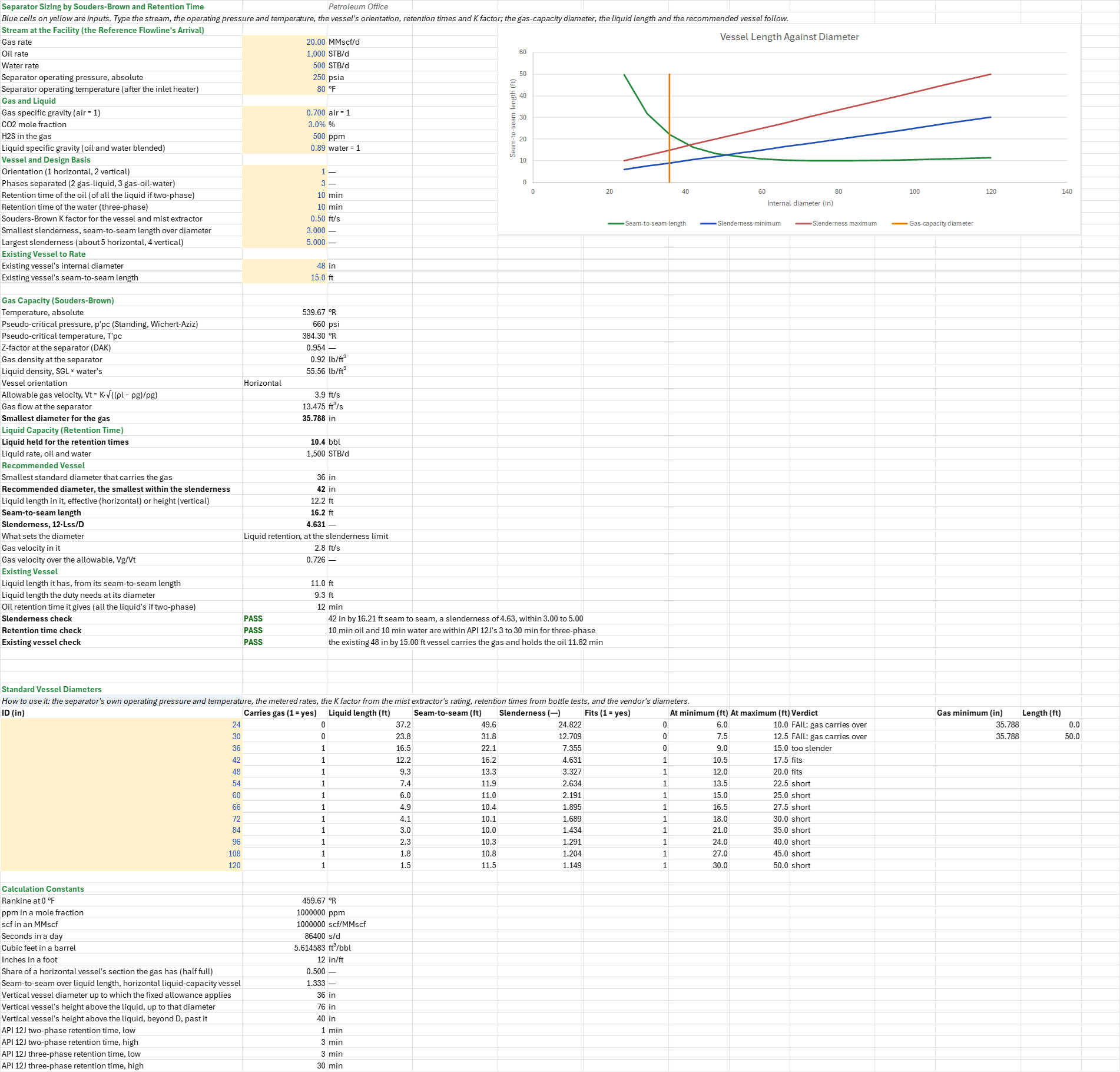
What vessel separates the stream, and how long is it? You enter the gas, oil and water rates, the separator's pressure and temperature, the gas and liquid gravities, the orientation, two or three phases, the retention times, the K factor and the slenderness limits. You read off the smallest diameter that carries the gas, the liquid volume held, and the recommended standard vessel's diameter, seam-to-seam length and slenderness; an existing vessel is rated against the same duty.
Parameters:
- Stream: the gas, oil and water rates
SEP_Qg,SEP_Qo,SEP_Qw, and the separator's pressureSEP_Pand temperatureSEP_T - Gas and liquid: the gas gravity
SEP_SG, its CO2SEP_CO2and H2SSEP_H2S, and the liquid gravitySEP_SGL - Vessel: the orientation
SEP_Orient(1 horizontal, 2 vertical), the phasesSEP_Phases(2 or 3), the oil and water retention timesSEP_TrO,SEP_TrW, the K factorSEP_Kand the slenderness limitsSEP_SRmin,SEP_SRmax - Existing vessel: its internal diameter
SEP_Dvand seam-to-seam lengthSEP_Lv
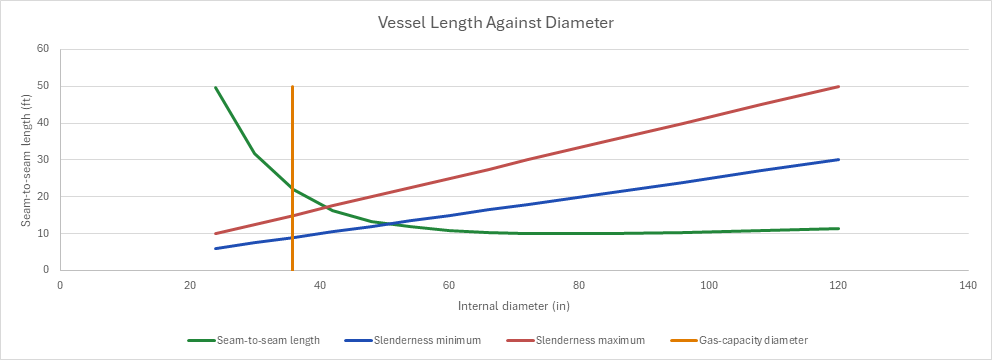
How to use it: Take the operating pressure and temperature from the separator's own gauges, the rates from the test or allocation meters, the K factor from the mist extractor's rating (derated at high pressure), and the retention times from bottle tests of the oil and water. Swap the standard diameters in the table for the fabricator's. The gas sets a smallest diameter: below it the gas moves faster than the Souders-Brown velocity and carries liquid over. The liquid sets a volume: the oil and water held for their retention times. A table sweeps standard vessel diameters from 24 to 120 in, with each one's liquid length, its seam-to-seam length and its slenderness, and the chart draws the seam-to-seam length against the diameter between the slenderness limits. The recommended vessel is the smallest diameter that carries the gas and stays within the largest slenderness.
Method:
- Gas. Z is DAK's at Standing's pseudo-criticals, corrected for CO2 and H2S by Wichert and Aziz. The allowable velocity is Vt = K·√((ρl − ρg)/ρg). The gas flow at the separator, over Vt, gives the area the gas needs: the whole section of a vertical vessel, or the upper half of a horizontal one taken half full of liquid. That area gives the gas-capacity diameter.
- Liquid. The liquid volume is (Qo·tr,o + Qw·tr,w)/1,440 bbl for three phases, or (Qo + Qw)·tr,o/1,440 for two. The liquid length in a vessel of diameter D is that volume over the liquid's share of the section: the effective length of a horizontal vessel, half full, or the liquid height of a vertical one.
- Seam-to-seam length. A horizontal vessel's seam-to-seam length is the larger of 4/3 of its effective length and the effective length plus D/12 ft, Arnold and Stewart's allowances for the inlet and gas sections. A vertical one adds the height above the liquid: 76 in up to 36 in diameter, and D + 40 in beyond.
- Slenderness. The slenderness is 12·Lss/D. The recommended vessel is the first standard diameter at or above the gas-capacity diameter whose slenderness is at most the largest slenderness. The gas sets it when that is the first standard size above the gas-capacity diameter; otherwise the liquid does, at the slenderness limit.
- Existing vessel. Its liquid length follows from its seam-to-seam length by the same allowances. The oil's retention time in it is the design time scaled by the liquid length it has over the length the duty needs.
- Checks.
- Slenderness: the recommended vessel's slenderness lies between the limits.
- Retention: the times are within API 12J's guide, 1 to 3 min for two phases and 3 to 30 for three.
- Existing vessel: it carries the gas and holds the oil for the design time.
Example: The default case is the stream of the flow-assurance family's reference flowline as it reaches the facility: 20 MMscf/d of the 0.7 gravity gas with 3 % CO2 and 500 ppm H2S, 1,000 STB/d of the reference oil and 500 bbl/d of water, blended to a 0.89 gravity. The Multiphase Flowline by Beggs and Brill sheet delivers it at 741 psia; a choke at the riser top takes it down to the separator's 250 psia, and the inlet heater warms it to 80 °F. The vessel is a horizontal three-phase separator holding the oil and the water 10 minutes each, with a K factor of 0.5 ft/s for a 10 ft horizontal vessel with a mist pad, the top of the API 12J range. The existing vessel to rate is 48 in by 15 ft.
Z at 250 psia and 80 °F is 0.9536, and the gas weighs 0.918 lb/ft³ against the liquid's 55.56. With K = 0.5 the gas may move at 3.858 ft/s. The 13.48 ft³/s of gas in half the section needs a 35.79 in vessel, so the smallest standard diameter that carries it is 36 in. The liquid held for 10 minutes is 10.42 bbl. In a 36 in vessel that is 16.55 ft of liquid and 22.06 ft seam to seam, a slenderness of 7.35, too slender. At 42 in it is 12.16 ft of liquid and 16.21 ft seam to seam, a slenderness of 4.63: the recommended vessel, set by the liquid at the slenderness limit. The gas moves at 2.80 ft/s in it, 73 % of Vt. The existing 48 in by 15 ft vessel has 11 ft of liquid length against the 9.31 ft the duty needs at 48 in, so it holds the oil 11.8 minutes: it passes. Cut to 8 ft it holds 4.3 minutes and fails. A vertical vessel with K = 0.25 and a slenderness limit of 4 also comes out at 42 in, 12.91 ft tall. A two-phase vessel holding the liquid 3 minutes needs only 3.13 bbl, so the gas sets it: 36 in by 7.96 ft, a slenderness of 2.65, short.
Functions used
PO.PVT.Ppc.ByStanding.Sour(SG_gas, y_H2S, y_CO2)
Calculates pseudo-critical pressure of sour gas using Standing correlation with Wichert-Aziz correction, [psi].
PO.PVT.Tpc.ByStanding.Sour(SG_gas, y_H2S, y_CO2)
Calculates pseudo-critical temperature of sour gas using Standing correlation with Wichert-Aziz correction, [degR].
PO.PVT.Z.ByDAK(Ppr, Tpr)
Calculates gas compressibility factor (Z) using Dranchuk and Abou-Kassem (1975) equation of state, [dimensionless].
PO.PVT.Rho.Gas.ByDefinition(P, T_degR, SG_gas, Z)
Calculates gas density, [g/cm3].
PO.PVT.Rho.Wat.Stn()
Water density at standard conditions, [lb/ft3].
PO.PVT.Bg.ByDefinition(P, T_degR, Z)
Calculates gas formation volume factor, [rcf/scf].
Names (67)
| Name | Refers to | Comment |
|---|---|---|
PO.SF.Sep.SoudersBrownLAMBDA |
=LAMBDA(orientation, qg, p, t, z, sg, rho_l, k_sb, output, IF(OR(AND(orientation<>"Vertical", orientation<>"Horizontal"), qg<=0, p<=0, t<=-459.67, z<=0, sg<=0, k_sb<=0), NA(), LET(tabs, t+459.67, rho_g, 28.9625*sg*p/(10.7316*z*tabs), IF(rho_l<=rho_g, NA(), LET(vel, k_sb*SQRT(MAX(0, rho_l-rho_g)/rho_g), qa, qg*1000000*(14.696/p)*(tabs/519.67)*z/86400, frac, IF(orientation="Vertical", 1, 0.5), IF(output="Velocity", vel, IF(output="Diameter", 12*SQRT(4*qa/(MAX(vel, 0.000001)*frac)/PI()), NA()))))))) |
Souders-Brown separator gas capacity: "Velocity" allowable gas velocity (ft/s) = K*sqrt((rho_l-rho_g)/rho_g), or "Diameter" minimum vessel ID (in), "Vertical" or "Horizontal" (half full of liquid). |
PO.SF.Sep.LiquidRetentionLAMBDA |
=LAMBDA(phases, orientation, qo, qw, tr_o, tr_w, d, output, IF(OR(AND(phases<>2, phases<>3), AND(orientation<>"Vertical", orientation<>"Horizontal"), qo<0, qw<0, tr_o<0, tr_w<0, d<=0), NA(), IF(OR(output="Volume", output="Length"), IF(phases=2, (qo+qw)*tr_o, qo*tr_o+qw*tr_w)/1440*IF(output="Volume", 1, 5.6145833)/IF(output="Volume", 1, PI()/4*(d/12)^2*IF(orientation="Vertical", 1, 0.5)), NA()))) |
Separator liquid retention: "Volume" (bbl) to hold oil qo and water qw (bbl/d) for tr_o/tr_w (min), 2 or 3 phases, or "Length" (ft) of liquid at ID d (in), "Vertical" full section or "Horizontal" half full. |
SEP_Qg |
$B$4 |
Gas rate, MMscf/d |
SEP_Qo |
$B$5 |
Oil rate, STB/d |
SEP_Qw |
$B$6 |
Water rate, STB/d |
SEP_P |
$B$7 |
Separator operating pressure, absolute, psia |
SEP_T |
$B$8 |
Separator operating temperature (after the inlet heater), °F |
SEP_SG |
$B$10 |
Gas specific gravity (air = 1), air = 1 |
SEP_CO2 |
$B$11 |
CO2 mole fraction, % |
SEP_H2S |
$B$12 |
H2S in the gas, ppm |
SEP_SGL |
$B$13 |
Liquid specific gravity (oil and water blended), water = 1 |
SEP_Orient |
$B$15 |
Orientation (1 horizontal, 2 vertical) |
SEP_Phases |
$B$16 |
Phases separated (2 gas-liquid, 3 gas-oil-water) |
SEP_TrO |
$B$17 |
Retention time of the oil (of all the liquid if two-phase), min |
SEP_TrW |
$B$18 |
Retention time of the water (three-phase), min |
SEP_K |
$B$19 |
Souders-Brown K factor for the vessel and mist extractor, ft/s |
SEP_SRmin |
$B$20 |
Smallest slenderness, seam-to-seam length over diameter |
SEP_SRmax |
$B$21 |
Largest slenderness (about 5 horizontal, 4 vertical) |
SEP_Dv |
$B$23 |
Existing vessel's internal diameter, in |
SEP_Lv |
$B$24 |
Existing vessel's seam-to-seam length, ft |
SEP_Inputs |
$B$4:$B$24 |
The stream's gas, oil and water rates, the operating pressure and temperature, the gas gravity, CO2 and H2S, the liquid gravity, the orientation, phases, retention times, K factor and slenderness limits, and an existing vessel's size |
SEP_TR |
$B$27 |
Temperature, absolute, °R |
SEP_Ppc |
$B$28 |
Pseudo-critical pressure, p′pc (Standing, Wichert-Aziz), psi |
SEP_Tpc |
$B$29 |
Pseudo-critical temperature, T′pc, °R |
SEP_Z |
$B$30 |
Z-factor at the separator (DAK) |
SEP_RhoG |
$B$31 |
Gas density at the separator, lb/ft³ |
SEP_RhoL |
$B$32 |
Liquid density, SGL × water's, lb/ft³ |
SEP_Vessel |
$B$33 |
Vessel orientation |
SEP_Vt |
$B$34 |
Allowable gas velocity, Vt = K·√((ρl − ρg)/ρg), ft/s |
SEP_Qa |
$B$35 |
Gas flow at the separator, ft³/s |
SEP_Dgas |
$B$36 |
Smallest diameter for the gas, in |
SEP_Vliq |
$B$38 |
Liquid held for the retention times, bbl |
SEP_QL |
$B$39 |
Liquid rate, oil and water, STB/d |
SEP_Dstd |
$B$41 |
Smallest standard diameter that carries the gas, in |
SEP_Drec |
$B$42 |
Recommended diameter, the smallest within the slenderness, in |
SEP_Leff |
$B$43 |
Liquid length in it, effective (horizontal) or height (vertical), ft |
SEP_Lss |
$B$44 |
Seam-to-seam length, ft |
SEP_SR |
$B$45 |
Slenderness, 12·Lss/D |
SEP_Governs |
$B$46 |
What sets the diameter |
SEP_Vg |
$B$47 |
Gas velocity in it, ft/s |
SEP_VgRatio |
$B$48 |
Gas velocity over the allowable, Vg/Vt |
SEP_LvLiq |
$B$50 |
Liquid length it has, from its seam-to-seam length, ft |
SEP_LvNeed |
$B$51 |
Liquid length the duty needs at its diameter, ft |
SEP_TrAvail |
$B$52 |
Oil retention time it gives (all the liquid's if two-phase), min |
SEP_SizeCheck |
$B$53 |
Slenderness check verdict |
SEP_SizeCheckNote |
$C$53 |
Slenderness check comment |
SEP_RetentionCheck |
$B$54 |
Retention time check verdict |
SEP_RetentionCheckNote |
$C$54 |
Retention time check comment |
SEP_ExistingCheck |
$B$55 |
Existing vessel check verdict |
SEP_ExistingCheckNote |
$C$55 |
Existing vessel check comment |
SEP_Results |
$B$27:$B$55 |
Z, the gas and liquid densities, the Souders-Brown velocity and gas-capacity diameter, the liquid held, the recommended vessel's diameter, liquid and seam-to-seam lengths and slenderness, the existing vessel's rating, and the three checks |
SEP_Curve |
$A$62:$I$74 |
Each standard vessel diameter: whether it carries the gas, its liquid length for the retention times, its seam-to-seam length and slenderness, whether it fits, the lengths at the smallest and largest slenderness, and a verdict |
SEP_R0 |
$B$77 |
Rankine at 0 °F, °R |
SEP_Ppm |
$B$78 |
ppm in a mole fraction, ppm |
SEP_Scf |
$B$79 |
scf in an MMscf, scf/MMscf |
SEP_Sec |
$B$80 |
Seconds in a day, s/d |
SEP_Ft3Bbl |
$B$81 |
Cubic feet in a barrel, ft³/bbl |
SEP_InFt |
$B$82 |
Inches in a foot, in/ft |
SEP_Half |
$B$83 |
Share of a horizontal vessel's section the gas has (half full) |
SEP_Shell |
$B$84 |
Seam-to-seam over liquid length, horizontal liquid-capacity vessel |
SEP_VertD |
$B$85 |
Vertical vessel diameter up to which the fixed allowance applies, in |
SEP_VertA |
$B$86 |
Vertical vessel's height above the liquid, up to that diameter, in |
SEP_VertB |
$B$87 |
Vertical vessel's height above the liquid, beyond D, past it, in |
SEP_Tr2Lo |
$B$88 |
API 12J two-phase retention time, low, min |
SEP_Tr2Hi |
$B$89 |
API 12J two-phase retention time, high, min |
SEP_Tr3Lo |
$B$90 |
API 12J three-phase retention time, low, min |
SEP_Tr3Hi |
$B$91 |
API 12J three-phase retention time, high, min |
Details
| Inserts | 91 rows × 12 columns |
| Category | Surface Facilities |
| For agents and tools | Descriptor (.md) |