Compressor Staging and Power
Description
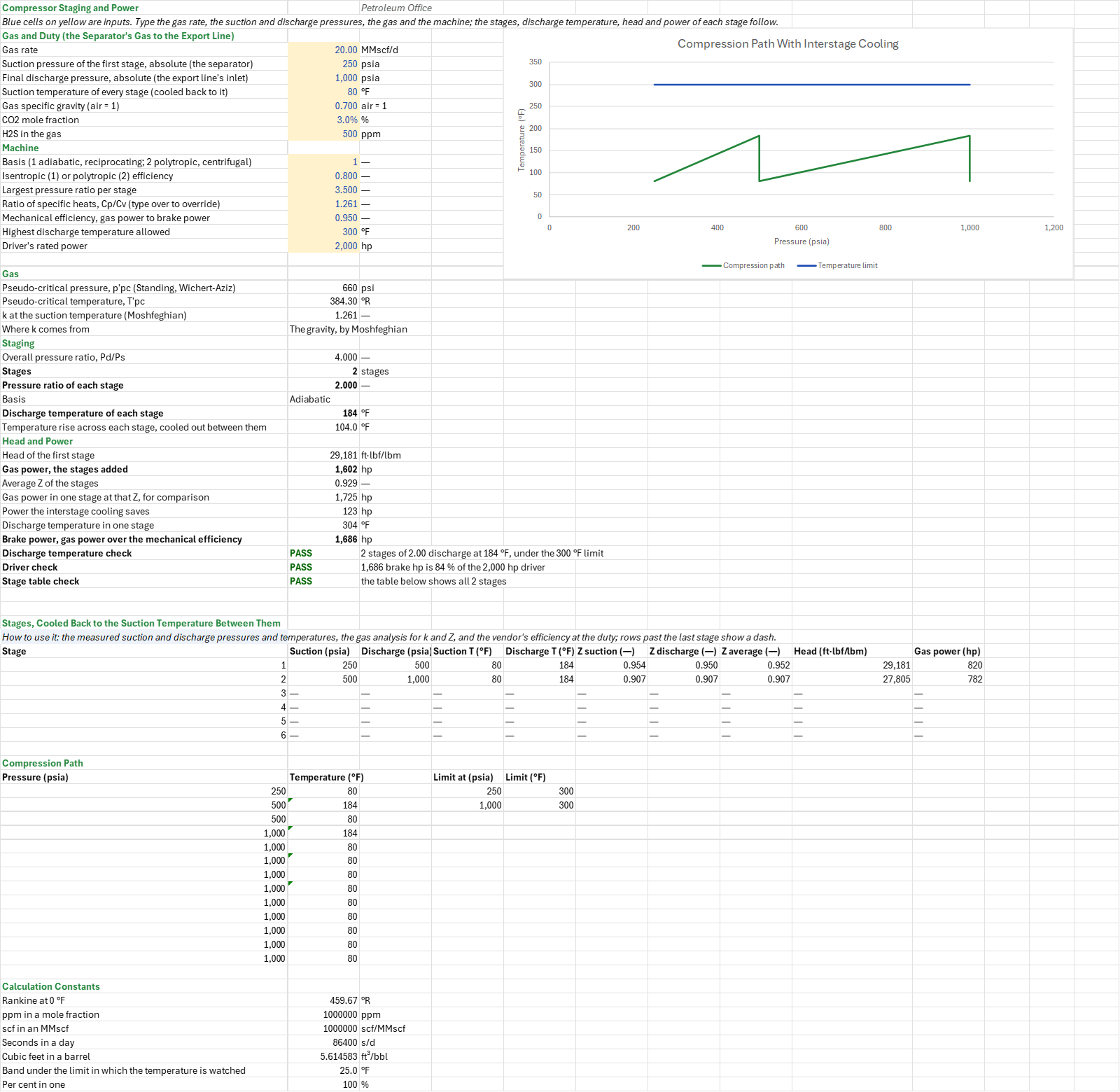
How many stages does a gas compressor need, how hot does each stage run, and what power does it take? You enter the gas rate, the suction and discharge pressures, the suction temperature, the gas and the machine. You read off the stages and their ratio, each stage's discharge temperature, Z, head and gas power with the gas cooled back to the suction temperature between stages, the gas and brake power against the driver, and one uncooled stage for comparison; the chart draws the compression path.
Parameters:
- Duty: the gas rate
CMP_Qg, the first stage's suction pressureCMP_Ps, the final discharge pressureCMP_Pdand the suction temperature of every stageCMP_Ts - Gas: the gravity
CMP_SG, its CO2CMP_CO2and H2SCMP_H2S - Machine: the basis
CMP_Mode(1 adiabatic, the reciprocating basis; 2 polytropic, the centrifugal one), its efficiencyCMP_Eff, the largest ratio per stageCMP_Rmax, kCMP_k(the gravity's until typed over), the mechanical efficiencyCMP_Mech, the discharge temperature limitCMP_Tmaxand the driver's ratingCMP_Driver
How to use it: take the suction and discharge pressures and temperatures from the compressor's own gauges, k and Z from the gas analysis (an equation of state's k on the composition replaces the gravity's), and the efficiency at the duty from the vendor's performance curve. The ratio of specific heats is Moshfeghian's from the gravity until a k from a gas analysis or a vendor's data sheet is typed over it. The discharge temperature limit is the packing's, the lube oil's or the valves', from the vendor.
Method:
- Stages. The fewest stages n with (Pd/Ps)^(1/n) at most the largest ratio, all at that equal ratio r.
- k. Moshfeghian's correlation, k = (1.6 − 0.44γ + 0.097γ²)·(1 + 0.0385γ − 0.000159·T), with T the suction temperature in °R.
- Discharge temperature. Adiabatic: T2 = T1·(1 + (r^((k−1)/k) − 1)/η). Polytropic: T2 = T1·r^((k−1)/(k·ηp)), in a cell. Every stage starts at the suction temperature, so every stage reaches the same one.
- Stage table. Stage i takes the gas from Ps·r^(i−1) to Ps·r^i. Z is DAK's at Standing's pseudo-criticals with the Wichert-Aziz correction, at its suction and at its discharge, and the stage takes their average. Its head and gas power are those of one stage: H = Z·R·T1/MW·(r^x − 1)/x, with x = (k − 1)/k adiabatic or (k − 1)/(k·ηp) polytropic, and the power w·H/(η·33,000) hp for the mass rate w in lb/min.
- Power. The gas power is the stages' sum, and the brake power that over the mechanical efficiency. One uncooled stage at the stages' average Z, the same power equation over the whole ratio, shows what the coolers save.
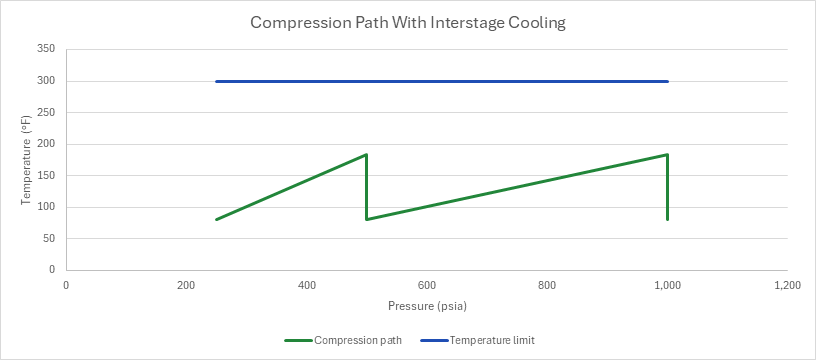
- Chart. The compression path runs up to each stage's discharge temperature and back down through each cooler.
- Checks.
- Discharge temperature: under the limit, with a warning within 25 °F of it.
- Driver: the brake power within the driver's rating.
- Stage table: the stages fit its six rows.
Example: The default case is the reference stream's gas: 20 MMscf/d of the 0.7 gravity gas with 3 % CO2 and 500 ppm H2S, from the Separator Sizing sheet's 250 psia and 80 °F to the Gas Pipeline Sizing sheet's 1,000 psia inlet. The machine is a reciprocating compressor at an isentropic efficiency of 0.8, held to a ratio of 3.5 per stage and a 300 °F discharge, with 95 % mechanical efficiency and a 2,000 hp driver. The overall ratio is 4. At most 3.5 per stage, that is 2 stages of 2.0. k at 80 °F for the 0.7 gravity gas is 1.2607, so each stage discharges at 184 °F: a 104 °F rise each cooler takes out. Stage 1, 250 to 500 psia at an average Z of 0.9518, has a head of 29,181 ft·lbf/lbm and takes 820.2 hp; stage 2, 500 to 1,000 psia at Z = 0.9070, takes 781.5 hp. The gas power is 1,601.7 hp and the brake power 1,686 hp, 84 % of the driver. One stage would run at 303.9 °F, over the limit, and take 1,725.1 hp, 123.4 hp more. Allowed a ratio of 4, the sheet takes that single stage and the temperature check fails. At 25 MMscf/d the brake power is 2,107 hp and the driver check fails. On a polytropic basis at ηp = 0.78 each stage discharges at 188.9 °F and the gas power is 1,679.0 hp.
Against a published check: the compressor unit operation of the Engineering library, version 6.0.0, compresses 1 MMscf/d of pure methane from 100 psia and 80 °F through a ratio of 3 at an isentropic efficiency of 1 (Peng-Robinson, an isentropic flash with k varying along the path). It discharges at 232.148 °F and takes 56.853 hp. The sheet with methane's gravity (16.043/28.9625), no CO2 or H2S, and k typed in as Moshfeghian's 1.296663 at 80 °F gives 234.2 °F and 56.96 hp, within 1 %.
Functions used
PO.PVT.Ppc.ByStanding.Sour(SG_gas, y_H2S, y_CO2)
Calculates pseudo-critical pressure of sour gas using Standing correlation with Wichert-Aziz correction, [psi].
PO.PVT.Tpc.ByStanding.Sour(SG_gas, y_H2S, y_CO2)
Calculates pseudo-critical temperature of sour gas using Standing correlation with Wichert-Aziz correction, [degR].
PO.PVT.Z.ByDAK(Ppr, Tpr)
Calculates gas compressibility factor (Z) using Dranchuk and Abou-Kassem (1975) equation of state, [dimensionless].
Names (52)
| Name | Refers to | Comment |
|---|---|---|
PO.SF.Comp.kLAMBDA |
=LAMBDA(sg, t, IF(OR(sg<0.55, sg>2, t<-13, t>302), NA(), (1.6-0.44*sg+0.097*sg^2)*(1+0.0385*sg-0.000159*(t+459.67)))) |
Ideal-gas ratio of specific heats k = Cp/Cv of a hydrocarbon gas of gravity sg (0.55 to 2.0) at t (deg F, -13 to 302), Moshfeghian (2013) correlation; #N/A outside its range. |
PO.SF.Comp.StagesLAMBDA |
=LAMBDA(ps, pd, r_max, output, IF(OR(ps<=0, pd<=ps, r_max<=1), NA(), LET(n, MAX(1, ROUNDUP(LN(pd/ps)/LN(r_max)-0.000000001, 0)), IF(output="Stages", n, IF(output="Ratio", (pd/ps)^(1/n), NA()))))) |
Compression stages, equal ratios: "Stages" = fewest n with (pd/ps)^(1/n) <= r_max, or "Ratio" = (pd/ps)^(1/n) per stage, for suction ps and discharge pd (psia). |
PO.SF.Comp.TdischLAMBDA |
=LAMBDA(t, ratio, k, eff, IF(OR(t<=-459.67, ratio<1, k<=1, eff<=0, eff>1), NA(), (t+459.67)*(1+(ratio^((k-1)/k)-1)/eff)-459.67)) |
Adiabatic discharge temperature (deg F) of one stage: T1 + T1*(ratio^((k-1)/k) - 1)/eff, suction t (deg F), stage pressure ratio, k = Cp/Cv and isentropic efficiency eff (1 = ideal). |
PO.SF.Comp.PowerLAMBDA |
=LAMBDA(mode, qg, ps, pd, t, sg, z, k, eff, stages, output, IF(OR(AND(mode<>"Adiabatic", mode<>"Polytropic"), qg<=0, ps<=0, pd<ps, t<=-459.67, sg<=0, z<=0, k<=1, eff<=0, eff>1, stages<1, stages<>INT(stages)), NA(), IF(OR(output="Head", output="Stage", output="Total"), z*1545.349*(t+459.67)/(28.9625*sg)/IF(mode="Polytropic", (k-1)/(k*eff), (k-1)/k)*(((pd/ps)^(1/stages))^IF(mode="Polytropic", (k-1)/(k*eff), (k-1)/k)-1)*IF(output="Head", 1, qg*1000000*14.696/(10.7316*519.67)*(28.9625*sg)/1440)/IF(output="Head", 1, eff*33000)*IF(output="Total", stages, 1), NA()))) |
Compressor gas power, "Adiabatic" or "Polytropic", equal-ratio stages intercooled to t: "Head" per stage (ft-lbf/lbm), "Stage" gas hp per stage or "Total" gas hp, for qg MMscf/d from ps to pd psia. |
CMP_Qg |
$B$4 |
Gas rate, MMscf/d |
CMP_Ps |
$B$5 |
Suction pressure of the first stage, absolute (the separator), psia |
CMP_Pd |
$B$6 |
Final discharge pressure, absolute (the export line's inlet), psia |
CMP_Ts |
$B$7 |
Suction temperature of every stage (cooled back to it), °F |
CMP_SG |
$B$8 |
Gas specific gravity (air = 1), air = 1 |
CMP_CO2 |
$B$9 |
CO2 mole fraction, % |
CMP_H2S |
$B$10 |
H2S in the gas, ppm |
CMP_Mode |
$B$12 |
Basis (1 adiabatic, reciprocating; 2 polytropic, centrifugal) |
CMP_Eff |
$B$13 |
Isentropic (1) or polytropic (2) efficiency |
CMP_Rmax |
$B$14 |
Largest pressure ratio per stage |
CMP_k |
$B$15 |
Ratio of specific heats, Cp/Cv (type over to override) |
CMP_Mech |
$B$16 |
Mechanical efficiency, gas power to brake power |
CMP_Tmax |
$B$17 |
Highest discharge temperature allowed, °F |
CMP_Driver |
$B$18 |
Driver's rated power, hp |
CMP_Inputs |
$B$4:$B$18 |
The gas rate, suction and final discharge pressures, the suction temperature, the gas gravity, CO2 and H2S, the basis, efficiency, largest ratio per stage, k, the mechanical efficiency, the discharge temperature limit and the driver's rating |
CMP_Ppc |
$B$21 |
Pseudo-critical pressure, p′pc (Standing, Wichert-Aziz), psi |
CMP_Tpc |
$B$22 |
Pseudo-critical temperature, T′pc, °R |
CMP_kCalc |
$B$23 |
k at the suction temperature (Moshfeghian) |
CMP_kFrom |
$B$24 |
Where k comes from |
CMP_Rall |
$B$26 |
Overall pressure ratio, Pd/Ps |
CMP_N |
$B$27 |
Stages, stages |
CMP_r |
$B$28 |
Pressure ratio of each stage |
CMP_Basis |
$B$29 |
Basis |
CMP_Td |
$B$30 |
Discharge temperature of each stage, °F |
CMP_dT |
$B$31 |
Temperature rise across each stage, cooled out between them, °F |
CMP_Head1 |
$B$33 |
Head of the first stage, ft·lbf/lbm |
CMP_Gas |
$B$34 |
Gas power, the stages added, hp |
CMP_Zall |
$B$35 |
Average Z of the stages |
CMP_One |
$B$36 |
Gas power in one stage at that Z, for comparison, hp |
CMP_Saved |
$B$37 |
Power the interstage cooling saves, hp |
CMP_TdOne |
$B$38 |
Discharge temperature in one stage, °F |
CMP_Brake |
$B$39 |
Brake power, gas power over the mechanical efficiency, hp |
CMP_TempCheck |
$B$40 |
Discharge temperature check verdict |
CMP_TempCheckNote |
$C$40 |
Discharge temperature check comment |
CMP_DriverCheck |
$B$41 |
Driver check verdict |
CMP_DriverCheckNote |
$C$41 |
Driver check comment |
CMP_StagesCheck |
$B$42 |
Stage table check verdict |
CMP_StagesCheckNote |
$C$42 |
Stage table check comment |
CMP_Results |
$B$21:$B$42 |
The pseudo-criticals, k, the overall and per-stage ratios, the stages, the discharge temperature and rise, the first stage's head, the gas power by stage, one uncooled stage for comparison, the brake power and the three checks |
CMP_Stages |
$A$48:$J$53 |
Each stage: its suction and discharge pressures and temperatures, Z at each end and their average, its head and gas power by PO.SF.Comp.Power |
CMP_Curve |
$A$57:$B$69 |
The compression path: each stage compressed to its discharge temperature, then cooled back to the suction temperature |
CMP_R0 |
$B$72 |
Rankine at 0 °F, °R |
CMP_Ppm |
$B$73 |
ppm in a mole fraction, ppm |
CMP_Scf |
$B$74 |
scf in an MMscf, scf/MMscf |
CMP_Sec |
$B$75 |
Seconds in a day, s/d |
CMP_Ft3Bbl |
$B$76 |
Cubic feet in a barrel, ft³/bbl |
CMP_Band |
$B$77 |
Band under the limit in which the temperature is watched, °F |
CMP_Pct |
$B$78 |
Per cent in one, % |
Details
| Inserts | 78 rows × 10 columns |
| Category | Surface Facilities |
| For agents and tools | Descriptor (.md) |