Well Control Pack
Description
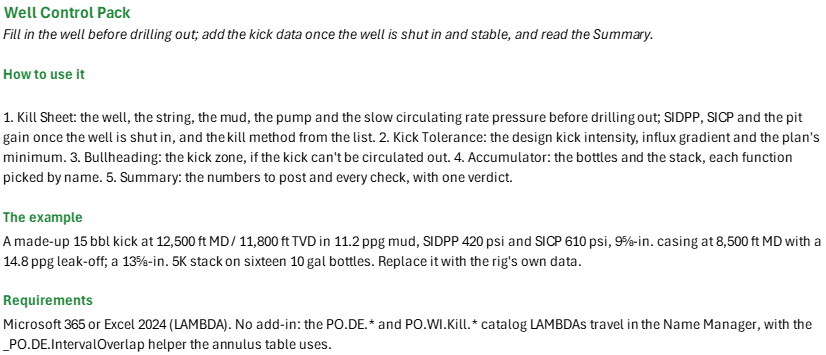
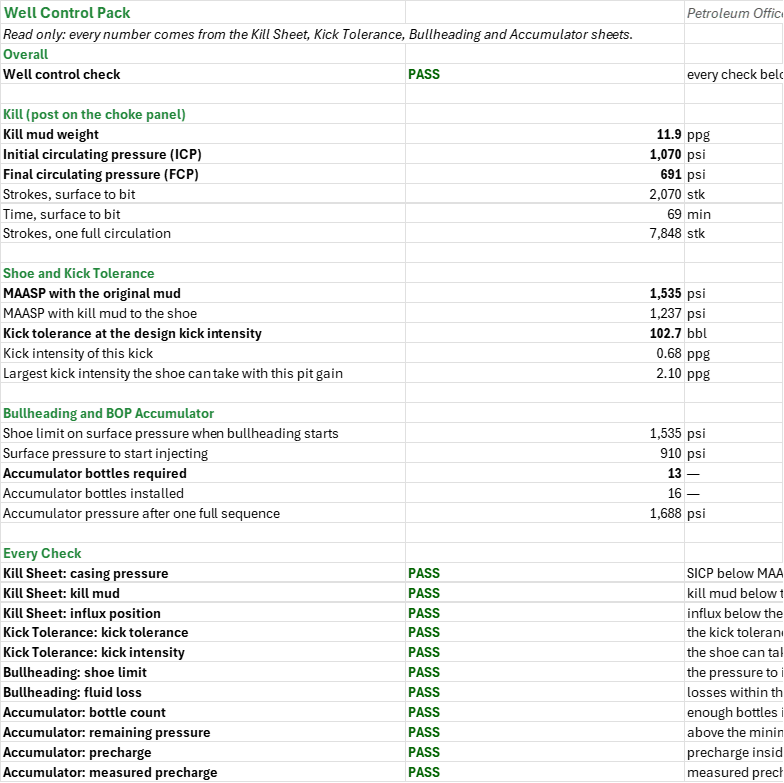
What does the driller post to kill this kick, how big a kick can the shoe take, can the kick be bullheaded, and will the accumulator close the stack? You enter the well, string, mud, pump and slow circulating rate pressure, then SIDPP, SICP and the pit gain once shut in, the kick zone and the stack's bottles. You read off the kill mud weight, ICP, FCP, strokes, MAASP and the drill pipe pressure schedule, the kick tolerance across kick intensities, the bullheading limit and losses, and the bottles needed with the precharge window. Field units; no add-in needed.
How to use it: The kick, well and stack are made up. On the Kill Sheet, enter the rig's string, the mud, the pump and the slow circulating rate pressure recorded on the rig before drilling out; once the well is shut in and stable, enter the stabilised shut-in pressures and the pit gain, and pick Wait & Weight or Driller's from the list. On Kick Tolerance set the design kick intensity, the influx gradient and the plan's minimum; on Bullheading the kick zone from offset logs or a test; on Accumulator the stack's own data sheet over the typical volumes, with the functions picked by name. The Summary lists what the driller posts and every check under one verdict.
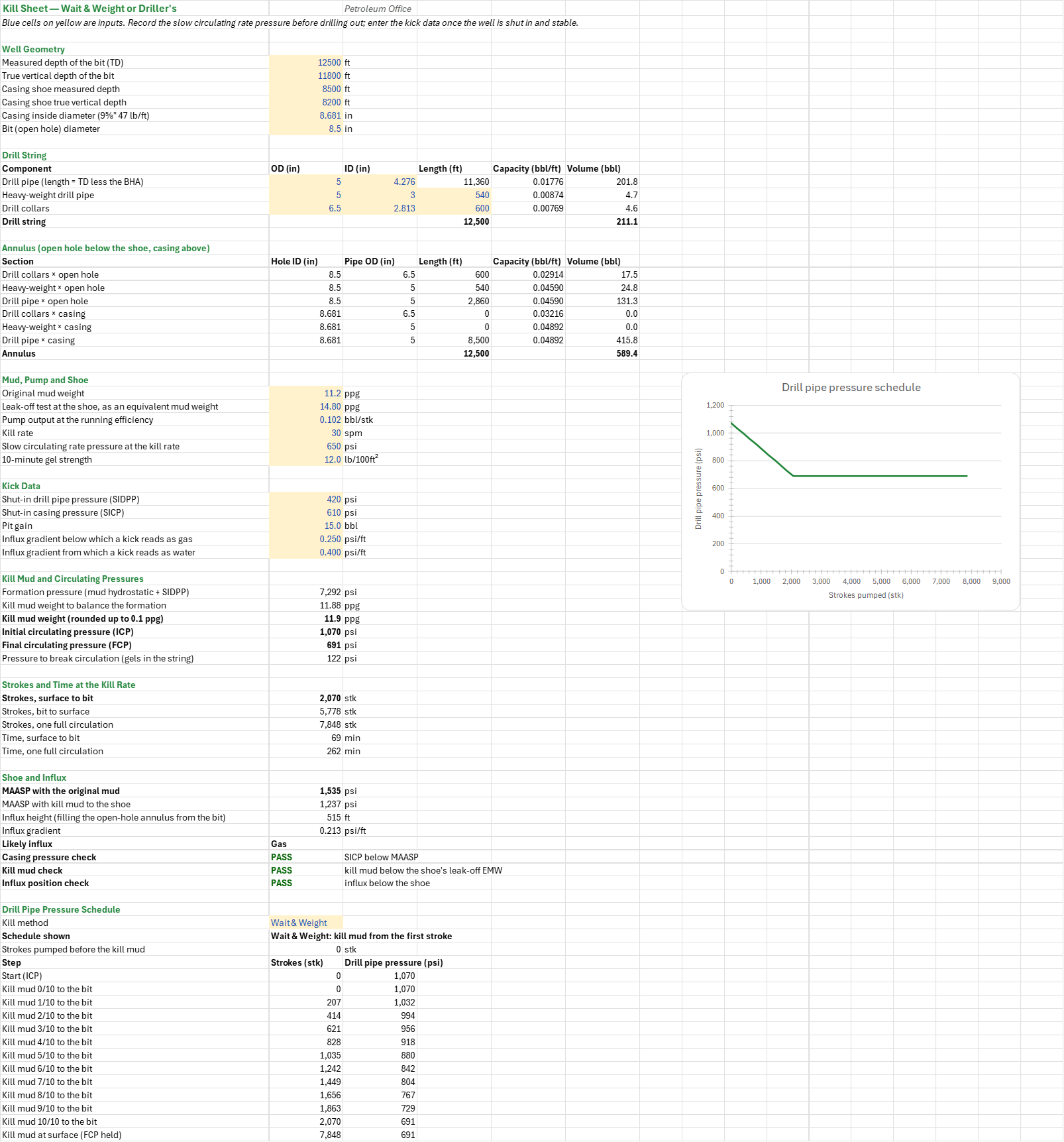
Method: Kill mud = MW + SIDPP / (0.052 TVD), rounded up to 0.1 ppg; ICP = SIDPP + SCR pressure; FCP = SCR × KMW / MW; MAASP = (LOT EMW − MW) 0.052 shoe TVD. The annulus is six sections, each string component against open hole and casing; the influx fills the open hole up from the bit, and its gradient 0.052 MW − (SICP − SIDPP) / height reads gas below 0.25 psi/ft and water from 0.40. Wait & Weight drops drill pipe pressure from ICP to FCP in ten steps while kill mud fills the string; the Driller's method first holds ICP for one circulation. Kick tolerance: the shoe allows an influx height H = (MAASP − 0.052 KI TVD) / (0.052 MW − G), with KI the kick intensity and G the influx gradient; the kick tolerance is the smaller of H around the BHA at the bit and H around the drill pipe below the shoe taken back to bottom-hole pressure by Boyle's law. Bullheading: the shoe's fracture pressure less the hydrostatic above it, falling as kill mud fills the cased annulus; losses to the kick zone are steady radial Darcy flow. Accumulator: usable fluid per bottle Vb (Pre/Pmin − Pre/Pmax), with Vb the bottle's nitrogen volume and Pre, Pmin and Pmax the precharge, minimum and full operating pressures; bottles for the functions times the design factor, and the precharge window. Every formula is a catalog LAMBDA in the Name Manager.
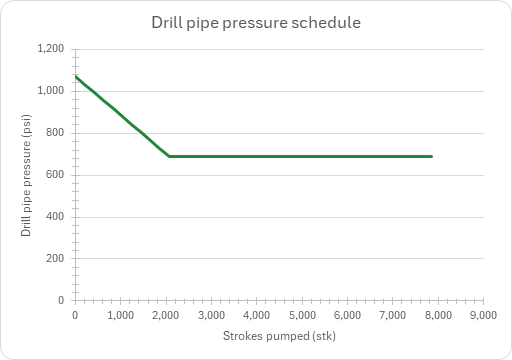
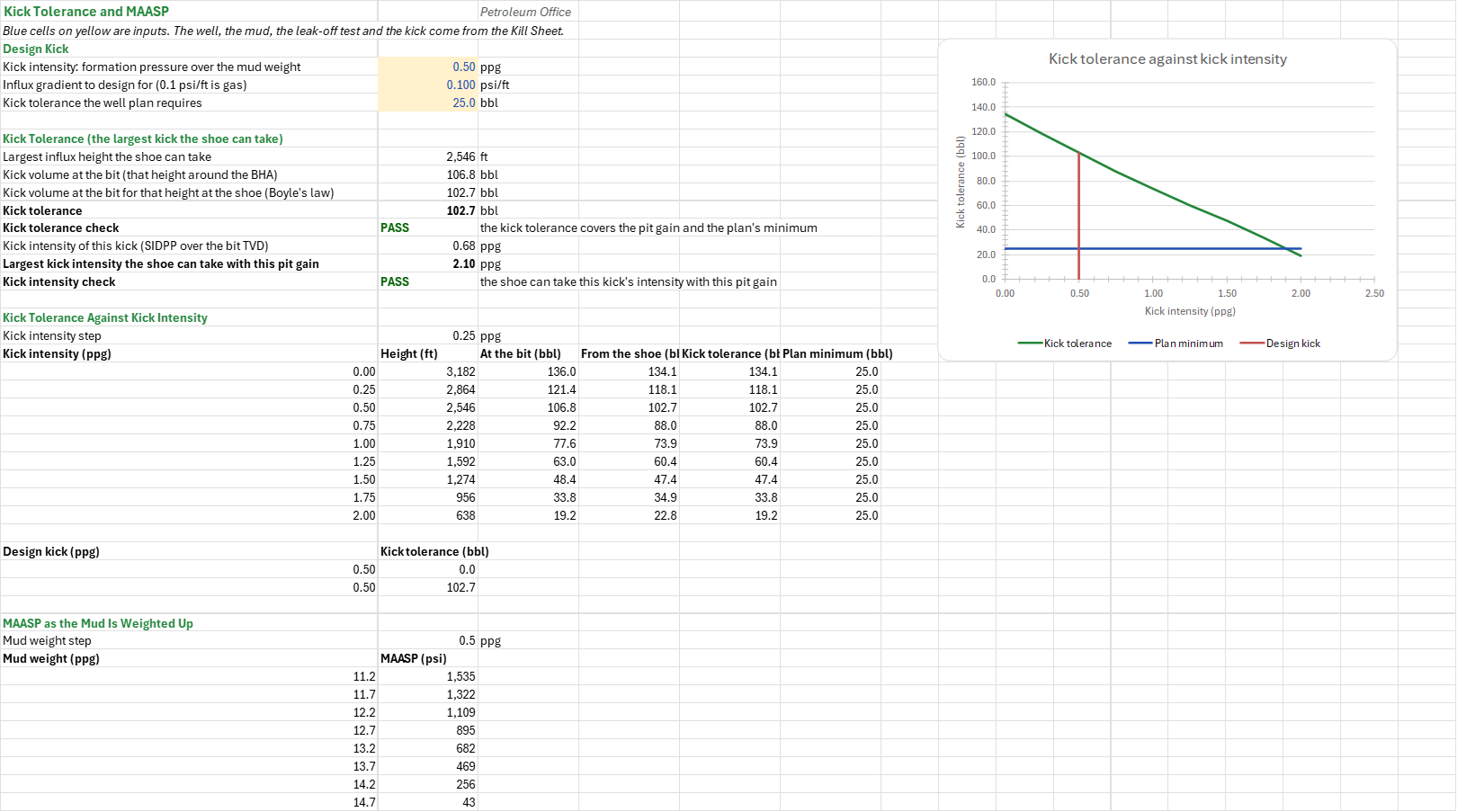
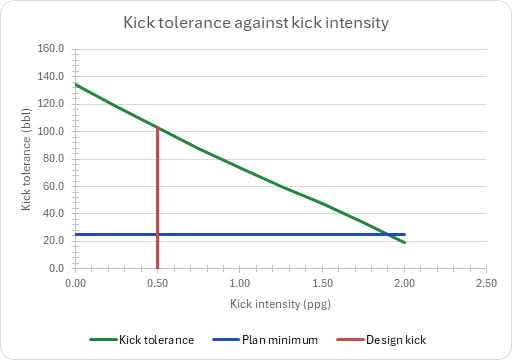
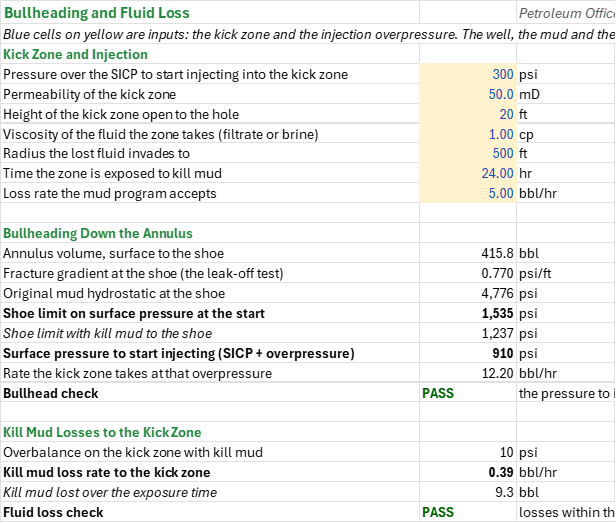
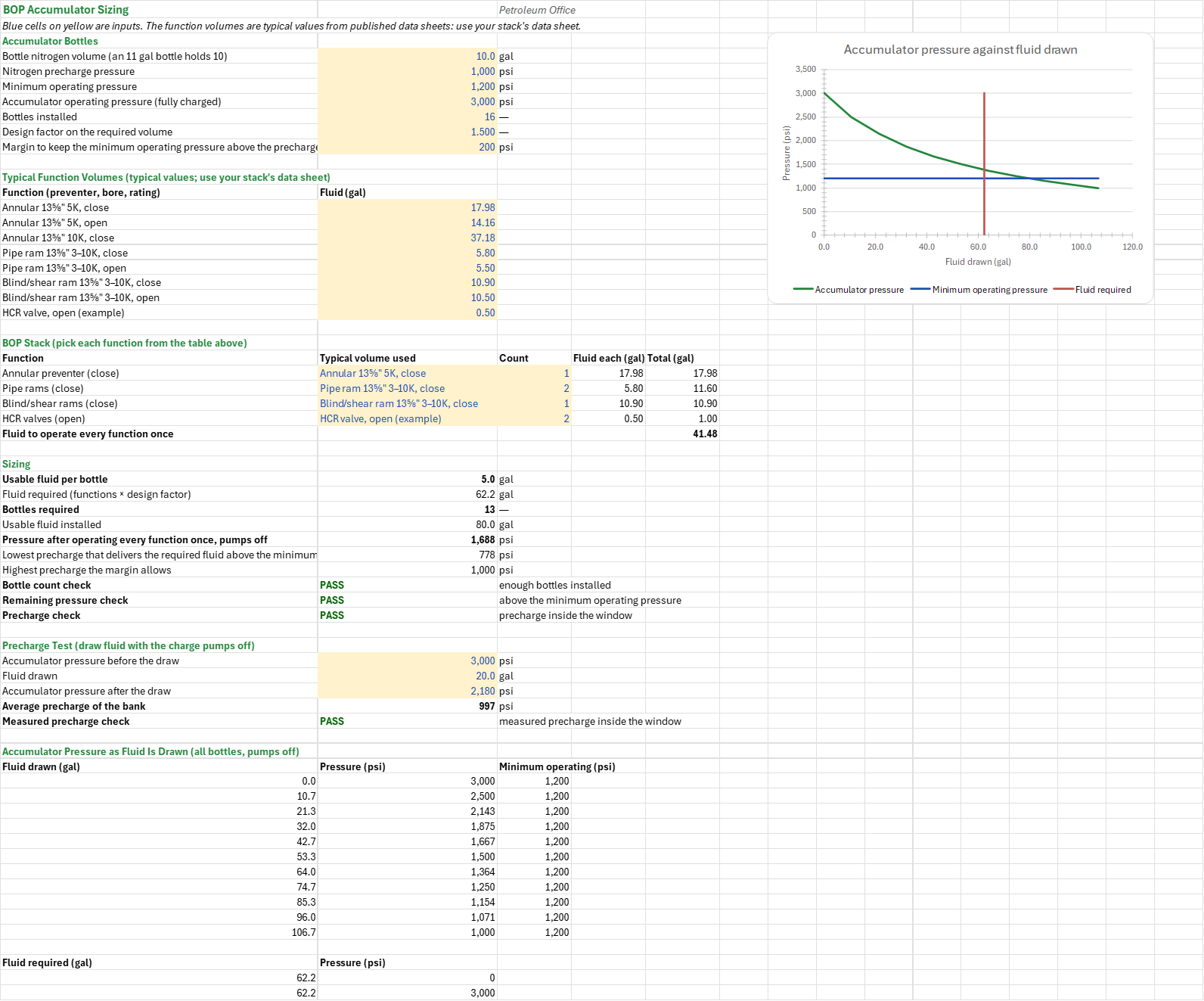
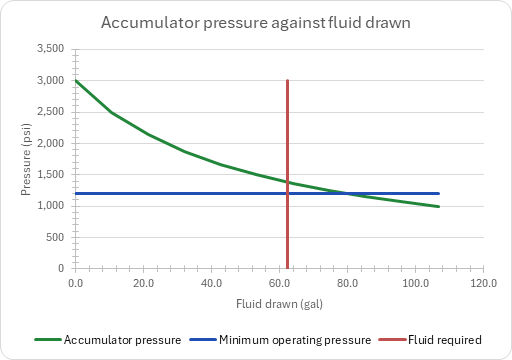
Example: The kill sheet blueprint's made-up kick: 15 bbl at 12,500 ft MD / 11,800 ft TVD in 11.2 ppg mud, SIDPP 420 psi, SICP 610 psi, 9⅝-in. shoe at 8,200 ft TVD with a 14.8 ppg leak-off. Kill mud 11.9 ppg, ICP 1,070 psi, FCP 691 psi, 2,070 strokes to the bit (69 min at 30 spm) and 7,848 for a circulation, where the Driller's kill mud starts. MAASP 1,535 psi, 1,237 psi with kill mud; the 515 ft influx at 0.21 psi/ft reads as gas. At 0.5 ppg the kick tolerance is 102.7 bbl (Boyle's law at the shoe governs; 106.8 bbl at the bit), 134.1 bbl at no intensity, 47.4 bbl at 1.5 ppg and 19.2 bbl at 2 ppg, where the bit governs; the kick's own 0.68 ppg is under the 2.10 ppg the shoe takes with 15 bbl. MAASP falls to 43 psi at 14.7 ppg. Bullheading may start at 1,535 psi; 910 psi passes, the zone takes 12.2 bbl/hr and loses 0.39 bbl/hr of kill mud. The 13⅝-in. stack needs 41.48 gal, 62.22 gal with the 1.5 factor: 13 of the 16 bottles, 1,688 psi left after one sequence, precharge window 778–1,000 psi, the test reads 997 psi.
Validity
A vertical or near-vertical well: hydrostatics use TVD and the schedule falls linearly with strokes, so a deviated well needs a schedule by section. One influx bubble at the bottom, no migration while shut in, ideal isothermal gas for the kick tolerance; a height past the shoe is flagged. Bullheading takes no friction or migration and steady radial losses with no filter cake (an upper bound). The function volumes are typical published values, not the rig's. Named alternatives: lubricate-and-bleed where bullheading would exceed the shoe or the wellhead; a deviated-well schedule; a dynamic kick simulator for a horizontal well. The add-in has no functions for these.
References
- Bourgoyne, A.T. et al. (1986). Applied Drilling Engineering. SPE Textbook Series Vol. 2, ch. 4.
- Watson, D., Brittenham, T. and Moore, P.L. (2003). Advanced Well Control. SPE Textbook Series Vol. 10.
- Grace, R.D. (1994). Advanced Blowout and Well Control. Gulf Publishing.
- Lapeyrouse, N.J. Formulas and Calculations for Drilling, Production and Workover. Gulf Professional Publishing, ch. 4 (kick tolerance, bullheading, accumulator precharge test).
- API Standard 53 (2018). Well Control Equipment Systems for Drilling Wells (accumulator sizing and precharge).
Inputs
| Input | Unit | Default | Name |
|---|---|---|---|
| Bit depth MD and TVD, shoe MD and TVD | ft | 12500, 11800, 8500, 8200 | KIL_MD, KIL_TVD, KIL_ShoeMD, KIL_ShoeTVD |
| Original mud weight | ppg | 11.2 | KIL_MW |
| Leak-off test at the shoe, as an equivalent mud weight | ppg | 14.8 | KIL_LOT |
| Pump output at the running efficiency | bbl/stk | 0.102 | KIL_PumpOut |
| Kill rate | spm | 30 | KIL_SPM |
| Slow circulating rate pressure at the kill rate | psi | 650 | KIL_Pscr |
| Shut-in drill pipe pressure (SIDPP) | psi | 420 | KIL_SIDPP |
| Shut-in casing pressure (SICP) | psi | 610 | KIL_SICP |
| Pit gain | bbl | 15 | KIL_Gain |
| Kill method, from a list | — | Wait & Weight | KIL_Method |
| Kick intensity: formation pressure over the mud weight | ppg | 0.5 | KTL_KI |
| Influx gradient to design for (0.1 psi/ft is gas) | psi/ft | 0.1 | KTL_Ginf |
| Kick tolerance the well plan requires | bbl | 25 | KTL_KTmin |
| Pressure over the SICP to start injecting into the kick zone | psi | 300 | BHD_BHover |
| Permeability of the kick zone | mD | 50 | BHD_Perm |
| Height of the kick zone open to the hole | ft | 20 | BHD_Hzone |
| Bottle nitrogen volume (an 11 gal bottle holds 10) | gal | 10 | ACU_Vb |
| Nitrogen precharge pressure | psi | 1000 | ACU_Pre |
| Minimum operating pressure | psi | 1200 | ACU_Pmin |
| Accumulator operating pressure (fully charged) | psi | 3000 | ACU_Pmax |
| Bottles installed | — | 16 | ACU_N |
| Design factor on the required volume | — | 1.5 | ACU_SF |
Sheets
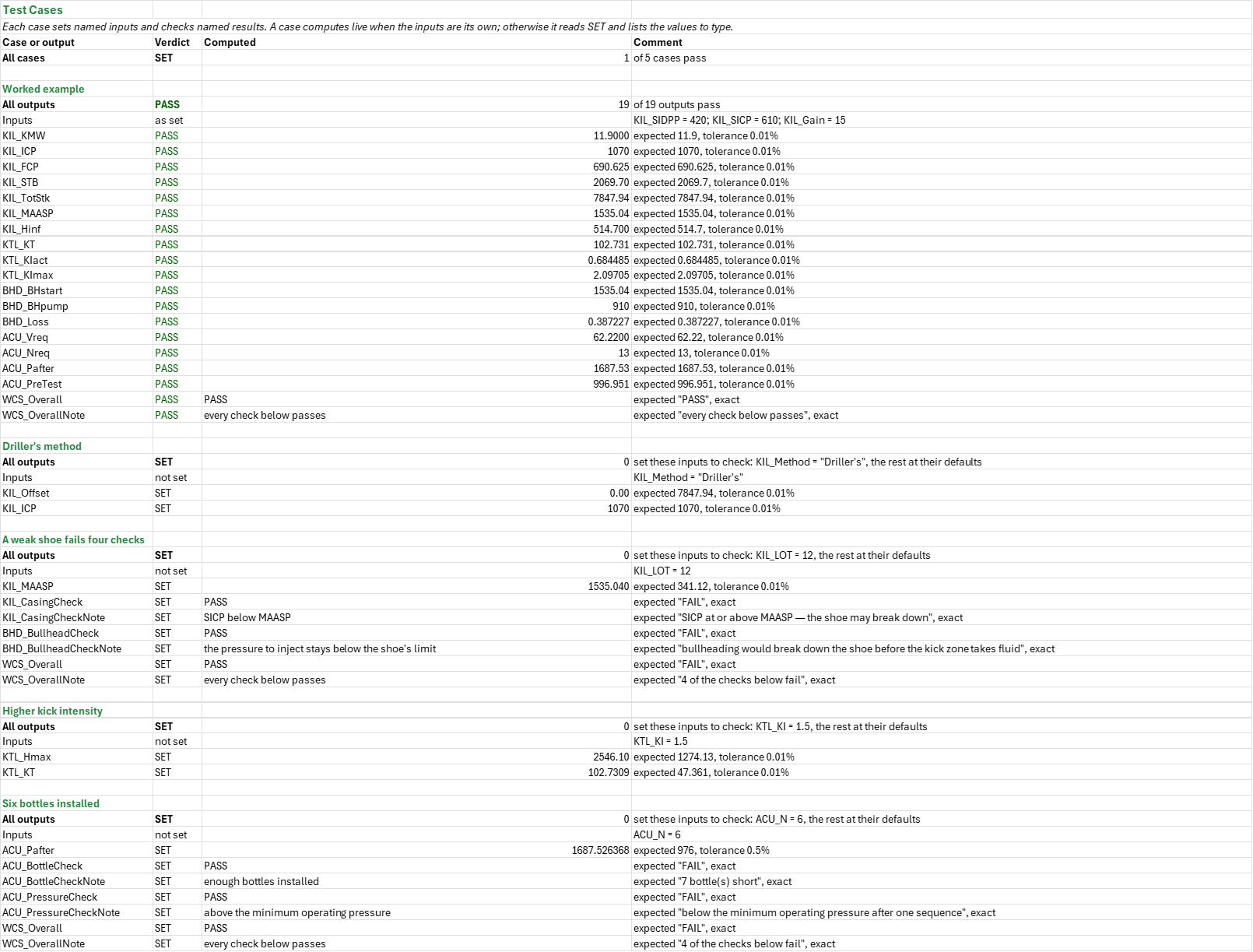
Guide— what the workbook answers and the order to work through its sheets.Kill Sheet— the well, the string, the mud, the pump and the slow circulating rate pressure, then SIDPP, SICP and the pit gain; the kill mud weight, ICP and FCP, strokes and time, MAASP, the influx height and gradient, and the drill pipe pressure schedule for the method picked from a list (Wait & Weight or Driller's), charted.Kick Tolerance— the largest kick the shoe can take at the design kick intensity, the kick's own intensity against what the shoe can take, the kick tolerance across kick intensities against the plan's minimum, and MAASP as the mud is weighted up.Bullheading— the shoe's limit on surface pressure, the rate the kick zone takes and the kill mud lost to it.Accumulator— the bottles sized by Boyle's law for the stack's functions, picked by name from typical volumes, with the precharge window, a precharge test and the pressure as fluid is drawn.Summary— what the driller posts and every check under one verdict.Test Cases— the worked example and other cases, with expected and computed results.
Three charts: the drill pipe pressure schedule, the kick tolerance against kick intensity, and the accumulator pressure against fluid drawn.
Functions used
Names (184)
| Name | Refers to | Comment |
|---|---|---|
PO.DE.Accumulator.PressureAfterDrawLAMBDA |
=LAMBDA(V_bottle_gal, P_precharge_psi, P_max_psi, V_drawn_gal, V_bottle_gal * P_precharge_psi / (V_bottle_gal * P_precharge_psi / P_max_psi + V_drawn_gal)) |
Accumulator pressure, psi, after V_drawn gal is drawn from a bottle charged to P_max (Boyle's law on the nitrogen precharge). |
PO.DE.Accumulator.UsableVolumeLAMBDA |
=LAMBDA(V_bottle_gal, P_precharge_psi, P_min_psi, P_max_psi, V_bottle_gal * P_precharge_psi * (1 / P_min_psi - 1 / P_max_psi)) |
Usable hydraulic fluid per accumulator bottle, gal, between the minimum and maximum operating pressures (Boyle's law on the nitrogen precharge). |
PO.DE.AnnularCapacityLAMBDA |
=LAMBDA(Dh_in, Dp_in, (Dh_in^2 - Dp_in^2) / 1029.4) |
Annular capacity, bbl/ft, from the hole and pipe diameters. |
PO.DE.BOP.ClosingVolumeLAMBDA |
=LAMBDA(Volumes_gal, Counts, DesignFactor, SUMPRODUCT(Volumes_gal, Counts) * DesignFactor) |
Hydraulic fluid, gal, to operate a list of BOP functions once (each function's volume times how many there are), times a design factor. |
PO.DE.BOP.PrechargeLAMBDA |
=LAMBDA(V_drawn_gal, V_total_gal, P_start_psi, P_final_psi, V_drawn_gal / V_total_gal * P_final_psi * P_start_psi / (P_start_psi - P_final_psi)) |
Accumulator nitrogen precharge, psi, that gives up V_drawn gal from a V_total gal bank as its pressure falls from P_start to P_final (Boyle's law). |
PO.DE.HydrostaticLAMBDA |
=LAMBDA(MW_ppg, TVD_ft, 0.052 * MW_ppg * TVD_ft) |
Hydrostatic pressure, psi, of a mud column of the given weight and true vertical depth. |
PO.DE.KickTol.IntensityLAMBDA |
=LAMBDA(MAASP_psi, MW_ppg, G_influx_psift, TVD_ft, V_kick_bbl, C_ann_bblft, (MAASP_psi - V_kick_bbl / C_ann_bblft * (0.052 * MW_ppg - G_influx_psift)) / (0.052 * TVD_ft)) |
Largest kick intensity, ppg over the mud weight, the shoe can take with an influx of V_kick bbl in an annulus of C_ann bbl/ft shut in at the bit. |
PO.DE.KickTol.VolumeLAMBDA |
=LAMBDA(MAASP_psi, MW_ppg, KI_ppg, G_influx_psift, TVD_ft, ShoeTVD_ft, C_bit_bblft, C_shoe_bblft, Output, LET(gMud, 0.052 * MW_ppg, hMax, MAX(0, (MAASP_psi - 0.052 * KI_ppg * TVD_ft) / (gMud - G_influx_psift)), vBit, hMax * C_bit_bblft, vShoe, hMax * C_shoe_bblft * (MAASP_psi + gMud * ShoeTVD_ft) / (0.052 * (MW_ppg + KI_ppg) * TVD_ft), IF(Output = 1, hMax, IF(Output = 2, vShoe, IF(Output = 3, vBit, MIN(vBit, vShoe)))))) |
Kick tolerance, bbl, single-bubble method: Output 0 the smaller of the two volumes; 1 the largest influx height, ft; 2 the volume at the shoe taken back to bottom-hole pressure; 3 the volume at the bit. |
PO.DE.PipeCapacityLAMBDA |
=LAMBDA(ID_in, ID_in^2 / 1029.4) |
Internal capacity of a pipe, bbl/ft, from its inside diameter. |
PO.DE.PressureToBreakCirculationLAMBDA |
=LAMBDA(GelStrength, L_ft, ID_in, GelStrength * L_ft / (300 * ID_in)) |
Pressure, psi, required to overcome mud gel strength and break circulation in a string of the given length and inside diameter. |
PO.DE.WellControl.FCPLAMBDA |
=LAMBDA(P_scr_psi, KMW_ppg, MW_ppg, P_scr_psi * KMW_ppg / MW_ppg) |
Final circulating pressure, psi: the slow circulating rate pressure scaled by kill mud weight over the original mud weight. |
PO.DE.WellControl.ICPLAMBDA |
=LAMBDA(SIDPP_psi, P_scr_psi, SIDPP_psi + P_scr_psi) |
Initial circulating pressure, psi: shut-in drill pipe pressure plus the slow circulating rate pressure at the kill rate. |
PO.DE.WellControl.InfluxGradientLAMBDA |
=LAMBDA(MW_ppg, SICP_psi, SIDPP_psi, H_ft, 0.052 * MW_ppg - (SICP_psi - SIDPP_psi) / H_ft) |
Influx gradient, psi/ft, from the difference between the shut-in casing and drill pipe pressures over the influx height. |
PO.DE.WellControl.KillMudWeightLAMBDA |
=LAMBDA(MW_ppg, SIDPP_psi, TVD_ft, MW_ppg + SIDPP_psi / (0.052 * TVD_ft)) |
Kill mud weight, ppg, that balances formation pressure: current mud weight plus the shut-in drill pipe pressure as an equivalent density at the bit's TVD. |
PO.DE.WellControl.MAASPLAMBDA |
=LAMBDA(EMW_shoe_ppg, MW_ppg, ShoeTVD_ft, (EMW_shoe_ppg - MW_ppg) * 0.052 * ShoeTVD_ft) |
Maximum allowable annular surface pressure, psi, from the shoe strength (leak-off EMW), the mud weight in the hole and the shoe TVD. |
PO.WI.Kill.BullheadLAMBDA |
=LAMBDA(FracGrad_psift, TVD_ft, P_hyd_initial_psi, KillFluid_ppg, V_string_bbl, V_pumped_bbl, FracGrad_psift * TVD_ft - ((1 - MAX(0, MIN(1, V_pumped_bbl / V_string_bbl))) * P_hyd_initial_psi + MAX(0, MIN(1, V_pumped_bbl / V_string_bbl)) * (0.052 * KillFluid_ppg * TVD_ft))) |
Maximum surface pressure, psi, while bullheading kill fluid down a string to a weak point: fracture pressure less the string's hydrostatic, kill fluid replacing the initial column as V_pumped goes in. |
PO.WI.Kill.FluidLossLAMBDA |
=LAMBDA(k_md, h_ft, dP_psi, mu_cp, re_ft, Dh_in, Time_hr, Output, LET(rate, 0.00708 * k_md * h_ft * dP_psi / (mu_cp * LN(re_ft / (Dh_in / 24))) / 24, IF(Output = 1, rate * Time_hr, rate))) |
Fluid lost to a zone by steady radial Darcy flow at an overbalance: Output 0 the rate, bbl/hr; 1 the volume over Time_hr, bbl. |
_PO.DE.IntervalOverlapLAMBDA |
=LAMBDA(top_ft, bottom_ft, from_ft, to_ft, MAX(0, MIN(bottom_ft, to_ft) - MAX(top_ft, from_ft))) |
Length, ft, of the interval top..bottom that lies inside from..to (0 when they do not overlap). |
ACU_BottleCheck |
Accumulator!$B$39 |
Bottle count check verdict |
ACU_BottleCheckNote |
Accumulator!$C$39 |
Bottle count check comment |
ACU_Curve |
Accumulator!$A$52:$C$62 |
Accumulator pressure against fluid drawn |
ACU_Functions |
Accumulator!$A$25:$E$28 |
BOP functions: the typical volume picked by name, how many, and the total |
ACU_Inputs |
Accumulator!$B$4:$B$10 |
Bottles, pressures, design factor and the precharge margin |
ACU_Margin |
Accumulator!$B$10 |
Margin to keep the minimum operating pressure above the precharge, psi |
ACU_N |
Accumulator!$B$8 |
Bottles installed |
ACU_Nreq |
Accumulator!$B$34 |
Bottles required |
ACU_Pafter |
Accumulator!$B$36 |
Pressure after operating every function once, pumps off, psi |
ACU_Pmax |
Accumulator!$B$7 |
Accumulator operating pressure (fully charged), psi |
ACU_Pmin |
Accumulator!$B$6 |
Minimum operating pressure, psi |
ACU_Pre |
Accumulator!$B$5 |
Nitrogen precharge pressure, psi |
ACU_PreHigh |
Accumulator!$B$38 |
Highest precharge the margin allows, psi |
ACU_PreLow |
Accumulator!$B$37 |
Lowest precharge that delivers the required fluid above the minimum, psi |
ACU_PreTest |
Accumulator!$B$47 |
Average precharge of the bank, psi |
ACU_PrechargeCheck |
Accumulator!$B$41 |
Precharge check verdict |
ACU_PrechargeCheckNote |
Accumulator!$C$41 |
Precharge check comment |
ACU_PressureCheck |
Accumulator!$B$40 |
Remaining pressure check verdict |
ACU_PressureCheckNote |
Accumulator!$C$40 |
Remaining pressure check comment |
ACU_Results |
Accumulator!$B$32:$B$41 |
Usable fluid, bottles required, pressure after one sequence, the precharge window and the checks |
ACU_SF |
Accumulator!$B$9 |
Design factor on the required volume |
ACU_TestCheck |
Accumulator!$B$48 |
Measured precharge check verdict |
ACU_TestCheckNote |
Accumulator!$C$48 |
Measured precharge check comment |
ACU_TestPf |
Accumulator!$B$46 |
Accumulator pressure after the draw, psi |
ACU_TestPs |
Accumulator!$B$44 |
Accumulator pressure before the draw, psi |
ACU_TestV |
Accumulator!$B$45 |
Fluid drawn, gal |
ACU_Test_Inputs |
Accumulator!$B$44:$B$46 |
The pressures before and after drawing a measured volume |
ACU_Test_Results |
Accumulator!$B$47:$B$48 |
Precharge measured by the test, and its check |
ACU_Typical |
Accumulator!$A$14:$B$21 |
Typical fluid to operate each BOP function once |
ACU_Usable |
Accumulator!$B$32 |
Usable fluid per bottle, gal |
ACU_Vb |
Accumulator!$B$4 |
Bottle nitrogen volume (an 11 gal bottle holds 10), gal |
ACU_Vfn |
Accumulator!$E$29 |
Fluid to operate every BOP function once, gal |
ACU_Vinst |
Accumulator!$B$35 |
Usable fluid installed, gal |
ACU_Vreq |
Accumulator!$B$33 |
Fluid required (functions × design factor), gal |
BHD_AnnShoe |
Bullheading!$B$13 |
Annulus volume, surface to the shoe, bbl |
BHD_BHend |
Bullheading!$B$17 |
Shoe limit with kill mud to the shoe, psi |
BHD_BHover |
Bullheading!$B$4 |
Pressure over the SICP to start injecting into the kick zone, psi |
BHD_BHpump |
Bullheading!$B$18 |
Surface pressure to start injecting (SICP + overpressure), psi |
BHD_BHstart |
Bullheading!$B$16 |
Shoe limit on surface pressure at the start, psi |
BHD_BullheadCheck |
Bullheading!$B$20 |
Bullhead check verdict |
BHD_BullheadCheckNote |
Bullheading!$C$20 |
Bullhead check comment |
BHD_Gfrac |
Bullheading!$B$14 |
Fracture gradient at the shoe (the leak-off test), psi/ft |
BHD_Hzone |
Bullheading!$B$6 |
Height of the kick zone open to the hole, ft |
BHD_Inputs |
Bullheading!$B$4:$B$10 |
Injection overpressure, the kick zone and the accepted loss rate |
BHD_Loss |
Bullheading!$B$24 |
Kill mud loss rate to the kick zone, bbl/hr |
BHD_LossCheck |
Bullheading!$B$26 |
Fluid loss check verdict |
BHD_LossCheckNote |
Bullheading!$C$26 |
Fluid loss check comment |
BHD_LossMax |
Bullheading!$B$10 |
Loss rate the mud program accepts, bbl/hr |
BHD_LossTime |
Bullheading!$B$9 |
Time the zone is exposed to kill mud, hr |
BHD_Loss_Results |
Bullheading!$B$23:$B$26 |
The overbalance with kill mud, the loss rate and volume, and the fluid loss check |
BHD_MuLoss |
Bullheading!$B$7 |
Viscosity of the fluid the zone takes (filtrate or brine), cp |
BHD_OB |
Bullheading!$B$23 |
Overbalance on the kick zone with kill mud, psi |
BHD_Perm |
Bullheading!$B$5 |
Permeability of the kick zone, mD |
BHD_Pshoe |
Bullheading!$B$15 |
Original mud hydrostatic at the shoe, psi |
BHD_Qinj |
Bullheading!$B$19 |
Rate the kick zone takes at that overpressure, bbl/hr |
BHD_Results |
Bullheading!$B$13:$B$20 |
The cased annulus, the shoe's fracture gradient and mud hydrostatic, its limits, the pressure to inject, the injection rate and the bullhead check |
BHD_Rinv |
Bullheading!$B$8 |
Radius the lost fluid invades to, ft |
BHD_Vlost |
Bullheading!$B$25 |
Kill mud lost over the exposure time, bbl |
KIL_AnnVol |
'Kill Sheet'!$F$27 |
Annular volume, bit to surface, bbl |
KIL_BTS |
'Kill Sheet'!$B$54 |
Strokes, bit to surface, stk |
KIL_Bit |
'Kill Sheet'!$B$10 |
Bit (open hole) diameter, in |
KIL_CapDC |
'Kill Sheet'!$E$21 |
Collars against open hole: annular capacity, bbl/ft |
KIL_CapDP |
'Kill Sheet'!$E$23 |
Drill pipe against open hole: annular capacity, bbl/ft |
KIL_CapHW |
'Kill Sheet'!$E$22 |
Heavy-weight against open hole: annular capacity, bbl/ft |
KIL_CasedVol |
'Kill Sheet'!$F$24:$F$26 |
Annulus against casing, the three sections: volume, bbl |
KIL_CasingCheck |
'Kill Sheet'!$B$65 |
Casing pressure check verdict |
KIL_CasingCheckNote |
'Kill Sheet'!$C$65 |
Casing pressure check comment |
KIL_CsgID |
'Kill Sheet'!$B$9 |
Casing inside diameter (9⅝" 47 lb/ft), in |
KIL_DCID |
'Kill Sheet'!$C$16 |
Drill collars: inside diameter, in |
KIL_DCL |
'Kill Sheet'!$D$16 |
Drill collars: length, ft |
KIL_DCOD |
'Kill Sheet'!$B$16 |
Drill collars: outside diameter, in |
KIL_DPID |
'Kill Sheet'!$C$14 |
Drill pipe (length = TD less the BHA): inside diameter, in |
KIL_DPL |
'Kill Sheet'!$D$14 |
Drill pipe (length = TD less the BHA): length, ft |
KIL_DPOD |
'Kill Sheet'!$B$14 |
Drill pipe (length = TD less the BHA): outside diameter, in |
KIL_FCP |
'Kill Sheet'!$B$49 |
Final circulating pressure (FCP), psi |
KIL_Gain |
'Kill Sheet'!$B$40 |
Pit gain, bbl |
KIL_Gel |
'Kill Sheet'!$B$35 |
10-minute gel strength, lb/100ft² |
KIL_Ggas |
'Kill Sheet'!$B$41 |
Influx gradient below which a kick reads as gas, psi/ft |
KIL_Ginflux |
'Kill Sheet'!$B$63 |
Influx gradient, psi/ft |
KIL_Gwater |
'Kill Sheet'!$B$42 |
Influx gradient from which a kick reads as water, psi/ft |
KIL_HWID |
'Kill Sheet'!$C$15 |
Heavy-weight drill pipe: inside diameter, in |
KIL_HWL |
'Kill Sheet'!$D$15 |
Heavy-weight drill pipe: length, ft |
KIL_HWOD |
'Kill Sheet'!$B$15 |
Heavy-weight drill pipe: outside diameter, in |
KIL_Hinf |
'Kill Sheet'!$B$62 |
Influx height (filling the open-hole annulus from the bit), ft |
KIL_ICP |
'Kill Sheet'!$B$48 |
Initial circulating pressure (ICP), psi |
KIL_Influx |
'Kill Sheet'!$B$64 |
Likely influx, read from its gradient |
KIL_Inputs |
'Kill Sheet'!$B$5:$B$42 |
The well, the string, the mud, the pump, the kick and the gradients that read an influx |
KIL_KMW |
'Kill Sheet'!$B$47 |
Kill mud weight (rounded up to 0.1 ppg), ppg |
KIL_KMWbal |
'Kill Sheet'!$B$46 |
Kill mud weight to balance the formation, ppg |
KIL_KmwCheck |
'Kill Sheet'!$B$66 |
Kill mud check verdict |
KIL_KmwCheckNote |
'Kill Sheet'!$C$66 |
Kill mud check comment |
KIL_LOT |
'Kill Sheet'!$B$31 |
Leak-off test at the shoe, as an equivalent mud weight, ppg |
KIL_LenDC |
'Kill Sheet'!$D$21 |
Collars against open hole: length, ft |
KIL_LenHW |
'Kill Sheet'!$D$22 |
Heavy-weight against open hole: length, ft |
KIL_MAASP |
'Kill Sheet'!$B$60 |
MAASP with the original mud, psi |
KIL_MAASPkill |
'Kill Sheet'!$B$61 |
MAASP with kill mud to the shoe, psi |
KIL_MD |
'Kill Sheet'!$B$5 |
Measured depth of the bit (TD), ft |
KIL_MW |
'Kill Sheet'!$B$30 |
Original mud weight, ppg |
KIL_Method |
'Kill Sheet'!$B$70 |
Kill method |
KIL_Method_Inputs |
'Kill Sheet'!$B$70 |
The kill method the schedule follows |
KIL_Method_Results |
'Kill Sheet'!$B$71:$B$72 |
The schedule shown and the strokes before the kill mud |
KIL_Offset |
'Kill Sheet'!$B$72 |
Strokes pumped before the kill mud, stk |
KIL_Pbreak |
'Kill Sheet'!$B$50 |
Pressure to break circulation (gels in the string), psi |
KIL_Pform |
'Kill Sheet'!$B$45 |
Formation pressure (mud hydrostatic + SIDPP), psi |
KIL_PositionCheck |
'Kill Sheet'!$B$67 |
Influx position check verdict |
KIL_PositionCheckNote |
'Kill Sheet'!$C$67 |
Influx position check comment |
KIL_Pscr |
'Kill Sheet'!$B$34 |
Slow circulating rate pressure at the kill rate, psi |
KIL_PumpOut |
'Kill Sheet'!$B$32 |
Pump output at the running efficiency, bbl/stk |
KIL_Results |
'Kill Sheet'!$B$45:$B$67 |
Kill mud, circulating pressures, strokes and time, MAASP, the influx and the three checks |
KIL_SICP |
'Kill Sheet'!$B$39 |
Shut-in casing pressure (SICP), psi |
KIL_SIDPP |
'Kill Sheet'!$B$38 |
Shut-in drill pipe pressure (SIDPP), psi |
KIL_SPM |
'Kill Sheet'!$B$33 |
Kill rate, spm |
KIL_STB |
'Kill Sheet'!$B$53 |
Strokes, surface to bit, stk |
KIL_Schedule |
'Kill Sheet'!$B$74:$C$86 |
Drill pipe pressure schedule |
KIL_ShoeMD |
'Kill Sheet'!$B$7 |
Casing shoe measured depth, ft |
KIL_ShoeTVD |
'Kill Sheet'!$B$8 |
Casing shoe true vertical depth, ft |
KIL_StringVol |
'Kill Sheet'!$F$17 |
Drill string internal volume, bbl |
KIL_TVD |
'Kill Sheet'!$B$6 |
True vertical depth of the bit, ft |
KIL_Tbit |
'Kill Sheet'!$B$56 |
Time, surface to bit, min |
KIL_Tcirc |
'Kill Sheet'!$B$57 |
Time, one full circulation, min |
KIL_TotStk |
'Kill Sheet'!$B$55 |
Strokes, one full circulation, stk |
KIL_VolDC |
'Kill Sheet'!$F$21 |
Collars against open hole: annular volume, bbl |
KIL_VolHW |
'Kill Sheet'!$F$22 |
Heavy-weight against open hole: annular volume, bbl |
KTL_Curve |
'Kick Tolerance'!$A$21:$F$29 |
Kick tolerance against kick intensity |
KTL_Ginf |
'Kick Tolerance'!$B$5 |
Influx gradient to design for (0.1 psi/ft is gas), psi/ft |
KTL_Hmax |
'Kick Tolerance'!$B$9 |
Largest influx height the shoe can take, ft |
KTL_Inputs |
'Kick Tolerance'!$B$4:$B$6 |
Design kick intensity, design influx gradient and the plan's minimum kick tolerance |
KTL_KI |
'Kick Tolerance'!$B$4 |
Kick intensity: formation pressure over the mud weight, ppg |
KTL_KIact |
'Kick Tolerance'!$B$14 |
Kick intensity of this kick (SIDPP over the bit TVD), ppg |
KTL_KImax |
'Kick Tolerance'!$B$15 |
Largest kick intensity the shoe can take with this pit gain, ppg |
KTL_KT |
'Kick Tolerance'!$B$12 |
Kick tolerance, bbl |
KTL_KTmin |
'Kick Tolerance'!$B$6 |
Kick tolerance the well plan requires, bbl |
KTL_KiCheck |
'Kick Tolerance'!$B$16 |
Kick intensity check verdict |
KTL_KiCheckNote |
'Kick Tolerance'!$C$16 |
Kick intensity check comment |
KTL_KtCheck |
'Kick Tolerance'!$B$13 |
Kick tolerance check verdict |
KTL_KtCheckNote |
'Kick Tolerance'!$C$13 |
Kick tolerance check comment |
KTL_Maasp |
'Kick Tolerance'!$A$38:$B$45 |
MAASP at the original mud weight and each step heavier, to the leak-off |
KTL_Results |
'Kick Tolerance'!$B$9:$B$16 |
Kick tolerance at the design kick, the kick's own intensity and the shoe's limit, and their checks |
KTL_Vbit |
'Kick Tolerance'!$B$10 |
Kick volume at the bit (that height around the BHA), bbl |
KTL_Vshoe |
'Kick Tolerance'!$B$11 |
Kick volume at the bit for that height at the shoe (Boyle's law), bbl |
KTL_dKI |
'Kick Tolerance'!$B$19 |
Kick intensity step, ppg |
KTL_dMW |
'Kick Tolerance'!$B$36 |
Mud weight step, ppg |
WCS_BHpump |
Summary!$B$23 |
Surface pressure to start injecting, psi |
WCS_BHstart |
Summary!$B$22 |
Shoe limit on surface pressure when bullheading starts, psi |
WCS_Bop_Results |
Summary!$B$22:$B$26 |
The bullheading limit and pressure, and the bottles required, installed, and the pressure left |
WCS_Checks |
Summary!$B$29:$B$39 |
Every check of the workbook, read from its sheet |
WCS_FCP |
Summary!$B$9 |
Final circulating pressure (FCP), psi |
WCS_ICP |
Summary!$B$8 |
Initial circulating pressure (ICP), psi |
WCS_KIact |
Summary!$B$18 |
Kick intensity of this kick, ppg |
WCS_KImax |
Summary!$B$19 |
Largest kick intensity the shoe can take with this pit gain, ppg |
WCS_KMW |
Summary!$B$7 |
Kill mud weight, ppg |
WCS_KT |
Summary!$B$17 |
Kick tolerance at the design kick intensity, bbl |
WCS_Kill_Results |
Summary!$B$7:$B$12 |
Kill mud weight, ICP, FCP, strokes and time to the bit, and strokes for one circulation |
WCS_MAASP |
Summary!$B$15 |
MAASP with the original mud, psi |
WCS_MAASPkill |
Summary!$B$16 |
MAASP with kill mud to the shoe, psi |
WCS_N |
Summary!$B$25 |
Accumulator bottles installed |
WCS_Nreq |
Summary!$B$24 |
Accumulator bottles required |
WCS_Overall |
Summary!$B$4 |
Well control check verdict |
WCS_OverallNote |
Summary!$C$4 |
Well control check comment |
WCS_Pafter |
Summary!$B$26 |
Accumulator pressure after one full sequence, psi |
WCS_STB |
Summary!$B$10 |
Strokes, surface to bit, stk |
WCS_Shoe_Results |
Summary!$B$15:$B$19 |
MAASP with the original and the kill mud, the kick tolerance and the two kick intensities |
WCS_Tbit |
Summary!$B$11 |
Time, surface to bit, min |
WCS_TotStk |
Summary!$B$12 |
Strokes, one full circulation, stk |
WCS_Verdict |
Summary!$B$4 |
One verdict over every check of the workbook |
WCS_VerdictNote |
Summary!$C$4 |
One verdict over every check of the workbook comment |
Details
| Opens in | Needs Microsoft 365 or Excel 2024: it uses functions Excel 2016 doesn't have, such as named LAMBDAs, which show #NAME? there. |
| File | WellControl.xlsx, 58 KB |
| Category | Drilling |
| For agents and tools | Descriptor (.md) |