Cementing Program
Description
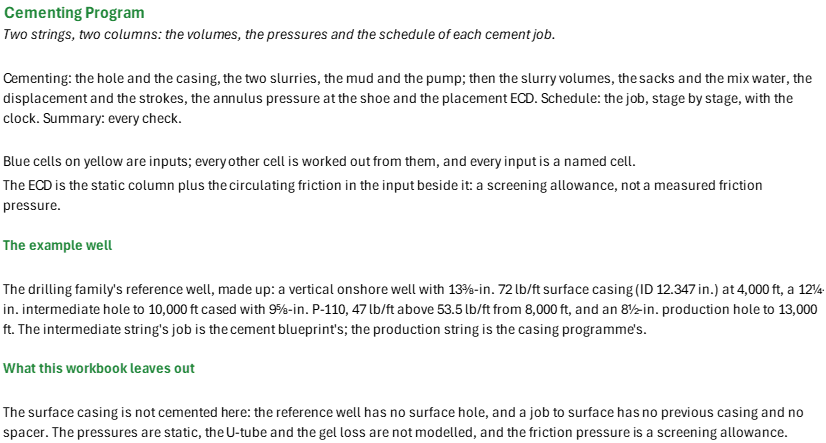
How much cement does each casing string take, how much displacement does it need, will the column break the formation down, and how long does the job run? For each string you enter the hole and casing, the lead and tail slurries and the spacer, the mud, the pump and the limits. You read off the slurry volumes, sacks and mix water, the displacement and strokes to bump the plug, the bump pressure against the burst rating, the placement ECD and equivalent mud weights against the fracture gradient, and the job clock stage by stage. Field units; no add-in needed.
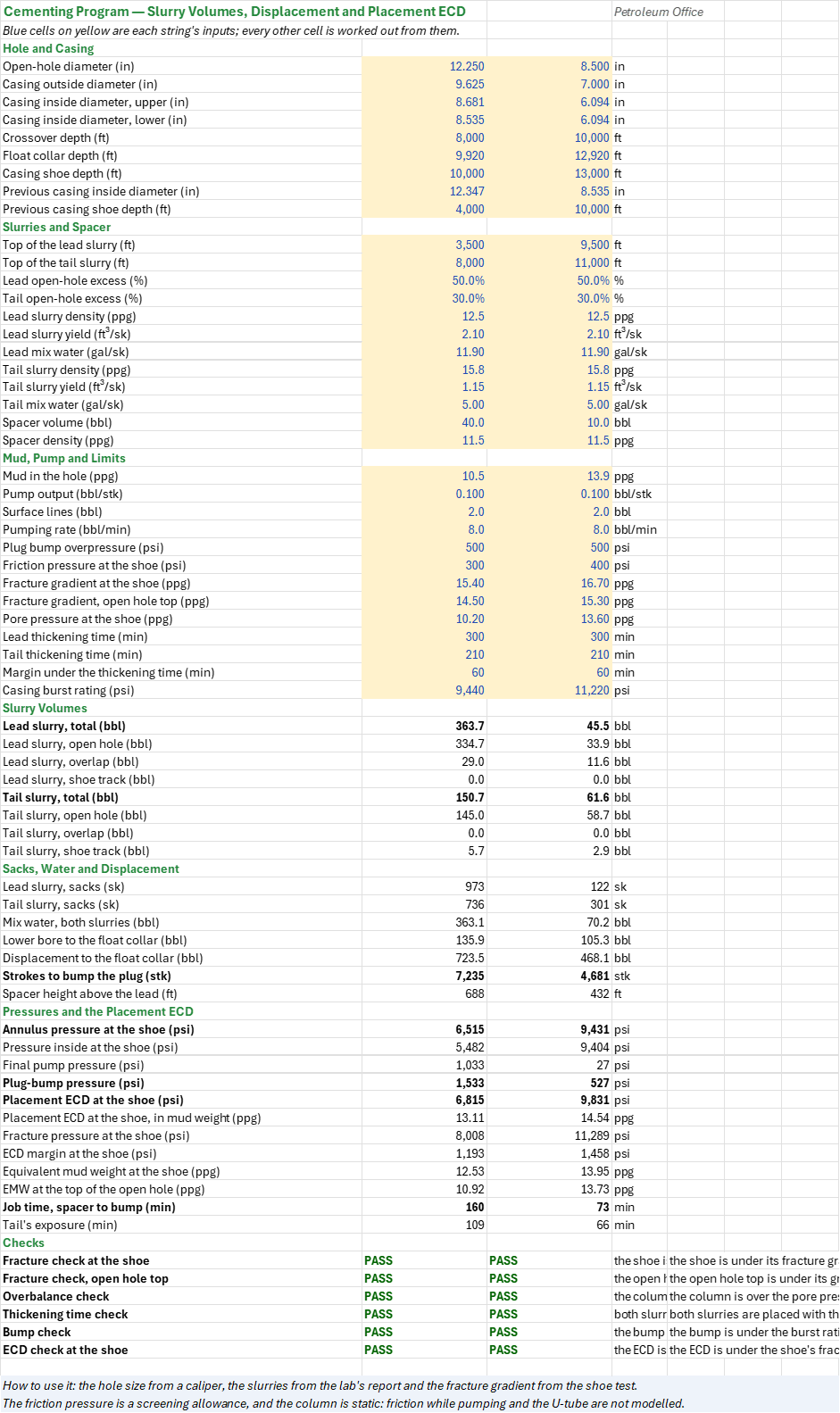
How to use it: The well is made up. Enter each string's hole, casing, slurries, spacer, mud, pump and limits in its column on the Cementing sheet. Take the hole size from a caliper and cut the excess to what the caliper does not see; each slurry's density, yield, mix water and thickening time from the lab's slurry report for the job's temperature; the fracture gradient from the shoe test and the pore pressure from the pore-pressure sheet; and the pump output from the rig's pump at its running efficiency. The friction pressure is a screening allowance and must be replaced by the pressure from the job's hydraulics. Read the job stage by stage on the Schedule sheet, and the headline numbers of both strings and every check on the Summary.
Method: Each slurry's volume is a capacity times a length: (Dh^2 - OD^2)/1029.4 bbl/ft for the open hole, times (1 + excess); (IDprev^2 - OD^2)/1029.4 for the overlap; and ID^2/1029.4 for the shoe track, with Dh the hole, OD the casing outside diameter and IDprev the previous casing's inside diameter. The lead fills the open hole from the tail's top up to the previous shoe and the overlap above it; the tail fills the open hole from the shoe up to its top, plus the shoe track. Sacks are the volume x 5.6146 ft3/bbl over the yield, and the mix water the sacks x water over 42 gal/bbl. The displacement is the upper bore (IDupper^2/1029.4 x crossover depth) plus the lower bore to the float collar and the surface lines, and the strokes are that over the pump output. The spacer rises above the lead in the cased annulus, a height of its volume over (IDprev^2 - OD^2)/1029.4. At the end of placement the annulus holds, from the top, mud, spacer, lead and tail, each at its height for a gauge hole, so the pressure at the shoe is the sum of 0.052 x density x height above. Inside the casing is mud to the float collar and tail in the shoe track. The final pump pressure is the annulus less the inside at the shoe, and the plug bumps at that plus the overpressure. The placement ECD at the shoe is the static annulus pressure plus the circulating friction pressure entered beside it. The lead is pumped from the start, so its exposure is the whole job, spacer to bump, at the rate; the tail's runs from its own start.
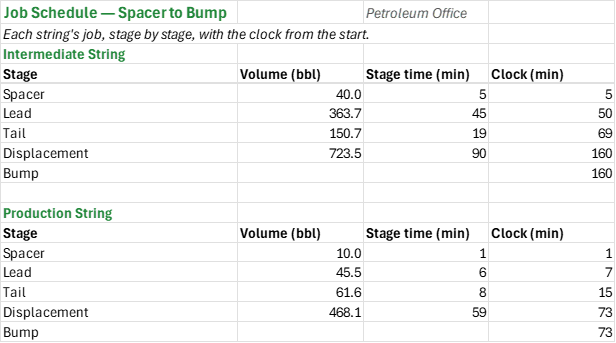
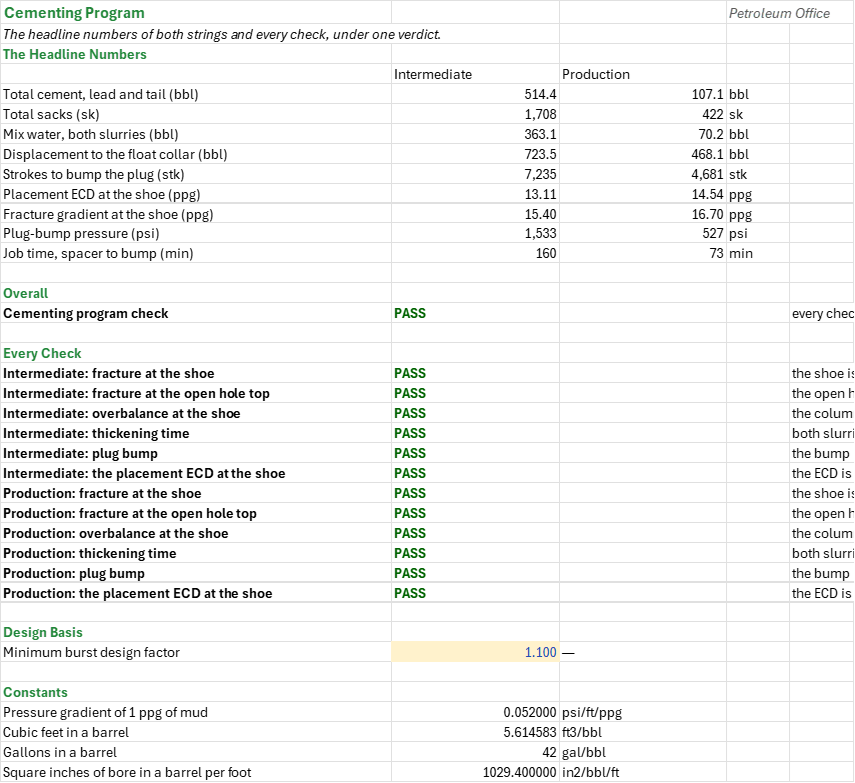
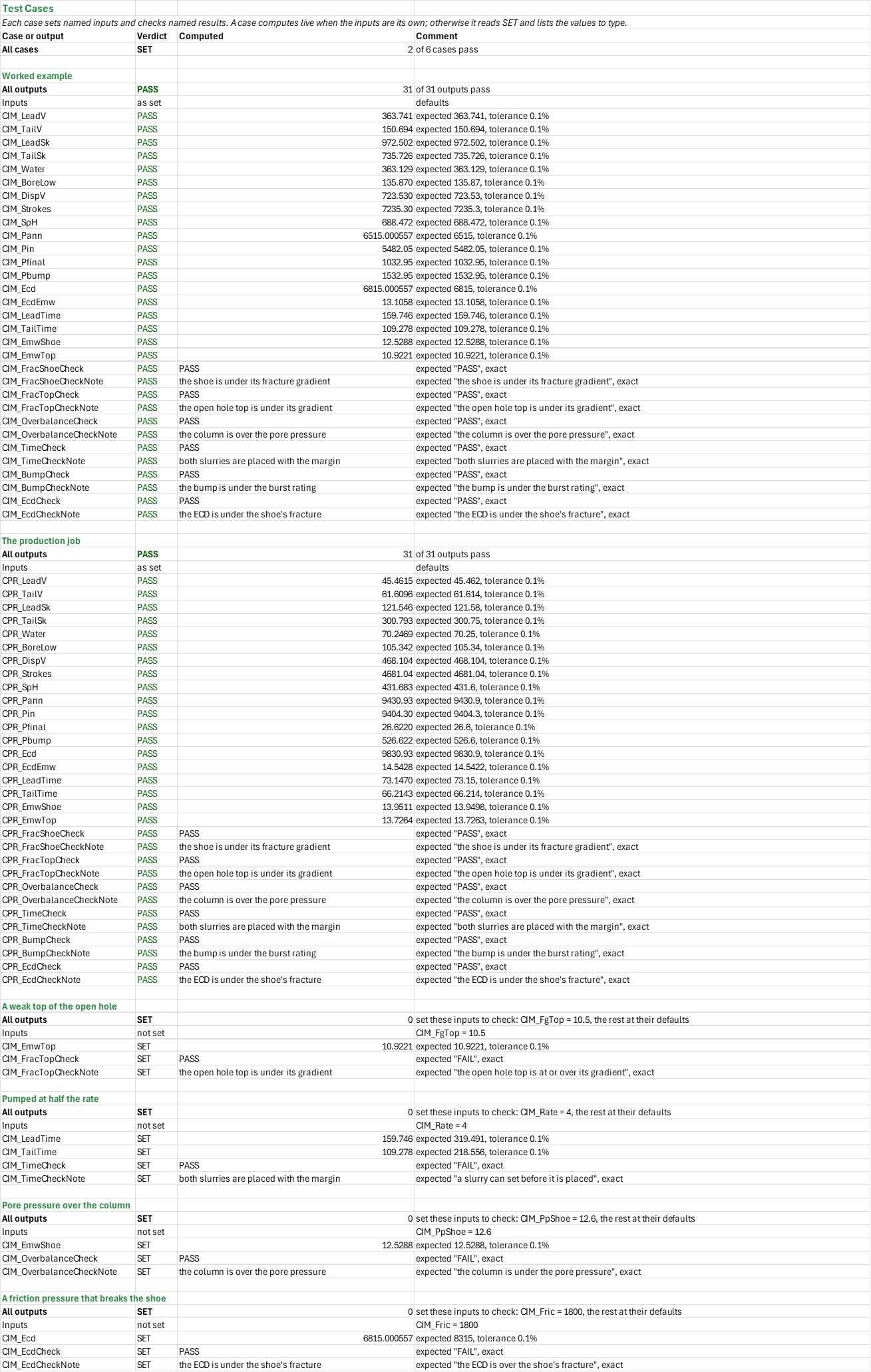
Example: The drilling family's reference well, made up: the 9-5/8-in. intermediate string cemented in the 12-1/4-in. hole below the 13-3/8-in. surface shoe, and the 7-in. production string cemented in the 8-1/2-in. hole below the intermediate shoe. The intermediate job takes 334.7 bbl of open hole at 50 % excess and 29.0 bbl of overlap, 363.7 bbl or 973 sacks of lead, and 145.0 bbl at 30 % with 5.7 bbl of shoe track, 150.7 bbl or 736 sacks of tail. Together they need 363 bbl of mix water. The displacement is 585.7 bbl down the upper bore, 135.9 bbl down the lower bore to the collar and 2 bbl of lines, 723.5 bbl or 7,235 strokes. The spacer stands 688 ft above the lead. At the end of the job the annulus puts 6,515 psi on the shoe, 12.53 ppg against a 15.4 ppg fracture gradient and 10.2 ppg of pore pressure; at the top of the open hole it is 10.92 ppg against the 14.5 ppg leak-off test. Inside, mud to the collar and tail in the shoe track make 5,482 psi, so the final pump pressure is 1,033 psi and the plug bumps at 1,533 psi, well under the 9,440 psi burst rating over 1.1. With the 300 psi screening allowance for friction the placement ECD is 6,815 psi, 13.11 ppg, 1,193 psi under the fracture pressure at the shoe. The whole job takes 160 min at 8 bbl/min, and the tail is in place 109 min after it starts. The production job takes 45.5 bbl of lead and 61.6 bbl of tail, 468.1 bbl of displacement or 4,681 strokes, and puts 9,431 psi on the shoe, 13.95 ppg against a 16.7 ppg fracture gradient; with 400 psi of friction the ECD is 9,831 psi, 14.54 ppg, 1,458 psi under the fracture pressure.
Validity
The volumes are for a gauge hole plus a flat excess, so the tops of cement in the column are where the design puts them, not where an enlarged hole would. The pressures are static: friction while pumping is an allowance the reader sets, and the free fall of heavy cement down the casing (the U-tube) can run the pumps ahead of the returns; the workbook does not model the dynamic U-tube. The end of placement is the highest static pressure the open hole sees when every slurry is heavier than the mud it displaces. Cement's loss of hydrostatic pressure as it gels (a flow risk after placement) is not modelled. The workbook does not compute centraliser spacing to API 10D. The fracture and pore pressures between the shoes are straight lines in mud weight; for a full profile use the pore-pressure sheet (po.de.pore.pressure.eaton). Mud compressibility and casing ballooning in the displacement are left out. The surface casing is not cemented here: the reference well has no surface hole, and a job cemented to surface has no previous casing and no spacer. Vertical well and field units. Named alternatives: the dynamic U-tube and API 10D centraliser spacing, for which the add-in has no functions.
References
- Nelson, E.B. and Guillot, D. (eds.) (2006). Well Cementing, 2nd ed. Schlumberger (job design volumes, displacement and plug bumping, placement pressures).
- Bourgoyne, A.T., Millheim, K.K., Chenevert, M.E. and Young, F.S. (1986). Applied Drilling Engineering. SPE Textbook Series Vol. 2, ch. 3 (cementing).
- Lapeyrouse, N.J. (2002). Formulas and Calculations for Drilling, Production and Workover, 2nd ed. Gulf Professional Publishing, ch. 4 (cementing calculations).
Inputs
One column per string: intermediate (CIM_) and production (CPR_). Defaults are intermediate, production.
| Input | Unit | Default | Name |
|---|---|---|---|
| Open-hole diameter | in | 12.25, 8.5 | CIM_Hole, CPR_Hole |
| Casing outside diameter | in | 9.625, 7 | CIM_OD, CPR_OD |
| Casing inside diameter, upper | in | see the Cementing sheet | CIM_IdTop, CPR_IdTop |
| Casing inside diameter, lower | in | see the Cementing sheet | CIM_IdBot, CPR_IdBot |
| Crossover depth | ft | see the Cementing sheet | CIM_Xover, CPR_Xover |
| Float collar depth | ft | see the Cementing sheet | CIM_FC, CPR_FC |
| Casing shoe depth | ft | see the Cementing sheet | CIM_Shoe, CPR_Shoe |
| Previous casing inside diameter | in | see the Cementing sheet | CIM_PrevId, CPR_PrevId |
| Previous casing shoe depth | ft | see the Cementing sheet | CIM_PrevShoe, CPR_PrevShoe |
| Top of the lead slurry | ft | 3500, 9500 | CIM_LeadTop, CPR_LeadTop |
| Top of the tail slurry | ft | 8000, 11000 | CIM_TailTop, CPR_TailTop |
| Lead open-hole excess | % | 50, 50 | CIM_LeadEx, CPR_LeadEx |
| Tail open-hole excess | % | 30, 30 | CIM_TailEx, CPR_TailEx |
| Lead slurry density | ppg | 12.5 | CIM_LeadW, CPR_LeadW |
| Lead slurry yield | ft3/sk | 2.1 | CIM_LeadY, CPR_LeadY |
| Lead mix water | gal/sk | 11.9 | CIM_LeadWat, CPR_LeadWat |
| Tail slurry density | ppg | 15.8 | CIM_TailW, CPR_TailW |
| Tail slurry yield | ft3/sk | 1.15 | CIM_TailY, CPR_TailY |
| Tail mix water | gal/sk | 5 | CIM_TailWat, CPR_TailWat |
| Spacer volume | bbl | 40, 10 | CIM_SpV, CPR_SpV |
| Spacer density | ppg | 11.5 | CIM_SpW, CPR_SpW |
| Mud in the hole | ppg | 10.5, 13.9 | CIM_MW, CPR_MW |
| Pump output | bbl/stk | 0.1 | CIM_PumpOut, CPR_PumpOut |
| Surface lines | bbl | 2 | CIM_Lines, CPR_Lines |
| Pumping rate | bbl/min | 8 | CIM_Rate, CPR_Rate |
| Plug bump overpressure | psi | 500 | CIM_Bump, CPR_Bump |
| Friction pressure at the shoe (screening allowance) | psi | 300, 400 | CIM_Fric, CPR_Fric |
| Fracture gradient at the shoe | ppg | 15.4, 16.7 | CIM_FgShoe, CPR_FgShoe |
| Fracture gradient, open hole top | ppg | 14.5, see the Cementing sheet | CIM_FgTop, CPR_FgTop |
| Pore pressure at the shoe | ppg | 10.2, see the Cementing sheet | CIM_PpShoe, CPR_PpShoe |
| Lead thickening time | min | 300 | CIM_LeadTT, CPR_LeadTT |
| Tail thickening time | min | 210 | CIM_TailTT, CPR_TailTT |
| Margin under the thickening time | min | 60 | CIM_TTMargin, CPR_TTMargin |
| Casing burst rating | psi | 9440, 11220 | CIM_Pburst, CPR_Pburst |
| Minimum burst design factor (Summary) | — | 1.1 | CSU_DFb |
Sheets
Guide— what the workbook answers, the example well and what the workbook leaves out.Cementing— one column per string: the hole and casing, slurries and spacer, mud, pump and limits; the lead and tail volumes with their open hole, overlap and shoe track; sacks, mix water, displacement and strokes; the pressures at the end of placement, the placement ECD and the equivalent mud weights at the shoe and at the top of the open hole; and the checks.Schedule— each string's job stage by stage, spacer, lead, tail, displacement and bump, with each stage's volume and time and the clock from the start.Summary— the headline numbers of both strings, the design basis and every check under one verdict.Test Cases— the worked example and other cases, with expected and computed results.
No chart: the job's answer is a set of numbers and a schedule.
Functions used
Names (157)
| Name | Refers to | Comment |
|---|---|---|
PO.DE.AnnularCapacityLAMBDA |
=LAMBDA(Dh_in, Dp_in, (Dh_in^2 - Dp_in^2) / 1029.4) |
Annular capacity, bbl/ft, from the hole and pipe diameters. |
PO.DE.Cement.DisplacementLAMBDA |
=LAMBDA(CasingID_in, FC_ft, Extra_bbl, PumpOut_bblstk, LET(vol, CasingID_in^2/1029.4*FC_ft + Extra_bbl, HSTACK(vol, vol/PumpOut_bblstk))) |
Cement displacement volume to the float collar, bbl, and the pump strokes to bump the plug: {bbl, strokes}. |
PO.DE.Cement.VolumeLAMBDA |
=LAMBDA(Dh_in, OD_in, ID_in, PrevID_in, OH_ft, CH_ft, Shoe_ft, Excess, LET(voh, (Dh_in^2 - OD_in^2)/1029.4*OH_ft*(1 + Excess), vch, (PrevID_in^2 - OD_in^2)/1029.4*CH_ft, vsh, ID_in^2/1029.4*Shoe_ft, HSTACK(voh + vch + vsh, voh, vch, vsh))) |
Slurry volume of one cement stage, bbl: open-hole annulus with excess, cased overlap and shoe track, as {total, open hole, overlap, shoe track}. |
PO.DE.HydrostaticLAMBDA |
=LAMBDA(MW_ppg, TVD_ft, 0.052 * MW_ppg * TVD_ft) |
Hydrostatic pressure, psi, of a mud column of the given weight and true vertical depth. |
PO.DE.PipeCapacityLAMBDA |
=LAMBDA(ID_in, ID_in^2 / 1029.4) |
Internal capacity of a pipe, bbl/ft, from its inside diameter. |
CIM_BoreLow |
Cementing!$B$53 |
|
CIM_Bump |
Cementing!$B$31 |
|
CIM_BumpCheck |
Cementing!$B$75 |
|
CIM_BumpCheckNote |
Cementing!$E$75 |
|
CIM_DispV |
Cementing!$B$54 |
|
CIM_Ecd |
Cementing!$B$62 |
|
CIM_EcdCheck |
Cementing!$B$76 |
|
CIM_EcdCheckNote |
Cementing!$E$76 |
|
CIM_EcdEmw |
Cementing!$B$63 |
|
CIM_EcdMargin |
Cementing!$B$65 |
|
CIM_EmwShoe |
Cementing!$B$66 |
|
CIM_EmwTop |
Cementing!$B$67 |
|
CIM_FC |
Cementing!$B$9 |
|
CIM_FgPsi |
Cementing!$B$64 |
|
CIM_FgShoe |
Cementing!$B$33 |
|
CIM_FgTop |
Cementing!$B$34 |
|
CIM_FracShoeCheck |
Cementing!$B$71 |
|
CIM_FracShoeCheckNote |
Cementing!$E$71 |
|
CIM_FracTopCheck |
Cementing!$B$72 |
|
CIM_FracTopCheckNote |
Cementing!$E$72 |
|
CIM_Fric |
Cementing!$B$32 |
|
CIM_Hole |
Cementing!$B$4 |
|
CIM_IdBot |
Cementing!$B$7 |
|
CIM_IdTop |
Cementing!$B$6 |
|
CIM_Inputs |
Cementing!$B$4:$B$39 |
|
CIM_Job |
Schedule!$B$5:$D$9 |
|
CIM_LeadEx |
Cementing!$B$16 |
|
CIM_LeadSk |
Cementing!$B$50 |
|
CIM_LeadTT |
Cementing!$B$36 |
|
CIM_LeadTime |
Cementing!$B$68 |
|
CIM_LeadTop |
Cementing!$B$14 |
|
CIM_LeadV |
Cementing!$B$41 |
|
CIM_LeadW |
Cementing!$B$18 |
|
CIM_LeadWat |
Cementing!$B$20 |
|
CIM_LeadY |
Cementing!$B$19 |
|
CIM_Lines |
Cementing!$B$29 |
|
CIM_MW |
Cementing!$B$27 |
|
CIM_OD |
Cementing!$B$5 |
|
CIM_OverbalanceCheck |
Cementing!$B$73 |
|
CIM_OverbalanceCheckNote |
Cementing!$E$73 |
|
CIM_Pann |
Cementing!$B$58 |
|
CIM_Pbump |
Cementing!$B$61 |
|
CIM_Pburst |
Cementing!$B$39 |
|
CIM_Pfinal |
Cementing!$B$60 |
|
CIM_Pin |
Cementing!$B$59 |
|
CIM_PpShoe |
Cementing!$B$35 |
|
CIM_PrevId |
Cementing!$B$11 |
|
CIM_PrevShoe |
Cementing!$B$12 |
|
CIM_PumpOut |
Cementing!$B$28 |
|
CIM_Rate |
Cementing!$B$30 |
|
CIM_Results |
Cementing!$B$41:$B$76 |
|
CIM_Shoe |
Cementing!$B$10 |
|
CIM_SpH |
Cementing!$B$56 |
|
CIM_SpV |
Cementing!$B$24 |
|
CIM_SpW |
Cementing!$B$25 |
|
CIM_Strokes |
Cementing!$B$55 |
|
CIM_TTMargin |
Cementing!$B$38 |
|
CIM_TailEx |
Cementing!$B$17 |
|
CIM_TailSk |
Cementing!$B$51 |
|
CIM_TailTT |
Cementing!$B$37 |
|
CIM_TailTime |
Cementing!$B$69 |
|
CIM_TailTop |
Cementing!$B$15 |
|
CIM_TailV |
Cementing!$B$45 |
|
CIM_TailW |
Cementing!$B$21 |
|
CIM_TailWat |
Cementing!$B$23 |
|
CIM_TailY |
Cementing!$B$22 |
|
CIM_TimeCheck |
Cementing!$B$74 |
|
CIM_TimeCheckNote |
Cementing!$E$74 |
|
CIM_Water |
Cementing!$B$52 |
|
CIM_Xover |
Cementing!$B$8 |
|
CPR_BoreLow |
Cementing!$C$53 |
|
CPR_Bump |
Cementing!$C$31 |
|
CPR_BumpCheck |
Cementing!$C$75 |
|
CPR_BumpCheckNote |
Cementing!$D$75 |
|
CPR_DispV |
Cementing!$C$54 |
|
CPR_Ecd |
Cementing!$C$62 |
|
CPR_EcdCheck |
Cementing!$C$76 |
|
CPR_EcdCheckNote |
Cementing!$D$76 |
|
CPR_EcdEmw |
Cementing!$C$63 |
|
CPR_EcdMargin |
Cementing!$C$65 |
|
CPR_EmwShoe |
Cementing!$C$66 |
|
CPR_EmwTop |
Cementing!$C$67 |
|
CPR_FC |
Cementing!$C$9 |
|
CPR_FgPsi |
Cementing!$C$64 |
|
CPR_FgShoe |
Cementing!$C$33 |
|
CPR_FgTop |
Cementing!$C$34 |
|
CPR_FracShoeCheck |
Cementing!$C$71 |
|
CPR_FracShoeCheckNote |
Cementing!$D$71 |
|
CPR_FracTopCheck |
Cementing!$C$72 |
|
CPR_FracTopCheckNote |
Cementing!$D$72 |
|
CPR_Fric |
Cementing!$C$32 |
|
CPR_Hole |
Cementing!$C$4 |
|
CPR_IdBot |
Cementing!$C$7 |
|
CPR_IdTop |
Cementing!$C$6 |
|
CPR_Inputs |
Cementing!$C$4:$C$39 |
|
CPR_Job |
Schedule!$B$13:$D$17 |
|
CPR_LeadEx |
Cementing!$C$16 |
|
CPR_LeadSk |
Cementing!$C$50 |
|
CPR_LeadTT |
Cementing!$C$36 |
|
CPR_LeadTime |
Cementing!$C$68 |
|
CPR_LeadTop |
Cementing!$C$14 |
|
CPR_LeadV |
Cementing!$C$41 |
|
CPR_LeadW |
Cementing!$C$18 |
|
CPR_LeadWat |
Cementing!$C$20 |
|
CPR_LeadY |
Cementing!$C$19 |
|
CPR_Lines |
Cementing!$C$29 |
|
CPR_MW |
Cementing!$C$27 |
|
CPR_OD |
Cementing!$C$5 |
|
CPR_OverbalanceCheck |
Cementing!$C$73 |
|
CPR_OverbalanceCheckNote |
Cementing!$D$73 |
|
CPR_Pann |
Cementing!$C$58 |
|
CPR_Pbump |
Cementing!$C$61 |
|
CPR_Pburst |
Cementing!$C$39 |
|
CPR_Pfinal |
Cementing!$C$60 |
|
CPR_Pin |
Cementing!$C$59 |
|
CPR_PpShoe |
Cementing!$C$35 |
|
CPR_PrevId |
Cementing!$C$11 |
|
CPR_PrevShoe |
Cementing!$C$12 |
|
CPR_PumpOut |
Cementing!$C$28 |
|
CPR_Rate |
Cementing!$C$30 |
|
CPR_Results |
Cementing!$C$41:$C$76 |
|
CPR_Shoe |
Cementing!$C$10 |
|
CPR_SpH |
Cementing!$C$56 |
|
CPR_SpV |
Cementing!$C$24 |
|
CPR_SpW |
Cementing!$C$25 |
|
CPR_Strokes |
Cementing!$C$55 |
|
CPR_TTMargin |
Cementing!$C$38 |
|
CPR_TailEx |
Cementing!$C$17 |
|
CPR_TailSk |
Cementing!$C$51 |
|
CPR_TailTT |
Cementing!$C$37 |
|
CPR_TailTime |
Cementing!$C$69 |
|
CPR_TailTop |
Cementing!$C$15 |
|
CPR_TailV |
Cementing!$C$45 |
|
CPR_TailW |
Cementing!$C$21 |
|
CPR_TailWat |
Cementing!$C$23 |
|
CPR_TailY |
Cementing!$C$22 |
|
CPR_TimeCheck |
Cementing!$C$74 |
|
CPR_TimeCheckNote |
Cementing!$D$74 |
|
CPR_Water |
Cementing!$C$52 |
|
CPR_Xover |
Cementing!$C$8 |
|
CSU_BblFt |
Summary!$B$39 |
|
CSU_Checks |
Summary!$B$19:$B$30 |
|
CSU_DFb |
Summary!$B$33 |
|
CSU_Ft3Bbl |
Summary!$B$37 |
|
CSU_GalBbl |
Summary!$B$38 |
|
CSU_Inputs |
Summary!$B$33 |
|
CSU_Overall |
Summary!$B$16 |
|
CSU_OverallNote |
Summary!$E$16 |
|
CSU_Psi |
Summary!$B$36 |
|
CSU_Results |
Summary!$B$5:$C$13 |
|
CSU_Verdict |
Summary!$B$16 |
|
CSU_VerdictNote |
Summary!$E$16 |
Details
| Opens in | Needs Microsoft 365 or Excel 2024: it uses functions Excel 2016 doesn't have, such as named LAMBDAs, which show #NAME? there. |
| File | Cementing.xlsx, 31 KB |
| Category | Drilling |
| For agents and tools | Descriptor (.md) |