Well Integrity Review
Description
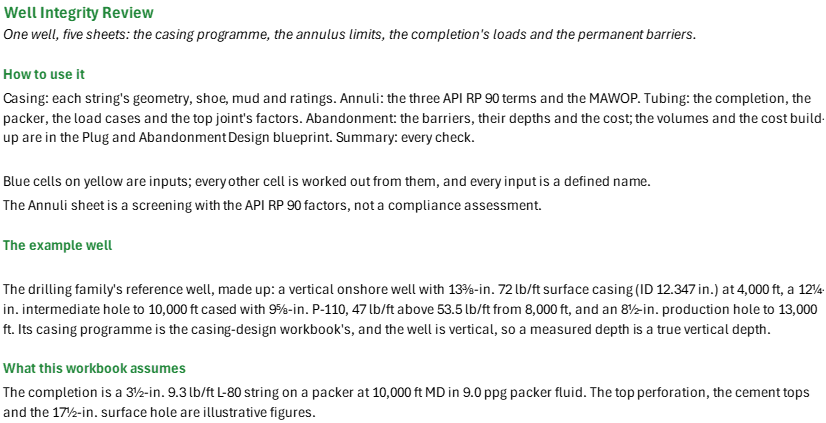
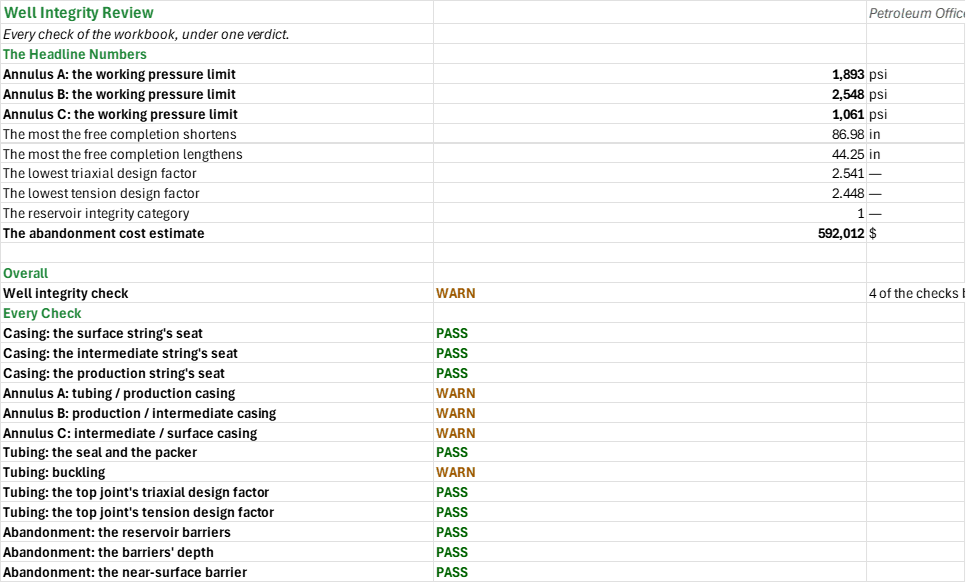
Does this well's integrity hold, from the casing to the abandonment plugs? You enter the casing programme, the annulus muds and pore pressures, the completion with its packer and load cases, and the permanent barriers with their rig days and prices. You read off each string's API ratings, each annulus's maximum allowable pressure, the tubing's movement against the seal travel with its design factors, and the barriers' status and abandonment cost, all under one verdict. Field units; no add-in or macro needed.
How to use it: Take the casing programme, the muds and the pore pressure from the well's own records and surveys and enter them on the Casing and Annuli sheets, with the fracture gradients from leak-off tests. On the Tubing sheet, enter the completion, the packer's seal travel and rating from its data sheet, and the load cases. On the Abandonment sheet, enter the cement tops, the reservoir pressure from the last survey, each plug's depth and length, its verification from its tag and pressure test, and the rig rates and prices. Read every check and the one verdict on the Summary.
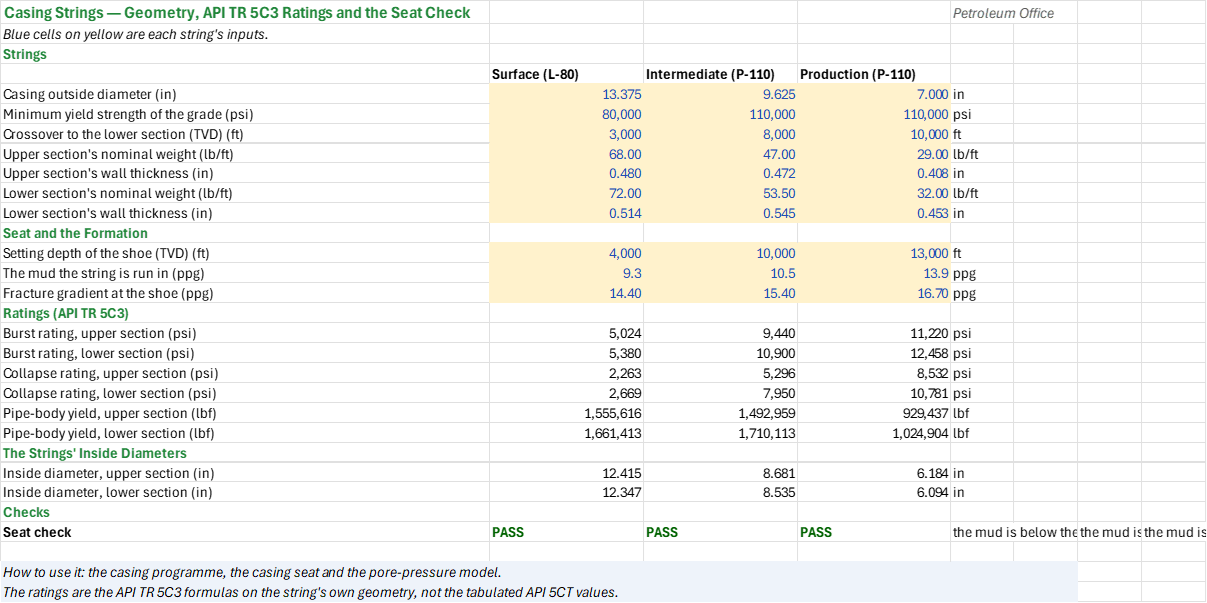
Method: The casing programme is the casing-design workbook's, so both state the same three strings and ratings: the API TR 5C3 burst, collapse and axial-yield formulas on each string's own geometry, and a seat check that the mud each string is run in stays below the fracture gradient at its shoe.
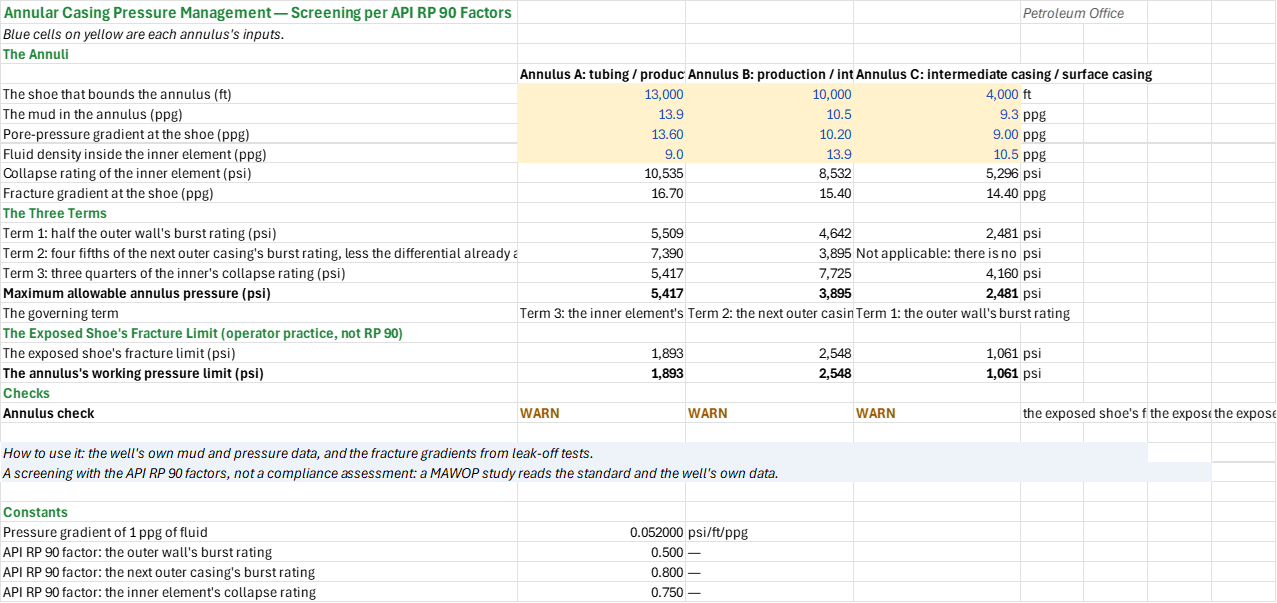
The annulus pressure limits are a three-term screening with the API RP 90 factors. At the governing depth (the shoe that bounds the annulus) each term is an allowable surface pressure,
term = factor x (rating - (rho_annulus - rho_other) x 0.052 x depth)
Term 1 is half the outer wall's burst rating. Term 2 is four fifths of the same for the next casing out; the outermost annulus has none. Term 3 is three quarters of the inner element's collapse rating. The differential already acting is the annulus mud less the fluid on the other side of that element. The MAWOP is the least of the applicable terms, and the sheet names the term that governs; beside it, the exposed shoe's fracture limit is checked, which is operator practice, not part of API RP 90.
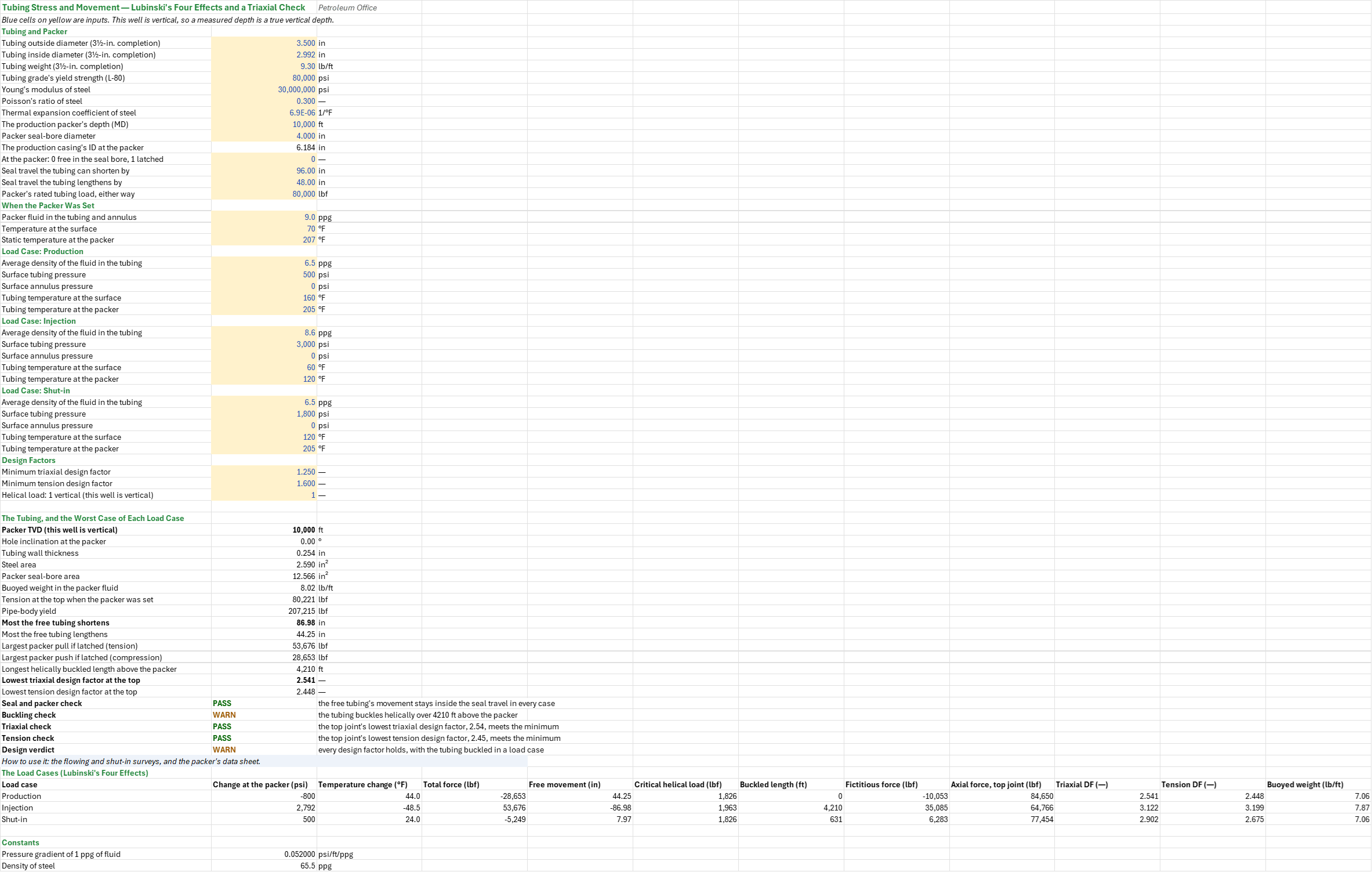
The Tubing sheet works out tubing stress and movement for this well, which is vertical, so the packer's TVD is its MD. Each of the three load cases (production, injection, shut-in) gives the tubing pressure and temperature at the surface and at the packer; Lubinski's four effects (piston, ballooning, temperature and helical buckling) give the forces, the length changes and the free tubing's movement. The packer's load if the tubing is latched follows, and the top joint's von Mises stress gives the triaxial design factor.
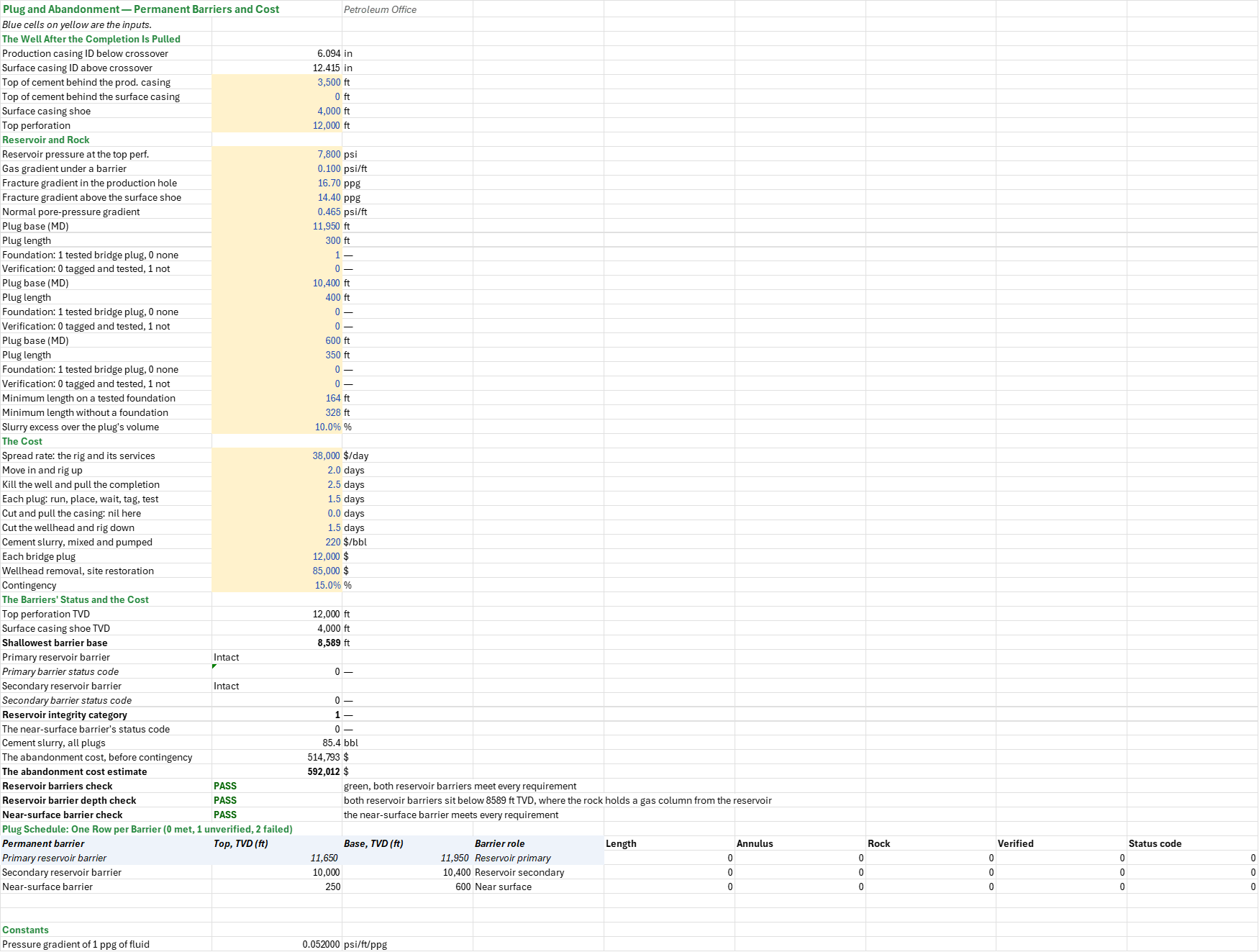
The Abandonment sheet sets this well's permanent barriers: a primary barrier across the reservoir in the production casing, a secondary barrier across the intermediate shoe in the production casing, and a plug in the surface casing near the surface. Each barrier is held to four requirements (its length, a cemented annulus across it, rock at its base that holds the pressure below, and its verification), and the cost prices the rig's days and the materials.
Example: The production casing is rated 11,220 psi burst in its lower section and 8,530 psi collapse in its upper section, and annulus A's maximum allowable annulus pressure is 5,417 psi. The completion's worst movement is 87 in of shortening against a 96 in seal travel; the lowest triaxial design factor is 2.54 against 1.25 and the lowest tension design factor 2.45 against 1.60. The barriers are intact (green).
Validity
The annulus pressure limits are a screening with the API RP 90 factors, not a compliance assessment; a MAWOP study reads the standard and the well's own data. The exposed shoe's fracture limit is operator practice, not part of API RP 90; it is checked on its own, beside the three terms. The annulus pressures assume the mud column of the section above each shoe. The example well is the drilling family's reference well, made up; the completion is adapted: a 3½-in. 9.3 lb/ft L-80 string on a production packer at 10,000 ft MD in 9.0 ppg packer fluid. The reservoir's top perforation at 12,000 ft MD, the reservoir pressure of 12.5 ppg at that depth, the cement tops and the 17½-in. surface hole are illustrative figures with no field data. The well is vertical, so the packer's TVD is its MD and the survey gives TVD = MD. Lubinski's effects are for one tubing size, elastic and without friction; a tapered string or a deviated well needs a full tubing-movement program. The Abandonment sheet summarises the barriers, the cost and the checks; it does not show the cement volume and cost build-ups. This well has full production casing, not a liner: the abandonment leaves the casing in place, so there is no cut and pull and the secondary barrier goes across the intermediate shoe in the production casing. The abandonment is a screening design: a well with more than one zone that can flow needs barriers for each, and a regulator's own rules can ask for more than the minimums here.
References
- American Petroleum Institute. API Recommended Practice 90, Annular Casing Pressure Management for Offshore Wells, Second Edition.
- American Petroleum Institute. API TR 5C3, Calculation of Casing, Tubing and Line Pipe Properties, and API 5CT.
- Lubinski, A., Althouse, W.S. and Logan, J.L. (1962). Helical Buckling of Tubing Sealed in Packers. JPT 14(6), 655-670.
- Standards Norway. NORSOK D-010, Well Integrity in Drilling and Well Operations.
- Offshore Energies UK. Guidelines on Decommissioning (the barrier requirements).
Inputs
Every input is a blue cell with the unit at the end of its row label. On the Casing sheet there is one column per string: surface (WIS_), intermediate (WIM_) and production (WIP_); on the Annuli sheet one column per annulus: A (WAN_A_), B (WAN_B_) and C (WAN_C_). Defaults are listed in that order.
| Input | Unit | Default | Name |
|---|---|---|---|
| Casing outside diameter | in | 13.375, 9.625, 7 | WIS_OD, WIM_OD, WIP_OD |
| Minimum yield strength of the grade | psi | 80000, 110000, 110000 | WIS_Yp, WIM_Yp, WIP_Yp |
| Crossover to the lower section (TVD) | ft | 3000, 8000, 10000 | WIS_Xover, WIM_Xover, WIP_Xover |
| Upper section's nominal weight | lb/ft | 68, 47, 29 | WIS_W1, WIM_W1, WIP_W1 |
| Upper section's wall thickness | in | 0.48, 0.472, 0.408 | WIS_T1, WIM_T1, WIP_T1 |
| Lower section's nominal weight | lb/ft | 72, 53.5, 32 | WIS_W2, WIM_W2, WIP_W2 |
| Lower section's wall thickness | in | 0.514, 0.545, 0.453 | WIS_T2, WIM_T2, WIP_T2 |
| Setting depth of the shoe (TVD) | ft | 4000, 10000, 13000 | WIS_Shoe, WIM_Shoe, WIP_Shoe |
| The mud the string is run in | ppg | 9.3, 10.5, 13.9 | WIS_MW, WIM_MW, WIP_MW |
| Fracture gradient at the shoe | ppg | 14.4, 15.4, 16.7 | WIS_Fg, WIM_Fg, WIP_Fg |
| The shoe that bounds the annulus | ft | 13000, 10000, 4000 | WAN_A_Depth, WAN_B_Depth, WAN_C_Depth |
| The mud in the annulus | ppg | 13.9, 10.5, 9.3 | WAN_A_Mud, WAN_B_Mud, WAN_C_Mud |
| Pore-pressure gradient at the shoe | ppg | 13.6, 10.2, 9 | WAN_A_Pore, WAN_B_Pore, WAN_C_Pore |
| Fluid density inside the inner element | ppg | 9, 13.9, 10.5 | WAN_A_Inner, WAN_B_Inner, WAN_C_Inner |
| Tubing outside diameter (3½-in. completion) | in | 3.5 | WTB_OD |
| Tubing inside diameter (3½-in. completion) | in | 2.992 | WTB_ID |
| Tubing weight (3½-in. completion) | lb/ft | 9.3 | WTB_W |
| Tubing grade's yield strength (L-80) | psi | 80000 | WTB_Yp |
| Young's modulus of steel | psi | 30000000 | WTB_E |
| Poisson's ratio of steel | — | 0.3 | WTB_Nu |
| Thermal expansion coefficient of steel | 1/F | 0.0000069 | WTB_Beta |
| The production packer's depth (MD) | ft | 10000 | WTB_Packer |
| Packer seal-bore diameter | in | 4 | WTB_Bore |
| At the packer: 0 free in the seal bore, 1 latched | — | 0 | WTB_Mode |
| Seal travel the tubing can shorten by | in | 96 | WTB_SealUp |
| Seal travel the tubing lengthens by | in | 48 | WTB_SealDown |
| Packer's rated tubing load, either way | lbf | 80000 | WTB_PkRating |
| Packer fluid in the tubing and annulus | ppg | 9 | WTB_Rho0 |
| Temperature at the surface, when the packer was set | F | 70 | WTB_Ts0 |
| Static temperature at the packer | F | 207 | WTB_Tp0 |
| Average density of the fluid in the tubing, production, injection, shut-in | ppg | 6.5, 8.6, 6.5 | WTB_RhoProd, WTB_RhoInj, WTB_RhoShut |
| Surface tubing pressure, each load case | psi | 500, 3000, 1800 | WTB_PtProd, WTB_PtInj, WTB_PtShut |
| Surface annulus pressure, each load case | psi | 0, 0, 0 | WTB_PaProd, WTB_PaInj, WTB_PaShut |
| Tubing temperature at the surface, each load case | F | 160, 60, 120 | WTB_TsProd, WTB_TsInj, WTB_TsShut |
| Tubing temperature at the packer, each load case | F | 205, 120, 205 | WTB_TpProd, WTB_TpInj, WTB_TpShut |
| Minimum triaxial design factor | — | 1.25 | WTB_DFvm |
| Minimum tension design factor | — | 1.6 | WTB_DFt |
| Helical load: 1 vertical (this well is vertical) | — | 1 | WTB_HelMode |
| Top of cement behind the prod. casing | ft | 3500 | WPA_PrdTOC |
| Top of cement behind the surface casing | ft | 0 | WPA_SurfTOC |
| Surface casing shoe | ft | 4000 | WPA_SurfShoe |
| Top perforation | ft | 12000 | WPA_PerfTop |
| Reservoir pressure at the top perf. | psi | 7800 | WPA_Pres |
| Gas gradient under a barrier | psi/ft | 0.1 | WPA_Gg |
| Fracture gradient in the production hole | ppg | 16.7 | WPA_FG |
| Fracture gradient above the surface shoe | ppg | 14.4 | WPA_FGs |
| Normal pore-pressure gradient | psi/ft | 0.465 | WPA_Gn |
| Plug base (MD), primary, secondary, near-surface | ft | 11950, 10400, 600 | WPA_P1Base, WPA_P2Base, WPA_P3Base |
| Plug length, each plug | ft | 300, 400, 350 | WPA_P1Len, WPA_P2Len, WPA_P3Len |
| Foundation: 1 tested bridge plug, 0 none | — | 1, 0, 0 | WPA_P1Fdn, WPA_P2Fdn, WPA_P3Fdn |
| Verification: 0 tagged and tested, 1 not | — | 0, 0, 0 | WPA_P1Ver, WPA_P2Ver, WPA_P3Ver |
| Minimum length on a tested foundation | ft | 164 | WPA_MinFdn |
| Minimum length without a foundation | ft | 328 | WPA_MinOpen |
| Slurry excess over the plug's volume | fraction | 0.1 | WPA_Excess |
| Spread rate: the rig and its services | $/d | 38000 | WPA_Spread |
| Move in and rig up | days | 2 | WPA_MobDays |
| Kill the well and pull the completion | days | 2.5 | WPA_PullDays |
| Each plug: run, place, wait, tag, test | days | 1.5 | WPA_PlugDays |
| Cut and pull the casing: nil here | days | 0 | WPA_CutDays |
| Cut the wellhead and rig down | days | 1.5 | WPA_SiteDays |
| Cement slurry, mixed and pumped | $/bbl | 220 | WPA_CmtCost |
| Each bridge plug | $ | 12000 | WPA_BpCost |
| Wellhead removal, site restoration | $ | 85000 | WPA_Fixed |
| Contingency | fraction | 0.15 | WPA_Cont |
Sheets
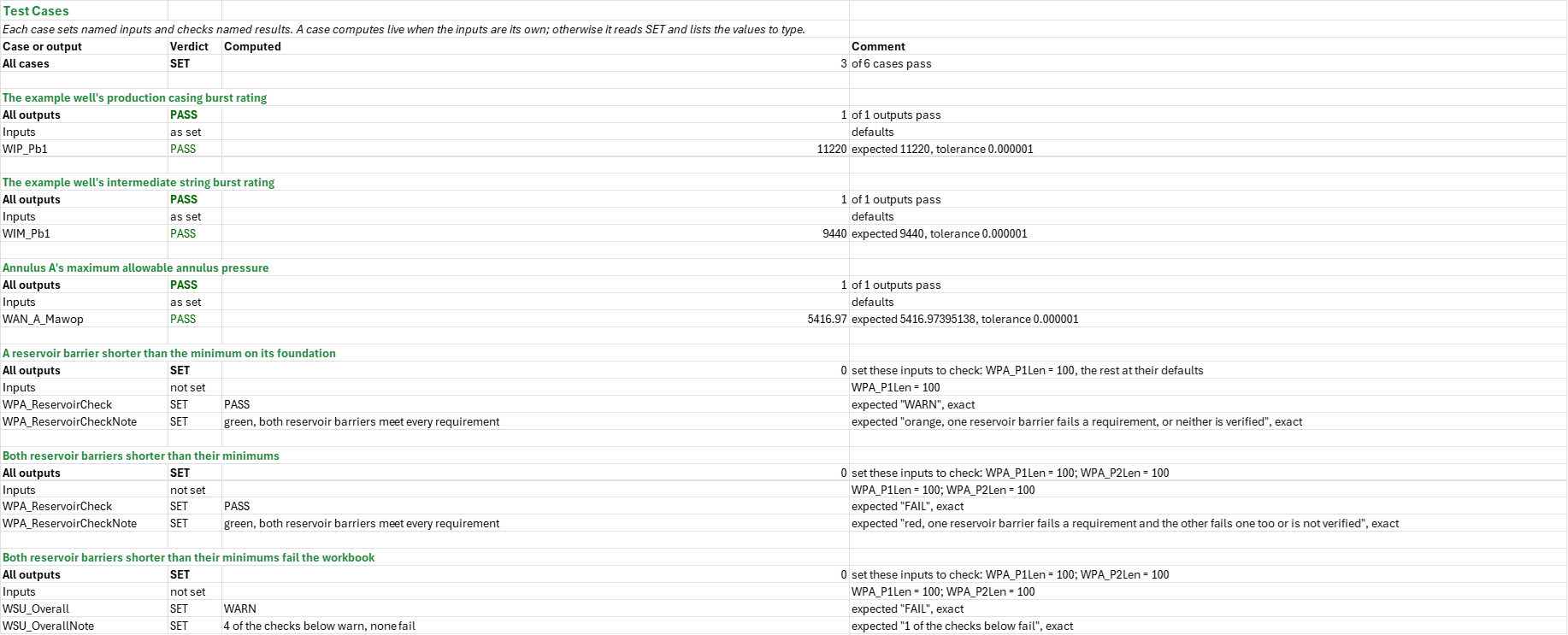
Guide— what the workbook answers, the well it describes and its assumptions.Casing— the three strings: geometry, shoes, muds, API TR 5C3 ratings and a seat check each.Annuli— the three annuli: their muds, the three API RP 90 terms, the maximum allowable annulus pressure and the term that governs, the exposed shoe's fracture limit and a check each.Tubing— the completion and packer, the three load cases, Lubinski's four effects, the tubing's movement against the seal travel, the packer's load if latched, and the top joint's triaxial and tension design factors.Abandonment— the permanent barriers, one row per plug, the four requirements on each, the abandonment cost and three checks.Summary— the headline numbers, every check of the workbook, and one verdict over them all.Test Cases— each worked case: its inputs, the expected results, the computed ones and a verdict.
Functions used
Names (182)
| Name | Refers to | Comment |
|---|---|---|
PO.CO.Schematic.DepthsLAMBDA |
=LAMBDA(MD_ft, Survey_MD, Survey_Inc, Survey_Azi, Survey_TVD, LET(n, COUNT(Survey_MD), k, IF(MD_ft < INDEX(Survey_MD, 1), 0, MATCH(MD_ft, Survey_MD, 1)), lo, MAX(1, MIN(k, n - 1)), hi, lo + 1, md_lo, INDEX(Survey_MD, lo), md_hi, INDEX(Survey_MD, hi), inc_lo, RADIANS(INDEX(Survey_Inc, lo)), inc_hi, RADIANS(INDEX(Survey_Inc, hi)), azi_lo, RADIANS(INDEX(Survey_Azi, lo)), azi_hi, RADIANS(INDEX(Survey_Azi, hi)), tvd_lo, INDEX(Survey_TVD, lo), dogleg, 2 * ASIN(SQRT(MIN(1, SIN((inc_hi - inc_lo) / 2)^2 + SIN(inc_lo) * SIN(inc_hi) * SIN((azi_hi - azi_lo) / 2)^2))), frac, (MD_ft - md_lo) / (md_hi - md_lo), cos_at, IF(dogleg < 0.000000001, COS(inc_lo), (SIN((1 - frac) * dogleg) * COS(inc_lo) + SIN(frac * dogleg) * COS(inc_hi)) / SIN(dogleg)), part, frac * dogleg, ratio, IF(part < 0.000000001, 1, 2 / part * TAN(part / 2)), IF(k = 0, tvd_lo - (md_lo - MD_ft), IF(k >= n, INDEX(Survey_TVD, hi) + (MD_ft - md_hi) * COS(inc_hi), tvd_lo + (MD_ft - md_lo) / 2 * (COS(inc_lo) + cos_at) * ratio)))) |
TVD, ft, of a measured depth on a survey: minimum-curvature interpolation between the two stations around it, vertical above the first and straight on below the last. |
PO.CO.Tubing.BallooningLAMBDA |
=LAMBDA(L_ft, OD_in, ID_in, dPia_psi, dPoa_psi, E_psi, Nu, LET(areaI, PI()/4*ID_in^2, areaO, PI()/4*OD_in^2, frc, 2*Nu*(dPia_psi*areaI - dPoa_psi*areaO), HSTACK(frc, -12*L_ft*frc/(E_psi*(areaO - areaI))))) |
Lubinski ballooning and reverse ballooning from the average pressure changes inside and outside the tubing: {force lbf, length change in.}. |
PO.CO.Tubing.BucklingLAMBDA |
=LAMBDA(Ff_lbf, Fcr_lbf, TbgL_ft, TbgOD_in, TbgID_in, CsgID_in, W_lbft, TbgE_psi, LET(mi, PI()/64*(TbgOD_in^4 - TbgID_in^4), clr, (CsgID_in - TbgOD_in)/2, fLow, MAX(Fcr_lbf, Ff_lbf - W_lbft*TbgL_ft), bkl, Ff_lbf > Fcr_lbf, HSTACK(IF(bkl, (fLow^2 - Ff_lbf^2)*clr^2/(8*TbgE_psi*mi*W_lbft/12), 0), IF(bkl, (Ff_lbf - fLow)/W_lbft, 0)))) |
Lubinski helical-buckling length change of tubing, in., above the packer, with the buckled length, ft, from the fictitious force and a critical load. |
PO.CO.Tubing.PistonLAMBDA |
=LAMBDA(L_ft, OD_in, ID_in, Bore_in, dPi_psi, dPo_psi, E_psi, LET(areaI, PI()/4*ID_in^2, areaO, PI()/4*OD_in^2, areaP, PI()/4*Bore_in^2, frc, (areaP - areaI)*dPi_psi - (areaP - areaO)*dPo_psi, HSTACK(frc, -12*L_ft*frc/(E_psi*(areaO - areaI))))) |
Lubinski piston effect at a packer: the force on the tubing, lbf, and the free-tubing length change, in. (negative shortens): {lbf, in}. |
PO.CO.Tubing.ThermalLAMBDA |
=LAMBDA(L_ft, OD_in, ID_in, dT_F, E_psi, Beta_perF, LET(steel, PI()/4*(OD_in^2 - ID_in^2), HSTACK(0 - E_psi*Beta_perF*steel*dT_F, 12*L_ft*Beta_perF*dT_F))) |
Lubinski temperature effect from the average tubing temperature change: {force lbf, length change in.}; cooling gives a positive force and a shortening. |
PO.DE.Casing.Axial.YieldLAMBDA |
=LAMBDA(BodyOD_in, BodyWall_in, BodyYp_psi, PI()/4*(BodyOD_in^2-(BodyOD_in-2*BodyWall_in)^2)*BodyYp_psi) |
API TR 5C3 pipe-body yield strength, Fy = (pi/4)(D^2 - d^2) Yp, [lbf]. |
PO.DE.Casing.Burst.API5C3LAMBDA |
=LAMBDA(OD_in, t_in, Yp_psi, 0.875*2*Yp_psi*t_in/OD_in) |
API TR 5C3 pipe-body internal yield (burst) pressure, Barlow with the 0.875 wall tolerance, [psi]. |
PO.DE.Casing.Collapse.API5C3LAMBDA |
=LAMBDA(OD_in, t_in, Yp_psi, Sa_psi, Output, LET(s, Sa_psi/Yp_psi, Ya, (SQRT(1-0.75*s^2)-0.5*s)*Yp_psi, kA, 2.8762+0.10679E-5*Ya+0.21301E-10*Ya^2-0.53132E-16*Ya^3, kB, 0.026233+0.50609E-6*Ya, kC, -465.93+0.030867*Ya-0.10483E-7*Ya^2+0.36989E-13*Ya^3, ba, kB/kA, xa, 3*ba/(2+ba), kF, 46950000*xa^3/(Ya*(xa-ba)*(1-xa)^2), kG, kF*ba, dtYP, (SQRT((kA-2)^2+8*(kB+kC/Ya))+(kA-2))/(2*(kB+kC/Ya)), dtPT, Ya*(kA-kF)/(kC+Ya*(kB-kG)), dtTE, (2+ba)/(3*ba), dt, OD_in/t_in, reg, IF(dt<=dtYP, 1, IF(dt<=dtPT, 2, IF(dt<=dtTE, 3, 4))), pc, IF(reg=1, 2*Ya*(dt-1)/dt^2, IF(reg=2, Ya*(kA/dt-kB)-kC, IF(reg=3, Ya*(kF/dt-kG), 46950000/(dt*(dt-1)^2)))), IF(Output=2, HSTACK(dtYP, dtPT, dtTE), IF(Output=1, HSTACK(pc, reg), pc)))) |
API TR 5C3 collapse pressure in the yield, plastic, transition or elastic regime chosen from D/t, with the axial-stress equivalent grade; Output 1 adds the regime, 2 returns the regime D/t limits, [psi]. |
PO.DE.Casing.VonMisesLAMBDA |
=LAMBDA(WallOD_in, t_in, Pi_psi, Po_psi, Sa_psi, r_in, LET(ro, WallOD_in/2, ri, ro-t_in, k, ro^2-ri^2, mean, (Pi_psi*ri^2-Po_psi*ro^2)/k, dev, (Pi_psi-Po_psi)*ri^2*ro^2/(k*r_in^2), sr, mean-dev, sh, mean+dev, SQRT(((Sa_psi-sr)^2+(sr-sh)^2+(sh-Sa_psi)^2)/2))) |
Triaxial (von Mises) equivalent stress at radius r of a casing wall: Lame radial and hoop stress from internal and external pressure plus the axial stress, [psi]. |
PO.DE.Cement.VolumeLAMBDA |
=LAMBDA(Dh_in, OD_in, ID_in, PrevID_in, OH_ft, CH_ft, Shoe_ft, Excess, LET(voh, (Dh_in^2 - OD_in^2)/1029.4*OH_ft*(1 + Excess), vch, (PrevID_in^2 - OD_in^2)/1029.4*CH_ft, vsh, ID_in^2/1029.4*Shoe_ft, HSTACK(voh + vch + vsh, voh, vch, vsh))) |
Slurry volume of one cement stage, bbl: open-hole annulus with excess, cased overlap and shoe track, as {total, open hole, overlap, shoe track}. |
PO.DE.Dir.DoglegSeverityLAMBDA |
=LAMBDA(Inc1_deg, Azi1_deg, Inc2_deg, Azi2_deg, dMD_ft, DEGREES(2 * ASIN(SQRT(MIN(1, SIN(RADIANS(Inc2_deg - Inc1_deg) / 2)^2 + SIN(RADIANS(Inc1_deg)) * SIN(RADIANS(Inc2_deg)) * SIN(RADIANS(Azi2_deg - Azi1_deg) / 2)^2)))) * 100 / dMD_ft) |
Dogleg severity in degrees per 100 ft between two directional surveys, from the inclinations, azimuths and course length. |
PO.DE.Dir.MinCurv.dTVDLAMBDA |
=LAMBDA(Inc1_deg, Inc2_deg, dMD_ft, RF, dMD_ft / 2 * (COS(RADIANS(Inc1_deg)) + COS(RADIANS(Inc2_deg))) * RF) |
Minimum curvature TVD increment, ft, over a course. |
PO.DE.Dir.RatioFactorLAMBDA |
=LAMBDA(Dogleg_deg, IF(Dogleg_deg < 0.000001, 1, 2 / RADIANS(Dogleg_deg) * TAN(RADIANS(Dogleg_deg) / 2))) |
Minimum curvature ratio factor from the dogleg angle over a course, degrees (1 for a straight course). |
PO.DE.TD.Buckling.HelicalLAMBDA |
=LAMBDA(OD_in, ID_in, Dh_in, Wb_lbft, Inc_deg, E_psi, Mode, LET(mi, PI()/64*(OD_in^4 - ID_in^4), wpi, Wb_lbft/12, IF(Mode=1, 5.55*(E_psi*mi*wpi^2)^(1/3), 2*SQRT(2)*SQRT(E_psi*mi*wpi*SIN(RADIANS(Inc_deg))/((Dh_in - OD_in)/2))))) |
Helical buckling load, lbf: the square root of 2 times Dawson-Paslay in an inclined hole (Mode 0) or 5.55 (EI w^2)^(1/3) in a vertical one (Mode 1). |
PO.DE.TD.BuoyancyLAMBDA |
=LAMBDA(PipeW_lbft, PipeOD_in, PipeID_in, MWi_ppg, MWo_ppg, RhoSteel_ppg, LET(bf, 1 - (MWo_ppg*PipeOD_in^2 - MWi_ppg*PipeID_in^2) / (RhoSteel_ppg*(PipeOD_in^2 - PipeID_in^2)), HSTACK(bf, PipeW_lbft*bf))) |
Buoyancy factor of a pipe with different fluids inside and outside, and its buoyed weight per foot: {BF, lb/ft}. |
PO.WI.Barrier.RatingLAMBDA |
=LAMBDA(Primary, Secondary, LET(worst, MAX(Primary, Secondary), best, MIN(Primary, Secondary), IF(worst <= 0, 1, IF(worst = 1, IF(best <= 0, 2, 3), IF(best <= 0, 3, 4))))) |
Well integrity category from the primary and secondary barrier statuses (0 intact, 1 degraded, 2 failed): 1 green, 2 yellow, 3 orange, 4 red. |
PO.WI.Barrier.StatusLAMBDA |
=LAMBDA(Elements, IF(COUNT(Elements) = 0, 2, MAX(0, MIN(2, MAX(Elements))))) |
Status of a well barrier envelope from its elements' statuses (0 intact, 1 degraded or not verified, 2 failed): the worst element governs, and an envelope with no element is failed. |
PO.WI.PA.BalancedPlugLAMBDA |
=LAMBDA(Slurry_bbl, Ahead_bbl, PlugHoleID_in, StringOD_in, StringID_in, Base_ft, LET(capA, (PlugHoleID_in^2 - StringOD_in^2)/1029.4, capP, StringID_in^2/1029.4, hIn, Slurry_bbl/(capA + capP), behind, Ahead_bbl*capP/capA, HSTACK(behind, hIn, Slurry_bbl/(PlugHoleID_in^2/1029.4), capP*(Base_ft - hIn) - behind))) |
Balanced cement plug: {spacer behind bbl, plug height with the pipe in ft, height after pulling out ft, displacement bbl}. |
WAN_ACheck |
Annuli!$B$21 |
|
WAN_ACheckNote |
Annuli!$G$21 |
|
WAN_A_Depth |
Annuli!$B$5 |
|
WAN_A_Inner |
Annuli!$B$8 |
|
WAN_A_Mawop |
Annuli!$B$15 |
|
WAN_A_Mud |
Annuli!$B$6 |
|
WAN_A_Pore |
Annuli!$B$7 |
|
WAN_BCheck |
Annuli!$C$21 |
|
WAN_BCheckNote |
Annuli!$H$21 |
|
WAN_B_Depth |
Annuli!$C$5 |
|
WAN_B_Inner |
Annuli!$C$8 |
|
WAN_B_Mud |
Annuli!$C$6 |
|
WAN_B_Pore |
Annuli!$C$7 |
|
WAN_CCheck |
Annuli!$D$21 |
|
WAN_CCheckNote |
Annuli!$E$21 |
|
WAN_C_Depth |
Annuli!$D$5 |
|
WAN_C_Inner |
Annuli!$D$8 |
|
WAN_C_Mud |
Annuli!$D$6 |
|
WAN_C_Pore |
Annuli!$D$7 |
|
WAN_Inputs |
Annuli!$B$5:$D$8 |
|
WAN_Results |
Annuli!$B$9:$D$21 |
|
WIM_Fg |
Casing!$C$15 |
|
WIM_Inputs |
Casing!$C$5:$C$15 |
|
WIM_MW |
Casing!$C$14 |
|
WIM_OD |
Casing!$C$5 |
|
WIM_Pb1 |
Casing!$C$17 |
|
WIM_Results |
Casing!$C$17:$C$27 |
|
WIM_SeatCheck |
Casing!$C$27 |
|
WIM_SeatCheckNote |
Casing!$H$27 |
|
WIM_Shoe |
Casing!$C$13 |
|
WIM_T1 |
Casing!$C$9 |
|
WIM_T2 |
Casing!$C$11 |
|
WIM_W1 |
Casing!$C$8 |
|
WIM_W2 |
Casing!$C$10 |
|
WIM_Xover |
Casing!$C$7 |
|
WIM_Yp |
Casing!$C$6 |
|
WIP_Fg |
Casing!$D$15 |
|
WIP_Inputs |
Casing!$D$5:$D$15 |
|
WIP_MW |
Casing!$D$14 |
|
WIP_OD |
Casing!$D$5 |
|
WIP_Pb1 |
Casing!$D$17 |
|
WIP_Results |
Casing!$D$17:$D$27 |
|
WIP_SeatCheck |
Casing!$D$27 |
|
WIP_SeatCheckNote |
Casing!$E$27 |
|
WIP_Shoe |
Casing!$D$13 |
|
WIP_T1 |
Casing!$D$9 |
|
WIP_T2 |
Casing!$D$11 |
|
WIP_W1 |
Casing!$D$8 |
|
WIP_W2 |
Casing!$D$10 |
|
WIP_Xover |
Casing!$D$7 |
|
WIP_Yp |
Casing!$D$6 |
|
WIS_Fg |
Casing!$B$15 |
|
WIS_Inputs |
Casing!$B$5:$B$15 |
|
WIS_MW |
Casing!$B$14 |
|
WIS_OD |
Casing!$B$5 |
|
WIS_Results |
Casing!$B$17:$B$27 |
|
WIS_SeatCheck |
Casing!$B$27 |
|
WIS_SeatCheckNote |
Casing!$G$27 |
|
WIS_Shoe |
Casing!$B$13 |
|
WIS_T1 |
Casing!$B$9 |
|
WIS_T2 |
Casing!$B$11 |
|
WIS_W1 |
Casing!$B$8 |
|
WIS_W2 |
Casing!$B$10 |
|
WIS_Xover |
Casing!$B$7 |
|
WIS_Yp |
Casing!$B$6 |
|
WPA_BpCost |
Abandonment!$B$39 |
|
WPA_CmtCost |
Abandonment!$B$38 |
|
WPA_Cont |
Abandonment!$B$41 |
|
WPA_CutDays |
Abandonment!$B$36 |
|
WPA_DepthCheck |
Abandonment!$B$56 |
|
WPA_DepthCheckNote |
Abandonment!$C$56 |
|
WPA_Excess |
Abandonment!$B$30 |
|
WPA_FG |
Abandonment!$B$13 |
|
WPA_FGs |
Abandonment!$B$14 |
|
WPA_Fixed |
Abandonment!$B$40 |
|
WPA_Gg |
Abandonment!$B$12 |
|
WPA_Gn |
Abandonment!$B$15 |
|
WPA_Inputs |
Abandonment!$B$4:$B$41 |
|
WPA_MinFdn |
Abandonment!$B$28 |
|
WPA_MinOpen |
Abandonment!$B$29 |
|
WPA_MobDays |
Abandonment!$B$33 |
|
WPA_P1Base |
Abandonment!$B$16 |
|
WPA_P1Fdn |
Abandonment!$B$18 |
|
WPA_P1Len |
Abandonment!$B$17 |
|
WPA_P1Ver |
Abandonment!$B$19 |
|
WPA_P2Base |
Abandonment!$B$20 |
|
WPA_P2Fdn |
Abandonment!$B$22 |
|
WPA_P2Len |
Abandonment!$B$21 |
|
WPA_P2Ver |
Abandonment!$B$23 |
|
WPA_P3Base |
Abandonment!$B$24 |
|
WPA_P3Fdn |
Abandonment!$B$26 |
|
WPA_P3Len |
Abandonment!$B$25 |
|
WPA_P3Ver |
Abandonment!$B$27 |
|
WPA_PerfTop |
Abandonment!$B$9 |
|
WPA_PlugDays |
Abandonment!$B$35 |
|
WPA_Plugs |
Abandonment!$A$60:$I$62 |
|
WPA_PrdID |
Abandonment!$B$4 |
|
WPA_PrdTOC |
Abandonment!$B$6 |
|
WPA_Pres |
Abandonment!$B$11 |
|
WPA_PullDays |
Abandonment!$B$34 |
|
WPA_ReservoirCheck |
Abandonment!$B$55 |
|
WPA_ReservoirCheckNote |
Abandonment!$C$55 |
|
WPA_Results |
Abandonment!$B$43:$B$57 |
|
WPA_SiteDays |
Abandonment!$B$37 |
|
WPA_Spread |
Abandonment!$B$32 |
|
WPA_SurfID |
Abandonment!$B$5 |
|
WPA_SurfShoe |
Abandonment!$B$8 |
|
WPA_SurfTOC |
Abandonment!$B$7 |
|
WPA_SurfaceCheck |
Abandonment!$B$57 |
|
WPA_SurfaceCheckNote |
Abandonment!$C$57 |
|
WSU_Checks |
Summary!$B$17:$B$29 |
|
WSU_Overall |
Summary!$B$15 |
|
WSU_OverallNote |
Summary!$C$15 |
|
WSU_Results |
Summary!$B$4:$B$12 |
|
WSU_Verdict |
Summary!$B$15 |
|
WSU_VerdictNote |
Summary!$C$15 |
|
WTB_Beta |
Tubing!$B$10 |
|
WTB_Bore |
Tubing!$B$12 |
|
WTB_BucklingCheck |
Tubing!$B$62 |
|
WTB_BucklingCheckNote |
Tubing!$C$62 |
|
WTB_Cases |
Tubing!$A$69:$L$71 |
|
WTB_CsgID |
Tubing!$B$13 |
|
WTB_DFt |
Tubing!$B$42 |
|
WTB_DFvm |
Tubing!$B$41 |
|
WTB_DesignCheck |
Tubing!$B$65 |
|
WTB_DesignCheckNote |
Tubing!$C$65 |
|
WTB_E |
Tubing!$B$8 |
|
WTB_HelMode |
Tubing!$B$43 |
|
WTB_ID |
Tubing!$B$5 |
|
WTB_Inputs |
Tubing!$B$4:$B$43 |
|
WTB_Mode |
Tubing!$B$14 |
|
WTB_Nu |
Tubing!$B$9 |
|
WTB_OD |
Tubing!$B$4 |
|
WTB_PaInj |
Tubing!$B$31 |
|
WTB_PaProd |
Tubing!$B$25 |
|
WTB_PaShut |
Tubing!$B$37 |
|
WTB_Packer |
Tubing!$B$11 |
|
WTB_PackerCheck |
Tubing!$B$61 |
|
WTB_PackerCheckNote |
Tubing!$C$61 |
|
WTB_PkRating |
Tubing!$B$17 |
|
WTB_PtInj |
Tubing!$B$30 |
|
WTB_PtProd |
Tubing!$B$24 |
|
WTB_PtShut |
Tubing!$B$36 |
|
WTB_Results |
Tubing!$B$46:$B$65 |
|
WTB_Rho0 |
Tubing!$B$19 |
|
WTB_RhoInj |
Tubing!$B$29 |
|
WTB_RhoProd |
Tubing!$B$23 |
|
WTB_RhoShut |
Tubing!$B$35 |
|
WTB_SealDown |
Tubing!$B$16 |
|
WTB_SealUp |
Tubing!$B$15 |
|
WTB_TensionCheck |
Tubing!$B$64 |
|
WTB_TensionCheckNote |
Tubing!$C$64 |
|
WTB_Tp0 |
Tubing!$B$21 |
|
WTB_TpInj |
Tubing!$B$33 |
|
WTB_TpProd |
Tubing!$B$27 |
|
WTB_TpShut |
Tubing!$B$39 |
|
WTB_TriaxialCheck |
Tubing!$B$63 |
|
WTB_TriaxialCheckNote |
Tubing!$C$63 |
|
WTB_Ts0 |
Tubing!$B$20 |
|
WTB_TsInj |
Tubing!$B$32 |
|
WTB_TsProd |
Tubing!$B$26 |
|
WTB_TsShut |
Tubing!$B$38 |
|
WTB_W |
Tubing!$B$6 |
|
WTB_Yp |
Tubing!$B$7 |
Details
| Opens in | Needs Microsoft 365 or Excel 2024: it uses functions Excel 2016 doesn't have, such as named LAMBDAs, which show #NAME? there. |
| File | WellIntegrity.xlsx, 38 KB |
| Category | Drilling |
| For agents and tools | Descriptor (.md) |