Drilling Program
Description
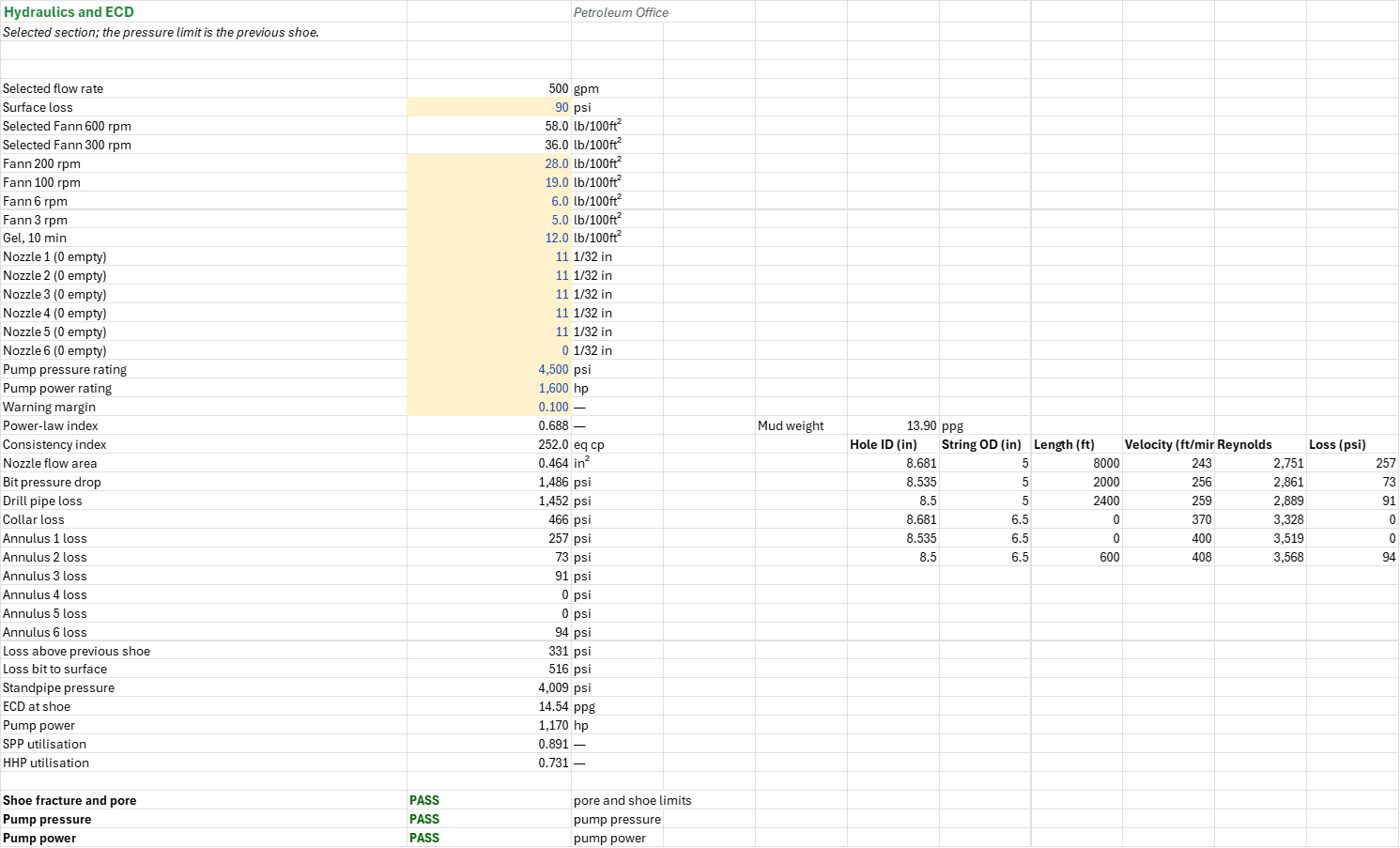
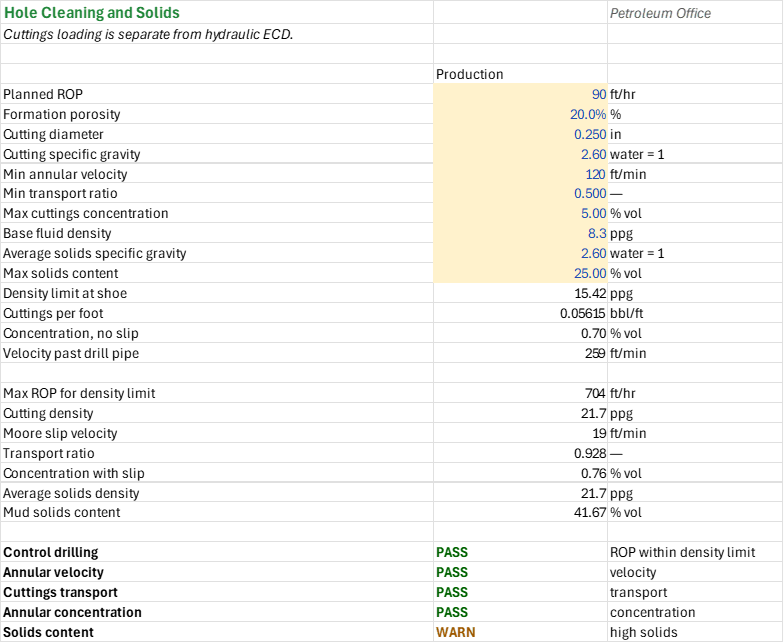
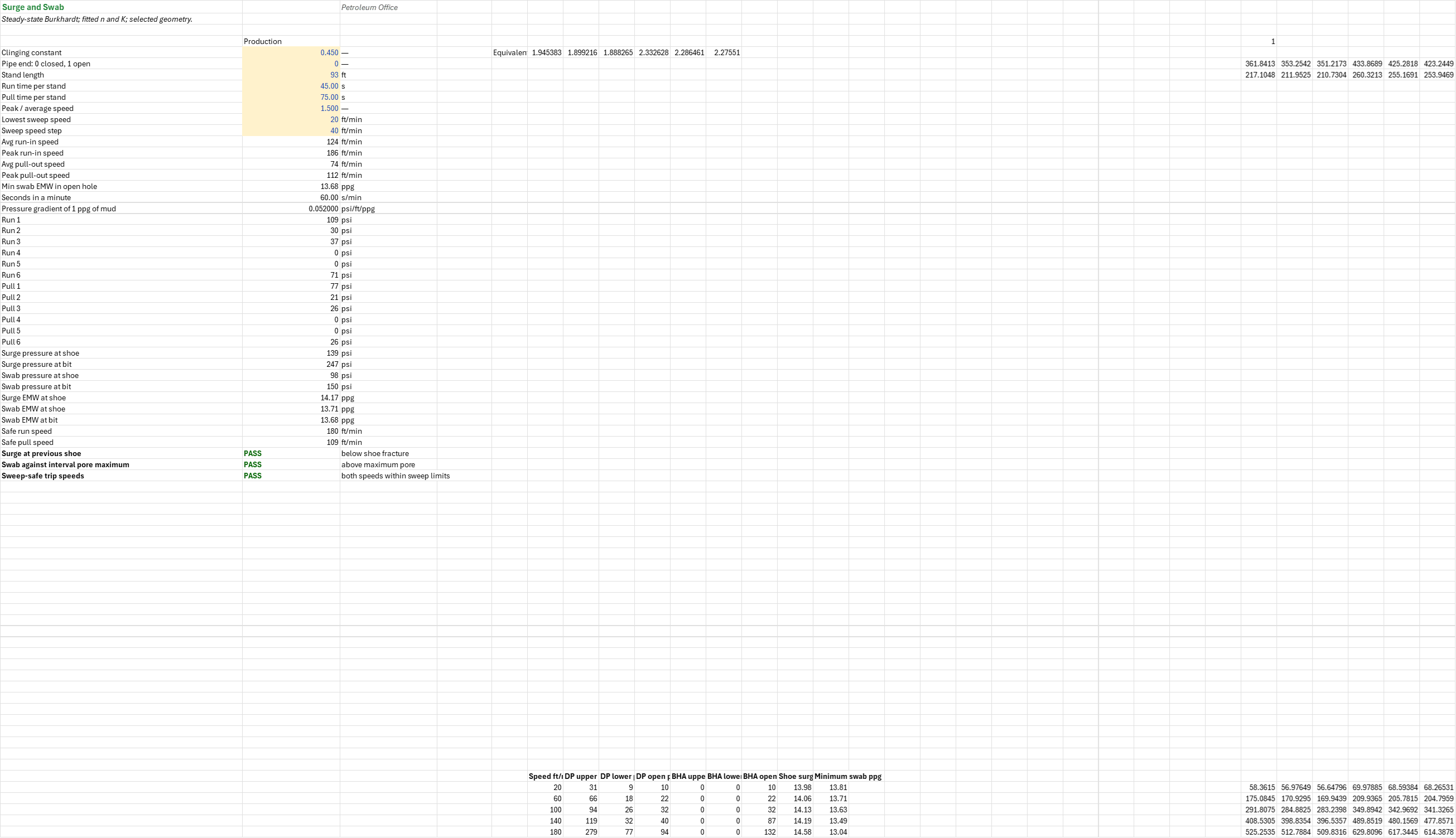
What mud weight does each hole section need, will the pumps clean the hole without breaking the shoe down, and how fast can the string be tripped? You enter a shale sonic log and its normal trend, the casing seats and leak-off tests, the hole and string geometry, the Fann readings, flow, nozzles, ROP and stand times. You read off pore and fracture pressure and the mud program by depth, and for the selected section the pump pressure, shoe ECD, cuttings transport and the surge and swab trip-speed limits. Field units; no add-in needed.
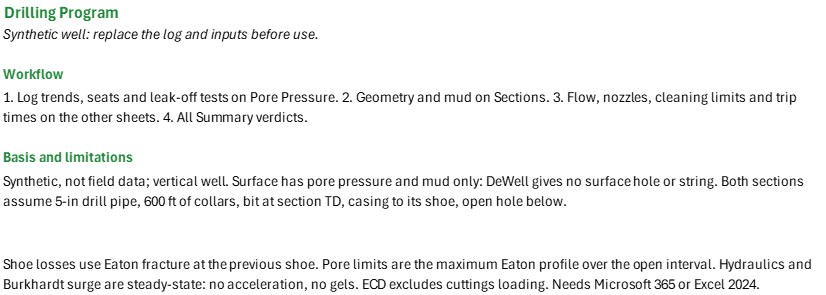
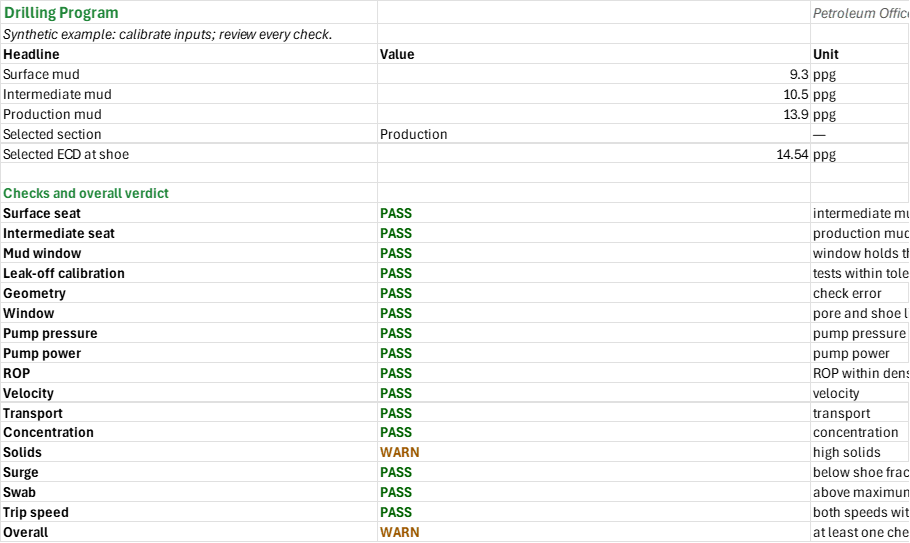
How to use it: The log and geometry are synthetic. Replace the log, the seats and the leak-off tests on the Pore Pressure sheet, and the geometry and mud on the Sections sheet, with the planned case. Pick Intermediate or Production on the Sections sheet (default Production); the Hydraulics, Hole Cleaning, Surge Swab and Summary sheets show only that section. Set the section's flow and Fann readings on Sections, the nozzles and pump ratings on Hydraulics, the ROP and cleaning limits on Hole Cleaning and the stand times on Surge Swab. Review every verdict on the Summary, which combines all named checks in a fail-closed verdict. For resistivity Eaton, use the pore-pressure blueprint po.bp.de.pore.pressure.eaton.
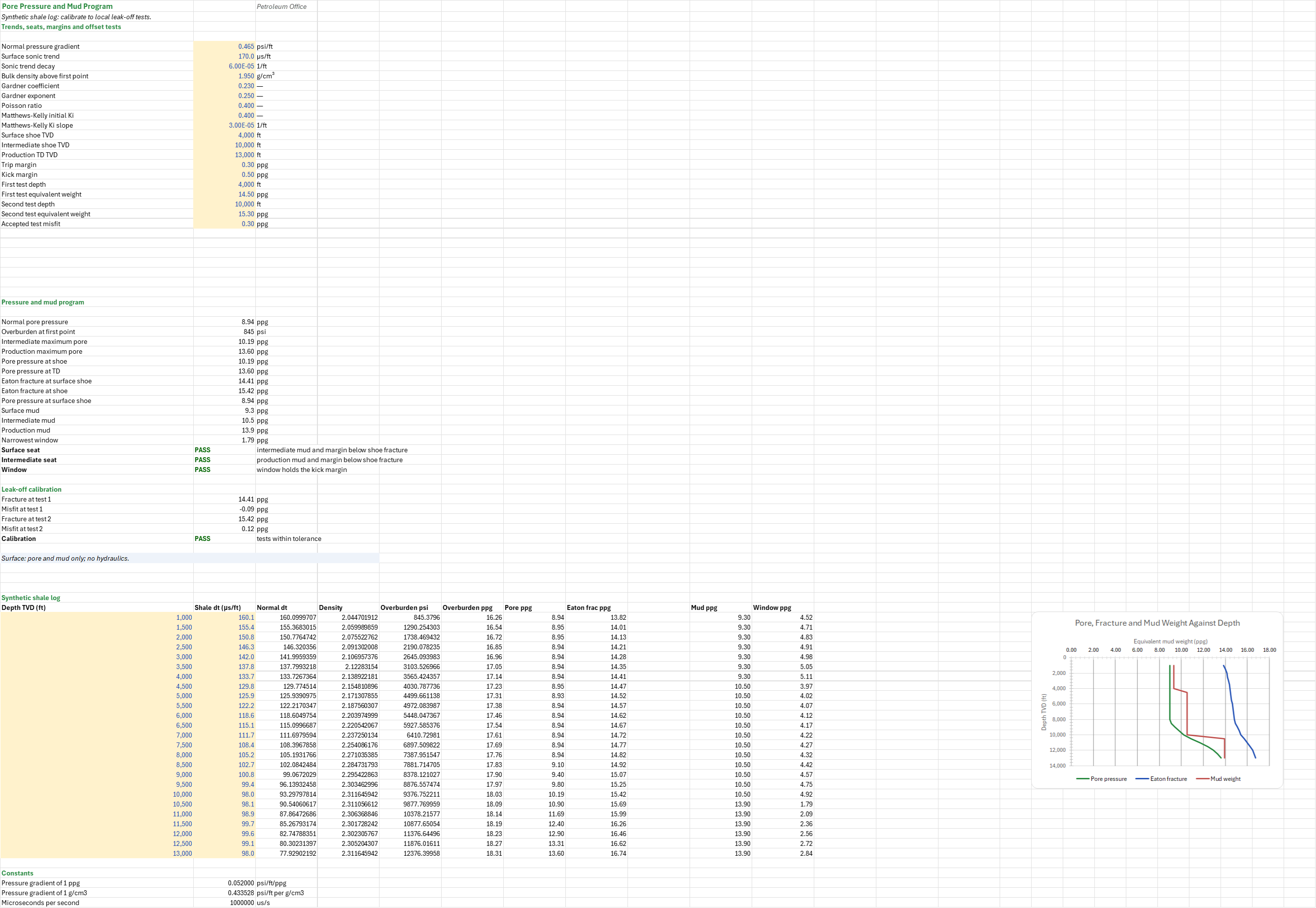
Method: The sonic log gives the normal and measured transit times; the pore pressure follows Eaton's compaction method against the normal trend, and the fracture pressure the Eaton and Matthews-Kelly relations on the same log. Mud weights follow the maximum pore gradient over the open interval plus the trip margin, and the leak-off tests calibrate the model against a misfit tolerance. Hydraulics fits a power law to the 600/300-rpm readings and sums pipe, collar, nozzle and annular losses; the shoe ECD uses the losses above the previous shoe. Hole cleaning uses the flow, mud and rheology, with its static cuttings-density estimate kept separate from the ECD. Surge and swab use the same rheology and geometry with Burkhardt displacement over a five-point sweep from 20 to 180 ft/min: shoe surge is checked against the previous shoe's fracture pressure, and the minimum swab mud weight at the shoe, the bit and the drill-pipe/collar boundary against the maximum open-interval pore gradient. Segment geometry is constant and friction varies linearly with depth, so those boundaries hold the equivalent-mud-weight extrema. The sweep interpolates the speed limit, returns zero if no sample is safe and caps the limit at the highest sample if all are safe. Surface has pore and mud results only: the reference well has no surface-hole diameter or string, so surface hydraulics are not modelled.
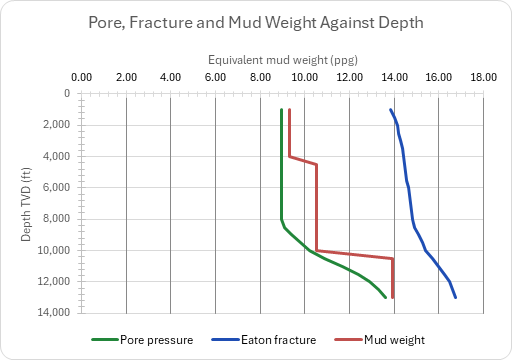
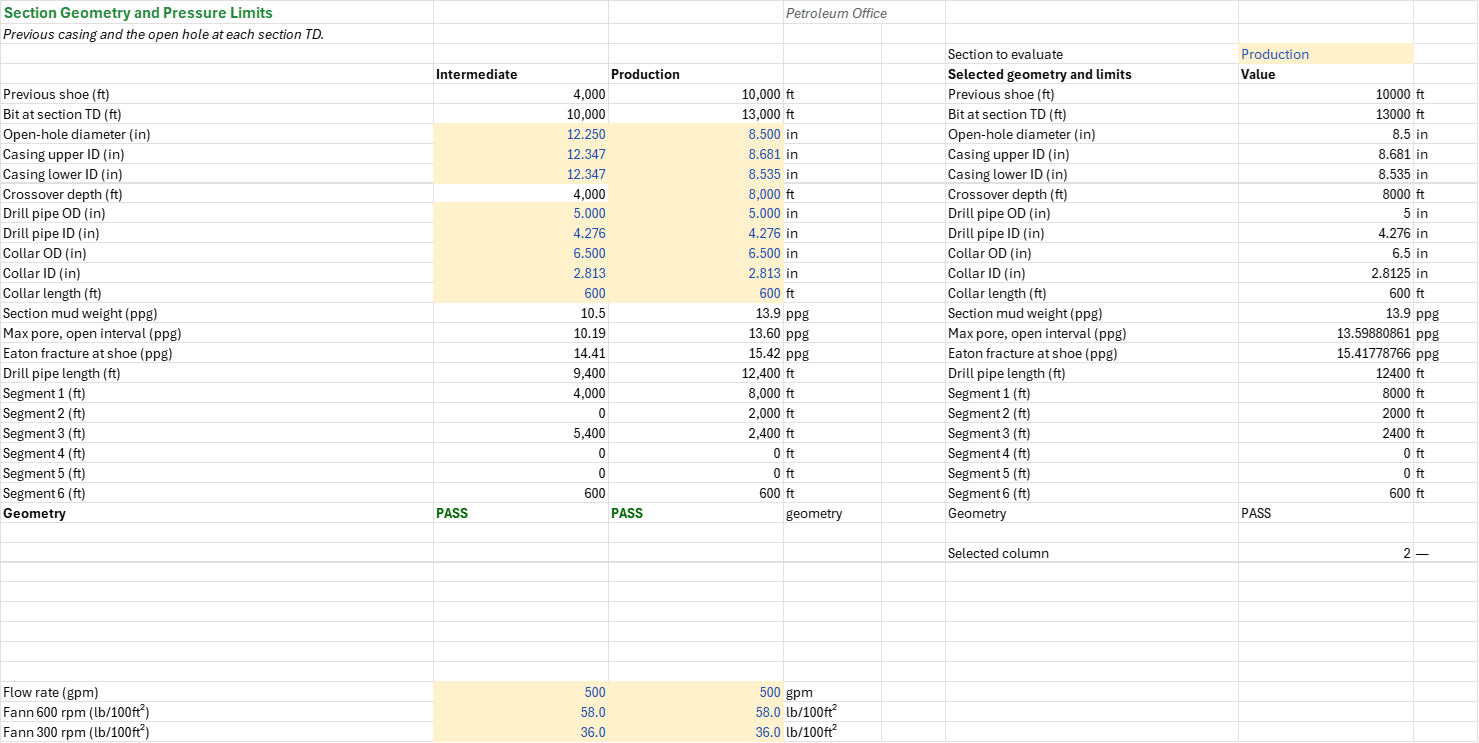
Example: The 12.25-in intermediate hole spans 4,000–10,000 ft below 12.347-in ID surface casing; the 8.5-in production hole spans 10,000–13,000 ft below 9.625-in casing, 8.681-in ID to 8,000 ft and 8.535-in ID to the shoe. Each assumes 5-in drill pipe, 600 ft of collars and the bit at section TD; these are not measured operational data. The program gives 9.3 ppg surface mud, 10.5 ppg intermediate mud and 13.9 ppg production mud, with the pore limit at the maximum Eaton gradient over each open interval.
Validity
The log and geometry are synthetic, not independent field validation. Surface-hole hydraulics are not modelled; the reference well gives no surface hole or string. Eaton's compaction method can under-read unloading; Gardner is unreliable in gas sands, salt and anhydrite. Replace and calibrate the log and fracture model to local data. The well is vertical; ECD excludes cuttings loading, gels, acceleration, temperature and transients. The steady-state tripping model is not a transient surge simulation. Cuttings transport and the density-limited ROP are screening estimates, not a coupled multiphase model. Validate a real program with the operator's approved methods.
Named alternatives, which the workbook does not compute and the add-in has no functions for: Herschel-Bulkley pipe and annulus losses, pump optimisation (nozzles and flow rate for maximum bit hydraulic horsepower or impact force), cuttings bed height in deviated hole, a dynamic surge model, Bowers's unloading pore pressure and the HPHT equivalent static density of the mud column.
References
- Eaton, B.A. (1975). “The Equation for Geopressure Prediction from Well Logs.” SPE-5544.
- Eaton, B.A. (1969). “Fracture Gradient Prediction and Its Application in Oilfield Operations.” Journal of Petroleum Technology.
- Matthews, W.R. and Kelly, J. (1967). “How to Predict Formation Pressure and Fracture Gradient.” Oil and Gas Journal.
- Bourgoyne, A.T. et al. (1986). Applied Drilling Engineering. SPE Textbook Series Vol. 2, chapters 6 and 7.
Inputs
| Input | Unit | Default | Name |
|---|---|---|---|
| Surface sonic trend, sonic trend decay | µs/ft, 1/ft | 170, 0.00006 | DPW_Dt0, DPW_DtC |
| Surface shoe TVD, intermediate shoe TVD, production TD TVD | ft | 4000, 10000, 13000 | DPW_Shoe1, DPW_Shoe2, DPW_TD |
| Trip margin, kick margin | ppg | 0.3, 0.5 | DPW_Trip, DPW_Kick |
| Poisson ratio, first and second test equivalent weight | —, ppg, ppg | 0.4, 14.5, 15.3 | DPW_Nu, DPW_Lot1, DPW_Lot2 |
| Open-hole diameter, intermediate and production | in | 12.25, 8.5 | DSI_Hole, DSP_Hole |
| Section to evaluate: Intermediate or Production | — | Production | DP_Section |
| Flow rate, intermediate and production | gpm | 500 each | DSI_Q, DSP_Q |
| Fann 600 rpm and Fann 300 rpm, per section (fit n and K) | lb/100 ft² | 58, 36 each section | DSI_R600, DSI_R300, DSP_R600, DSP_R300 |
| Planned ROP | ft/h | 90 | DC_ROP |
| Run time per stand, pull time per stand | s | 45, 75 | DT_TimeIn, DT_TimeOut |
DH_Q, DH_R600, and DH_R300 are calculated projections of the selected section, not editable inputs.
Sheets
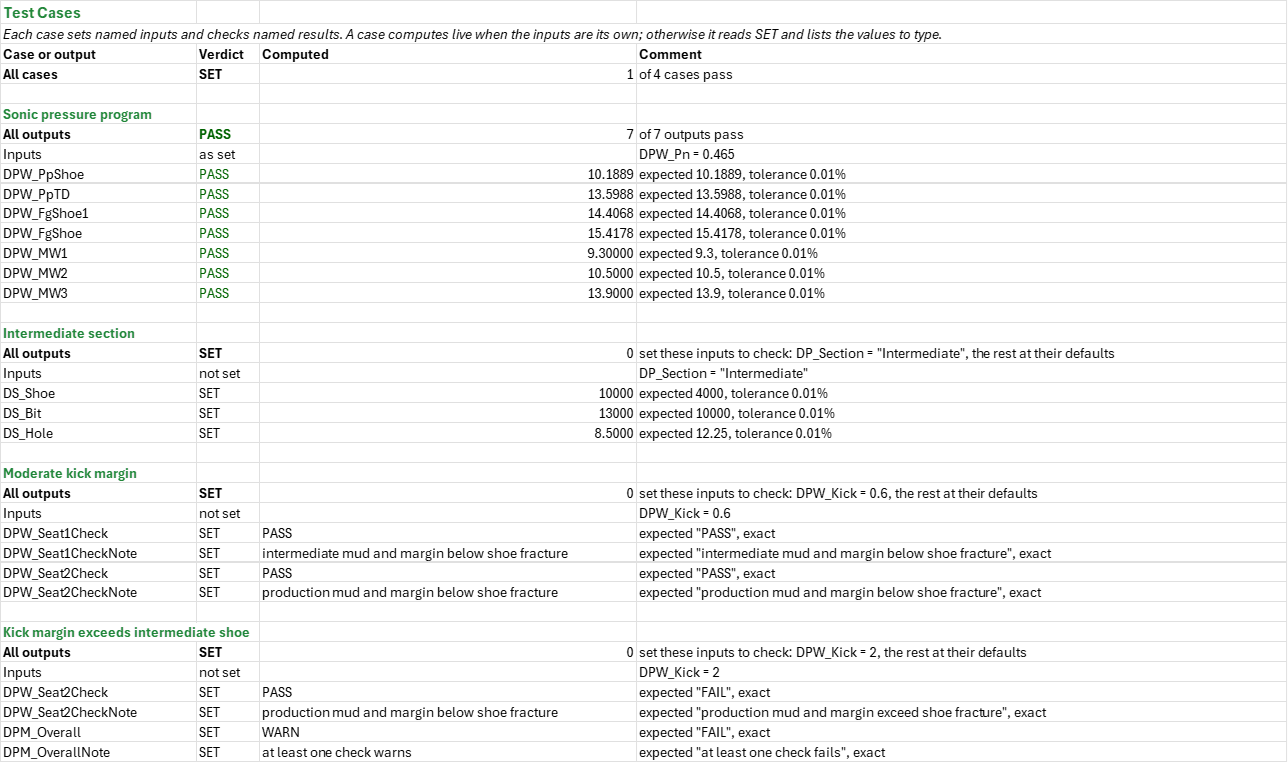
Guide— what the workbook answers and the order to work through its sheets.Pore Pressure— the sonic log, Eaton's pore pressure, Gardner's overburden, Eaton's and Matthews-Kelly's fracture pressure calibrated to two leak-off tests, and the mud program, charted against depth.Sections— the section picker, and for the intermediate and production holes the previous casing, the open hole, the string, the section mud weight, the pressure limits and each section's flow and Fann readings.Hydraulics— for the selected section, the power-law fit, pipe, collar, nozzle and annular losses, pump pressure and power against the pump ratings, and the shoe ECD.Hole Cleaning— for the selected section, annular velocity, cuttings transport ratio and concentration, solids content, and the highest ROP the density limit allows.Surge Swab— for the selected section, Burkhardt surge and swab over a sweep of trip speeds, the shoe surge against fracture and the swab against pore pressure, and the trip-speed limits.Summary— the selected section's answers and every check under one fail-closed verdict.Test Cases— the worked example and other cases, with expected and computed results.
One chart: pore, fracture and mud weight against depth.
Functions used
None: the workbook calculates with Excel's own functions.
Names (250)
| Name | Refers to | Comment |
|---|---|---|
PO.DE.AnnularVelocityLAMBDA |
=LAMBDA(Q_gpm, Dh_in, Dp_in, 24.5 * Q_gpm / (Dh_in^2 - Dp_in^2)) |
Average annular velocity, ft/min, from flow rate and the hole and pipe diameters. |
PO.DE.Bit.HydraulicHPLAMBDA |
=LAMBDA(dP_bit_psi, Q_gpm, dP_bit_psi * Q_gpm / 1714) |
Hydraulic horsepower expended at the bit, hp, from the bit pressure drop and flow rate. |
PO.DE.Bit.NozzleAreaLAMBDA |
=LAMBDA(Size_32nds, PI() / 4 * (Size_32nds / 32)^2) |
Flow area, in2, of one bit nozzle given its size in 32nds of an inch (0 for an empty slot). |
PO.DE.Bit.NozzlePressureLossLAMBDA |
=LAMBDA(MW_ppg, Q_gpm, A_nozzle_in2, MW_ppg * Q_gpm^2 / (10858 * A_nozzle_in2^2)) |
Pressure loss across the bit nozzles, psi, from mud weight, flow rate and total nozzle flow area. Nozzle discharge coefficient of 0.95 is embedded in the constant. |
PO.DE.Cuttings.ConcentrationLAMBDA |
=LAMBDA(ROP_fthr, V_cuttings_bblft, Q_gpm, LET(cuttings_bblmin, ROP_fthr * V_cuttings_bblft / 60, 100 * cuttings_bblmin / (Q_gpm / 42 + cuttings_bblmin))) |
Volume percent of drilled cuttings in the returns, from ROP, cuttings volume per foot and flow rate (no slip between cuttings and mud). |
PO.DE.Cuttings.VolumeLAMBDA |
=LAMBDA(Dh_in, Porosity, LET(gross_bblft, Dh_in^2 / 1029.4, gross_bblft * (1 - Porosity))) |
Solid cuttings volume generated per foot of hole drilled, bbl/ft, from hole diameter and formation porosity. |
PO.DE.ECDLAMBDA |
=LAMBDA(MW_ppg, P_ann_psi, TVD_ft, MW_ppg + P_ann_psi / (0.052 * TVD_ft)) |
Equivalent circulating density, ppg: static mud weight plus annular pressure loss converted to an equivalent density over the true vertical depth. |
PO.DE.FG.EatonLAMBDA |
=LAMBDA(Sv, Pp, Nu, Nu/(1-Nu)*(Sv-Pp)+Pp) |
Eaton fracture gradient from Poisson's ratio: FG = nu/(1 - nu) (Sv - Pp) + Pp, in the unit of Sv and Pp. |
PO.DE.FG.MatthewsKellyLAMBDA |
=LAMBDA(Sv, Pp, Ki, Ki*(Sv-Pp)+Pp) |
Matthews-Kelly fracture gradient from the matrix-stress coefficient: FG = Ki (Sv - Pp) + Pp, in the unit of Sv and Pp. |
PO.DE.HC.SlipVelocityLAMBDA |
=LAMBDA(Dc_in, RhoC_ppg, MW_ppg, n, K_eqcp, Dh_in, Dp_in, Va_ftmin, LET(vMud, Va_ftmin / 60, muApp, K_eqcp / 144 * ((Dh_in - Dp_in) / vMud) ^ (1 - n) * ((2 + 1 / n) / 0.0208) ^ n, dRho, RhoC_ppg - MW_ppg, vsMid, 2.9 * Dc_in * dRho ^ 0.667 / (MW_ppg ^ 0.333 * muApp ^ 0.333), reMid, 928 * MW_ppg * vsMid * Dc_in / muApp, vsTurb, 1.54 * SQRT(Dc_in * dRho / MW_ppg), vsLam, 82.87 * Dc_in ^ 2 * dRho / muApp, 60 * IF(reMid > 300, vsTurb, IF(reMid < 3, vsLam, vsMid)))) |
Cuttings slip velocity, ft/min, by Moore's correlation in a power-law mud: apparent viscosity in the annulus, then the laminar, intermediate or turbulent drag regime by particle Reynolds number. |
PO.DE.HC.TransportRatioLAMBDA |
=LAMBDA(Vslip_ftmin, Va_ftmin, 1 - Vslip_ftmin / Va_ftmin) |
Cuttings transport ratio, the net rise velocity of the cuttings over the annular velocity: 1 - slip velocity / annular velocity (1 carries everything, 0 or less the cuttings settle). |
PO.DE.Hyd.AnnulusLossLAMBDA |
=LAMBDA(Q_gpm, Dh_in, Dp_in, L_ft, MW_ppg, n, K_cp, LET(v, Q_gpm / (2.448 * (Dh_in^2 - Dp_in^2)), gap, Dh_in - Dp_in, re, 109000 * MW_ppg * v^(2 - n) / K_cp * (0.0208 * (Dh_in - Dp_in) / (2 + 1 / n))^n, L_ft * IF(re < 3470 - 1370 * n, K_cp * v^n * ((2 + 1 / n) / 0.0208)^n / (144000 * gap^(1 + n)), 0.0791 / re^0.25 * MW_ppg * v^2 / (21.1 * gap)))) |
Frictional pressure loss, psi, in an annulus for a power-law mud: laminar below the API RP 13D limit 3470 - 1370n, Blasius turbulent above (Bourgoyne et al.). |
PO.DE.Hyd.AnnulusReynoldsLAMBDA |
=LAMBDA(Q_gpm, Dh_in, Dp_in, MW_ppg, n, K_cp, LET(v, Q_gpm / (2.448 * (Dh_in^2 - Dp_in^2)), 109000 * MW_ppg * v^(2 - n) / K_cp * (0.0208 * (Dh_in - Dp_in) / (2 + 1 / n))^n)) |
Power-law Reynolds number in an annulus, slot approximation (Bourgoyne et al.), from flow rate, hole and pipe diameters, mud weight, n and K (eq cp). |
PO.DE.Hyd.PipeLossLAMBDA |
=LAMBDA(Q_gpm, ID_in, L_ft, MW_ppg, n, K_cp, LET(v, Q_gpm / (2.448 * ID_in^2), re, 89100 * MW_ppg * v^(2 - n) / K_cp * (0.0416 * ID_in / (3 + 1 / n))^n, L_ft * IF(re < 3470 - 1370 * n, K_cp * v^n * ((3 + 1 / n) / 0.0416)^n / (144000 * ID_in^(1 + n)), 0.0791 / re^0.25 * MW_ppg * v^2 / (25.8 * ID_in)))) |
Frictional pressure loss, psi, inside a pipe for a power-law mud: laminar below the API RP 13D limit 3470 - 1370n, Blasius turbulent above (Bourgoyne et al.). |
PO.DE.PP.EatonLAMBDA |
=LAMBDA(Sv, Pn, Observed, Normal, Mode, LET(ratio, IF(Mode=1, Normal/Observed, Observed/Normal), expo, IF(Mode=1, 3, 1.2), IF(OR(Mode=1, Mode=2), Sv-(Sv-Pn)*ratio^expo, NA()))) |
Eaton pore pressure from the ratio of a log to its normal-compaction trend. Mode 1 sonic (exponent 3), Mode 2 resistivity (exponent 1.2). Same unit as Sv and Pn. |
PO.DE.Rheo.PowerLawIndexLAMBDA |
=LAMBDA(Theta600, Theta300, 3.32 * LOG10(Theta600 / Theta300)) |
Power-law flow behavior index n from the 600 and 300 rpm viscometer dial readings. |
PO.DE.Rheo.PowerLawKLAMBDA |
=LAMBDA(Theta300, FlowIdx, 510 * Theta300 / 511^FlowIdx) |
Power-law consistency index, eq cp, from the 300 rpm dial reading and the flow behavior index (Bourgoyne et al.). |
PO.DE.Solids.FractionLAMBDA |
=LAMBDA(MW_ppg, MW_base_ppg, Rho_solids_ppg, 100 * (MW_ppg - MW_base_ppg) / (Rho_solids_ppg - MW_base_ppg)) |
Volume percent solids in a two-component mud, from the mud weight, the base fluid weight and the solids density. |
PO.DE.Surge.BurkhardtLAMBDA |
=LAMBDA(Vp_ftmin, Dh_in, Dp_in, Di_in, Kc, Mode, Vp_ftmin*(IF(Mode=1, Dp_in^2 - Di_in^2, Dp_in^2)/(Dh_in^2 - Dp_in^2) + Kc)) |
Burkhardt effective annular velocity, ft/min, of the mud a moving pipe displaces, with the clinging constant; closed-end (Mode 0) or open-end (Mode 1) pipe. |
PO.GM.Density.GardnerLAMBDA |
=LAMBDA(Vp, A, B, A*Vp^B) |
Bulk density from P-wave velocity by Gardner's power law, rho = A Vp^B (g/cc; A 0.23 and B 0.25 with Vp in ft/s). |
PO.GM.Stress.OverburdenLAMBDA |
=LAMBDA(Z_ft, TVD_ft, Rho_gcc, Sv0_psi, LET(n, ROWS(TVD_ft), i, SEQUENCE(n), shift, --(i=TRANSPOSE(i)+1), d_prev, MMULT(shift, TVD_ft), r_prev, MMULT(shift, Rho_gcc), d_end, IF(TVD_ft<Z_ft, TVD_ft, Z_ft), width, IF(i>1, IF(d_end>d_prev, d_end-d_prev, 0), 0), r_end, r_prev+(Rho_gcc-r_prev)*IF(TVD_ft>d_prev, (d_end-d_prev)/(TVD_ft-d_prev), 0), d_last, INDEX(TVD_ft, n), tail, IF(Z_ft>d_last, (Z_ft-d_last)*INDEX(Rho_gcc, n), 0), sv, Sv0_psi+0.433528*(SUM(width*(r_prev+r_end)/2)+tail), IF(Z_ft<INDEX(TVD_ft, 1), NA(), HSTACK(sv, sv/Z_ft, sv/Z_ft/0.052)))) |
Overburden stress at a depth by integrating a bulk-density log (trapezoids) below the stress at its first depth: {Sv psi, psi/ft, ppg}. |
_PO.DE.ControlDrilling.MaxRateLAMBDA |
=LAMBDA(MW_in_ppg, MW_max_ppg, Q_gpm, Dh_in, 67 * (MW_max_ppg - MW_in_ppg) * Q_gpm / Dh_in^2) |
Maximum drilling rate, ft/hr, that keeps the mud weight increase across the annulus within the allowed limit. |
_PO.DE.Solids.DensityLAMBDA |
=LAMBDA(SG, 8.34 * SG) |
Density of solids, ppg, from their specific gravity: fresh water is 8.34 ppg. |
DC_AVdp |
'Hole Cleaning'!$B$18 |
Velocity past drill pipe, ft/min |
DC_AVmin |
'Hole Cleaning'!$B$9 |
Min annular velocity, ft/min |
DC_Conc |
'Hole Cleaning'!$B$17 |
Concentration, no slip, % vol |
DC_ConcAnn |
'Hole Cleaning'!$B$24 |
Concentration with slip, % vol |
DC_ConcMax |
'Hole Cleaning'!$B$11 |
Max cuttings concentration, % vol |
DC_ConcentrationCheck |
'Hole Cleaning'!$B$31 |
Annular concentration verdict |
DC_ConcentrationCheckNote |
'Hole Cleaning'!$C$31 |
Annular concentration comment |
DC_Dc |
'Hole Cleaning'!$B$7 |
Cutting diameter, in |
DC_FT |
'Hole Cleaning'!$B$23 |
Transport ratio |
DC_FTmin |
'Hole Cleaning'!$B$10 |
Min transport ratio |
DC_Inputs |
'Hole Cleaning'!$B$5:$B$14 |
ROP, cuttings and cleaning limits |
DC_MWbase |
'Hole Cleaning'!$B$12 |
Base fluid density, ppg |
DC_MWmax |
'Hole Cleaning'!$B$15 |
Density limit at shoe, ppg |
DC_Por |
'Hole Cleaning'!$B$6 |
Formation porosity, % |
DC_ROP |
'Hole Cleaning'!$B$5 |
Planned ROP, ft/hr |
DC_ROPmax |
'Hole Cleaning'!$B$20 |
Max ROP for density limit, ft/hr |
DC_Results |
'Hole Cleaning'!$B$15:$B$32 |
Cuttings load, transport, solids and ... |
DC_RopCheck |
'Hole Cleaning'!$B$28 |
Control drilling verdict |
DC_RopCheckNote |
'Hole Cleaning'!$C$28 |
Control drilling comment |
DC_SGc |
'Hole Cleaning'!$B$8 |
Cutting specific gravity, water = 1 |
DC_SGs |
'Hole Cleaning'!$B$13 |
avg. solids specific gravity, water = 1 |
DC_Solids |
'Hole Cleaning'!$B$26 |
Mud solids content, % vol |
DC_SolidsCheck |
'Hole Cleaning'!$B$32 |
Solids content verdict |
DC_SolidsCheckNote |
'Hole Cleaning'!$C$32 |
Solids content comment |
DC_SolidsMax |
'Hole Cleaning'!$B$14 |
Max solids content, % vol |
DC_TransportCheck |
'Hole Cleaning'!$B$30 |
Cuttings transport verdict |
DC_TransportCheckNote |
'Hole Cleaning'!$C$30 |
Cuttings transport comment |
DC_VelocityCheck |
'Hole Cleaning'!$B$29 |
Annular velocity verdict |
DC_VelocityCheckNote |
'Hole Cleaning'!$C$29 |
Annular velocity comment |
DC_Vslip |
'Hole Cleaning'!$B$22 |
Moore slip velocity, ft/min |
DH_AnnShoe |
Hydraulics!$B$35 |
Loss above previous shoe, psi |
DH_AnnTotal |
Hydraulics!$B$36 |
Loss bit to surface, psi |
DH_EcdShoe |
Hydraulics!$B$38 |
ECD at shoe, ppg |
DH_Gel |
Hydraulics!$B$13 |
Gel, 10 min, lb/100ft² |
DH_HHPUse |
Hydraulics!$B$41 |
HHP utilisation |
DH_HHPmax |
Hydraulics!$B$21 |
Pump power rating, hp |
DH_Inputs |
Hydraulics!$B$5:$B$22 |
Flow, Fann readings, nozzles and pump... |
DH_K |
Hydraulics!$B$24 |
Consistency index, eq cp |
DH_MW |
Hydraulics!$F$23 |
Mud weight, ppg |
DH_Margin |
Hydraulics!$B$22 |
Warning margin |
DH_Noz1 |
Hydraulics!$B$14 |
Nozzle 1 (0 empty), 1/32 in |
DH_Noz2 |
Hydraulics!$B$15 |
Nozzle 2 (0 empty), 1/32 in |
DH_Noz3 |
Hydraulics!$B$16 |
Nozzle 3 (0 empty), 1/32 in |
DH_Noz4 |
Hydraulics!$B$17 |
Nozzle 4 (0 empty), 1/32 in |
DH_Noz5 |
Hydraulics!$B$18 |
Nozzle 5 (0 empty), 1/32 in |
DH_Noz6 |
Hydraulics!$B$19 |
Nozzle 6 (0 empty), 1/32 in |
DH_PowerCheck |
Hydraulics!$B$45 |
Pump power verdict |
DH_PowerCheckNote |
Hydraulics!$C$45 |
Pump power comment |
DH_PumpCheck |
Hydraulics!$B$44 |
Pump pressure verdict |
DH_PumpCheckNote |
Hydraulics!$C$44 |
Pump pressure comment |
DH_PumpHHP |
Hydraulics!$B$39 |
Pump power, hp |
DH_Q |
Hydraulics!$B$5 |
Selected flow rate, gpm |
DH_R100 |
Hydraulics!$B$10 |
Fann 100 rpm, lb/100ft² |
DH_R200 |
Hydraulics!$B$9 |
Fann 200 rpm, lb/100ft² |
DH_R3 |
Hydraulics!$B$12 |
Fann 3 rpm, lb/100ft² |
DH_R300 |
Hydraulics!$B$8 |
Selected Fann 300 rpm, lb/100ft² |
DH_R6 |
Hydraulics!$B$11 |
Fann 6 rpm, lb/100ft² |
DH_R600 |
Hydraulics!$B$7 |
Selected Fann 600 rpm, lb/100ft² |
DH_Results |
Hydraulics!$B$23:$B$45 |
Rheology, losses, ECD and pump checks |
DH_SPP |
Hydraulics!$B$37 |
Standpipe pressure, psi |
DH_SPPUse |
Hydraulics!$B$40 |
SPP utilisation |
DH_SPPmax |
Hydraulics!$B$20 |
Pump pressure rating, psi |
DH_Surf |
Hydraulics!$B$6 |
Surface loss, psi |
DH_TFA |
Hydraulics!$B$25 |
Nozzle flow area, in² |
DH_WindowCheck |
Hydraulics!$B$43 |
Shoe fracture and pore verdict |
DH_WindowCheckNote |
Hydraulics!$C$43 |
Shoe fracture and pore comment |
DH_dPbit |
Hydraulics!$B$26 |
Bit pressure drop, psi |
DH_n |
Hydraulics!$B$23 |
Power-law index |
DPM_Checks |
Summary!$B$11:$B$26 |
Every sheet verdict; invalid and erro... |
DPM_IntermediateMW |
Summary!$B$5 |
Intermediate mud, ppg |
DPM_Overall |
Summary!$B$27 |
Overall verdict |
DPM_OverallNote |
Summary!$C$27 |
Overall comment |
DPM_ProductionMW |
Summary!$B$6 |
Production mud, ppg |
DPM_Section |
Summary!$B$7 |
Selected section |
DPM_ShoeEcd |
Summary!$B$8 |
Selected ECD at shoe, ppg |
DPM_SurfaceMW |
Summary!$B$4 |
Surface mud, ppg |
DPM_Verdict |
Summary!$B$27 |
Overall verdict over every named check |
DPM_VerdictNote |
Summary!$C$27 |
Overall verdict over every named chec... |
DPW_CalCheck |
'Pore Pressure'!$B$55 |
Calibration verdict |
DPW_CalCheckNote |
'Pore Pressure'!$C$55 |
Calibration comment |
DPW_Curve |
'Pore Pressure'!$A$63:$K$87 |
Synthetic log and calculated pressures |
DPW_Dt0 |
'Pore Pressure'!$B$6 |
Surface sonic trend, µs/ft |
DPW_DtC |
'Pore Pressure'!$B$7 |
Sonic trend decay, 1/ft |
DPW_Fg |
'Pore Pressure'!$H$63:$H$87 |
Eaton fracture pressure, ppg |
DPW_Fg1 |
'Pore Pressure'!$B$51 |
Fracture at test 1, ppg |
DPW_Fg2 |
'Pore Pressure'!$B$53 |
Fracture at test 2, ppg |
DPW_FgShoe |
'Pore Pressure'!$B$40 |
Eaton fracture at shoe, ppg |
DPW_FgShoe1 |
'Pore Pressure'!$B$39 |
Eaton fracture at surface shoe, ppg |
DPW_GA |
'Pore Pressure'!$B$9 |
Gardner coefficient |
DPW_GB |
'Pore Pressure'!$B$10 |
Gardner exponent |
DPW_Inputs |
'Pore Pressure'!$B$5:$B$18 |
Sonic trend, seats and margins |
DPW_Ki0 |
'Pore Pressure'!$B$12 |
Matthews-Kelly initial Ki |
DPW_KiSlope |
'Pore Pressure'!$B$13 |
Matthews-Kelly Ki slope, 1/ft |
DPW_Kick |
'Pore Pressure'!$B$18 |
Kick margin, ppg |
DPW_Lot1 |
'Pore Pressure'!$B$20 |
First test equivalent weight, ppg |
DPW_Lot1Z |
'Pore Pressure'!$B$19 |
First test depth, ft |
DPW_Lot2 |
'Pore Pressure'!$B$22 |
Second test equivalent weight, ppg |
DPW_Lot2Z |
'Pore Pressure'!$B$21 |
Second test depth, ft |
DPW_LotTol |
'Pore Pressure'!$B$23 |
Accepted test misfit, ppg |
DPW_Lot_Inputs |
'Pore Pressure'!$B$19:$B$23 |
Leak-off tests and tolerance |
DPW_Lot_Results |
'Pore Pressure'!$B$51:$B$55 |
Test predictions, misfits and calibra... |
DPW_MW1 |
'Pore Pressure'!$B$42 |
Surface mud, ppg |
DPW_MW2 |
'Pore Pressure'!$B$43 |
Intermediate mud, ppg |
DPW_MW3 |
'Pore Pressure'!$B$44 |
Production mud, ppg |
DPW_Miss1 |
'Pore Pressure'!$B$52 |
Misfit at test 1, ppg |
DPW_Miss2 |
'Pore Pressure'!$B$54 |
Misfit at test 2, ppg |
DPW_Nu |
'Pore Pressure'!$B$11 |
Poisson ratio |
DPW_Pn |
'Pore Pressure'!$B$5 |
Normal pressure gradient, psi/ft |
DPW_PnEmw |
'Pore Pressure'!$B$33 |
Normal pore pressure, ppg |
DPW_PoreMaxIntermediate |
'Pore Pressure'!$B$35 |
Intermediate maximum pore, ppg |
DPW_PoreMaxProduction |
'Pore Pressure'!$B$36 |
Production maximum pore, ppg |
DPW_Pp |
'Pore Pressure'!$G$63:$G$87 |
Eaton pore pressure, ppg |
DPW_PpShoe |
'Pore Pressure'!$B$37 |
Pore pressure at shoe, ppg |
DPW_PpShoe1 |
'Pore Pressure'!$B$41 |
Pore pressure at surface shoe, ppg |
DPW_PpTD |
'Pore Pressure'!$B$38 |
Pore pressure at TD, ppg |
DPW_Results |
'Pore Pressure'!$B$33:$B$48 |
Pressure, mud weights and seat checks |
DPW_RhoTop |
'Pore Pressure'!$B$8 |
Bulk density above first point, g/cm³ |
DPW_Seat1Check |
'Pore Pressure'!$B$46 |
Surface seat verdict |
DPW_Seat1CheckNote |
'Pore Pressure'!$C$46 |
Surface seat comment |
DPW_Seat2Check |
'Pore Pressure'!$B$47 |
Intermediate seat verdict |
DPW_Seat2CheckNote |
'Pore Pressure'!$C$47 |
Intermediate seat comment |
DPW_Shoe1 |
'Pore Pressure'!$B$14 |
Surface shoe TVD, ft |
DPW_Shoe2 |
'Pore Pressure'!$B$15 |
Intermediate shoe TVD, ft |
DPW_Sv0 |
'Pore Pressure'!$B$34 |
Overburden at first point, psi |
DPW_TD |
'Pore Pressure'!$B$16 |
Production TD TVD, ft |
DPW_Trip |
'Pore Pressure'!$B$17 |
Trip margin, ppg |
DPW_Window |
'Pore Pressure'!$B$45 |
Narrowest window, ppg |
DPW_WindowCheck |
'Pore Pressure'!$B$48 |
Window verdict |
DPW_WindowCheckNote |
'Pore Pressure'!$C$48 |
Window comment |
DPW_Z |
'Pore Pressure'!$A$63:$A$87 |
Log depth, ft TVD |
DP_Col |
Sections!$G$28 |
Column of the selected section |
DP_Section |
Sections!$G$3 |
Section to evaluate |
DSI_BhaID |
Sections!$B$14 |
Collar ID, in |
DSI_BhaL |
Sections!$B$15 |
Collar length, ft |
DSI_BhaOD |
Sections!$B$13 |
Collar OD, in |
DSI_Bit |
Sections!$B$6 |
Bit at section TD, ft |
DSI_DpID |
Sections!$B$12 |
Drill pipe ID, in |
DSI_DpOD |
Sections!$B$11 |
Drill pipe OD, in |
DSI_Frac |
Sections!$B$18 |
Eaton fracture at shoe, ppg |
DSI_GeometryCheck |
Sections!$B$26 |
Geometry verdict |
DSI_GeometryCheckNote |
Sections!$F$26 |
Geometry comment |
DSI_Hole |
Sections!$B$7 |
Open-hole diameter, in |
DSI_IdBot |
Sections!$B$9 |
Casing lower ID, in |
DSI_IdTop |
Sections!$B$8 |
Casing upper ID, in |
DSI_MW |
Sections!$B$16 |
Section mud weight, ppg |
DSI_Pore |
Sections!$B$17 |
Max pore, open interval, ppg |
DSI_Q |
Sections!$B$35 |
Flow rate, gpm |
DSI_R300 |
Sections!$B$37 |
Fann 300 rpm, lb/100ft² |
DSI_R600 |
Sections!$B$36 |
Fann 600 rpm, lb/100ft² |
DSI_Results |
Sections!$B$5:$B$26 |
Section geometry, press. limits and c... |
DSI_Shoe |
Sections!$B$5 |
Previous shoe, ft |
DSI_Xover |
Sections!$B$10 |
Crossover depth, ft |
DSP_BhaID |
Sections!$C$14 |
Collar ID, in |
DSP_BhaL |
Sections!$C$15 |
Collar length, ft |
DSP_BhaOD |
Sections!$C$13 |
Collar OD, in |
DSP_Bit |
Sections!$C$6 |
Bit at section TD, ft |
DSP_DpID |
Sections!$C$12 |
Drill pipe ID, in |
DSP_DpOD |
Sections!$C$11 |
Drill pipe OD, in |
DSP_Frac |
Sections!$C$18 |
Eaton fracture at shoe, ppg |
DSP_GeometryCheck |
Sections!$C$26 |
Geometry verdict |
DSP_GeometryCheckNote |
Sections!$D$26 |
Geometry comment |
DSP_Hole |
Sections!$C$7 |
Open-hole diameter, in |
DSP_IdBot |
Sections!$C$9 |
Casing lower ID, in |
DSP_IdTop |
Sections!$C$8 |
Casing upper ID, in |
DSP_MW |
Sections!$C$16 |
Section mud weight, ppg |
DSP_Pore |
Sections!$C$17 |
Max pore, open interval, ppg |
DSP_Q |
Sections!$C$35 |
Flow rate, gpm |
DSP_R300 |
Sections!$C$37 |
Fann 300 rpm, lb/100ft² |
DSP_R600 |
Sections!$C$36 |
Fann 600 rpm, lb/100ft² |
DSP_Results |
Sections!$C$5:$C$26 |
Section geometry, press. limits and c... |
DSP_Shoe |
Sections!$C$5 |
Previous shoe, ft |
DSP_Xover |
Sections!$C$10 |
Crossover depth, ft |
DS_BhaID |
Sections!$G$14 |
Selected section BhaID |
DS_BhaL |
Sections!$G$15 |
Selected section BhaL |
DS_BhaOD |
Sections!$G$13 |
Selected section BhaOD |
DS_Bit |
Sections!$G$6 |
Selected section Bit |
DS_DPL |
Sections!$G$19 |
Selected section DPL |
DS_DpID |
Sections!$G$12 |
Selected section DpID |
DS_DpOD |
Sections!$G$11 |
Selected section DpOD |
DS_Frac |
Sections!$G$18 |
Selected section Frac |
DS_GeometryCheck |
Sections!$G$26 |
Selected section geometry check |
DS_Hole |
Sections!$G$7 |
Selected section Hole |
DS_IdBot |
Sections!$G$9 |
Selected section IdBot |
DS_IdTop |
Sections!$G$8 |
Selected section IdTop |
DS_Len1 |
Sections!$G$20 |
Selected section Len1 |
DS_Len2 |
Sections!$G$21 |
Selected section Len2 |
DS_Len3 |
Sections!$G$22 |
Selected section Len3 |
DS_Len4 |
Sections!$G$23 |
Selected section Len4 |
DS_Len5 |
Sections!$G$24 |
Selected section Len5 |
DS_Len6 |
Sections!$G$25 |
Selected section Len6 |
DS_MW |
Sections!$G$16 |
Selected section MW |
DS_Pore |
Sections!$G$17 |
Selected section Pore |
DS_Shoe |
Sections!$G$5 |
Selected section Shoe |
DS_Xover |
Sections!$G$10 |
Selected section Xover |
DT_EmwSurgeShoe |
'Surge Swab'!$B$36 |
Surge EMW at shoe, ppg |
DT_EmwSwabBit |
'Surge Swab'!$B$38 |
Swab EMW at bit, ppg |
DT_EmwSwabMin |
'Surge Swab'!$B$17 |
Min swab EMW in open hole, ppg |
DT_EmwSwabShoe |
'Surge Swab'!$B$37 |
Swab EMW at shoe, ppg |
DT_Hydro |
'Surge Swab'!$B$19 |
press. gradient of 1 ppg of mud, psi/... |
DT_Inputs |
'Surge Swab'!$B$5:$B$12 |
Trip timings, end mode and speed sweep |
DT_Kc |
'Surge Swab'!$B$5 |
Clinging constant |
DT_Mode |
'Surge Swab'!$B$6 |
Pipe end: 0 closed, 1 open |
DT_Peak |
'Surge Swab'!$B$10 |
Peak / average speed |
DT_Results |
'Surge Swab'!$B$13:$B$43 |
Planned trip pressures, speed limits ... |
DT_SafeIn |
'Surge Swab'!$B$39 |
Safe run speed, ft/min |
DT_SafeOut |
'Surge Swab'!$B$40 |
Safe pull speed, ft/min |
DT_SecMin |
'Surge Swab'!$B$18 |
Seconds in a minute, s/min |
DT_SpeedCheck |
'Surge Swab'!$B$43 |
Sweep-safe trip speeds verdict |
DT_SpeedCheckNote |
'Surge Swab'!$C$43 |
Sweep-safe trip speeds comment |
DT_Stand |
'Surge Swab'!$B$7 |
Stand length, ft |
DT_Start |
'Surge Swab'!$B$11 |
Lowest sweep speed, ft/min |
DT_Step |
'Surge Swab'!$B$12 |
Sweep speed step, ft/min |
DT_SurgeBit |
'Surge Swab'!$B$33 |
Surge pressure at bit, psi |
DT_SurgeCheck |
'Surge Swab'!$B$41 |
Surge at previous shoe verdict |
DT_SurgeCheckNote |
'Surge Swab'!$C$41 |
Surge at previous shoe comment |
DT_SurgeShoe |
'Surge Swab'!$B$32 |
Surge pressure at shoe, psi |
DT_SwabBit |
'Surge Swab'!$B$35 |
Swab pressure at bit, psi |
DT_SwabCheck |
'Surge Swab'!$B$42 |
Swab against interval pore max. verdict |
DT_SwabCheckNote |
'Surge Swab'!$C$42 |
Swab against interval pore max. comment |
DT_SwabShoe |
'Surge Swab'!$B$34 |
Swab pressure at shoe, psi |
DT_Sweep |
'Surge Swab'!$F$71:$N$75 |
Shared five-speed Burkhardt sweep |
DT_TimeIn |
'Surge Swab'!$B$8 |
Run time per stand, s |
DT_TimeOut |
'Surge Swab'!$B$9 |
Pull time per stand, s |
DT_VavgIn |
'Surge Swab'!$B$13 |
Avg run-in speed, ft/min |
DT_VavgOut |
'Surge Swab'!$B$15 |
Avg pull-out speed, ft/min |
DT_VpIn |
'Surge Swab'!$B$14 |
Peak run-in speed, ft/min |
DT_VpOut |
'Surge Swab'!$B$16 |
Peak pull-out speed, ft/min |
Details
| Opens in | Needs Microsoft 365 or Excel 2024: it uses functions Excel 2016 doesn't have, such as named LAMBDAs, which show #NAME? there. |
| File | DrillingProgram.xlsx, 59 KB |
| Category | Drilling |
| For agents and tools | Descriptor (.md) |