Rod Pump System Design
Description
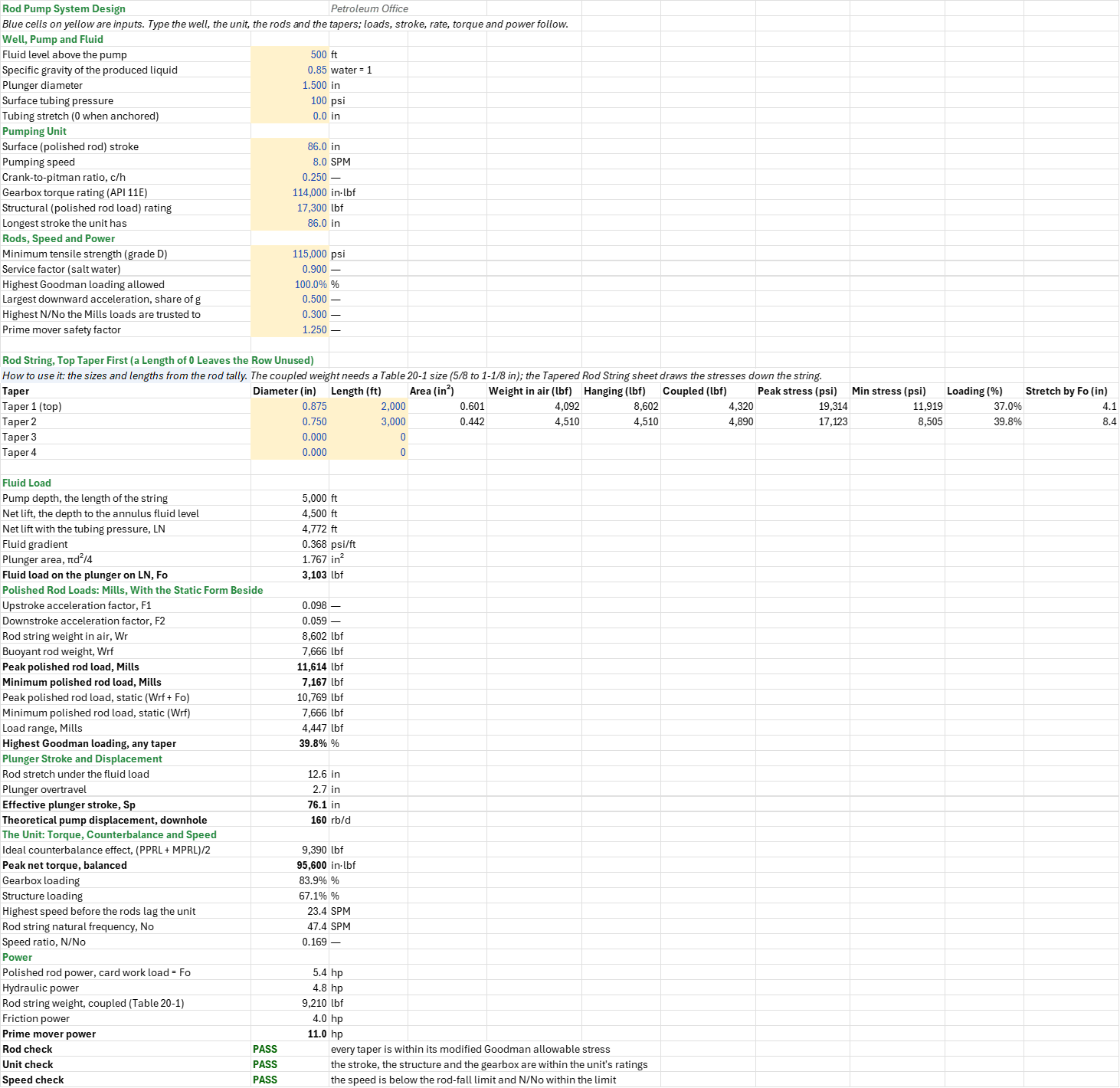
What does a sucker-rod pumping system load, stroke and displace, and does it fit the pumping unit? You enter the well, pump and fluid, the unit's stroke, speed, crank-to-pitman ratio and ratings, the rod grade and limits, and up to four tapers. You read off the Mills and static polished rod loads, each taper's modified Goodman loading, the effective plunger stroke and the rate it displaces, the ideal counterbalance and balanced peak torque, the speed limits and the prime mover's power, with a verdict on the rods, the unit and the speed.
Parameters:
- Well, pump and fluid: the fluid level above the pump
RSD_Hsub, the liquid's specific gravityRSD_SG, the plunger diameterRSD_Dp, the surface tubing pressureRSD_Ptfand the tubing stretchRSD_TubStretch(0 when the tubing is anchored) - Pumping unit: the surface stroke
RSD_S, the speedRSD_N, the crank-to-pitman ratioRSD_CH, and the unit's gearbox ratingRSD_Gearbox, structural ratingRSD_Structureand longest strokeRSD_MaxStroke - Rods, speed and power: the grade's minimum tensile strength
RSD_T, the service factorRSD_SF, the highest Goodman loading allowedRSD_MaxLoading, the largest downward accelerationRSD_Lacc(a share of g), the highest speed ratio N/No the Mills loads are trusted toRSD_NNoMax, and the prime mover's safety factorRSD_Fs - Tapers: each taper's diameter
RSD_DiaAtoRSD_DiaDand lengthRSD_LenAtoRSD_LenD, top first; a length of 0 leaves the row unused
How to use it: Take the tapers from the rod tally, the unit's ratings and c/h from its nameplate and data sheet (the API 11E designation C-114D-173-86 reads 114,000 in·lbf, 17,300 lbf and 86 in), and the fluid level from an acoustic shot (the Rod Pump Sizing sheet). The rod check fails when a taper is loaded past the allowed share of its Goodman range; redesign the string on the Tapered Rod String Design (Modified Goodman) sheet, which draws the stresses down the string. The unit check compares the stroke, the peak polished rod load and the balanced peak torque with the unit's ratings, and the speed check the speed with the rod-fall limit and N/No with its limit. A dynamometer card's peak and minimum loads replace the computed ones on the Pumping Unit Torque and Counterbalance sheet.
Method: The pump depth is the string's length. The net lift LN = (depth − fluid above the pump) + Ptf/(0.433·SG) counts the surface tubing pressure as a column of the produced liquid (Economides Eq. 20-14), and the fluid load is Fo = Ap·LN·0.433·SG: the liquid column over the plunger plus Ap·Ptf. That one Fo carries into the loads, the stresses, the stretch, the torque and the power. Mills' factors, which add the acceleration of the rods on each stroke, are F1 = S·N²·(1 + c/h)/70,471.2 and F2 = S·N²·(1 − c/h)/70,471.2 for a conventional unit; with Wr the string's weight in air, PPRL = Fo − SG·62.4·Wr/490 + Wr·(1 + F1) and MPRL = Wr·(1 − F2) − SG·62.4·Wr/490 (Guo Eq. 12.17). The static loads, Wrf + Fo and Wrf, are shown beside them. Each taper's peak and minimum stresses are the same loads over the rods hanging below its top, and its loading is checked against the modified Goodman allowable stress Sa = (T/4 + 0.5625·Smin)·SF. The rods stretch Fo·L·12/(E·A) a taper under the fluid load, the plunger overtravels 5.79 × 10⁻⁴·S·L²·N²/E, and Sp = S + overtravel − (rod + tubing stretch) (Economides Eq. 20-9); the displacement is 0.1166·d²·Sp·N, in barrels a day at pump conditions (rb/d, a downhole volume, before any shrinkage to stock tank). The ideal counterbalance is (PPRL + MPRL)/2 and the balanced peak torque (PPRL − MPRL)·S/4. The highest speed before the rods lag the carrier bar is √(70,471.2·L/(S·(1 − c/h))) (Guo Eq. 12.34), and the rods' natural frequency No = 237,000/L (Economides Eq. 20-8). The polished rod power takes the fluid load as the card work load, the frictionless lower bound; the prime mover is Fs·(hydraulic + friction power) (Economides Eqs. 20-12 to 20-15, the coupled rod weight from Table 20-1).
Example: The default case is the rod-pump well the four rod-pump sheets share: a 1.5 in pump at 5,000 ft under 500 ft of 0.85 SG fluid, with 100 psig at the tubing head, on 2,000 ft of 7/8 in over 3,000 ft of 3/4 in grade D rods (SF 0.9, salt water), driven at 86 in and 8 SPM by a conventional unit with c/h = 0.25 rated at 114,000 in·lbf on the gearbox and 17,300 lbf on the structure.
The 100 psig at the tubing head adds 100/(0.433 × 0.85) = 272 ft to the 4,500 ft net lift, LN = 4,772 ft, so the fluid load is 1.767 in² × 4,772 ft × 0.368 psi/ft = 3,103 lb, of which 1.767 × 100 = 177 lb is the tubing pressure. The rods weigh 8,602 lb in air, so F1 = 0.0976 and F2 = 0.0586 give PPRL = 11,614 lb and MPRL = 7,167 lb, against 10,769 lb and 7,666 lb static: the motion adds 845 lb on the upstroke and takes 499 lb off on the downstroke. The 3/4 in taper is the more loaded, at 39.8 % of its Goodman range. The rods stretch 12.56 in under the fluid load and the plunger overtravels 2.66 in, so the 86 in stroke makes Sp = 76.1 in and the pump displaces 160 bbl/d at pump conditions. The ideal counterbalance is 9,390 lb and the balanced peak torque 95,600 in·lbf, 83.9 % of the gearbox and 67.1 % of the structure, within the unit's ratings. At 8 SPM the unit is well under the 23.4 SPM rod-fall limit, and N/No = 8/47.4 = 0.169. The prime mover needs 1.25 × (4.77 + 4.00) = 11.0 hp.
Functions used
PO.RP.Rod.Area(d)
Calculates rod cross-sectional area from diameter, [in2].
PO.RP.Rod.Wair(Ar, L)
Calculates rod string weight in air, [lbf].
PO.RP.Rod.Wft.Coupled(d)
Looks up the weight per foot of a sucker rod with its couplings, Economides Table 20-1 (5/8, 3/4, 7/8, 1 and 1-1/8 in only), [lbm/ft].
PO.RP.Rod.MaxStress(PPRL, Ar)
Calculates maximum rod stress from peak load, [psi].
PO.RP.Load.PPRL.Mills(Wf, Wr, SG, F1)
Calculates Peak Polished Rod Load with the approximate (Mills) acceleration factor, PPRL = Wf − SG·62.4·Wr/490 + Wr·(1 + F1) (Guo Eq. 12.17), [lbf].
PO.RP.Rod.MinStress(MPRL, Ar)
Calculates minimum rod stress from minimum load, [psi].
PO.RP.Load.MPRL.Mills(Wr, SG, F2)
Calculates Minimum Polished Rod Load with the approximate (Mills) acceleration factor, MPRL = Wr·(1 − F2) − SG·62.4·Wr/490 (Guo Section 12.4.2), [lbf].
PO.RP.Rod.Stretch.FluidLoad(Fo, L, Ar)
Calculates rod stretch due to fluid load, [in].
PO.RP.Pump.NetLift(H, p_tf, SG)
Calculates the net lift the pump works against, L_N = H + p_tf/(0.433·SG) (Economides Eq. 20-14), [ft].
PO.ESP.Head.ToPressure(H, SG)
Converts head to pressure using fluid specific gravity, [psi].
PO.RP.Load.FluidLoad(Ap, H, G)
Calculates fluid load on plunger, [lbf].
PO.RP.Load.F1.Mills(S, N, c_h, [geometry])
Calculates the upstroke acceleration factor F1 of the approximate (Mills) polished rod load, F1 = S·N²·(1 ± c/h)/70,471.2 (Guo Eqs. 12.20 and 12.21), [dimensionless].
PO.RP.Load.F2.Mills(S, N, c_h, [geometry])
Calculates the downstroke acceleration factor F2 of the approximate (Mills) polished rod load, F2 = S·N²·(1 ∓ c/h)/70,471.2 (Guo Eqs. 12.23 and 12.24), [dimensionless].
PO.RP.Rod.Wbuoy(Wair, SG)
Calculates buoyant rod string weight (weight in fluid), [lbf].
PO.RP.Load.PPRL.Simple(Wrf, Fo)
Calculates simplified PPRL (static, no dynamic effects), [lbf].
PO.RP.Load.MPRL.Simple(Wrf)
Calculates simplified MPRL (static, no dynamic effects), [lbf].
PO.RP.Load.Range(PPRL, MPRL)
Calculates polished rod load range (PPRL - MPRL), [lbf].
PO.RP.Pump.Overtravel(S, L, N)
Calculates plunger overtravel from rod-string acceleration, e_p = 5.79e-4·S·L²·N²/E for steel rods (overtravel term of Economides Eq. 20-10), [in].
PO.RP.Pump.Stroke.Eff(S, ΔLr, ΔLt, [ep])
Calculates effective plunger stroke from surface stroke, stretch and plunger overtravel, Sp = S + e_p − (ΔLr + ΔLt) (Economides Eq. 20-9), [in].
PO.RP.Pump.Displacement.FromDiameter(d, Sp, N)
Calculates theoretical pump displacement from plunger diameter, [bbl/d].
PO.RP.Torque.IdealCBE.Loads(PPRL, MPRL)
Calculates ideal counterbalance effect from PPRL and MPRL, [lbf].
PO.RP.Torque.Peak(PPRL, MPRL, S)
Calculates estimated peak net torque (simplified), [lbf.in].
PO.RP.Load.Nmax(S, c_h, L_acc, [geometry])
Calculates the highest pumping speed that keeps the downward acceleration at the top of the stroke within a fraction L of gravity, N = sqrt(70,471.2·L/(S·(1 ∓ c/h))) (Guo Eq. 12.34), [SPM].
PO.RP.Rod.Nres(L)
Calculates the lowest pumping speed that excites the steel rod string's natural frequency, N = 237,000/L (Economides Eq. 20-8); pump below it, [SPM].
PO.RP.Torque.PRHP(W, S, N)
Calculates polished rod horsepower from the dynamometer card work load, [hp].
PO.RP.Torque.HHP(q, SG, L_N)
Calculates the hydraulic horsepower to lift the produced liquid, P_h = 7.36e-6·q·SG·L_N (Economides Eq. 20-13), [hp].
PO.RP.Torque.FHP(Wr, S, N)
Calculates the horsepower lost to friction in the pump, polished rod and rod string, P_f = 6.31e-7·Wr·S·N (Economides Eq. 20-15), [hp].
PO.RP.Torque.PMHP(P_h, P_f, Fs)
Calculates the prime mover horsepower, P_pm = Fs·(P_h + P_f) (Economides Eq. 20-12), [hp].
Names (67)
| Name | Refers to | Comment |
|---|---|---|
PO.RP.Rod.TaperStressLAMBDA |
=LAMBDA(t_min, s_max, s_min, sf, output, IF(OR(t_min<=0, sf<=0, s_min<0, s_max<s_min), NA(), LET(sa, (t_min/4+0.5625*s_min)*sf, IF(output="Sa", sa, IF(output="Loading", IF(sa<=s_min, NA(), (s_max-s_min)/(sa-s_min)), IF(output="Margin", sa-s_max, NA())))))) |
API RP 11BR modified Goodman check of a rod taper, Sa = (T/4 + 0.5625·Smin)·SF; output "Sa" (psi), "Loading" ((Smax − Smin)/(Sa − Smin)) or "Margin" (Sa − Smax, psi). |
RSD_Hsub |
$B$4 |
Fluid level above the pump, ft |
RSD_SG |
$B$5 |
Specific gravity of the produced liquid, water = 1 |
RSD_Dp |
$B$6 |
Plunger diameter, in |
RSD_Ptf |
$B$7 |
Surface tubing pressure, psi |
RSD_TubStretch |
$B$8 |
Tubing stretch (0 when anchored), in |
RSD_S |
$B$10 |
Surface (polished rod) stroke, in |
RSD_N |
$B$11 |
Pumping speed, SPM |
RSD_CH |
$B$12 |
Crank-to-pitman ratio, c/h |
RSD_Gearbox |
$B$13 |
Gearbox torque rating (API 11E), in·lbf |
RSD_Structure |
$B$14 |
Structural (polished rod load) rating, lbf |
RSD_MaxStroke |
$B$15 |
Longest stroke the unit has, in |
RSD_T |
$B$17 |
Minimum tensile strength (grade D), psi |
RSD_SF |
$B$18 |
Service factor (salt water) |
RSD_MaxLoading |
$B$19 |
Highest Goodman loading allowed, % |
RSD_Lacc |
$B$20 |
Largest downward acceleration, share of g |
RSD_NNoMax |
$B$21 |
Highest N/No the Mills loads are trusted to |
RSD_Fs |
$B$22 |
Prime mover safety factor |
RSD_Inputs |
$B$4:$B$22 |
The well, pump and fluid, the pumping unit and its ratings, the rod grade, and the speed and power limits |
RSD_Tapers |
$A$27:$K$30 |
Each taper's diameter and length, top first, with its area, weights, the Mills peak and minimum stress at its top, its Goodman loading and its stretch under the fluid load |
RSD_DiaA |
$B$27 |
Taper 1 rod diameter, in |
RSD_LenA |
$C$27 |
Taper 1 length, ft (0 = unused) |
RSD_DiaB |
$B$28 |
Taper 2 rod diameter, in |
RSD_LenB |
$C$28 |
Taper 2 length, ft (0 = unused) |
RSD_DiaC |
$B$29 |
Taper 3 rod diameter, in |
RSD_LenC |
$C$29 |
Taper 3 length, ft (0 = unused) |
RSD_DiaD |
$B$30 |
Taper 4 rod diameter, in |
RSD_LenD |
$C$30 |
Taper 4 length, ft (0 = unused) |
RSD_Depth |
$B$33 |
Pump depth, the length of the string, ft |
RSD_NetLift |
$B$34 |
Net lift, the depth to the annulus fluid level, ft |
RSD_LN |
$B$35 |
Net lift with the tubing pressure, LN, ft |
RSD_Grad |
$B$36 |
Fluid gradient, psi/ft |
RSD_Ap |
$B$37 |
Plunger area, πd²/4, in² |
RSD_Fo |
$B$38 |
Fluid load on the plunger on LN, Fo, lbf |
RSD_F1 |
$B$40 |
Upstroke acceleration factor, F1 |
RSD_F2 |
$B$41 |
Downstroke acceleration factor, F2 |
RSD_Wr |
$B$42 |
Rod string weight in air, Wr, lbf |
RSD_Wrf |
$B$43 |
Buoyant rod weight, Wrf, lbf |
RSD_PPRL |
$B$44 |
Peak polished rod load, Mills, lbf |
RSD_MPRL |
$B$45 |
Minimum polished rod load, Mills, lbf |
RSD_PprlStatic |
$B$46 |
Peak polished rod load, static (Wrf + Fo), lbf |
RSD_MprlStatic |
$B$47 |
Minimum polished rod load, static (Wrf), lbf |
RSD_Range |
$B$48 |
Load range, Mills, lbf |
RSD_Loading |
$B$49 |
Highest Goodman loading, any taper, % |
RSD_RodStretch |
$B$51 |
Rod stretch under the fluid load, in |
RSD_Ep |
$B$52 |
Plunger overtravel, in |
RSD_Sp |
$B$53 |
Effective plunger stroke, Sp, in |
RSD_PD |
$B$54 |
Theoretical pump displacement, downhole, rb/d |
RSD_CBE |
$B$56 |
Ideal counterbalance effect, (PPRL + MPRL)/2, lbf |
RSD_Tpeak |
$B$57 |
Peak net torque, balanced, in·lbf |
RSD_GearboxLoad |
$B$58 |
Gearbox loading, % |
RSD_StructureLoad |
$B$59 |
Structure loading, % |
RSD_Nmax |
$B$60 |
Highest speed before the rods lag the unit, SPM |
RSD_No |
$B$61 |
Rod string natural frequency, No, SPM |
RSD_NNo |
$B$62 |
Speed ratio, N/No |
RSD_PRHP |
$B$64 |
Polished rod power, card work load = Fo, hp |
RSD_HHP |
$B$65 |
Hydraulic power, hp |
RSD_Wc |
$B$66 |
Rod string weight, coupled (Table 20-1), lbf |
RSD_FHP |
$B$67 |
Friction power, hp |
RSD_PMHP |
$B$68 |
Prime mover power, hp |
RSD_RodCheck |
$B$69 |
Rod check verdict |
RSD_RodCheckNote |
$C$69 |
Rod check comment |
RSD_UnitCheck |
$B$70 |
Unit check verdict |
RSD_UnitCheckNote |
$C$70 |
Unit check comment |
RSD_SpeedCheck |
$B$71 |
Speed check verdict |
RSD_SpeedCheckNote |
$C$71 |
Speed check comment |
RSD_Results |
$B$33:$B$71 |
The net lift with the tubing pressure and the fluid load on it, the Mills and static polished rod loads, the Goodman loading, the plunger stroke and displacement, the unit's torque, counterbalance and speed, the power, and the three checks |
Details
| Inserts | 71 rows × 11 columns |
| Category | Rod Pump |
| For agents and tools | Descriptor (.md) |