Artificial Lift Method Screening
Description
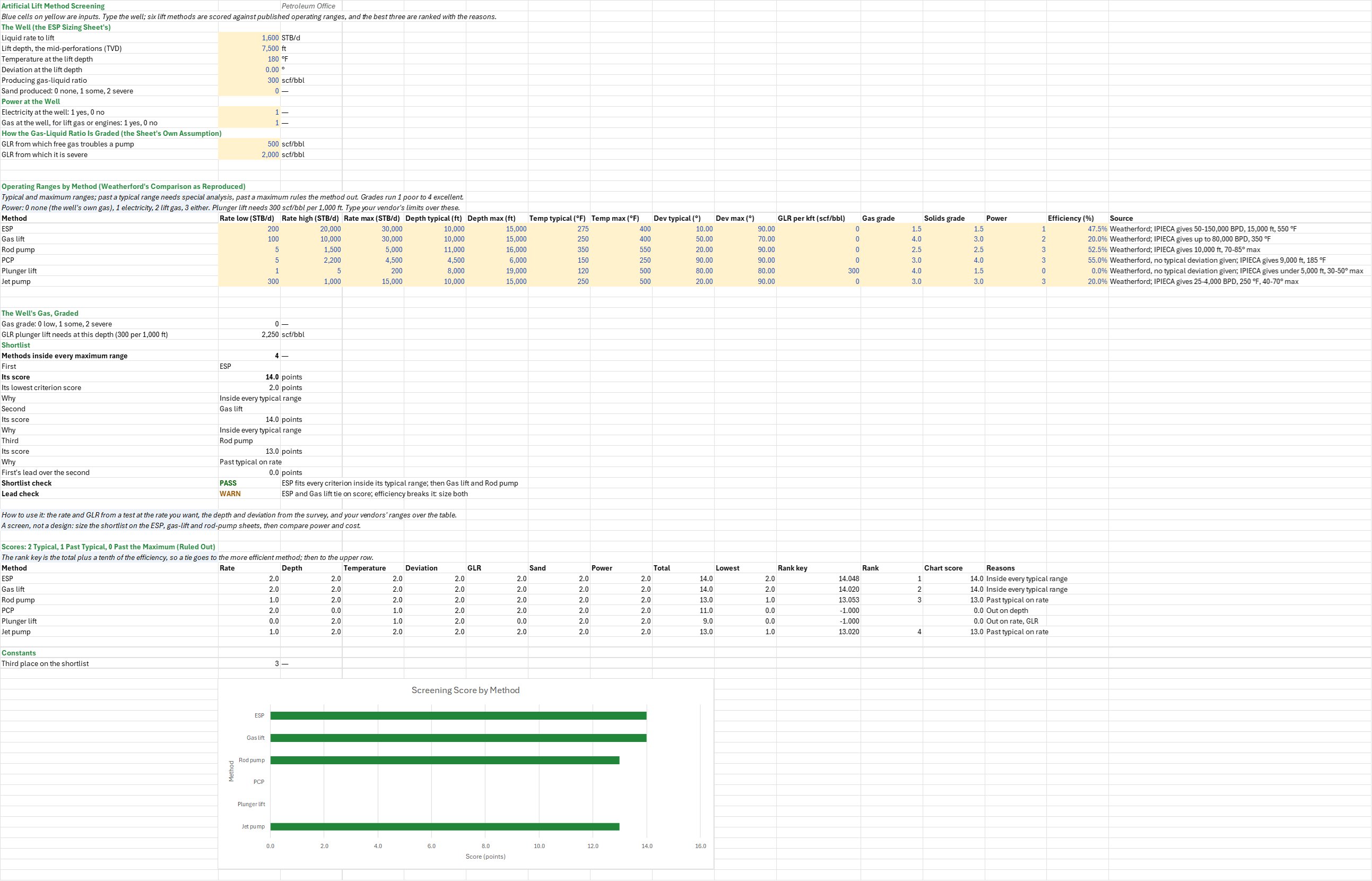
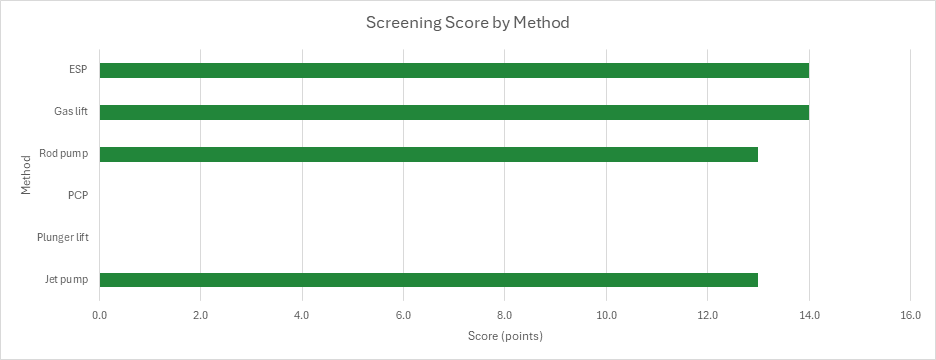
Which lift methods suit this well, and in what order? You enter the well's liquid rate, lift depth, temperature, deviation, gas-liquid ratio and sand, and the power at the well. You read off a score for each of six methods, ESP, gas lift, rod pump, progressing cavity pump (PCP), plunger lift and jet pump, against published typical and maximum operating ranges, which methods are ruled out, and a ranked shortlist of three with the reasons; a chart draws the scores.
Parameters:
- Well:
- the liquid rate
LS_Q(STB/d); - the lift depth
LS_D(ft TVD); - the temperature
LS_T(°F) and deviationLS_Dev(°) there; - the producing GLR
LS_GLR(scf/bbl); - the sand
LS_Sand(0 none, 1 some, 2 severe).
- the liquid rate
- Power: electricity at the well
LS_Elecand gas at the wellLS_Gas(1 yes, 0 no). The gas is for lift gas or for engines. - Gas grading: the GLRs from which free gas troubles a pump (
LS_GlrSome) and is severe (LS_GlrSevere). These are the sheet's own assumption. - Ranges: the table of each method's limits, with its source. Type your vendors' over it.
How to use it: take the rate and GLR from a test at the rate you want to lift, and the depth and deviation from the survey. Then type your vendors' ranges over the table, and grade the gas against the separator you would fit. The limits come from a published table of each method's typical and maximum operating ranges: Weatherford's comparison, as reproduced, cross-checked against IPIECA's 2023 table. The sheet names the source of every limit beside it. A criterion scores 2 inside the typical range and 1 past it but inside the maximum, where the vendor must make a special analysis. It scores 0 past the maximum, which rules the method out. Gas and sand are scored from the method's handling grade against how much the well makes. The methods that survive are ranked by total score, the system efficiency breaking a tie. Two checks read the shortlist and the first's lead over the second.
Method:
The four range criteria.
- Rate: 2 inside the typical low-to-high range, 1 outside it but under the maximum, and 0 over the maximum.
- Depth, temperature and deviation: 2 at or under the typical limit, 1 at or under the maximum, and 0 over it.
Gas. The well's GLR is graded 0 under the GLR from which free gas troubles a pump, 1 from there, and 2 from the GLR at which it is severe. A method then scores MIN(2, MAX(0, its gas grade − the well's grade)), or 2 when the well's grade is 0. The method grades run 1 poor, 2 fair, 3 good and 4 excellent; "poor to fair" is 1.5. Plunger lift also needs 300 scf/bbl per 1,000 ft of depth (Weatherford), and scores 0 without it.
Sand. The same rule on the solids grade, against the well's sand grade.
Power. A method that needs nothing (plunger lift, on the well's own gas) scores 2. Otherwise it scores 2 when what it needs is at the well and 0 when not:
- electricity for the ESP;
- lift gas for gas lift;
- either for the rod pump, PCP and jet pump, whose prime movers are gas engines or electric motors.
Ranking. A method with any 0 is out. The rest rank by their total plus a tenth of the middle of their system-efficiency range, so a tie goes to the more efficient method, then to the method listed first. The reasons list the criteria that rule a method out, or those past their typical range.
Example: The default well is the ESP sizing sheet's: 1,600 STB/d of liquid from mid-perforations at 7,500 ft, 180 °F, vertical, no sand, with electricity and gas at the well. The sizing sheet carries no gas, so a GLR of 300 scf/bbl is assumed here; that is 40 % water cut with a 500 scf/STB GOR. At 1,600 STB/d, 7,500 ft and 180 °F:
- ESP sits inside every typical range: 200–20,000 BPD, 10,000 ft, 275 °F. It scores 14 of 14.
- Gas lift does too, with 14.
- Rod pump scores 13: 1,600 STB/d is past its typical 1,500 but under its 5,000 maximum.
- Jet pump scores 13 too: 1,600 STB/d is past its typical 300–1,000.
- PCP is out on depth: 7,500 ft is past its 6,000 ft maximum.
- Plunger lift is out on rate (over 200 BPD) and on GLR (300 against the 2,250 scf/bbl it needs at 7,500 ft).
The ESP and gas lift tie on 14. The ESP's middle efficiency of 47.5 % against gas lift's 20 % puts it first, then gas lift, then the rod pump: 13 plus 52.5 % beats the jet pump's 13 plus 20 %. With the first two tied, size both.
Functions used
None: the blueprint calculates with Excel's own functions.
Names (38)
| Name | Refers to | Comment |
|---|---|---|
LS_Q |
$B$4 |
Liquid rate to lift, STB/d |
LS_D |
$B$5 |
Lift depth, the mid-perforations (TVD), ft |
LS_T |
$B$6 |
Temperature at the lift depth, °F |
LS_Dev |
$B$7 |
Deviation at the lift depth, ° |
LS_GLR |
$B$8 |
Producing gas-liquid ratio, scf/bbl |
LS_Sand |
$B$9 |
Sand produced: 0 none, 1 some, 2 severe |
LS_Elec |
$B$11 |
Electricity at the well: 1 yes, 0 no |
LS_Gas |
$B$12 |
Gas at the well, for lift gas or engines: 1 yes, 0 no |
LS_GlrSome |
$B$14 |
GLR from which free gas troubles a pump, scf/bbl |
LS_GlrSevere |
$B$15 |
GLR from which it is severe, scf/bbl |
LS_Inputs |
$B$4:$B$15 |
The well's rate, lift depth, temperature, deviation, gas-liquid ratio and sand, the power at the well, and the GLR grades |
LS_Limits |
$A$22:$P$27 |
Each method's typical and maximum rate, depth, temperature and deviation, the GLR it needs, its gas and solids grades, the power it needs, its efficiency and the source |
LS_Methods |
$A$22:$A$27 |
The lift methods screened |
LS_Scores |
$A$55:$N$60 |
Each method's score on the seven criteria, its total and lowest score, the rank key with the efficiency tie-break, its rank, and the reasons |
LS_Ranks |
$L$55:$L$60 |
Each method's rank, blank when ruled out |
LS_Totals |
$I$55:$I$60 |
Each method's total score |
LS_Lowest |
$J$55:$J$60 |
Each method's lowest criterion score |
LS_Reasons |
$N$55:$N$60 |
Each method's reasons |
LS_GasGrade |
$B$31 |
Gas grade: 0 low, 1 some, 2 severe |
LS_GlrPlunger |
$B$32 |
GLR plunger lift needs at this depth (300 per 1,000 ft), scf/bbl |
LS_Count |
$B$34 |
Methods inside every maximum range |
LS_First |
$B$35 |
First |
LS_FirstScore |
$B$36 |
Its score, points |
LS_FirstLowest |
$B$37 |
Its lowest criterion score, points |
LS_FirstWhy |
$B$38 |
Why |
LS_Second |
$B$39 |
Second |
LS_SecondScore |
$B$40 |
Its score, points |
LS_SecondWhy |
$B$41 |
Why |
LS_Third |
$B$42 |
Third |
LS_ThirdScore |
$B$43 |
Its score, points |
LS_ThirdWhy |
$B$44 |
Why |
LS_Lead |
$B$45 |
First's lead over the second, points |
LS_ShortlistCheck |
$B$46 |
Shortlist check verdict |
LS_ShortlistCheckNote |
$C$46 |
Shortlist check comment |
LS_LeadCheck |
$B$47 |
Lead check verdict |
LS_LeadCheckNote |
$C$47 |
Lead check comment |
LS_Results |
$B$31:$B$47 |
The gas grade, the GLR plunger lift needs, the number of methods that fit, the first three with their scores and reasons, the first's lead, and the checks |
LS_Rank3 |
$B$63 |
Third place on the shortlist |
Details
| Inserts | 63 rows × 16 columns |
| Category | Well Performance |
| For agents and tools | Descriptor (.md) |