Plunger Lift for a Loading Gas Well
Description
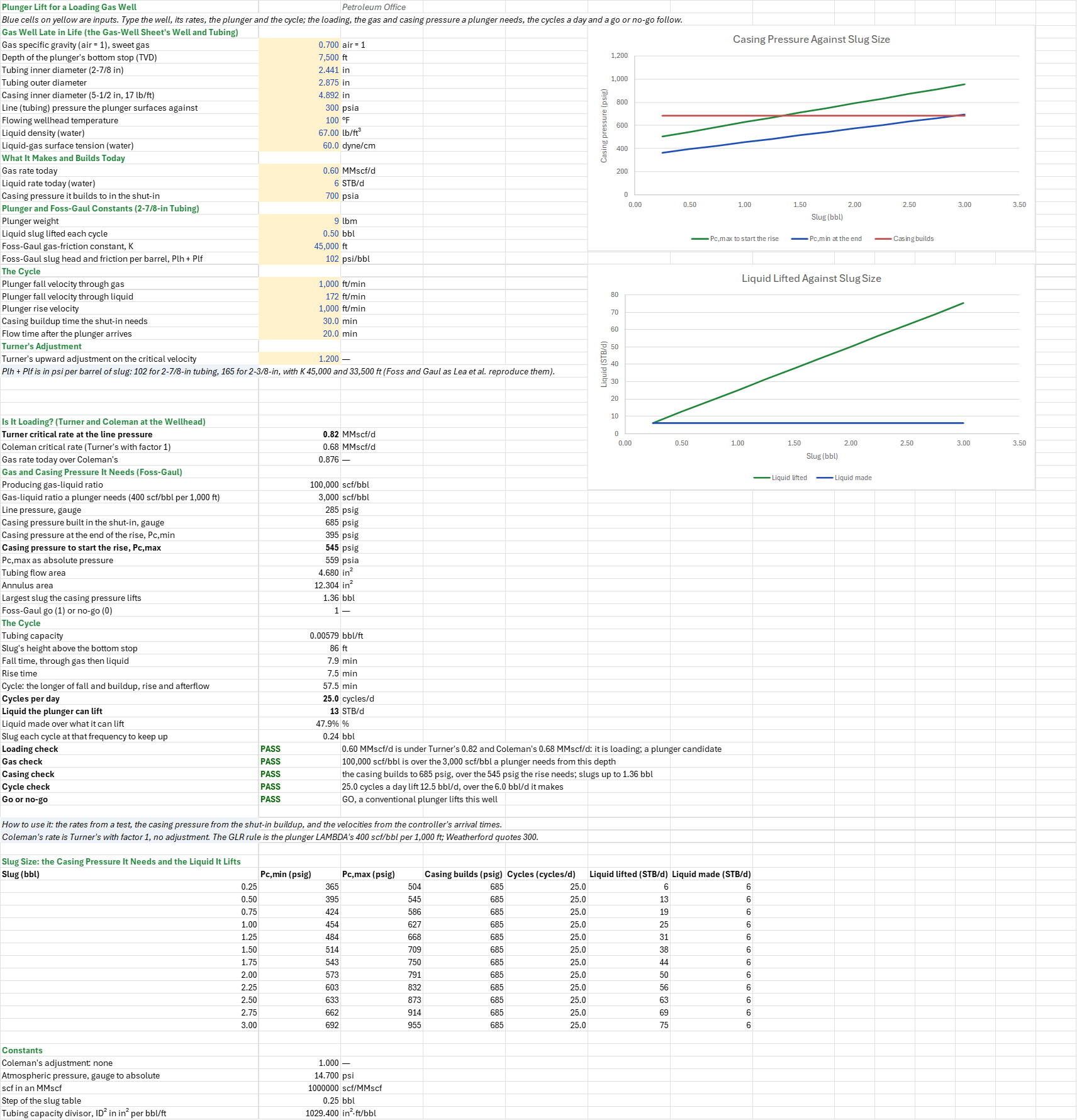
Can a conventional plunger keep this gas well unloaded, and how many trips a day does it need? You enter the gas, the tubing and casing, the line pressure, today's gas and liquid rates and shut-in casing pressure, the plunger, Foss and Gaul's constants and the cycle's velocities and times. You read off whether the well is loading by Turner and by Coleman, the gas and casing pressure a plunger needs by Foss and Gaul, the cycles a day and the liquid lifted, and a go or no-go.
Parameters:
- Well: the gas gravity
PLG_SGg, the bottom stop's depthPLG_Depth(ft), the tubing's inner and outer diametersPLG_IDandPLG_ODand the casing'sPLG_CsgID(in), the line pressurePLG_Pline(psia), the wellhead temperaturePLG_Twh(°F), and the water's densityPLG_RhoLand surface tensionPLG_IFT - Today: the gas rate
PLG_Qg(MMscf/d), the liquid ratePLG_Ql(STB/d) and the casing pressure the shut-in builds toPLG_SICP(psia) - Plunger: its weight
PLG_Wp(lbm) and slugPLG_Slug(bbl), and Foss and Gaul's constants for the tubing size,PLG_K(ft) andPLG_PLHF(psi/bbl) - Cycle: the fall velocities through gas and liquid
PLG_VgasandPLG_Vliqand the rise velocityPLG_Vrise(ft/min), and the buildup and afterflow timesPLG_BuildupandPLG_Afterflow(min) - Limits: Turner's adjustment
PLG_TurnerF(1.2)
How to use it: take the rates from a test, the casing pressure from the shut-in buildup, and the velocities from the controller's arrival times. Take K and Plh + Plf for your tubing from Foss and Gaul's table (Lea et al.): 33,500 ft and 165 psi/bbl for 2-3/8-in tubing. The sheet answers in four steps:
- Loading: whether the well is loading at the line pressure, by Turner's critical rate and by Coleman's. Coleman's is Turner's with a factor of 1; there is no separate Coleman function.
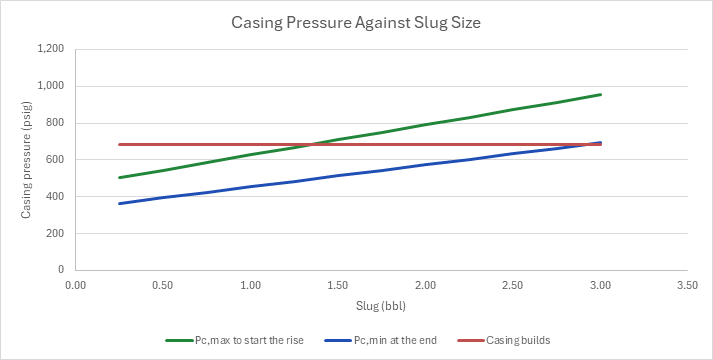
- Gas and casing pressure: what a plunger needs by Foss and Gaul, set against what the well makes and builds. That is the gas-liquid ratio, and the casing pressure at the end of the rise (Pc,min) and at its start (Pc,max). The sheet also gives the largest slug the casing lifts.
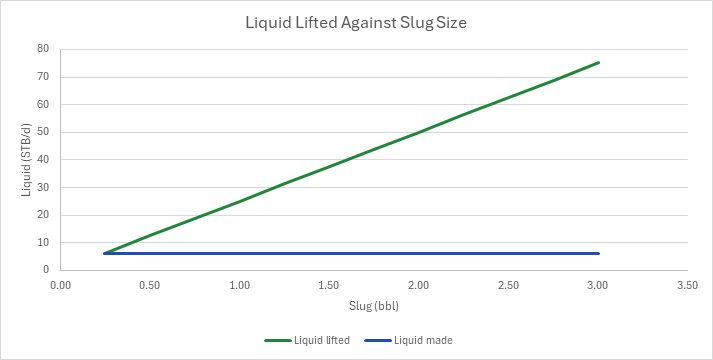
- The cycle: the fall through gas and liquid, the rise, and the shut-in, which is the longer of the fall and the casing buildup. From these come the cycles a day and the liquid the plunger can lift, set against what the well makes.
- Go or no-go.
A slug-size table steps from a quarter barrel to three barrels. One chart draws Foss and Gaul's casing pressures against what the casing builds. A second draws the liquid lifted against the liquid made. Five checks read the loading, the gas, the casing pressure, the cycle, and the go or no-go.
Method:
- Turner's critical rate at the line pressure and wellhead temperature is the critical-rate LAMBDA with Turner's 1.2. Coleman's is the same with 1, a constant on the sheet.
- Gauge and absolute. Foss and Gaul's pressures are gauge, so the line and casing pressures go in less 14.7 psi of atmosphere. The casing pressures needed are:
- at the end of the rise, Pc,min = (Wp/At + pt + (Plh + Plf)·VL)·(1 + D/K);
- at its start, Pc,max = Pc,min·(Aa + At)/Aa, with At the tubing's flow area and Aa the annulus.
- The gas a plunger needs is the LAMBDA's rule of thumb, 400 scf/bbl per 1,000 ft of lift. "Go" is 1 when the GLR and the casing pressure meet them.
- The largest slug the casing lifts is the slug at which Pc,max equals the casing pressure, solved from the same equation: VL = (Pc·Aa/(Aa + At)/(1 + D/K) − Wp/At − pt)/(Plh + Plf).
- The cycle. The slug stands VL/capacity above the bottom stop, with capacity ID²/1,029.4 bbl/ft. The fall is (D − h)/vgas + h/vliq, the rise D/vrise, and the cycle the longer of fall and buildup plus the rise and the afterflow. The cycles a day are 1,440 over the cycle, and the liquid lifted is the slug times the cycles.
Example: The default case is the gas-well sheet's well late in life: the gas-inflow family's reference well and its 2-7/8-in tubing (2.441 in ID, 2.875 in OD) to 7,500 ft TVD, making a 0.7 gravity gas and Turner's water (67 lb/ft³, 60 dyne/cm). It now flows to a 300 psia line after compression, the liquid-loading sheet's low-pressure case, at 100 °F at the wellhead. Today it makes 0.6 MMscf/d of gas and 6 STB/d of water, and its casing builds to 700 psia in a shut-in. Three things are synthetic, stated, not taken from a well: the 5-1/2-in casing (17 lb/ft, 4.892 in ID), today's rates, and the casing pressure. The plunger weighs 9 lbm and lifts a half-barrel slug. Foss and Gaul's constants for 2-7/8-in tubing are K = 45,000 ft and Plh + Plf = 102 psi/bbl. The cycle takes 1,000 ft/min falling through gas, 172 ft/min through liquid and 1,000 ft/min rising, a 30 min buildup and 20 min of afterflow. These are the plunger LAMBDAs' own example values.
- Loading: at 300 psia and 100 °F, Turner's rate is 0.822 MMscf/d and Coleman's 0.685. Today's 0.6 is under both, so the well is loading.
- Gas: the well makes 100,000 scf/bbl against the 3,000 it needs from 7,500 ft.
- Casing pressure: the line is 285.3 psig. The plunger adds 9/4.680 = 1.92 psi and the half-barrel slug 51 psi, so Pc,min = (1.92 + 285.3 + 51)·(1 + 7,500/45,000) = 394.6 psig. The annulus is 12.304 in² against the tubing's 4.680, so Pc,max = 394.6 × 16.984/12.304 = 544.7 psig, 559.4 psia. The casing builds to 685.3 psig, enough for slugs up to 1.36 bbl.
- Cycle: the slug stands 86.4 ft above the stop. The plunger falls in 7.91 min, inside the 30 min buildup, and rises in 7.5. The cycle is 57.5 min, 25.0 cycles a day, lifting 12.5 bbl/d against the 6 made.
The sheet says GO: a conventional plunger lifts this well.
Functions used
PO.PVT.Z.ByDAK(Ppr, Tpr)
Calculates gas compressibility factor (Z) using Dranchuk and Abou-Kassem (1975) equation of state, [dimensionless].
PO.PVT.Ppc.BySutton(SG_gas)
Calculates pseudo-critical pressure of hydrocarbon gas using Sutton (1985) correlation, [psi].
PO.PVT.Tpc.BySutton(SG_gas)
Calculates pseudo-critical temperature of hydrocarbon gas using Sutton (1985) correlation, [degR].
PO.PVT.Rho.Gas.ByDefinition(P, T_degR, SG_gas, Z)
Calculates gas density, [g/cm3].
Names (66)
| Name | Refers to | Comment |
|---|---|---|
PO.PE.Loading.TurnerRateLAMBDA |
=LAMBDA(p, t, sg_g, tubing_id, sigma, rho_l, factor, IF(OR(p<=0, t<=-459.67, sg_g<=0, tubing_id<=0, sigma<=0, rho_l<=0, factor<=0), NA(), LET(tr, t+459.67, z, PO.PVT.Z.ByDAK(p/PO.PVT.Ppc.BySutton(sg_g), tr/PO.PVT.Tpc.BySutton(sg_g)), rho_g, PO.PVT.Rho.Gas.ByDefinition(p, tr, sg_g, z)*62.428, IF(rho_l<=rho_g, NA(), 3.06*p*factor*1.593*sigma^0.25*(rho_l-rho_g)^0.25/rho_g^0.5*PI()*tubing_id^2/576/(tr*z))))) |
Turner critical gas rate to unload liquid, MMscf/d: p (psia) and t (°F) where it is read, usually the wellhead, gas gravity sg_g, tubing_id (in), the liquid's sigma (dyne/cm) and rho_l (lb/ft³), and factor (1.2 Turner, 1 Coleman). |
PO.PE.Plunger.FeasibilityLAMBDA |
=LAMBDA(depth, tubing_id, tubing_od, casing_id, plunger_wt, pt, slug, k, plhf, glr, pc, output, IF(OR(depth<=0, tubing_id<=0, tubing_od<tubing_id, casing_id<=tubing_od, plunger_wt<0, pt<0, slug<=0, k<=0, plhf<=0, glr<0, pc<0), NA(), LET(at, PI()*tubing_id^2/4, aa, PI()*(casing_id^2-tubing_od^2)/4, pcmin, (plunger_wt/at+pt+plhf*slug)*(1+depth/k), pcmax, pcmin*(aa+at)/aa, glrmin, 0.4*depth, IF(output="PcMin", pcmin, IF(output="PcMax", pcmax, IF(output="GLRMin", glrmin, IF(output="Go", (glr>=glrmin)*(pc>=pcmax), NA()))))))) |
Foss-Gaul plunger lift check: output "PcMin" or "PcMax" casing pressure (psi), "GLRMin" (scf/bbl, 400 per 1,000 ft) or "Go" (1 when glr and pc meet them). K (ft) and plhf (psi/bbl) are the tubing's Foss-Gaul constants. |
PO.PE.Plunger.CycleLAMBDA |
=LAMBDA(depth, liquid_ht, v_gas, v_liq, v_rise, buildup, afterflow, slug, output, IF(OR(depth<=0, liquid_ht<0, liquid_ht>depth, v_gas<=0, v_liq<=0, v_rise<=0, buildup<0, afterflow<0, slug<0), NA(), LET(fall, (depth-liquid_ht)/v_gas+liquid_ht/v_liq, rise, depth/v_rise, cyc, MAX(fall, buildup)+rise+afterflow, IF(output="Fall", fall, IF(output="Rise", rise, IF(output="Cycle", cyc, IF(output="Cycles", 1440/cyc, IF(output="Liquid", slug*1440/cyc, NA())))))))) |
Plunger cycle, minutes: output "Fall", "Rise", "Cycle" (shut-in as the longer of fall and buildup, plus rise and afterflow), "Cycles" per day, or "Liquid" (bbl/d, slug × cycles). Depths in ft, velocities in ft/min, times in min. |
PLG_SGg |
$B$4 |
Gas specific gravity (air = 1), sweet gas, air = 1 |
PLG_Depth |
$B$5 |
Depth of the plunger's bottom stop (TVD), ft |
PLG_ID |
$B$6 |
Tubing inner diameter (2-7/8 in), in |
PLG_OD |
$B$7 |
Tubing outer diameter, in |
PLG_CsgID |
$B$8 |
Casing inner diameter (5-1/2 in, 17 lb/ft), in |
PLG_Pline |
$B$9 |
Line (tubing) pressure the plunger surfaces against, psia |
PLG_Twh |
$B$10 |
Flowing wellhead temperature, °F |
PLG_RhoL |
$B$11 |
Liquid density (water), lb/ft³ |
PLG_IFT |
$B$12 |
Liquid-gas surface tension (water), dyne/cm |
PLG_Qg |
$B$14 |
Gas rate today, MMscf/d |
PLG_Ql |
$B$15 |
Liquid rate today (water), STB/d |
PLG_SICP |
$B$16 |
Casing pressure it builds to in the shut-in, psia |
PLG_Wp |
$B$18 |
Plunger weight, lbm |
PLG_Slug |
$B$19 |
Liquid slug lifted each cycle, bbl |
PLG_K |
$B$20 |
Foss-Gaul gas-friction constant, K, ft |
PLG_PLHF |
$B$21 |
Foss-Gaul slug head and friction per barrel, Plh + Plf, psi/bbl |
PLG_Vgas |
$B$23 |
Plunger fall velocity through gas, ft/min |
PLG_Vliq |
$B$24 |
Plunger fall velocity through liquid, ft/min |
PLG_Vrise |
$B$25 |
Plunger rise velocity, ft/min |
PLG_Buildup |
$B$26 |
Casing buildup time the shut-in needs, min |
PLG_Afterflow |
$B$27 |
Flow time after the plunger arrives, min |
PLG_TurnerF |
$B$29 |
Turner's upward adjustment on the critical velocity |
PLG_Inputs |
$B$4:$B$29 |
The gas, the tubing and casing, the line pressure and wellhead temperature, the water, today's gas and liquid rates and casing pressure, the plunger, Foss and Gaul's constants, the cycle's velocities and times, and Turner's adjustment |
PLG_QcT |
$B$35 |
Turner critical rate at the line pressure, MMscf/d |
PLG_QcC |
$B$36 |
Coleman critical rate (Turner's with factor 1), MMscf/d |
PLG_QRatio |
$B$37 |
Gas rate today over Coleman's |
PLG_GLR |
$B$39 |
Producing gas-liquid ratio, scf/bbl |
PLG_GLRMin |
$B$40 |
Gas-liquid ratio a plunger needs (400 scf/bbl per 1,000 ft), scf/bbl |
PLG_Ptg |
$B$41 |
Line pressure, gauge, psig |
PLG_Pcg |
$B$42 |
Casing pressure built in the shut-in, gauge, psig |
PLG_PcMin |
$B$43 |
Casing pressure at the end of the rise, Pc,min, psig |
PLG_PcMax |
$B$44 |
Casing pressure to start the rise, Pc,max, psig |
PLG_PcMaxA |
$B$45 |
Pc,max as absolute pressure, psia |
PLG_At |
$B$46 |
Tubing flow area, in² |
PLG_Aa |
$B$47 |
Annulus area, in² |
PLG_SlugMax |
$B$48 |
Largest slug the casing pressure lifts, bbl |
PLG_Go |
$B$49 |
Foss-Gaul go (1) or no-go (0) |
PLG_TubCap |
$B$51 |
Tubing capacity, bbl/ft |
PLG_Hl |
$B$52 |
Slug's height above the bottom stop, ft |
PLG_Fall |
$B$53 |
Fall time, through gas then liquid, min |
PLG_Rise |
$B$54 |
Rise time, min |
PLG_Cycle |
$B$55 |
Cycle: the longer of fall and buildup, rise and afterflow, min |
PLG_Cycles |
$B$56 |
Cycles per day, cycles/d |
PLG_Lift |
$B$57 |
Liquid the plunger can lift, STB/d |
PLG_Use |
$B$58 |
Liquid made over what it can lift, % |
PLG_SlugNeed |
$B$59 |
Slug each cycle at that frequency to keep up, bbl |
PLG_LoadCheck |
$B$60 |
Loading check verdict |
PLG_LoadCheckNote |
$C$60 |
Loading check comment |
PLG_GasCheck |
$B$61 |
Gas check verdict |
PLG_GasCheckNote |
$C$61 |
Gas check comment |
PLG_CasingCheck |
$B$62 |
Casing check verdict |
PLG_CasingCheckNote |
$C$62 |
Casing check comment |
PLG_CycleCheck |
$B$63 |
Cycle check verdict |
PLG_CycleCheckNote |
$C$63 |
Cycle check comment |
PLG_GoCheck |
$B$64 |
Go or no-go verdict |
PLG_GoCheckNote |
$C$64 |
Go or no-go comment |
PLG_Results |
$B$35:$B$64 |
Turner's and Coleman's rates, the gas-liquid ratio against the one needed, Foss and Gaul's casing pressures, the largest slug, the cycle, cycles a day and liquid lifted, and the checks |
PLG_Coleman |
$B$85 |
Coleman's adjustment: none |
PLG_Patm |
$B$86 |
Atmospheric pressure, gauge to absolute, psi |
PLG_Scf |
$B$87 |
scf in an MMscf, scf/MMscf |
PLG_Step |
$B$88 |
Step of the slug table, bbl |
PLG_Cap |
$B$89 |
Tubing capacity divisor, ID² in in² per bbl/ft, in²·ft/bbl |
PLG_Slugs |
$A$71:$G$82 |
Slugs from a quarter barrel to three barrels: Foss and Gaul's casing pressures against what the casing builds, and the cycles and liquid lifted against what the well makes |
Details
| Inserts | 89 rows × 7 columns |
| Category | Vertical Flow Performance |
| For agents and tools | Descriptor (.md) |