Proppant Settling and Transport
Whether proppant stays suspended to the fracture tip, and how much conductivity the pack keeps after closure.
Hydraulic Fracturing 97 rows × 5 columnsMicrosoft 365
Use this blueprint
How to use this blueprint
- In Excel, go to the Petroleum Office ribbon tab and click Blueprint Manager
- Search for Proppant Settling and Transport
- Click on the blueprint to preview
- Click Insert to place it into your worksheet. Modify the input values to match your data.
Requires the Petroleum Office add-in for Excel. Needs Microsoft 365 or Excel 2024: it uses functions Excel 2016 doesn't have (LAMBDA and LET), which show #NAME? there.
Description
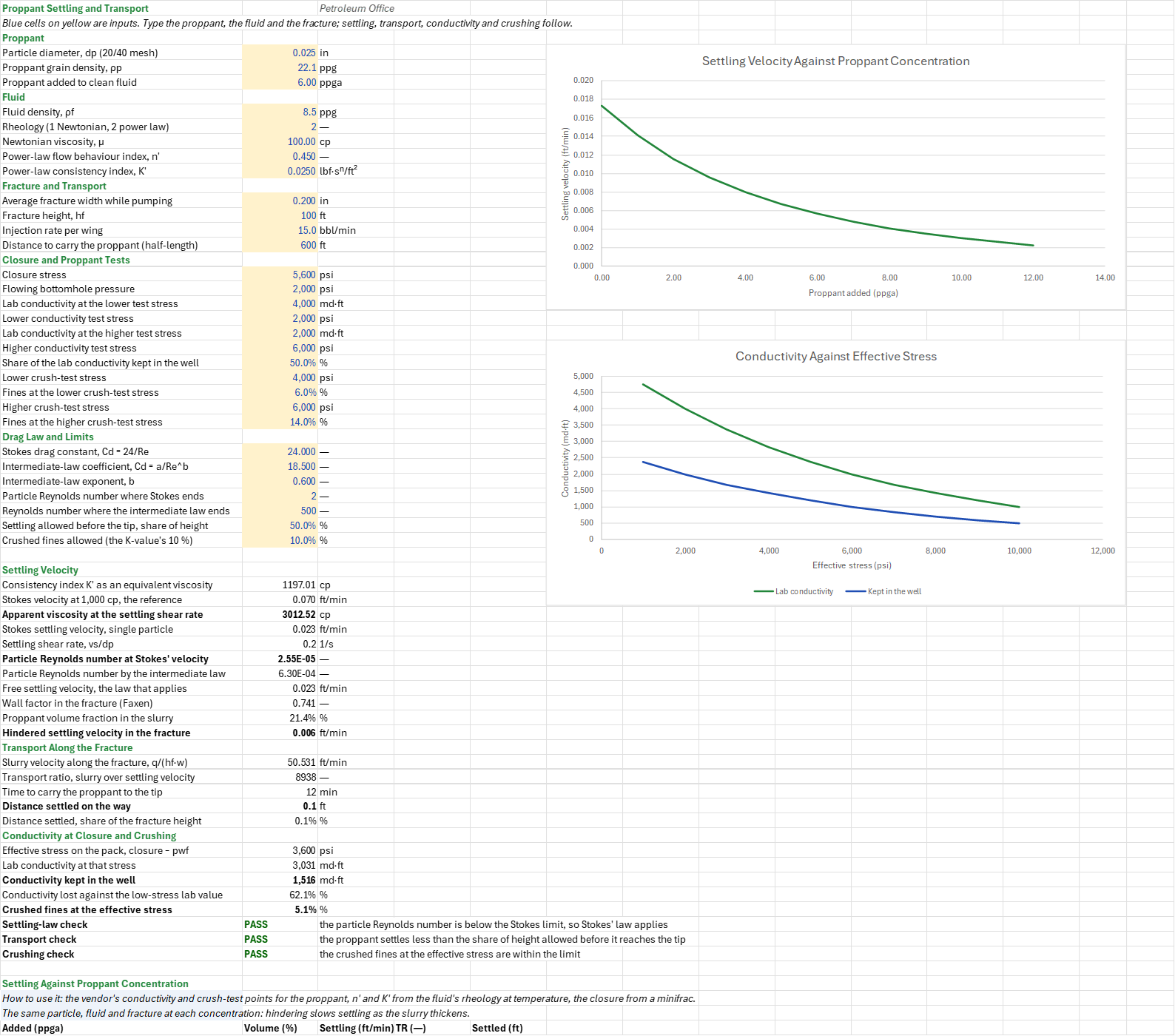
Will the proppant stay suspended until it reaches the tip, and how much conductivity will the pack keep once the fracture closes on it? You enter the proppant, a Newtonian or power-law fluid, the fracture's width, height, rate and length, the closure stress and flowing pressure, and the vendor's conductivity and crush-test points. You read off the settling velocity and the law that applies, the transport ratio, the distance settled before the tip, and the pack's conductivity and crushed fines at the effective stress.
Parameters:
- Proppant: diameter
FPS_Dp, grain densityFPS_RhoPand concentration addedFPS_Ca - Fluid: density
FPS_RhoF, the rheology selectorFPS_Fluid(1 Newtonian with viscosityFPS_Mu, 2 power law withFPS_NandFPS_Kp) - Fracture: average width while pumping
FPS_W, heightFPS_Hf, rate per wingFPS_Qand the distance to the tipFPS_L - Closure and tests: closure stress
FPS_Closureand flowing pressureFPS_Pwf; the lab conductivity at two stresses (FPS_KfwLoatFPS_SigLo,FPS_KfwHiatFPS_SigHi) and the share kept in the wellFPS_Retained; the crush-test fines at two stresses (FPS_FinesLoatFPS_CrushLo,FPS_FinesHiatFPS_CrushHi) - Drag law and limits: Stokes' constant
FPS_CdStokes, the intermediate law'sFPS_CdAandFPS_CdB, the Reynolds numbers where each law ends (FPS_ReStokes,FPS_ReMax), the settling allowed before the tipFPS_SettleMaxand the fines allowedFPS_FinesMax
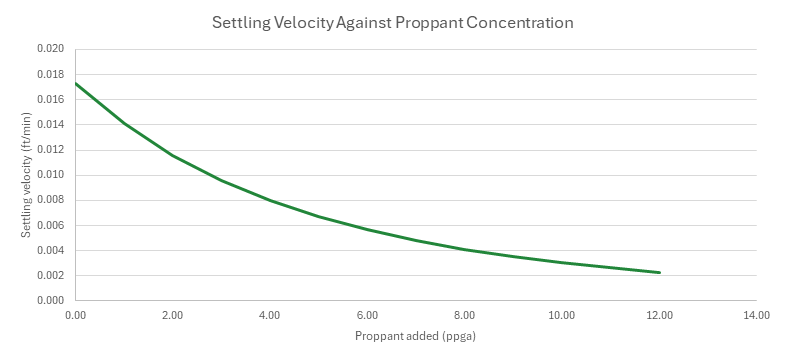
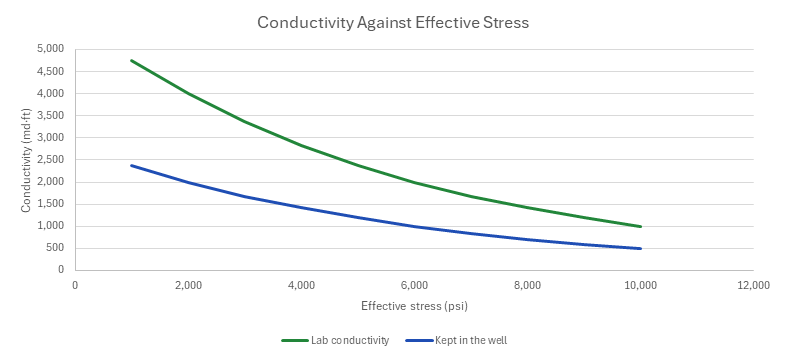
How to use it: Take the conductivity and crush-test points from the proppant vendor's sheets (ISO 13503-5 and 13503-2), n′ and K′ from the fluid's rheology at the bottomhole temperature and after the shear history, and the closure stress from a minifrac. The test points shipped are synthetic, typical of a 20/40 sand. The sheet finds a grain's settling velocity, checks the particle Reynolds number to see which settling law applies (Stokes below the limit, the intermediate law above it), and corrects it for the fracture walls and for the other grains in the slurry. The slurry's velocity along the fracture then gives the transport ratio and the distance the proppant settles before it reaches the tip. At closure, the pack's conductivity at the effective stress and the fines it crushes to come from the vendor's test data. Two charts draw settling against proppant concentration and conductivity against effective stress. Three checks judge the settling law, the settling before the tip against the share of height allowed, and the crushed fines against the limit.
Method: The Stokes velocity is taken at a reference 1,000 cp and scaled by 1,000/μ, since Stokes' velocity is inverse in viscosity and the Stokes function refuses a Reynolds number above about 0.1. In a power-law fluid the viscosity is the apparent one at the settling shear rate vs/dp, μa = K′·(vs/dp)^(n′−1), solved with Stokes' law in closed form: vsⁿ′ = vs(K′)·dp^(n′−1) in ft and s, with vs(K′) Stokes' velocity at μ = K′. The particle Reynolds number at that velocity picks the law: Stokes (Cd = 24/Re) below the Stokes limit, else the intermediate law Cd = 18.5/Re^0.6, whose Reynolds number Re = (24·Re(Stokes)/18.5)^(1/1.4) carries the same weight and buoyancy. The free velocity is multiplied by Faxen's wall factor and hindered by the slurry's volume fraction Cv = ca/(ca + ρp) (Richardson-Zaki). The slurry velocity is q/(hf·w), the transport ratio is the slurry velocity over the settling velocity, and the distance settled is the settling velocity times the time to reach the tip. At closure the pack carries σ′ = σc − pwf; its conductivity is the lab line through the two test points at σ′, times the share kept, and its fines are the crush test's line at σ′.
Example: The default is 20/40 sand (0.025 in, 22.07 ppg, SG 2.65) at 6 ppga in a borate crosslinked guar of 8.5 ppg with n′ = 0.45 and K′ = 0.025 lbf·sⁿ/ft², pumped at 15 bbl/min a wing into a 0.2 in wide, 100 ft high fracture that carries it 600 ft, the treatment the Fracture Design Screening (Unified Fracture Design) sheet schedules. The sand's lab conductivity is 4,000 md·ft at 2,000 psi and 2,000 md·ft at 6,000 psi, half of it kept in the well; its crush test made 6 % fines at 4,000 psi and 14 % at 6,000 psi. The well closes at 5,600 psi and flows at 2,000 psi.
K′ = 0.025 lbf·sⁿ/ft² is 1,197 cp·s^(n′−1). The settling shear rate is 0.187 1/s, where the gel's apparent viscosity is 3,013 cp, so a grain settles at 0.0233 ft/min with a particle Reynolds number of 2.5 × 10⁻⁵: Stokes applies. The walls (factor 0.741) and the 21.4 % sand by volume (hindering to 0.327) slow it to 0.00565 ft/min. The slurry moves along the fracture at 50.5 ft/min, a transport ratio of 8,938, and reaches the tip in 11.9 min, having settled 0.067 ft, a negligible share of the 100 ft height. At closure the sand carries 3,600 psi, where the lab line gives 3,031 md·ft and the well keeps 1,516 md·ft, 62 % below the 2,000 psi lab value; it crushes to 5.1 % fines, inside the 10 % allowed. In slickwater (1 cp) the same sand settles at 17.9 ft/min by the intermediate law (Re = 231 by Stokes', past the Stokes limit), and loses half the fracture height before the tip.
Functions used
PO.UnitConverterConverts value from one unit to another.PO.FRAC.Proppant.Vs.StokesStokes settling velocity (infinite dilution), [ft/min].PO.FRAC.Proppant.ReParticle Reynolds number for settling, [dimensionless].PO.FRAC.Proppant.WallFactorWall correction factor for settling in narrow fracture (Faxen), [dimensionless].PO.FRAC.Proppant.Vs.HinderedHindered settling velocity (Richardson-Zaki), [ft/min].PO.FRAC.Proppant.TRProppant transport ratio (horizontal/settling velocity), [dimensionless].PO.FRAC.Proppant.DsProppant settling distance during transport, [ft].
Names it defines (63)
| Name | Refers to | Comment |
|---|---|---|
PO.FRAC.Proppant.Conductivity |
=LAMBDA(kfw_lo, sigma_lo, kfw_hi, sigma_hi, sigma_eff, retained, IF(OR(kfw_lo<=0, kfw_hi<=0, sigma_hi=sigma_lo, retained<0, retained>1), NA(), retained*kfw_lo*EXP(LN(kfw_hi/kfw_lo)*(sigma_eff-sigma_lo)/(sigma_hi-sigma_lo)))) |
Proppant pack conductivity at an effective closure stress [md·ft]: log-linear in stress through two lab points, times the share retained after gel damage, embedment and fines. |
PO.FRAC.Proppant.Crushing |
=LAMBDA(sigma_c, pwf, sigma_lo, fines_lo, sigma_hi, fines_hi, IF(OR(fines_lo<=0, fines_hi<=0, sigma_hi=sigma_lo), NA(), MIN(1, fines_lo*EXP(LN(fines_hi/fines_lo)*(MAX(0, sigma_c-pwf)-sigma_lo)/(sigma_hi-sigma_lo))))) |
Crushed fines (fraction) at the pack's effective stress, closure less flowing pressure: log-linear in stress through two crush-test points (ISO 13503-2), capped at 1. |
FPS_Dp |
$B$4 |
Particle diameter, dp (20/40 mesh), in |
FPS_RhoP |
$B$5 |
Proppant grain density, ρp, ppg |
FPS_Ca |
$B$6 |
Proppant added to clean fluid, ppga |
FPS_RhoF |
$B$8 |
Fluid density, ρf, ppg |
FPS_Fluid |
$B$9 |
Rheology (1 Newtonian, 2 power law) |
FPS_Mu |
$B$10 |
Newtonian viscosity, μ, cp |
FPS_N |
$B$11 |
Power-law flow behaviour index, n′ |
FPS_Kp |
$B$12 |
Power-law consistency index, K′, lbf·sⁿ/ft² |
FPS_W |
$B$14 |
Average fracture width while pumping, in |
FPS_Hf |
$B$15 |
Fracture height, hf, ft |
FPS_Q |
$B$16 |
Injection rate per wing, bbl/min |
FPS_L |
$B$17 |
Distance to carry the proppant (half-length), ft |
FPS_Closure |
$B$19 |
Closure stress, psi |
FPS_Pwf |
$B$20 |
Flowing bottomhole pressure, psi |
FPS_KfwLo |
$B$21 |
Lab conductivity at the lower test stress, md·ft |
FPS_SigLo |
$B$22 |
Lower conductivity test stress, psi |
FPS_KfwHi |
$B$23 |
Lab conductivity at the higher test stress, md·ft |
FPS_SigHi |
$B$24 |
Higher conductivity test stress, psi |
FPS_Retained |
$B$25 |
Share of the lab conductivity kept in the well, % |
FPS_CrushLo |
$B$26 |
Lower crush-test stress, psi |
FPS_FinesLo |
$B$27 |
Fines at the lower crush-test stress, % |
FPS_CrushHi |
$B$28 |
Higher crush-test stress, psi |
FPS_FinesHi |
$B$29 |
Fines at the higher crush-test stress, % |
FPS_CdStokes |
$B$31 |
Stokes drag constant, Cd = 24/Re |
FPS_CdA |
$B$32 |
Intermediate-law coefficient, Cd = a/Re^b |
FPS_CdB |
$B$33 |
Intermediate-law exponent, b |
FPS_ReStokes |
$B$34 |
Particle Reynolds number where Stokes ends |
FPS_ReMax |
$B$35 |
Reynolds number where the intermediate law ends |
FPS_SettleMax |
$B$36 |
Settling allowed before the tip, share of height, % |
FPS_FinesMax |
$B$37 |
Crushed fines allowed (the K-value's 10 %), % |
FPS_Inputs |
$B$4:$B$37 |
The proppant, the fluid's rheology, the fracture and transport, the closure and the proppant's test data, and the drag law and limits |
FPS_MuK |
$B$40 |
Consistency index K′ as an equivalent viscosity, cp |
FPS_VsRef |
$B$41 |
Stokes velocity at 1,000 cp, the reference, ft/min |
FPS_MuEff |
$B$42 |
Apparent viscosity at the settling shear rate, cp |
FPS_VsS |
$B$43 |
Stokes settling velocity, single particle, ft/min |
FPS_Shear |
$B$44 |
Settling shear rate, vs/dp, 1/s |
FPS_ReS |
$B$45 |
Particle Reynolds number at Stokes' velocity |
FPS_ReI |
$B$46 |
Particle Reynolds number by the intermediate law |
FPS_VsFree |
$B$47 |
Free settling velocity, the law that applies, ft/min |
FPS_Wall |
$B$48 |
Wall factor in the fracture (Faxen) |
FPS_Cv |
$B$49 |
Proppant volume fraction in the slurry, % |
FPS_Vs |
$B$50 |
Hindered settling velocity in the fracture, ft/min |
FPS_Vh |
$B$52 |
Slurry velocity along the fracture, q/(hf·w), ft/min |
FPS_TR |
$B$53 |
Transport ratio, slurry over settling velocity |
FPS_Tt |
$B$54 |
Time to carry the proppant to the tip, min |
FPS_Ds |
$B$55 |
Distance settled on the way, ft |
FPS_DsShare |
$B$56 |
Distance settled, share of the fracture height, % |
FPS_SigEff |
$B$58 |
Effective stress on the pack, closure − pwf, psi |
FPS_KfwLab |
$B$59 |
Lab conductivity at that stress, md·ft |
FPS_Kfw |
$B$60 |
Conductivity kept in the well, md·ft |
FPS_KfwLoss |
$B$61 |
Conductivity lost against the low-stress lab value, % |
FPS_Fines |
$B$62 |
Crushed fines at the effective stress, % |
FPS_Check |
$B$63 |
Settling-law check verdict |
FPS_CheckNote |
$C$63 |
Settling-law check comment |
FPS_TransportCheck |
$B$64 |
Transport check verdict |
FPS_TransportCheckNote |
$C$64 |
Transport check comment |
FPS_CrushCheck |
$B$65 |
Crushing check verdict |
FPS_CrushCheckNote |
$C$65 |
Crushing check comment |
FPS_Results |
$B$40:$B$65 |
Settling by the law that applies, transport along the fracture, conductivity at closure, crushing, and the three checks |
FPS_Curve |
$A$71:$E$83 |
Proppant added from 0 to 12 ppga: volume fraction, hindered settling velocity, transport ratio and distance settled |
FPS_Stress |
$A$88:$D$97 |
Effective stress from 1,000 to 10,000 psi: the lab conductivity, the conductivity kept in the well, and the crushed fines |
Details
| Inserts | 97 rows × 5 columns |
| Category | Hydraulic Fracturing |
| For agents and tools | Descriptor (.md) |
| Tags | frac · proppant · settling · settling-velocity · Stokes · Reynolds-number · hindered-settling · power-law-fluid · transport-ratio · fracture-conductivity · proppant-crushing |
Need a custom calculation? Request a blueprint