Unit Converter and Decline Rate Conversions
Converts values between 72 oilfield and metric units and decline rates between time bases and between nominal and effective.
Utilities 137 rows × 5 columnsMicrosoft 365
Use this blueprint
How to use this blueprint
- In Excel, go to the Petroleum Office ribbon tab and click Blueprint Manager
- Search for Unit Converter and Decline Rate Conversions
- Click on the blueprint to preview
- Click Insert to place it into your worksheet. Modify the input values to match your data.
Requires the Petroleum Office add-in for Excel. Needs Microsoft 365 or Excel 2024: it uses a function Excel 2016 doesn't have (LAMBDA), which shows #NAME? there.
Description
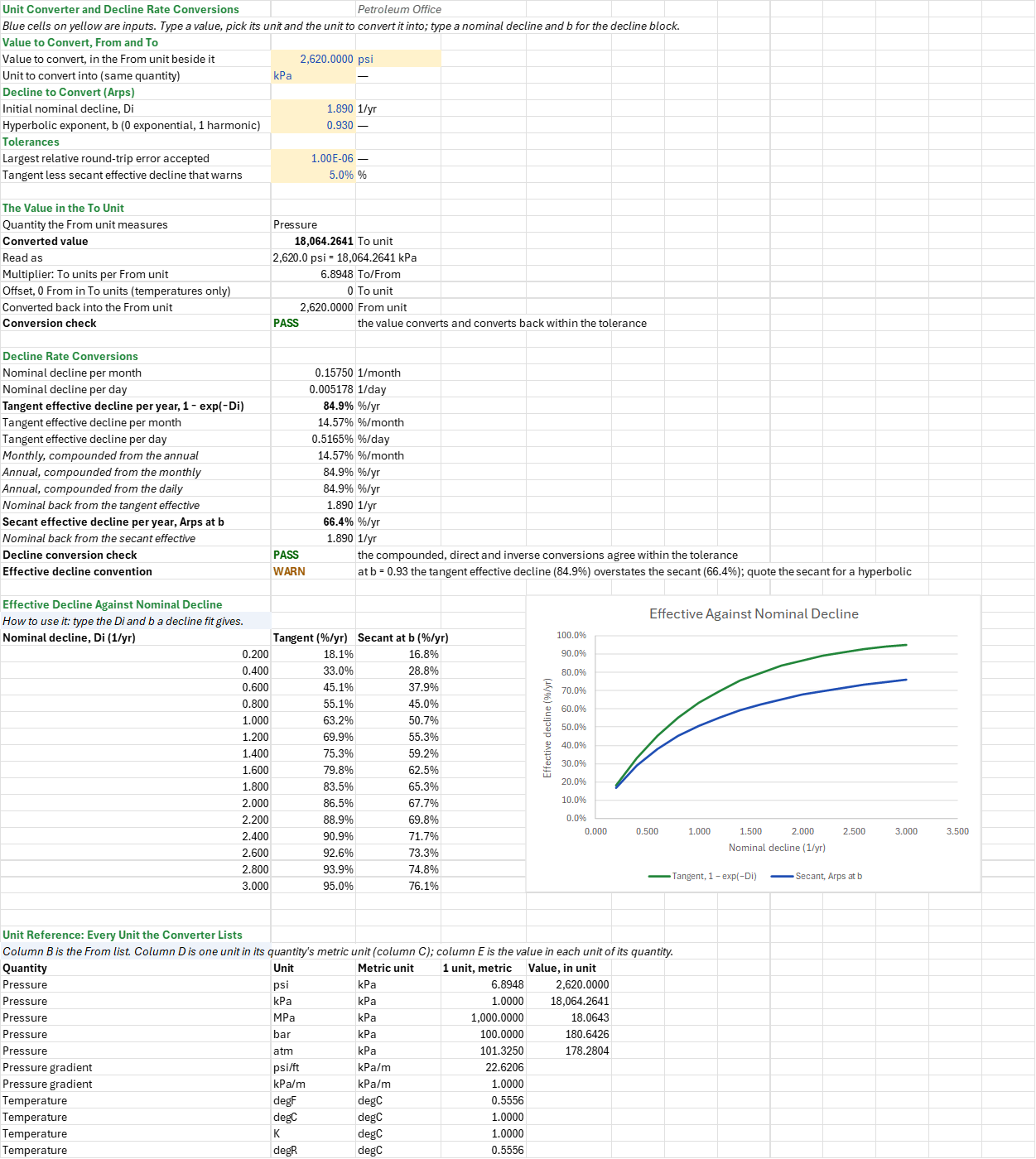
What is a value in another oilfield or metric unit, and a decline rate in another time base or convention? You enter a value, its unit and the unit to convert it into, from 72 units in 19 quantities, and a nominal decline with its Arps exponent. You read off the converted value, the multiplier and offset between the units and the value converted back, and the decline's monthly and daily nominal declines, its tangent effective declines per year, month and day, and its secant effective decline.
Parameters:
- Value: the value
UC_Valueand its unitUC_From, a list of every unit in the reference table's column B - To unit:
UC_To, a list of the From unit's quantity's units only, so the pair always measures the same thing - Decline: the nominal decline
UC_Di(1/yr) and the Arps exponentUC_b - Tolerances: the relative round-trip error accepted,
UC_Tol, and the tangent less secant effective decline that warns,UC_Gap
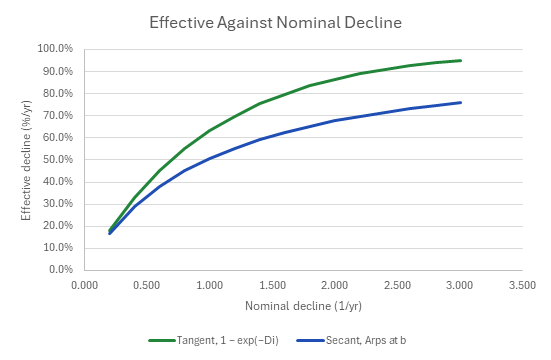
How to use it: Type the value and pick its unit from the list (every unit the sheet carries), then the unit to convert it into from the units of the same quantity; for a decline, type the Di and b a decline fit gives. The decline block checks that the compounded and inverse conversions agree. A chart draws the tangent and secant effective declines against the nominal one, and a reference table lists every unit with its size in its quantity's metric unit and the value converted into it. The quantities, units and metric units are in the reference table, which a reader can extend: a new row of quantity, unit and metric unit, inside the quantity's rows, joins both lists.
Method: The units convert through the Team76.UnitsOfMeasure library, which holds each unit as a scale and offset on its SI base. A conversion between two units is then y = a·x + b, where the multiplier a = f(1) − f(0) and the offset b = f(0), f being the conversion; b is zero for every quantity but temperature (°F and °C carry offsets, K and °R do not). Converting the result back gives the value again within the round-trip tolerance. The reference table sizes each unit in its quantity's metric unit (the SPE metric standard's: kPa, m, m³, m³/d, kg/m³, mPa·s, mD) and, for the picked quantity's units, shows the value converted into each.
For the declines, Arps' nominal decline D = −(dq/dt)/q scales with its time base, so per month it is Di/12 and per day Di/365. The tangent effective decline, the fraction of the rate an exponential loses in one period, is De = 1 − exp(−D), and its inverse D = −ln(1 − De). Effective declines compound between time bases: the monthly one is 1 − (1 − De)^(1/12), the annual one from it 1 − (1 − Dm)^12, and from a daily one 1 − (1 − Dd)^365, taking a 365-day year. A hyperbolic's effective decline is the secant one, the fraction of the rate it loses in the first year, De = 1 − (1 + b·Di)^(−1/b), and its inverse Di = ((1 − De)^(−b) − 1)/b. The decline check compares the compounded and inverse conversions with the direct ones; the convention check warns when the tangent effective decline of a hyperbolic overstates its secant one by more than the gap.
Example: The default value is the PVT reference oil's measured bubble point, 2,620 psi (Ahmed's oil 2, the reference black oil of the PVT sheets), into kPa. The default decline is the decline family's reference well: a tight-oil horizontal fitted to Di = 1.89/yr and b = 0.93 on the Arps, Decline Fitting and EUR sheets.
2,620 psi is 18,064.26 kPa: the multiplier is 6.894757 kPa/psi with no offset, and 18,064.26 kPa converts back to 2,620 psi. For the reference well's Di = 1.89/yr the nominal decline is 0.1575/month and 0.005178/day; the tangent effective decline is 84.89 %/yr, 14.57 %/month and 0.5165 %/day, and compounding the monthly and the daily ones back to a year gives the same 84.89 %. At b = 0.93 the secant effective decline is 66.40 %/yr, which inverts to Di = 1.89/yr again. The conversion and decline checks pass; the convention check warns, since the tangent figure overstates the secant one by 18.5 points for this hyperbolic. The sweep shows the gap grows with the decline: at Di = 0.2/yr the two are 18.1 % and 16.8 %, at 3.0/yr 95.0 % and 76.1 %.
The factors are the published ones: 1 psi = 6.894757 kPa, 1 bbl = 0.1589873 m³, 1 ft = 0.3048 m, 1 lbf = 4.448222 N, 1 hp = 0.7457 kW (NIST SP 811, Appendix B.8), 1 Mscf = 28.31685 m³ and 1 scf/STB = 0.1781076 m³/m³ (SPE metric standard).
Functions used
PO.UnitConverterConverts value from one unit to another.PO.DCA.Convert.NominalToEffectiveConverts nominal (continuous) decline rate to effective (periodic) decline rate. De = 1 - exp(-Dn).PO.DCA.Convert.AnnualToMonthlyConverts annual effective decline rate to monthly effective decline rate using compound conversion.PO.DCA.Convert.MonthlyToAnnualConverts monthly effective decline rate to annual effective decline rate using compound conversion.PO.DCA.Convert.DailyToAnnualConverts daily effective decline rate to annual effective decline rate using compound conversion.PO.DCA.Convert.EffectiveToNominalConverts effective (periodic) decline rate to nominal (continuous) decline rate. Dn = -ln(1 - De).
Names it defines (41)
| Name | Refers to | Comment |
|---|---|---|
PO.DCA.Arps.SecantEff |
=LAMBDA(Di, b, IF(OR(Di<0, b<0), NA(), IF(b=0, 1-EXP(-Di), 1-(1+b*Di)^(-1/b)))) |
Secant effective decline (fraction per period) of an Arps hyperbolic: 1 - (1 + b*Di)^(-1/b), or 1 - exp(-Di) for b = 0. Di is the nominal decline per period (1/yr gives the effective annual decline) and b the exponent. |
UC_Value |
$B$4 |
Value to convert, in the From unit |
UC_From |
$C$4 |
The unit the value is in, picked from the unit list in column B of the reference table |
UC_To |
$B$5 |
The unit to convert into, picked from the units of the same quantity as the From unit |
UC_Di |
$B$7 |
Initial nominal decline, Di, 1/yr |
UC_b |
$B$8 |
Hyperbolic exponent, b (0 exponential, 1 harmonic) |
UC_Tol |
$B$10 |
Largest relative round-trip error accepted |
UC_Gap |
$B$11 |
Tangent less secant effective decline that warns, % |
UC_Inputs |
$B$4:$C$11 |
The value with its From unit, the To unit, the nominal decline and b to convert, and the round-trip and tangent-secant tolerances |
UC_Quantity |
$B$14 |
Quantity the From unit measures |
UC_Result |
$B$15 |
Converted value, To unit |
UC_Reads |
$B$16 |
Read as |
UC_Mult |
$B$17 |
Multiplier: To units per From unit, To/From |
UC_Offset |
$B$18 |
Offset, 0 From in To units (temperatures only), To unit |
UC_Back |
$B$19 |
Converted back into the From unit, From unit |
UC_Check |
$B$20 |
Conversion check verdict |
UC_CheckNote |
$C$20 |
Conversion check comment |
UC_DiMo |
$B$23 |
Nominal decline per month, 1/month |
UC_DiDay |
$B$24 |
Nominal decline per day, 1/day |
UC_DeYr |
$B$25 |
Tangent effective decline per year, 1 − exp(−Di), %/yr |
UC_DeMo |
$B$26 |
Tangent effective decline per month, %/month |
UC_DeDay |
$B$27 |
Tangent effective decline per day, %/day |
UC_DeMoC |
$B$28 |
Monthly, compounded from the annual, %/month |
UC_DeYrM |
$B$29 |
Annual, compounded from the monthly, %/yr |
UC_DeYrD |
$B$30 |
Annual, compounded from the daily, %/yr |
UC_DiTan |
$B$31 |
Nominal back from the tangent effective, 1/yr |
UC_DeSec |
$B$32 |
Secant effective decline per year, Arps at b, %/yr |
UC_DiSec |
$B$33 |
Nominal back from the secant effective, 1/yr |
UC_DeclineCheck |
$B$34 |
Decline conversion check verdict |
UC_DeclineCheckNote |
$C$34 |
Decline conversion check comment |
UC_ConventionCheck |
$B$35 |
Effective decline convention check verdict |
UC_ConventionCheckNote |
$C$35 |
Effective decline convention check comment |
UC_Results |
$B$14:$B$35 |
The quantity, the converted value, its reading, the multiplier and offset, the value converted back and the conversion check; the decline in each time base, its tangent and secant effective declines, and the two decline checks |
UC_Curve |
$A$40:$C$54 |
Nominal declines in steps, with the tangent effective decline and the secant one at the b typed |
UC_Reference |
$A$60:$E$131 |
Every unit the converter lists, by quantity: its metric unit, one unit's size in it, and the value converted into it |
UC_Qty |
$A$60:$A$131 |
The quantity each listed unit measures |
UC_Unit |
$B$60:$B$131 |
Every unit the converter lists, the From list |
UC_MoYr |
$B$134 |
Months in a year, months/yr |
UC_DaysYr |
$B$135 |
Days in a year, as DailyToAnnual compounds, days/yr |
UC_DStep |
$B$136 |
Nominal decline step of the sweep, 1/yr |
UC_Small |
$B$137 |
Below this size a reading is in scientific notation |
Details
| Inserts | 137 rows × 5 columns |
| Category | Utilities |
| For agents and tools | Descriptor (.md) |
| Tags | units · conversion · unit-conversion · measurement · decline · nominal · effective · secant |
Need a custom calculation? Request a blueprint