Black-Oil PVT Table Above and Below the Bubble Point
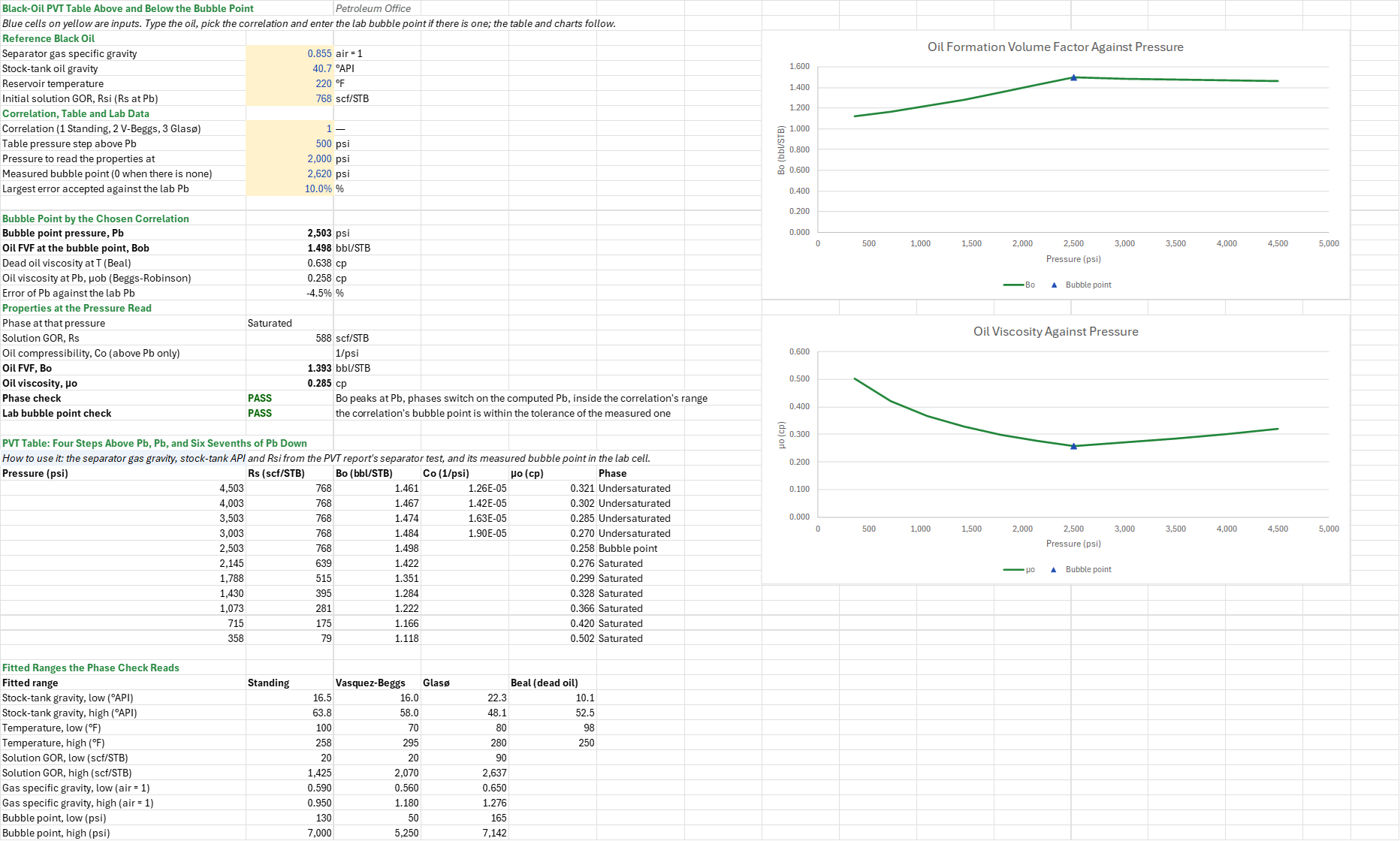
Builds a black-oil table of Rs, Bo, Co and viscosity above and below the bubble point from gas gravity, API, temperature and solution GOR.
PVT Properties 56 rows × 6 columns
Use this blueprint
How to use this blueprint
- In Excel, go to the Petroleum Office ribbon tab and click Blueprint Manager
- Search for Black-Oil PVT Table Above and Below the Bubble Point
- Click on the blueprint to preview
- Click Insert to place it into your worksheet. Modify the input values to match your data.
Requires the Petroleum Office add-in for Excel.
Description
What are an oil's bubble point, Rs, Bo, Co and viscosity at every pressure, above and below the bubble point? You enter four numbers from a separator test (the gas gravity, the stock-tank API, the reservoir temperature and the initial solution GOR), pick Standing, Vasquez-Beggs or Glasø, and type the measured bubble point if there is one. You read off the bubble point and Bob, a table of Rs, Bo, Co, μo and the phase around the bubble point, the properties at one pressure, and the error against the lab bubble point.
Parameters:
- Oil: the separator gas gravity
FPVT_SGg, the stock-tank gravityFPVT_API, the reservoir temperatureFPVT_Tand the initial solution GORFPVT_Rsi - Correlation and table:
FPVT_Corrpicks Pb, Rs and Bo by 1 Standing, 2 Vasquez-Beggs or 3 Glasø;FPVT_dPis the table's step above Pb, andFPVT_Pthe pressure the "Properties at the Pressure Read" block reads - Lab data: the measured bubble point
FPVT_LabPb(0 when there is none) and the error accepted against it,FPVT_Tol
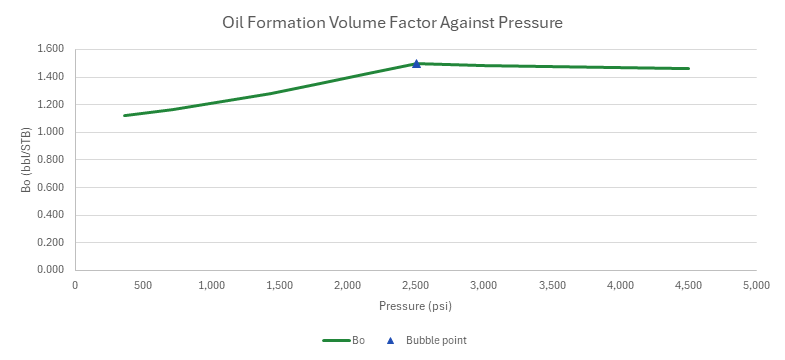
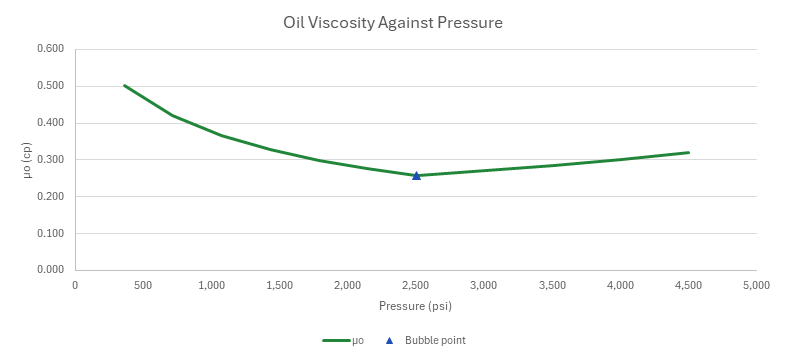
How to use it: Take the gas gravity, API and Rsi from the PVT report's separator test at the field's separator conditions, and the bubble point from its constant composition expansion. Vasquez-Beggs expects the gas gravity at a 100 psig separator; correct it first when the separator ran elsewhere. Standing is correlation 1. The sheet computes the bubble point from Rsi, generates the pressure column around it, and switches every property and the phase label on that computed Pb, so a row is never on the wrong branch whatever the inputs. Bo and μo are charted against pressure with the bubble point marked, and the measured bubble point, when there is one, checks the correlation.
Method: Pb is the chosen correlation's bubble point at Rsi, and Bob the same correlation's saturated Bo at Rsi. The table runs four rows above Pb in steps of the table step, one row at Pb, and six rows below it at 6/7, 5/7, … 1/7 of Pb. Each row tests P > Pb once and picks its branch from it:
- above Pb, Rs = Rsi, Co by Vasquez-Beggs, Bo = Bob·exp(Co·(Pb − P)) by the definition of the undersaturated oil's compressibility, and μo by Vasquez-Beggs' undersaturated viscosity from μob;
- at and below Pb, Rs = MIN(Rsi, Rs(P)) by the chosen correlation's Rs, the inverse of its Pb, Bo by its saturated Bo at that Rs, μo by Beggs-Robinson from Beal's dead-oil viscosity, and no Co.
The phase reads Undersaturated above Pb, Bubble point at Pb and Saturated below. The phase check finds the row where Bo peaks and fails unless it is the Pb row, and reads each correlation's fitted range from the Fitted Ranges table at the foot of the sheet.
Example: The default case is the PVT family's reference black oil: oil 2 of Ahmed's six crude-oil systems, 40.7 °API stock-tank oil with a 0.855 gravity separator gas (separator at 100 psig and 75 °F) and 768 scf/STB in solution at 220 °F, whose measured bubble point is 2,620 psi and Bob 1.474 rb/STB. The Bubble Point by Regional Correlation, Oil Viscosity Correlations and PVT Sensitivity to Oil Gravity sheets start from the same oil.
By Standing the reference oil's bubble point is 2,503 psi, 4.5 % under the measured 2,620 psi, and Bob is 1.498 rb/STB against the measured 1.474. Beal gives a 0.638 cp dead oil and Beggs-Robinson 0.258 cp at Pb. At 2,000 psi the oil is saturated, with Rs = 588 scf/STB, Bo = 1.393 rb/STB and μo = 0.285 cp; at 4,000 psi it is undersaturated, with Co = 1.42 × 10⁻⁵ 1/psi, Bo = 1.467 rb/STB and μo = 0.302 cp. Bo peaks at the Pb row, the oil lies inside Standing's range, and the 4.5 % miss is inside the 10 % tolerance. Vasquez-Beggs puts Pb at 2,740 psi (+4.6 %) and Glasø at 2,797 psi (+6.7 %).
Functions used
PO.PVT.Pb.ByStandingCalculates oil bubble point pressure using Standing (1947) correlation, [psi].PO.PVT.Pb.ByVasquezBeggsCalculates oil bubble point pressure using Vasquez and Beggs (1980) correlation, [psi].PO.PVT.Pb.ByGlasoCalculates oil bubble point pressure using Glaso (1980) correlation, [psi].PO.PVT.Bo.Sat.ByStandingCalculates oil formation volume factor using Standing (1947) correlation, P <= Pb, [bbl/STB].PO.PVT.Bo.Sat.ByVasquezBeggsCalculates oil formation volume factor using Vasquez and Beggs (1980) correlation, P <= Pb, [bbl/STB].PO.PVT.Bo.Sat.ByGlasoCalculates oil formation volume factor using Glaso (1980) correlation, P <= Pb, [bbl/STB].PO.PVT.Uo.Dead.ByBealCalculates dead oil viscosity using Beal (1946) correlation. Standing's curve fit of Beal's graphical correlation. Best performer per Fotias (2022), [cP].PO.PVT.Uo.Sat.ByBeggsRobinsonCalculates oil viscosity with solution gas using Beggs and Robinson (1975) correlation, P <= Pb, [cP].PO.PVT.Rs.ByStandingCalculates solution gas-oil ratio using Standing correlation (1947), the exact inverse of Standing Pb, P <= Pb, [SCF/STB].PO.PVT.Rs.ByVasquezBeggsCalculates solution gas-oil ratio using Vasquez and Beggs (1980) correlation, P <= Pb, [SCF/STB].PO.PVT.Rs.ByGlasoCalculates solution gas-oil ratio using Glaso (1980) correlation, P <= Pb, [SCF/STB].PO.PVT.Co.UnSat.ByVasquezBeggsCalculates oil compressibility using Vasquez and Beggs (1980) correlation, P > Pb, [1/psi].PO.PVT.Bo.UnSat.ByDefinitionCalculates oil formation volume factor for undersaturated oil, P > Pb, [bbl/STB].PO.PVT.Uo.UnSat.ByVasquezBeggsCalculates oil viscosity for undersaturated conditions using Vasquez and Beggs (1980) correlation, P > Pb, [cP].
Names it defines (27)
| Name | Refers to | Comment |
|---|---|---|
FPVT_SGg |
$B$4 |
Separator gas specific gravity, air = 1 |
FPVT_API |
$B$5 |
Stock-tank oil gravity, °API |
FPVT_T |
$B$6 |
Reservoir temperature, °F |
FPVT_Rsi |
$B$7 |
Initial solution GOR, Rsi (Rs at Pb), scf/STB |
FPVT_Corr |
$B$9 |
Correlation (1 Standing, 2 V-Beggs, 3 Glasø) |
FPVT_dP |
$B$10 |
Table pressure step above Pb, psi |
FPVT_P |
$B$11 |
Pressure to read the properties at, psi |
FPVT_LabPb |
$B$12 |
Measured bubble point (0 when there is none), psi |
FPVT_Tol |
$B$13 |
Largest error accepted against the lab Pb, % |
FPVT_Inputs |
$B$4:$B$13 |
The oil and gas gravities, the temperature and the initial solution GOR, the correlation, the table's step, the pressure to read at, and the lab bubble point with its tolerance |
FPVT_Pb |
$B$16 |
Bubble point pressure, Pb, psi |
FPVT_Bob |
$B$17 |
Oil FVF at the bubble point, Bob, bbl/STB |
FPVT_Uod |
$B$18 |
Dead oil viscosity at T (Beal), cp |
FPVT_Uob |
$B$19 |
Oil viscosity at Pb, μob (Beggs-Robinson), cp |
FPVT_PbErr |
$B$20 |
Error of Pb against the lab Pb, % |
FPVT_PhaseP |
$B$22 |
Phase at that pressure |
FPVT_RsP |
$B$23 |
Solution GOR, Rs, scf/STB |
FPVT_CoP |
$B$24 |
Oil compressibility, Co (above Pb only), 1/psi |
FPVT_BoP |
$B$25 |
Oil FVF, Bo, bbl/STB |
FPVT_UoP |
$B$26 |
Oil viscosity, μo, cp |
FPVT_Ranges |
$A$47:$E$56 |
The range each correlation was fitted to: low and high gravity, temperature, GOR, gas gravity and bubble point |
FPVT_Check |
$B$27 |
Phase check verdict |
FPVT_CheckNote |
$C$27 |
Phase check comment |
FPVT_LabCheck |
$B$28 |
Lab bubble point check verdict |
FPVT_LabCheckNote |
$C$28 |
Lab bubble point check comment |
FPVT_Results |
$B$16:$B$28 |
The bubble point, Bob and the viscosities there, the error against the lab Pb, the phase and properties at the pressure read, and the two checks |
FPVT_Curve |
$A$33:$F$43 |
Pressure, Rs, Bo, Co, μo and the phase, four steps above the bubble point, at it, and at six sevenths of it down |
Details
| Inserts | 56 rows × 6 columns |
| Category | PVT Properties |
| For agents and tools | Descriptor (.md) |
| Tags | oil · PVT · black-oil · table · bubble-point · Rs · Bo · Co · viscosity · Standing · Vasquez-Beggs · Glaso · complete |
Need a custom calculation? Request a blueprint