Horizontal Well Productivity Index
Estimates a horizontal well's productivity index by five published methods to show how much the answer depends on the method.
Inflow Performance Relationship 67 rows × 6 columns
Use this blueprint
How to use this blueprint
- In Excel, go to the Petroleum Office ribbon tab and click Blueprint Manager
- Search for Horizontal Well Productivity Index
- Click on the blueprint to preview
- Click Insert to place it into your worksheet. Modify the input values to match your data.
Requires the Petroleum Office add-in for Excel.
Description
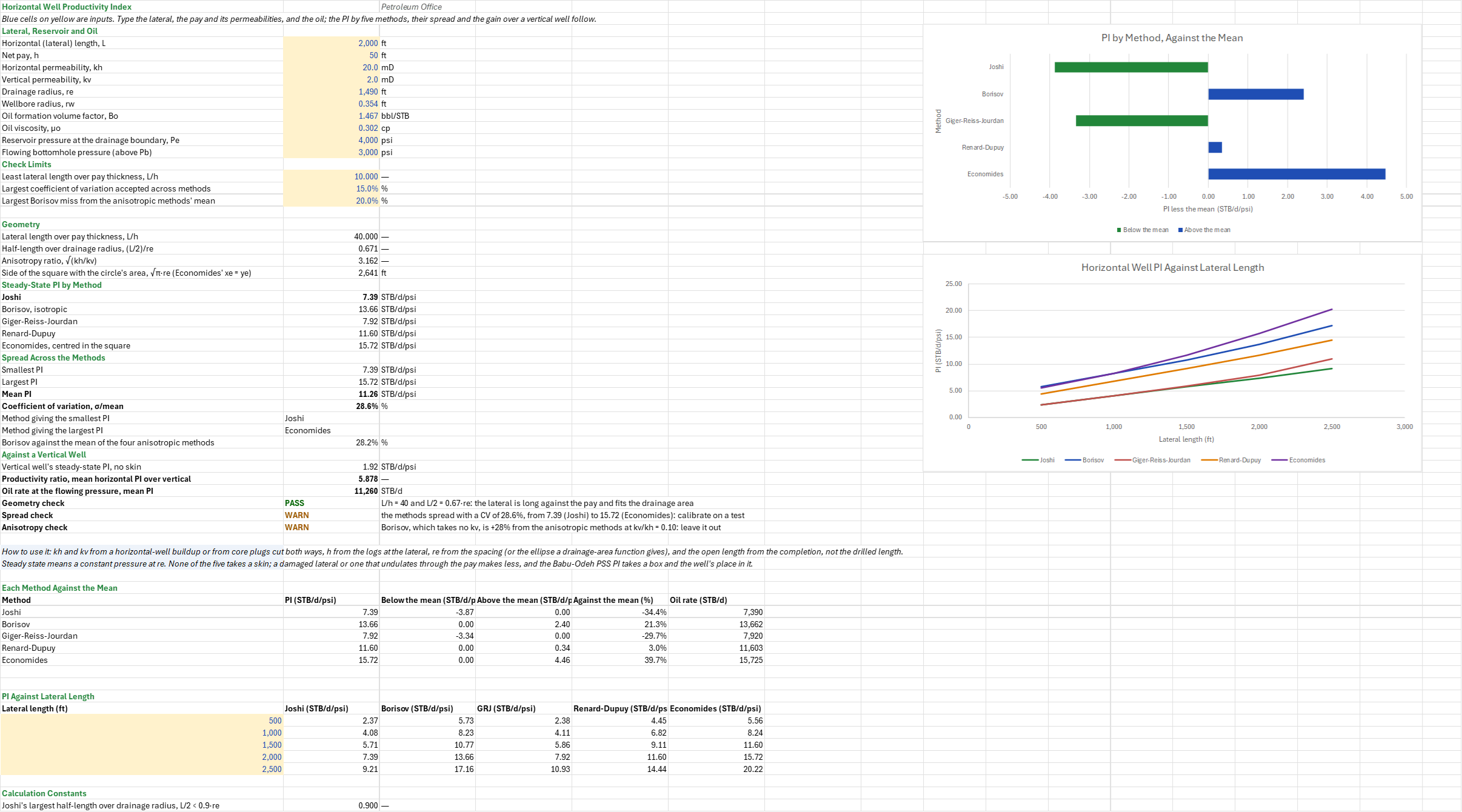
How productive would the well be drilled horizontally, and how much does the answer depend on the method? You enter the lateral length, the pay, the drainage and wellbore radii, the horizontal and vertical permeabilities, the oil's FVF and viscosity, and the boundary and flowing pressures. You read off the steady-state productivity index by five published methods, their spread (smallest, largest, mean and coefficient of variation), the gain over the same well drilled vertically, and the rate at the flowing pressure.
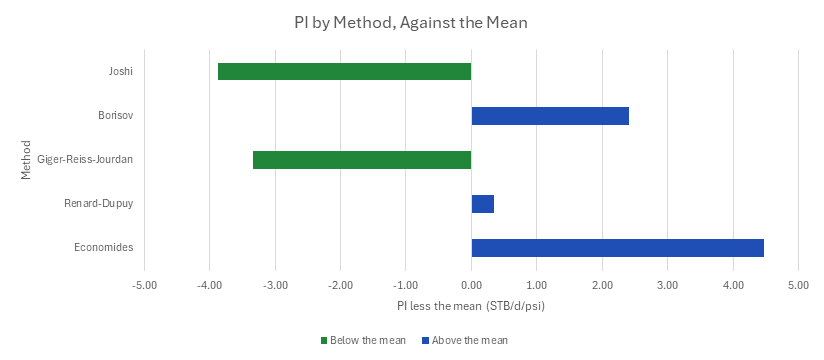
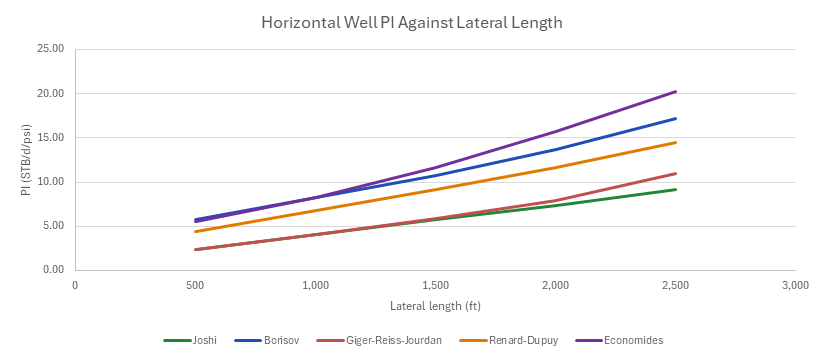
Joshi, Giger-Reiss-Jourdan and Renard-Dupuy take an ellipse round the lateral and the vertical permeability. Borisov takes an isotropic layer, and Economides a rectangular drainage area with the well at its centre. The sheet names the methods that give the smallest and largest PI. A bar chart draws each method's PI against the mean, and a second chart the PI against lateral length from 500 to 2,500 ft. Three checks read the geometry (L/h and L/2 against re), the spread, and Borisov's miss, which shows what ignoring the anisotropy costs.
Parameters:
- Lateral and reservoir: the lateral length
IHW_L, the net payIHW_h, the drainage radiusIHW_re(ft) and the wellbore radiusIHW_rw(ft); the horizontal and vertical permeabilitiesIHW_khandIHW_kv(mD) - Oil and pressures: the oil FVF
IHW_Bo(rb/STB) and viscosityIHW_Uo(cp), the pressure at the drainage boundaryIHW_Prand the flowing pressureIHW_Pwf(psi) - Check limits: the least L/h
IHW_LhMin, the largest coefficient of variation acceptedIHW_CvMax, and the largest Borisov miss acceptedIHW_BorTol
How to use it: Take kh and kv from a horizontal-well buildup, or from core plugs cut both ways; h from the logs along the lateral; re from the spacing, or from the area of the drainage ellipse a drainage-area function gives for the lateral; and the open length from the completion, not the drilled length.
Method: Joshi's PI is J = 0.007078·kh·h/(Bo·μo·(ln((a + √(a² − (L/2)²))/(L/2)) + (β²·h/L)·ln(h/(2·rw)))), with β = √(kh/kv) and a = (L/2)·(0.5 + √(0.25 + (2·re/L)⁴))^0.5, the half major axis of the drainage ellipse. Renard-Dupuy writes the horizontal resistance as cosh⁻¹(2a/L), which is Joshi's logarithm, and the vertical one as (β·h/L)·ln(h/(2·π·rw′)) with an effective wellbore radius rw′ = rw·(1 + β)/(2·β). Giger-Reiss-Jourdan takes L/(2·re) in place of the ellipse. Borisov's J = 0.007078·k·h/(Bo·μo·(ln(4·re/L) + (h/L)·ln(h/(2·π·rw)))) takes no kv. Economides's model takes a box of side xe and ye with the well centred, here the square of the circle's area, side √π·re (the helper row, the same for xe and ye), and kh in both horizontal directions. The spread is the minimum, maximum and mean of the five, and the coefficient of variation is the population standard deviation over the mean (STDEV.P). The vertical well's PI is the steady-state one with no skin, the fair comparison for these skin-free formulas.
Example: The default case is the oil-inflow family's reference well drilled with a 2,000 ft lateral: 160 acres (re = 1,490 ft, rw = 0.354 ft) of 50 ft of 20 mD sand with kv = 2 mD (kv/kh = 0.1, the Productivity Index and Flow Efficiency sheet's), producing the reference black oil (Ahmed's oil 2, Bo = 1.467 rb/STB and μo = 0.302 cp at 4,000 psi) from 4,000 psi to 3,000 psi flowing.
With L = 2,000 ft in h = 50 ft, L/h = 40 and L/2 = 0.67·re, so the lateral is long against the pay and fits the drainage area. With β = 3.16, Joshi gives 7.39 STB/d/psi, Giger-Reiss-Jourdan 7.92, Renard-Dupuy 11.60, Borisov 13.66 and Economides 15.72. The mean is 11.26 STB/d/psi, with a coefficient of variation of 28.6 %, from Joshi's low to Economides's high. The spread check warns: past 15 %, the methods disagree enough that a test should pick one. Borisov is 28 % above the mean of the four that take kv, which the anisotropy check flags at kv/kh = 0.1. The vertical well's steady-state PI with no skin is 1.92, so the mean horizontal PI is 5.9 times it, 11,260 STB/d at 1,000 psi drawdown. Over 500 to 2,500 ft every method's PI rises nearly linearly with length.
Functions used
PO.IPR.HW.SS.PI.ByJoshiCalculates steady state productivity index for horizontal well using Joshi method (anisotropic reservoir), [STB/(psi.d)].PO.IPR.HW.SS.PI.ByBorisovCalculates steady state productivity index for horizontal well using Borisov method (isotropic reservoir), [STB/(psi.d)].PO.IPR.HW.SS.PI.ByGRJCalculates steady state productivity index for horizontal well using Giger-Reiss-Jourdan method (anisotropic reservoir), [STB/(psi.d)].PO.IPR.HW.SS.PI.ByRenardDupuyCalculates steady state productivity index for horizontal well using Renard-Dupuy method (anisotropic reservoir), [STB/(psi.d)].PO.IPR.HW.SS.PI.ByEconomides.CenteredCalculates steady state productivity index for horizontal well using Economides model for centered well (Zw = h/2), [STB/(psi.d)]. Economides et al. (1994) correlation.PO.IPR.VW.SS.PICalculates steady state productivity index for vertical well, [bbl/(psi.d)].
Names it defines (45)
| Name | Refers to | Comment |
|---|---|---|
IHW_L |
$B$4 |
Horizontal (lateral) length, L, ft |
IHW_h |
$B$5 |
Net pay, h, ft |
IHW_kh |
$B$6 |
Horizontal permeability, kh, mD |
IHW_kv |
$B$7 |
Vertical permeability, kv, mD |
IHW_re |
$B$8 |
Drainage radius, re, ft |
IHW_rw |
$B$9 |
Wellbore radius, rw, ft |
IHW_Bo |
$B$10 |
Oil formation volume factor, Bo, bbl/STB |
IHW_Uo |
$B$11 |
Oil viscosity, μo, cp |
IHW_Pr |
$B$12 |
Reservoir pressure at the drainage boundary, Pe, psi |
IHW_Pwf |
$B$13 |
Flowing bottomhole pressure (above Pb), psi |
IHW_LhMin |
$B$15 |
Least lateral length over pay thickness, L/h |
IHW_CvMax |
$B$16 |
Largest coefficient of variation accepted across methods, % |
IHW_BorTol |
$B$17 |
Largest Borisov miss from the anisotropic methods' mean, % |
IHW_Inputs |
$B$4:$B$17 |
The lateral length, the pay and its horizontal and vertical permeabilities, the drainage and wellbore radii, the oil, the pressures, and the three check limits |
IHW_Lh |
$B$20 |
Lateral length over pay thickness, L/h |
IHW_Lre |
$B$21 |
Half-length over drainage radius, (L/2)/re |
IHW_Beta |
$B$22 |
Anisotropy ratio, √(kh/kv) |
IHW_Side |
$B$23 |
Side of the square with the circle's area, √π·re (Economides' xe = ye), ft |
IHW_JJoshi |
$B$25 |
Joshi, STB/d/psi |
IHW_JBor |
$B$26 |
Borisov, isotropic, STB/d/psi |
IHW_JGRJ |
$B$27 |
Giger-Reiss-Jourdan, STB/d/psi |
IHW_JRD |
$B$28 |
Renard-Dupuy, STB/d/psi |
IHW_JEcon |
$B$29 |
Economides, centred in the square, STB/d/psi |
IHW_JMin |
$B$31 |
Smallest PI, STB/d/psi |
IHW_JMax |
$B$32 |
Largest PI, STB/d/psi |
IHW_JMean |
$B$33 |
Mean PI, STB/d/psi |
IHW_CV |
$B$34 |
Coefficient of variation, σ/mean, % |
IHW_LowMethod |
$B$35 |
Method giving the smallest PI |
IHW_HighMethod |
$B$36 |
Method giving the largest PI |
IHW_BorErr |
$B$37 |
Borisov against the mean of the four anisotropic methods, % |
IHW_Jv |
$B$39 |
Vertical well's steady-state PI, no skin, STB/d/psi |
IHW_Ratio |
$B$40 |
Productivity ratio, mean horizontal PI over vertical |
IHW_q |
$B$41 |
Oil rate at the flowing pressure, mean PI, STB/d |
IHW_GeoCheck |
$B$42 |
Geometry check verdict |
IHW_GeoCheckNote |
$C$42 |
Geometry check comment |
IHW_SpreadCheck |
$B$43 |
Spread check verdict |
IHW_SpreadCheckNote |
$C$43 |
Spread check comment |
IHW_AnisCheck |
$B$44 |
Anisotropy check verdict |
IHW_AnisCheckNote |
$C$44 |
Anisotropy check comment |
IHW_Results |
$B$20:$B$44 |
L/h, (L/2)/re, the anisotropy and Economides' square, the PI by each method, their minimum, maximum, mean and CV with the methods at either end, Borisov's miss, the vertical PI, the ratio and rate, and three checks |
IHW_Methods |
$A$51:$A$55 |
The five methods' names |
IHW_PIs |
$B$51:$B$55 |
The five methods' PIs, STB/d/psi |
IHW_Methods_Curve |
$A$51:$D$55 |
PI by Method, Against the Mean |
IHW_Curve |
$A$60:$F$64 |
Lateral lengths from 500 to 2,500 ft and the PI by each method at each |
IHW_JoshiMax |
$B$67 |
Joshi's largest half-length over drainage radius, L/2 < 0.9·re |
Details
| Inserts | 67 rows × 6 columns |
| Category | Inflow Performance Relationship |
| For agents and tools | Descriptor (.md) |
| Tags | IPR · horizontal · productivity-index · comparison · Joshi · Borisov · Giger-Reiss-Jourdan · Renard-Dupuy · Economides · anisotropy |
Need a custom calculation? Request a blueprint