Productivity Index and Flow Efficiency
How productive the well is, how much its skin costs, and how much of the skin a matrix treatment could remove.
Inflow Performance Relationship 73 rows × 4 columnsMicrosoft 365
Use this blueprint
How to use this blueprint
- In Excel, go to the Petroleum Office ribbon tab and click Blueprint Manager
- Search for Productivity Index and Flow Efficiency
- Click on the blueprint to preview
- Click Insert to place it into your worksheet. Modify the input values to match your data.
Requires the Petroleum Office add-in for Excel. Needs Microsoft 365 or Excel 2024: it uses functions Excel 2016 doesn't have (LAMBDA and LET), which show #NAME? there.
Description
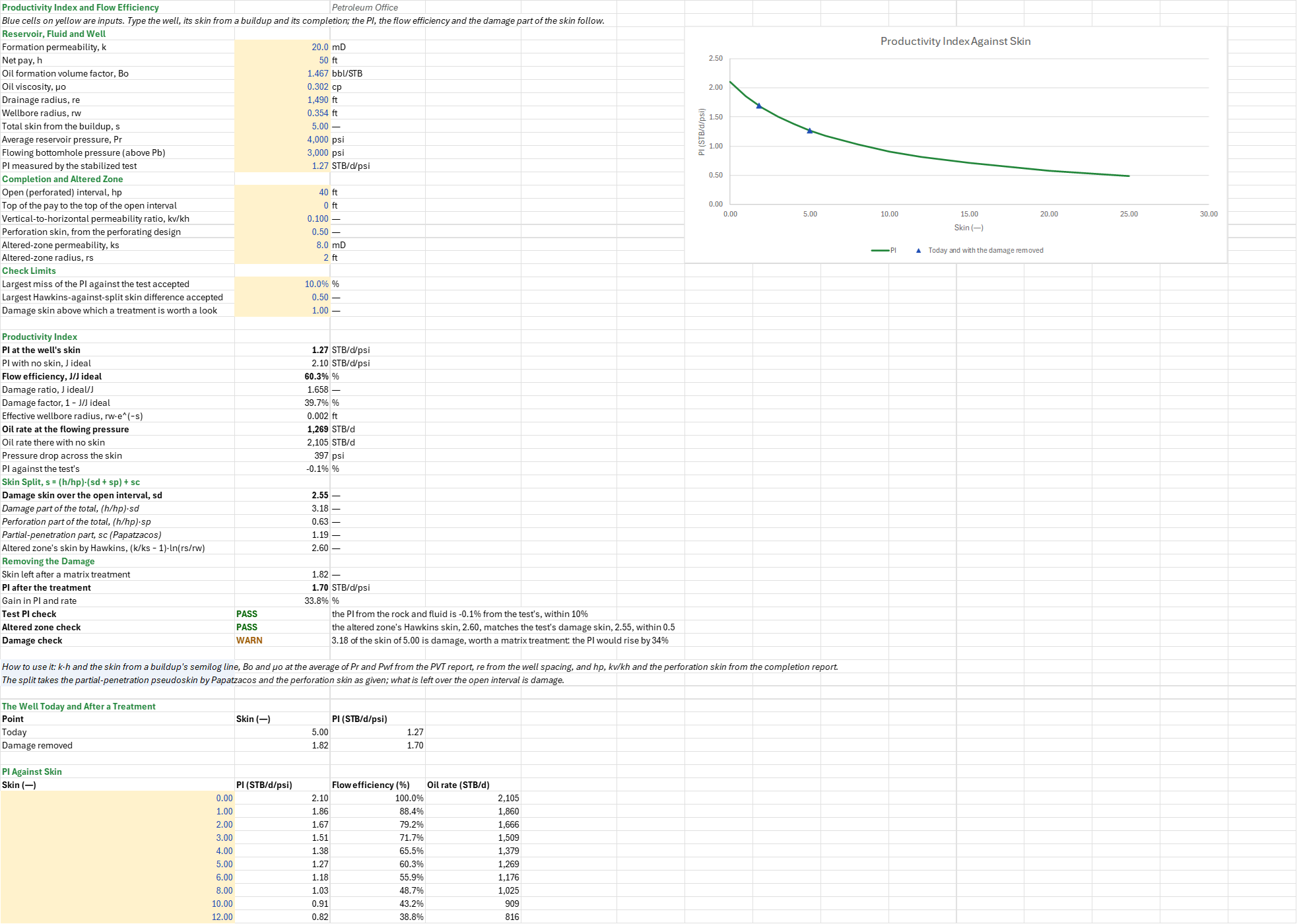
How productive is the well, how much of that does its skin take away, and how much of the skin could a treatment remove? You enter the rock, oil and well, the total skin from a buildup, the pressures, the completion and an altered zone from core. You read off the PI with and without skin, the flow efficiency and damage ratio, the skin's pressure drop, the skin split into damage, partial penetration and perforations, and the PI with the damage removed.
Parameters:
- Well: permeability
IPI_k(mD), net payIPI_h(ft), oil FVFIPI_Bo(rb/STB) and viscosityIPI_Uo(cp), drainage and wellbore radiiIPI_reandIPI_rw(ft), the total skin from a buildupIPI_s, the reservoir and flowing pressuresIPI_PrandIPI_Pwf(psi), and the PI the stabilized test measured,IPI_JTest(STB/d/psi) - Completion and altered zone: the open interval
IPI_hpand its depth below the top of the payIPI_htop(ft), the permeability ratioIPI_kvkh, the perforation skinIPI_sp, and the altered zone's permeabilityIPI_ks(mD) and radiusIPI_rs(ft) - Check limits: the PI's miss against the test
IPI_JTol, the Hawkins-against-split differenceIPI_sTol, and the damage skin worth a lookIPI_sdMax
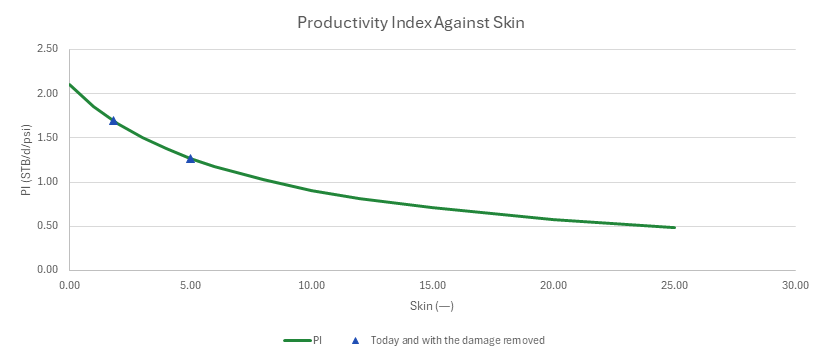
How to use it: Take k·h and the skin from a buildup's semilog straight line, Bo and μo at the average of Pr and Pwf from the PVT report, re from the spacing, and the open interval, kv/kh and the perforation skin (Karakas and Tariq, from the gun's shot density, phasing and penetration) from the completion report. The altered zone's permeability and radius come from core, from a return-permeability test on the mud, or from the invasion depth a resistivity log reads. A chart draws the PI against skin, with the well today and with its damage removed marked on it. Three checks compare the PI with the test's, the altered zone with the split, and say whether the damage is worth treating.
Method: The sheet computes the radial pseudosteady-state PI at the well's skin and with none: J = k·h/(141.2·Bo·μo·(ln(re/rw) − 0.75 + s)), in STB/d/psi, and J ideal the same at s = 0. From the two it gives the flow efficiency, J/J ideal, the damage ratio, its inverse, and the damage factor, 1 − J/J ideal; the skin takes (Pr − Pwf)·(1 − FE) of the drawdown. The effective wellbore radius is rwa = rw·e^(−s). The split of the test's total skin into the part a matrix treatment can remove and the parts it can't follows Saidikowski, s = (h/hp)·(sd + sp) + sc: sd is the formation-damage skin over the open interval, sp the perforation skin and sc Papatzacos's partial-penetration pseudoskin from hp/h, htop/h and (rw/h)·√(kv/kh). The partial-penetration part shown is what is left once the damage and perforation parts, each scaled by h/hp, are taken from s. The damage part is checked against the skin of an altered zone of known permeability and depth by Hawkins, (k/ks − 1)·ln(rs/rw), and a treatment that removes the damage leaves s − (h/hp)·sd, from which the sheet gives the PI the well would have with its damage removed. The table and chart sweep the skin from 0 to 25, with the well today and with its damage removed marked on the curve.
Example: The default case is the oil-inflow family's reference well, the same on the Composite Oil IPR, Fetkovich Oil IPR Fitted to a Multi-Rate Test, Klins-Clark Oil IPR and Skin Sensitivity of the IPR sheets: a vertical oil well on 160 acres (re = 1,490 ft, rw = 0.354 ft) in 50 ft of 20 mD sand, producing the reference black oil (Ahmed's oil 2, Pb = 2,620 psi, Bo = 1.467 rb/STB and μo = 0.302 cp at 4,000 psi) from a 4,000 psi reservoir, with a total skin of 5 from a buildup. It is perforated over the top 40 ft (kv/kh = 0.1, perforation skin 0.5), and core shows an altered zone of 8 mD out to 2 ft. The Composite Oil IPR sheet's test, 1,270 STB/d at 3,000 psi, measured J = 1.27.
ln(1,490/0.354) = 8.345, so J = 1,000/(141.2 × 1.467 × 0.302 × (8.345 − 0.75 + 5)) = 1.269 STB/d/psi, 0.1 % from the test's 1.27, and J ideal = 2.105. The flow efficiency is 60.3 %: the damage ratio is 1.658, and the skin takes 39.7 % of the 1,000 psi drawdown, 397 psi. The well makes 1,269 STB/d at 3,000 psi against 2,105 with no skin, and rwa = 0.0024 ft. With 40 of 50 ft open at kv/kh = 0.1, Papatzacos gives sc = 1.19, so sd = 0.8 × (5 − 1.19) − 0.5 = 2.55. Over the whole pay that is 3.18 of the skin, and the perforations take 0.63. The altered zone gives (20/8 − 1) × ln(2/0.354) = 2.60, within 0.5 of the split's 2.55. Removing the damage leaves a skin of 1.82 and raises the PI to 1.698 STB/d/psi, 34 %. The PI and altered-zone checks pass; the damage check warns that 3.18 of the skin is damage, worth a matrix treatment.
Functions used
Names it defines (50)
| Name | Refers to | Comment |
|---|---|---|
PO.CO.Damage.Flow |
=LAMBDA(j_actual, j_ideal, measure, IF((j_actual<=0)+(j_ideal<=0), NA(), IF(measure="FE", j_actual/j_ideal, IF(measure="DR", j_ideal/j_actual, IF(measure="DF", 1-j_actual/j_ideal, NA()))))) |
Flow efficiency of a well from its PI j_actual and its undamaged PI j_ideal: measure "FE" gives j_actual/j_ideal, "DR" the damage ratio j_ideal/j_actual, "DF" the damage factor 1 - j_actual/j_ideal. |
PO.CO.Damage.Decomposition |
=LAMBDA(s_t, s_p, h, h_p, h_top, r_w, kv_kh, IF((h<=0)+(h_p<=0)+(h_p>h)+(h_top<0)+(h_top+h_p>h)+(r_w<=0)+(kv_kh<=0), NA(), LET(hp_d, h_p/h, ht_d, h_top/h, r_d, r_w/h*SQRT(kv_kh), a_term, 1/(ht_d+hp_d/4), b_term, 1/(ht_d+3*hp_d/4), s_c, (1/hp_d-1)*LN(PI()/(2*r_d))+1/hp_d*LN(hp_d/(2+hp_d)*SQRT((a_term-1)/(b_term-1))), hp_d*(s_t-s_c)-s_p))) |
Damage skin s_d left in a test's total skin s_t: (h_p/h)*(s_t - s_c) - s_p (Saidikowski), s_c the Papatzacos partial-penetration skin of h_p ft open h_top ft below the top of h ft of pay, s_p the perforation skin. |
PO.CO.Damage.Hawkins |
=LAMBDA(k, k_s, r_s, r_w, IF((k<=0)+(k_s<=0)+(r_w<=0)+(r_s<r_w), NA(), (k/k_s-1)*LN(r_s/r_w))) |
Hawkins (1956) skin of an altered zone round the wellbore: (k/k_s - 1)*ln(r_s/r_w). k formation and k_s altered-zone permeability (mD), r_s altered-zone and r_w wellbore radius (ft). Positive when damaged, negative when stimulated. |
IPI_k |
$B$4 |
Formation permeability, k, mD |
IPI_h |
$B$5 |
Net pay, h, ft |
IPI_Bo |
$B$6 |
Oil formation volume factor, Bo, bbl/STB |
IPI_Uo |
$B$7 |
Oil viscosity, μo, cp |
IPI_re |
$B$8 |
Drainage radius, re, ft |
IPI_rw |
$B$9 |
Wellbore radius, rw, ft |
IPI_s |
$B$10 |
Total skin from the buildup, s |
IPI_Pr |
$B$11 |
Average reservoir pressure, Pr, psi |
IPI_Pwf |
$B$12 |
Flowing bottomhole pressure (above Pb), psi |
IPI_JTest |
$B$13 |
PI measured by the stabilized test, STB/d/psi |
IPI_hp |
$B$15 |
Open (perforated) interval, hp, ft |
IPI_htop |
$B$16 |
Top of the pay to the top of the open interval, ft |
IPI_kvkh |
$B$17 |
Vertical-to-horizontal permeability ratio, kv/kh |
IPI_sp |
$B$18 |
Perforation skin, from the perforating design |
IPI_ks |
$B$19 |
Altered-zone permeability, ks, mD |
IPI_rs |
$B$20 |
Altered-zone radius, rs, ft |
IPI_JTol |
$B$22 |
Largest miss of the PI against the test accepted, % |
IPI_sTol |
$B$23 |
Largest Hawkins-against-split skin difference accepted |
IPI_sdMax |
$B$24 |
Damage skin above which a treatment is worth a look |
IPI_Inputs |
$B$4:$B$24 |
The rock, oil and well, the skin from the buildup, the pressures and the test's PI, the completion and the altered zone, and the three check limits |
IPI_J |
$B$27 |
PI at the well's skin, STB/d/psi |
IPI_J0 |
$B$28 |
PI with no skin, J ideal, STB/d/psi |
IPI_FE |
$B$29 |
Flow efficiency, J/J ideal, % |
IPI_DR |
$B$30 |
Damage ratio, J ideal/J |
IPI_DF |
$B$31 |
Damage factor, 1 − J/J ideal, % |
IPI_rwa |
$B$32 |
Effective wellbore radius, rw·e^(−s), ft |
IPI_q |
$B$33 |
Oil rate at the flowing pressure, STB/d |
IPI_q0 |
$B$34 |
Oil rate there with no skin, STB/d |
IPI_dPs |
$B$35 |
Pressure drop across the skin, psi |
IPI_JErr |
$B$36 |
PI against the test's, % |
IPI_sd |
$B$38 |
Damage skin over the open interval, sd |
IPI_sDam |
$B$39 |
Damage part of the total, (h/hp)·sd |
IPI_sPerf |
$B$40 |
Perforation part of the total, (h/hp)·sp |
IPI_sc |
$B$41 |
Partial-penetration part, sc (Papatzacos) |
IPI_sHawk |
$B$42 |
Altered zone's skin by Hawkins, (k/ks − 1)·ln(rs/rw) |
IPI_sLeft |
$B$44 |
Skin left after a matrix treatment |
IPI_JTreat |
$B$45 |
PI after the treatment, STB/d/psi |
IPI_Gain |
$B$46 |
Gain in PI and rate, % |
IPI_JCheck |
$B$47 |
Test PI check verdict |
IPI_JCheckNote |
$C$47 |
Test PI check comment |
IPI_ZoneCheck |
$B$48 |
Altered zone check verdict |
IPI_ZoneCheckNote |
$C$48 |
Altered zone check comment |
IPI_DamCheck |
$B$49 |
Damage check verdict |
IPI_DamCheckNote |
$C$49 |
Damage check comment |
IPI_Results |
$B$27:$B$49 |
The PI with and without skin, the flow efficiency, damage ratio and factor, rwa, the rates and the skin's pressure drop, the miss against the test, the skin split, the Hawkins skin, the treated PI and its gain, and the three checks |
IPI_Points |
$A$56:$C$57 |
The well's skin and PI today and with its damage removed, the chart's markers |
IPI_Curve |
$A$61:$D$73 |
Skin from 0 to 25, the PI and the flow efficiency at each, and the oil rate at the flowing pressure |
Details
| Inserts | 73 rows × 4 columns |
| Category | Inflow Performance Relationship |
| For agents and tools | Descriptor (.md) |
| Tags | IPR · productivity · PI · Darcy · skin · damage · flow-efficiency · damage-ratio · Hawkins · partial-penetration · stimulation |
Need a custom calculation? Request a blueprint