Gas PVT Table
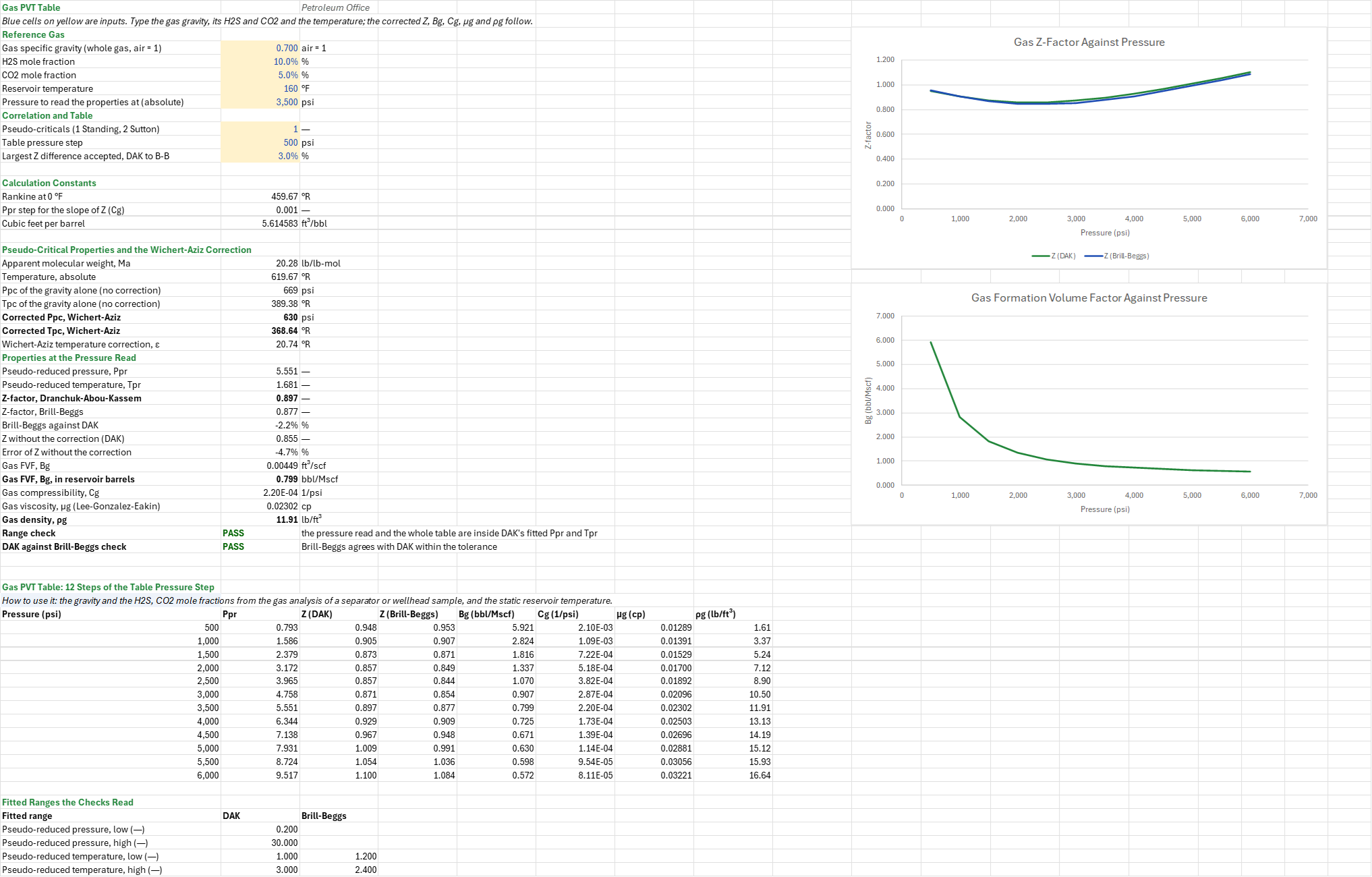
Builds a gas PVT table from gravity, acid-gas content and temperature, comparing Z-factors by DAK and Brill-Beggs.
PVT Properties 65 rows × 8 columns
Use this blueprint
How to use this blueprint
- In Excel, go to the Petroleum Office ribbon tab and click Blueprint Manager
- Search for Gas PVT Table
- Click on the blueprint to preview
- Click Insert to place it into your worksheet. Modify the input values to match your data.
Requires the Petroleum Office add-in for Excel.
Description
What are a gas's Z-factor, volume factor, compressibility, viscosity and density at reservoir conditions, sweet or sour? You enter the gas gravity, its H2S and CO2 mole fractions, the reservoir temperature and a pressure to read. You read off the pseudo-critical properties corrected for the acid gases, the Z-factor by Dranchuk-Abou-Kassem (DAK) and by Brill-Beggs side by side, and Bg, Cg, μg and ρg at that pressure and on a twelve-row pressure table.
Parameters:
- Gas: the whole-gas specific gravity
GPP_SGg, the H2S and CO2 mole fractionsGPP_yH2SandGPP_yCO2, the reservoir temperatureGPP_Tand the absolute pressureGPP_Pthe "Properties at the Pressure Read" block reads - Correlation and table:
GPP_Corrpicks the pseudo-criticals, 1 Standing or 2 Sutton;GPP_dPis the table's pressure step (twelve rows);GPP_Tolis the largest Brill-Beggs difference from DAK the check accepts
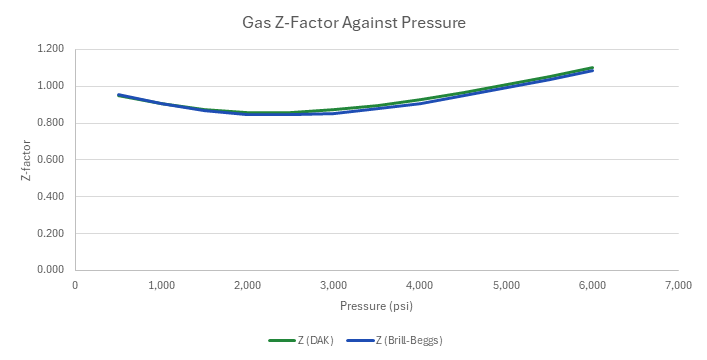
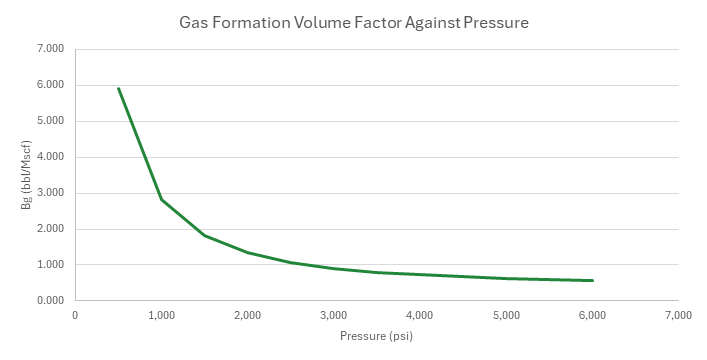
How to use it: Take the gravity and the H2S and CO2 from the gas analysis of a separator or wellhead sample (the gravity of the whole gas, acid gases included), the static temperature from a bottomhole survey, and enter pressures as absolute. A gas with N2 or water vapour needs those handled first; see Validity. The pseudo-criticals are computed from the gravity by Standing or Sutton, not typed, and each Z-factor is checked against the Ppr and Tpr it was fitted to. Z and Bg are charted against pressure.
Method: Ppc and Tpc are Standing's or Sutton's fits of the gravity, and the corrected p′pc and T′pc the same fits with the Wichert-Aziz correction: ε = 120(A^0.9 − A^1.6) + 15(B^0.5 − B^4), with A the H2S plus CO2 and B the H2S mole fraction, T′pc = Tpc − ε and p′pc = Ppc·T′pc/(Tpc + B(1 − B)ε). The apparent molecular weight Ma is the gravity times the molecular weight of air. The temperature is converted to Rankine with 459.67. Ppr = P/p′pc and Tpr = T/T′pc give Z by DAK and by Brill-Beggs. From DAK's Z the sheet takes Bg = 0.02827·Z·T/P by definition (ft³/scf, and in bbl/Mscf), ρg = P·Ma/(Z·R·T) by definition (converted from g/cm³ to lb/ft³ by the density of water at standard conditions), μg by Lee-Gonzalez-Eakin and Cg = 1/P − (1/Z)·dZ/dP, with dZ/dP from a central difference of DAK over ±0.001 in Ppr. The same Z without the correction shows what ignoring the acid gases costs.
Example: The default case is the PVT family's reference gas: a 0.7 gravity sour gas with 10 % H2S and 5 % CO2 at 3,500 psia and 160 °F, the Wichert-Aziz worked example of the textbooks (Ahmed's Reservoir Engineering Handbook, ch. 2). The Sour Gas Properties and H2S Exposure sheet starts from the same gas.
The gas has Ma = 20.28. Standing gives Tpc = 389.38 °R and Ppc = 669.13 psia; Wichert-Aziz's ε is 20.74 °R, so T′pc = 368.64 °R and p′pc = 630.47 psia, Ppr = 5.55 and Tpr = 1.68. DAK's Z is 0.8965, against the 0.89 the textbook reads from the Standing-Katz chart (0.7 %), and Brill-Beggs' 0.8768, 2.2 % lower. Ignoring the correction gives Z = 0.8545, 4.7 % low. At 3,500 psia Bg = 0.00449 ft³/scf (0.799 bbl/Mscf), Cg = 2.20 × 10⁻⁴ 1/psi, μg = 0.0230 cp and ρg = 11.91 lb/ft³, where the textbook, with its chart Z, gets 11.98. The gas lies inside both correlations' fitted ranges, and Brill-Beggs is within the 3 % tolerance of DAK.
Functions used
PO.PVT.Ma.Air.StnMolecular weight of air at standard conditions, [g/mol].PO.PVT.Ppc.ByStandingCalculates pseudo-critical pressure of hydrocarbon gas using Standing correlation, [psi].PO.PVT.Ppc.BySuttonCalculates pseudo-critical pressure of hydrocarbon gas using Sutton (1985) correlation, [psi].PO.PVT.Tpc.ByStandingCalculates pseudo-critical temperature of hydrocarbon gas using Standing correlation, [degR].PO.PVT.Tpc.BySuttonCalculates pseudo-critical temperature of hydrocarbon gas using Sutton (1985) correlation, [degR].PO.PVT.Ppc.ByStanding.SourCalculates pseudo-critical pressure of sour gas using Standing correlation with Wichert-Aziz correction, [psi].PO.PVT.Ppc.BySutton.SourCalculates pseudo-critical pressure of sour gas using Sutton correlation with Wichert-Aziz correction, [psi].PO.PVT.Tpc.ByStanding.SourCalculates pseudo-critical temperature of sour gas using Standing correlation with Wichert-Aziz correction, [degR].PO.PVT.Tpc.BySutton.SourCalculates pseudo-critical temperature of sour gas using Sutton correlation with Wichert-Aziz correction, [degR].PO.PVT.Z.ByDAKCalculates gas compressibility factor (Z) using Dranchuk and Abou-Kassem (1975) equation of state, [dimensionless].PO.PVT.Z.ByBrillBeggsCalculates gas compressibility factor (Z) using Brill and Beggs (1974) correlation, [dimensionless].PO.PVT.Bg.ByDefinitionCalculates gas formation volume factor, [rcf/scf].PO.PVT.Ug.ByLGECalculates gas viscosity using Lee, Gonzales and Eakin (1966) correlation, [cP].PO.PVT.Rho.Gas.ByDefinitionCalculates gas density, [g/cm3].PO.PVT.Rho.Wat.StnWater density at standard conditions, [lb/ft3].
Names it defines (38)
| Name | Refers to | Comment |
|---|---|---|
GPP_SGg |
$B$4 |
Gas specific gravity (whole gas, air = 1), air = 1 |
GPP_yH2S |
$B$5 |
H2S mole fraction, % |
GPP_yCO2 |
$B$6 |
CO2 mole fraction, % |
GPP_T |
$B$7 |
Reservoir temperature, °F |
GPP_P |
$B$8 |
Pressure to read the properties at (absolute), psi |
GPP_Corr |
$B$10 |
Pseudo-criticals (1 Standing, 2 Sutton) |
GPP_dP |
$B$11 |
Table pressure step, psi |
GPP_Tol |
$B$12 |
Largest Z difference accepted, DAK to B-B, % |
GPP_Inputs |
$B$4:$B$12 |
The gas gravity, its H2S and CO2, the temperature and the pressure to read at, the pseudo-critical correlation, the table's step and the Z tolerance |
GPP_R0 |
$B$15 |
Rankine at 0 °F, °R |
GPP_h |
$B$16 |
Ppr step for the slope of Z (Cg) |
GPP_ft3bbl |
$B$17 |
Cubic feet per barrel, ft³/bbl |
GPP_Ma |
$B$20 |
Apparent molecular weight, Ma, lb/lb-mol |
GPP_TR |
$B$21 |
Temperature, absolute, °R |
GPP_Ppc0 |
$B$22 |
Ppc of the gravity alone (no correction), psi |
GPP_Tpc0 |
$B$23 |
Tpc of the gravity alone (no correction), °R |
GPP_Ppc |
$B$24 |
Corrected Ppc, Wichert-Aziz, psi |
GPP_Tpc |
$B$25 |
Corrected Tpc, Wichert-Aziz, °R |
GPP_Eps |
$B$26 |
Wichert-Aziz temperature correction, ε, °R |
GPP_Ppr |
$B$28 |
Pseudo-reduced pressure, Ppr |
GPP_Tpr |
$B$29 |
Pseudo-reduced temperature, Tpr |
GPP_Z |
$B$30 |
Z-factor, Dranchuk-Abou-Kassem |
GPP_ZBB |
$B$31 |
Z-factor, Brill-Beggs |
GPP_ZDiff |
$B$32 |
Brill-Beggs against DAK, % |
GPP_Z0 |
$B$33 |
Z without the correction (DAK) |
GPP_Z0Err |
$B$34 |
Error of Z without the correction, % |
GPP_Bg |
$B$35 |
Gas FVF, Bg, ft³/scf |
GPP_BgB |
$B$36 |
Gas FVF, Bg, in reservoir barrels, bbl/Mscf |
GPP_Cg |
$B$37 |
Gas compressibility, Cg, 1/psi |
GPP_Ug |
$B$38 |
Gas viscosity, μg (Lee-Gonzalez-Eakin), cp |
GPP_Rho |
$B$39 |
Gas density, ρg, lb/ft³ |
GPP_Ranges |
$A$62:$C$65 |
The pseudo-reduced pressure and temperature DAK and Brill-Beggs were fitted to |
GPP_Check |
$B$40 |
Range check verdict |
GPP_CheckNote |
$C$40 |
Range check comment |
GPP_ZCheck |
$B$41 |
DAK against Brill-Beggs verdict |
GPP_ZCheckNote |
$C$41 |
DAK against Brill-Beggs comment |
GPP_Results |
$B$20:$B$41 |
The pseudo-criticals with and without the Wichert-Aziz correction, Ppr, Tpr, Z by DAK and Brill-Beggs, the error of ignoring the correction, Bg, Cg, μg and ρg at the pressure read, and the two checks |
GPP_Curve |
$A$47:$H$58 |
Pressure, Ppr, Z by DAK and Brill-Beggs, Bg, Cg, μg and ρg on the generated pressure grid, from the corrected pseudo-criticals |
Details
| Inserts | 65 rows × 8 columns |
| Category | PVT Properties |
| For agents and tools | Descriptor (.md) |
| Tags | gas · PVT · z-factor · DAK · Brill-Beggs · Wichert-Aziz · pseudo-critical · Bg · Cg · viscosity · density · comparison |
Need a custom calculation? Request a blueprint