Stone Three-Phase Relative Permeability
Calculates three-phase oil relative permeability by Stone's Models I and II over the saturation triangle.
Special Core Analysis 76 rows × 12 columns
Use this blueprint
How to use this blueprint
- In Excel, go to the Petroleum Office ribbon tab and click Blueprint Manager
- Search for Stone Three-Phase Relative Permeability
- Click on the blueprint to preview
- Click Insert to place it into your worksheet. Modify the input values to match your data.
Requires the Petroleum Office add-in for Excel.
Description
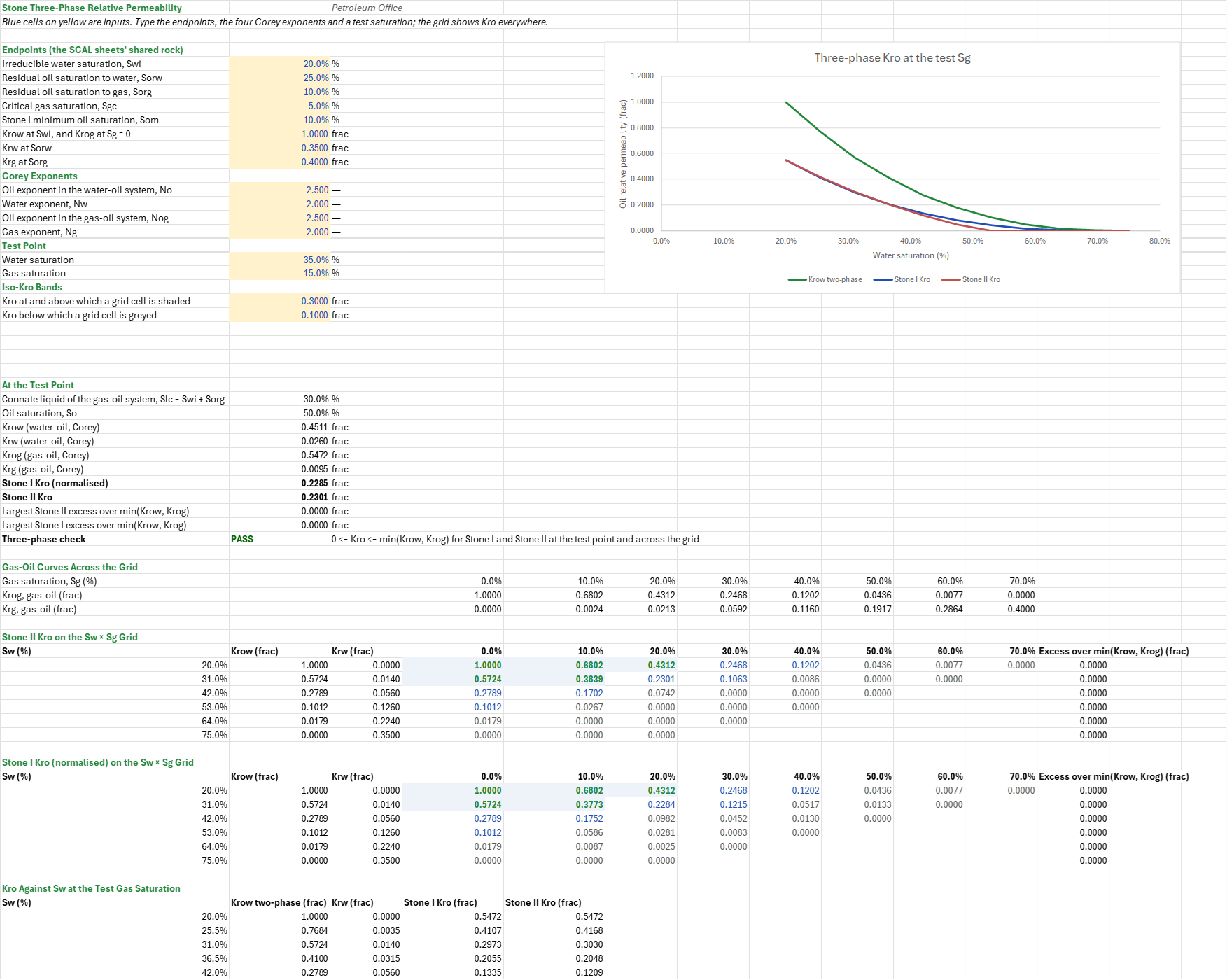
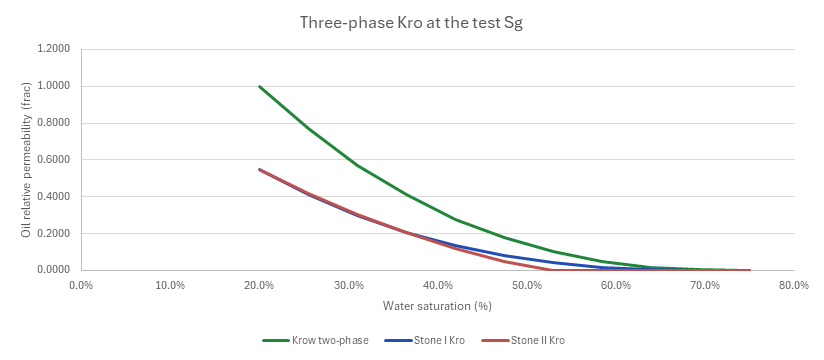
What oil relative permeability do Stone's Model I (normalised) and Model II give in three-phase flow, from the water-oil and gas-oil curves? You enter the endpoints, the four Corey exponents and a test water and gas saturation. You read off both models' Kro at the test point, Kro over an Sw × Sg grid of the three-phase triangle shaded in iso-Kro bands, and a check that 0 ≤ Kro ≤ min(Krow, Krog); the chart draws Kro against Sw at the test gas saturation beside the two-phase Krow.
Parameters:
- Endpoints:
SST_Swi,SST_Sorw, residual oil to gasSST_Sorg, critical gasSST_Sgc, Stone I's minimum oil saturationSST_Som, and the kr endpointsSST_KrowEnd(Krow at Swi, which is also Krog at Sg = 0),SST_KrwEndandSST_KrgEnd(Krg at Sorg) - Corey exponents:
SST_No,SST_Nw,SST_Nog,SST_Ng - Test point:
SST_Sw,SST_Sg - Bands: the iso-Kro band limits
SST_BandHigh(0.3) andSST_BandLow(0.1); the check allows a billionth of Krow@Swi for rounding
How to use it: fit the four Corey exponents and the endpoints to the measured water-oil curve (at Sgc = 0) and gas-oil curve (at Swi) first, with SCAL Endpoint Analysis for the water-oil pair, and type them here. The sheet builds both two-phase curves from them, so the iso-Kro pattern on the grid reads at a glance. The check holds both models to 0 ≤ Kro ≤ min(Krow, Krog) at the test point and across the grid.
Method: The water-oil pair is Corey at Sw: Krow = Krow@Swi·(1 − Sw*)^No and Krw = Krw@Sorw·Sw*^Nw, with Sw* = (Sw − Swi)/(1 − Swi − Sorw), by the catalog's Corey functions. The gas-oil pair is Corey at Sg with the connate liquid Slc = Swi + Sorg, written in the cells because the catalog has no gas-oil Corey function: Krog = Krow@Swi·((1 − Sg − Slc)/(1 − Slc))^Nog, which equals Krow@Swi at Sg = 0 as Stone requires, and Krg = Krg@Sorg·((Sg − Sgc)/(1 − Sgc − Slc))^Ng.
- Stone I, in its normalised form (Aziz and Settari): Kro = Krow@Swi·Son·[Krow/(Krow@Swi·(1 − Swn))]·[Krog/(Krow@Swi·(1 − Sgn))], with Son = (So − Som)/(1 − Swi − Som), Swn = (Sw − Swi)/(1 − Swi − Som) and Sgn = Sg/(1 − Swi − Som), and 0 when So ≤ Som. The sheet calls the catalog's Stone I function, which takes Krow@Swi = 1, so Krow and Krog go in divided by Krow@Swi and the result is multiplied back. The function needs add-in v2.4 or later; earlier versions leave out the (1 − Swn)(1 − Sgn) normalisation and under-read Kro.
- Stone II: Kro = Krow@Swi·[(Krow/Krow@Swi + Krw)(Krog/Krow@Swi + Krg) − Krw − Krg], floored at 0.
Both satisfy Stone's consistency conditions: with no gas they return the water-oil Krow, and at Sw = Swi they return the gas-oil Krog. The grid takes Sw from Swi to 1 − Sorw in fifths of the mobile range down the rows and Sg from 0 to 1 − Slc in sevenths across, and leaves a cell blank where Sw + Sg is above 1. A cell is shaded and bold at Kro ≥ 0.3, blue between 0.1 and 0.3, and grey below 0.1. Each grid row's excess is its largest Kro − min(Krow, Krog), which the check reads.
Example: The defaults are the rock the six relative-permeability sheets share: Swi 20 %, Sorw 25 %, Sorg 10 %, Sgc 5 %, Krow@Swi 1, Krw@Sorw 0.35, Krg@Sorg 0.40 and exponents 2.5, 2, 2.5 and 2. Som is set to Sorg, the smaller residual. At Sw = 35 % and Sg = 15 % (So = 50 %), the two-phase values are Krow = 0.4511, Krw = 0.0260, Krog = 0.5472 and Krg = 0.0095. Stone I gives Kro = 0.2285 (Som 10 %) and Stone II 0.2301. By hand, Stone II is (0.4511 + 0.0260)(0.5472 + 0.0095) − 0.0260 − 0.0095 = 0.2301. On the grid, both models return Krog along the Sw = Swi row and Krow down the Sg = 0 column. They part at low oil saturation: at Sw = 42 % and Sg = 30 % (So = 28 %), Stone I gives 0.0452 and Stone II 0. Neither model exceeds min(Krow, Krog) anywhere on the grid.
Functions used
PO.SCAL.Corey.KrowCalculates Corey-type oil relative permeability, [fraction].PO.SCAL.Corey.KrwCalculates Corey-type water relative permeability, [fraction].PO.SCAL.Stone.I.KroStone I three-phase oil relative permeability, [fraction]. Stone (1970).PO.SCAL.Stone.II.KroStone II three-phase oil relative permeability, [fraction]. Stone (1973).
Names it defines (33)
| Name | Refers to | Comment |
|---|---|---|
SST_Swi |
$B$5 |
Irreducible water saturation, Swi, % |
SST_Sorw |
$B$6 |
Residual oil saturation to water, Sorw, % |
SST_Sorg |
$B$7 |
Residual oil saturation to gas, Sorg, % |
SST_Sgc |
$B$8 |
Critical gas saturation, Sgc, % |
SST_Som |
$B$9 |
Stone I minimum oil saturation, Som, % |
SST_KrowEnd |
$B$10 |
Krow at Swi, and Krog at Sg = 0, frac |
SST_KrwEnd |
$B$11 |
Krw at Sorw, frac |
SST_KrgEnd |
$B$12 |
Krg at Sorg, frac |
SST_No |
$B$14 |
Oil exponent in the water-oil system, No |
SST_Nw |
$B$15 |
Water exponent, Nw |
SST_Nog |
$B$16 |
Oil exponent in the gas-oil system, Nog |
SST_Ng |
$B$17 |
Gas exponent, Ng |
SST_Sw |
$B$19 |
Water saturation, % |
SST_Sg |
$B$20 |
Gas saturation, % |
SST_BandHigh |
$B$22 |
Kro at and above which a grid cell is shaded, frac |
SST_BandLow |
$B$23 |
Kro below which a grid cell is greyed, frac |
SST_Inputs |
$B$5:$B$23 |
The two-phase endpoints, the Corey exponents, the test point and the iso-Kro bands |
SST_Slc |
$B$29 |
Connate liquid of the gas-oil system, Slc = Swi + Sorg, % |
SST_So |
$B$30 |
Oil saturation, So, % |
SST_Krow |
$B$31 |
Krow (water-oil, Corey), frac |
SST_Krw |
$B$32 |
Krw (water-oil, Corey), frac |
SST_Krog |
$B$33 |
Krog (gas-oil, Corey), frac |
SST_Krg |
$B$34 |
Krg (gas-oil, Corey), frac |
SST_KroI |
$B$35 |
Stone I Kro (normalised), frac |
SST_KroII |
$B$36 |
Stone II Kro, frac |
SST_ExcessII |
$B$37 |
Largest Stone II excess over min(Krow, Krog), frac |
SST_ExcessI |
$B$38 |
Largest Stone I excess over min(Krow, Krog), frac |
SST_Check |
$B$39 |
Three-phase check verdict |
SST_CheckNote |
$C$39 |
Three-phase check comment |
SST_Results |
$B$29:$B$39 |
Slc, So, the two-phase values and both Stone Kro at the test point, the grid's largest excesses and the check |
SST_StoneII |
$D$48:$K$53 |
Stone II Kro on the Sw × Sg Grid: Kro at each Sw (rows) and Sg (columns), blank where Sw + Sg is above 1 |
SST_StoneI |
$D$57:$K$62 |
Stone I Kro (normalised) on the Sw × Sg Grid: Kro at each Sw (rows) and Sg (columns), blank where Sw + Sg is above 1 |
SST_Curve |
$A$66:$E$76 |
Sw from Swi to 1 − Sorw at the test Sg: the two-phase Krow and Krw, and Stone I and Stone II Kro |
Details
| Inserts | 76 rows × 12 columns |
| Category | Special Core Analysis |
| For agents and tools | Descriptor (.md) |
| Tags | SCAL · Stone · three-phase · relative-permeability · gas-oil-water |
Need a custom calculation? Request a blueprint