Volumetric Gas in Place
Description
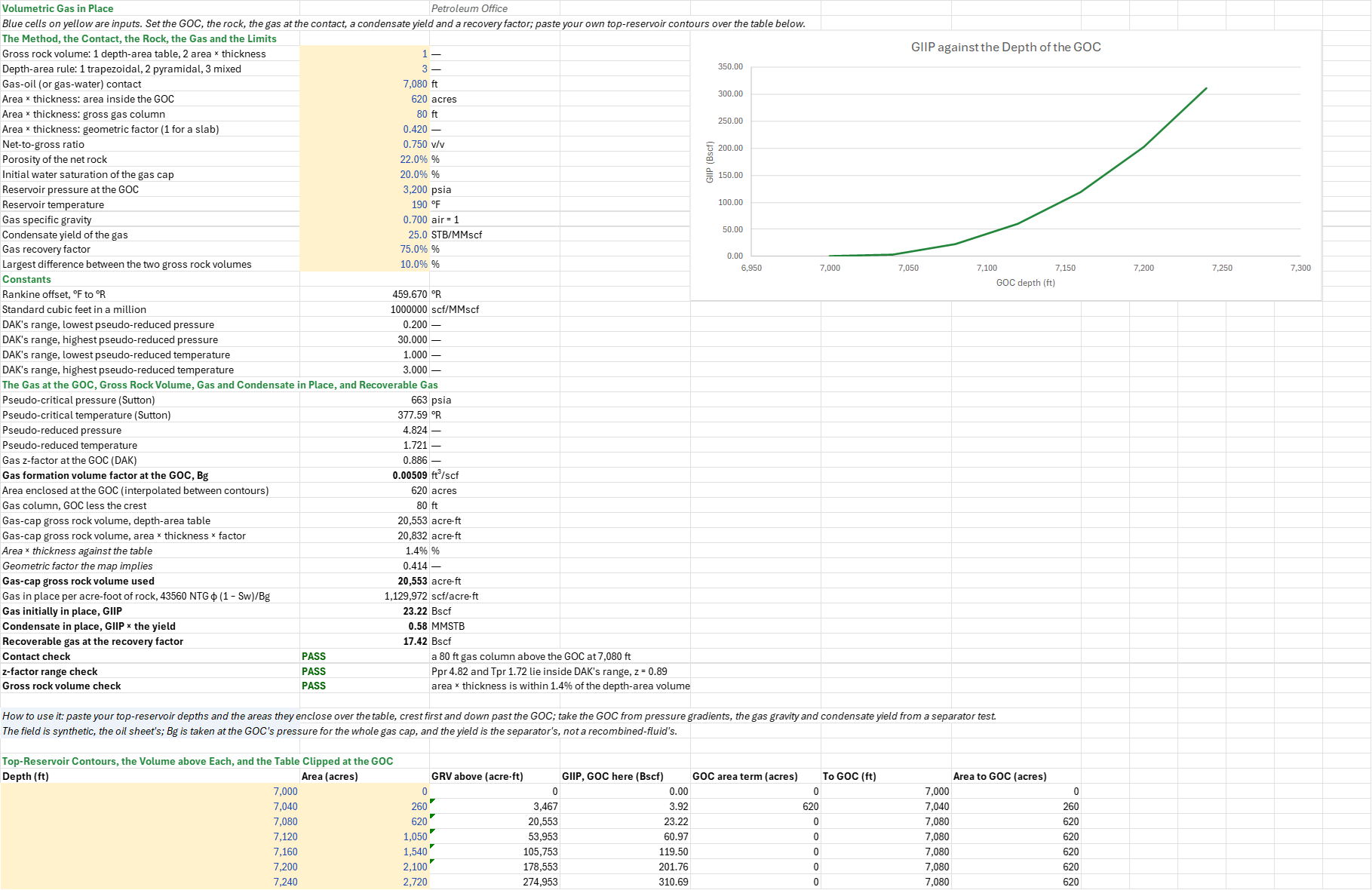
How much gas does the gas cap hold, how much condensate comes with it, and how much gas will come out? You enter the top-reservoir depth-area table and the gas-oil contact, or an area, a thickness and a geometric factor, then the rock, the gas's pressure, temperature and gravity at the contact, a condensate yield and a recovery factor. You read off the gas cap's gross rock volume, Bg from the z-factor, the gas and condensate in place, and the recoverable gas.
Parameters:
- Method:
VG_Method(1 the depth-area table, 2 area × thickness) and the depth-area ruleVG_DARule(1 trapezoidal, 2 pyramidal, 3 pyramidal where a slice's smaller area is at most half its larger) - Contact:
VG_GOC(ft TVDSS), or the gas-water contact of a gas field - Area × thickness: the area inside the GOC
VG_Area(acres), the gross gas columnVG_H(ft) and the geometric factorVG_Factor - Rock:
VG_NTG,VG_Phiand the gas cap'sVG_Sw - Gas: the pressure at the GOC
VG_P(psia), the temperatureVG_T(°F), the gas gravityVG_SG, and the condensate yieldVG_CGR(STB/MMscf) - Recovery and limit: the gas recovery factor
VG_RF, andVG_Tolfor the two volumes' difference - Contours: each top-reservoir depth and the area it encloses, crest first, in the contour table
How to use it: The field is synthetic. Paste your top-reservoir contours over the table, crest first and on past the GOC. Take the GOC from pressure gradients, the pressure at it from a formation test, the gas gravity and condensate yield from a separator test, and NTG, porosity and Sw from the gas cap's petrophysics.
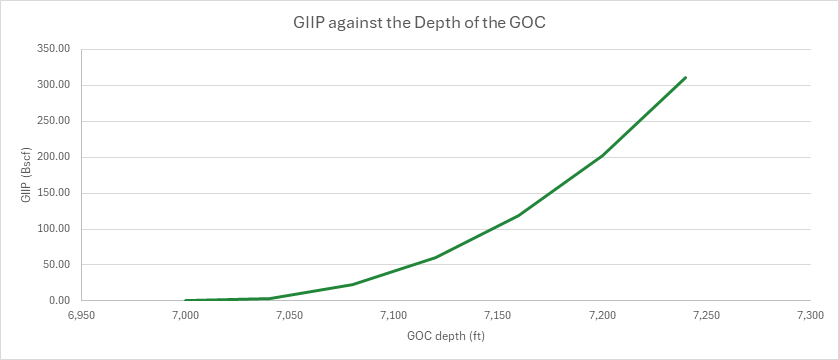
The GOC's area is interpolated between the contours either side of it, and the table is clipped at the GOC before it is integrated. The table also integrates the map down to every contour, and the chart draws the GIIP a GOC at each depth would give at this Bg.
Three checks give PASS, WARN or FAIL. The contact check fails when the GOC is at or above the crest, or below the deepest contour. The z-factor check fails when the reduced pressure or temperature lies outside the range DAK was fitted over. The gross rock volume check warns when area × thickness differs from the table by more than the limit.
Method:
- Gas at the contact. Ppc and Tpc are Sutton's for the gravity, Ppr = P/Ppc and Tpr = (T + 459.67)/Tpc. z is the Dranchuk-Abou-Kassem (DAK) z-factor at Ppr and Tpr, and Bg = 0.02827 z T/P rcf/scf by its definition, T in °R.
- Gross rock volume. The GOC's area is A_i + (C − d_i)/(d_{i+1} − d_i) (A_{i+1} − A_i), between the contours either side of it, and the table clipped at the GOC is integrated by the depth-area rule chosen. By the other method the GRV is A h F.
- In place and recoverable. GIIP = 43560 GRV NTG φ (1 − Sw)/Bg, 43560 being the cubic feet in an acre-foot. The condensate in place is GIIP × CGR / 10⁶, and the recoverable gas GIIP × RF.
Example: The default case is the volumetrics family's synthetic field, the one the Volumetric Oil in Place sheet computes: a four-way dip closure with its crest at 7,000 ft and a gas cap down to the GOC at 7,080 ft, above an oil leg to 7,180 ft. The gas cap's sand is 75% net with 22% porosity and 20% water. The gas is a 0.70-gravity rich gas at 3,200 psia and 190 °F at the GOC, yielding 25 STB of condensate per MMscf, and the recovery factor is 75%.
Sutton gives a Ppc of 663.3 psia and a Tpc of 377.6 °R for the 0.70-gravity gas, so at 3,200 psia and 650 °R Ppr is 4.82 and Tpr 1.72. DAK's z is 0.886 and Bg 0.005089 ft³/scf. The GOC at 7,080 ft encloses 620 acres, and the 80 ft gas column above it holds 20,553 acre·ft, the crest's slice by the pyramidal rule. Area × thickness, 620 acres × 80 ft × 0.42, gives 20,832, 1.4% more, within the 10% limit; the map implies a factor of 0.414. Each acre-foot holds 1.13 MMscf, so GIIP is 23.22 Bscf. At 25 STB/MMscf that is 0.58 MMSTB of condensate, and at 75% the recoverable gas is 17.42 Bscf. The trapezoidal rule overstates the dome's crest: 22,800 acre·ft and 25.76 Bscf. A GOC 20 ft deeper, at 7,100 ft, encloses 835 acres, 35,103 acre·ft and 39.67 Bscf, and area × thickness, left at the old column, warns. A GOC at the crest fails the contact check. At 100 psia Ppr is 0.15, below DAK's range, and the z-factor check fails.
Functions used
PO.PVT.Ppc.BySutton(SG_gas)
Calculates pseudo-critical pressure of hydrocarbon gas using Sutton (1985) correlation, [psi].
PO.PVT.Tpc.BySutton(SG_gas)
Calculates pseudo-critical temperature of hydrocarbon gas using Sutton (1985) correlation, [degR].
PO.PVT.Z.ByDAK(Ppr, Tpr)
Calculates gas compressibility factor (Z) using Dranchuk and Abou-Kassem (1975) equation of state, [dimensionless].
PO.PVT.Bg.ByDefinition(P, T_degR, Z)
Calculates gas formation volume factor, [rcf/scf].
Names (51)
| Name | Refers to | Comment |
|---|---|---|
PO.RES.Vol.GRVLAMBDA |
=LAMBDA(Area, H, Factor, IF(OR(Factor<=0, Factor>1), NA(), Area*H*Factor)) |
Gross rock volume, acre-ft: area (acres) x gross thickness (ft) x a geometric factor (1 for a slab, below 1 for a dome or wedge). |
PO.RES.Vol.GRV.DepthAreaLAMBDA |
=LAMBDA(Depth, Area, Mode, LET(i, SEQUENCE(ROWS(Depth)), shift, --(i=TRANSPOSE(i)+1), d_prev, MMULT(shift, Depth), a_prev, MMULT(shift, Area), dh, ABS(Depth-d_prev)*(i>1), trap, dh*(Area+a_prev)/2, pyr, dh*(Area+a_prev+SQRT(Area*a_prev))/3, lo, (Area+a_prev-ABS(Area-a_prev))/2, hi, (Area+a_prev+ABS(Area-a_prev))/2, IF(Mode=1, SUM(trap), IF(Mode=2, SUM(pyr), IF(Mode=3, SUM(IF(lo<=0.5*hi, pyr, trap)), NA()))))) |
Gross rock volume, acre-ft, from a depth-area (or isopach) table: Mode 1 trapezoid, 2 pyramidal frustum, 3 pyramidal where the smaller area is at most half the larger, trapezoid otherwise. |
PO.RES.Vol.GIIPLAMBDA |
=LAMBDA(GRV, NTG, Phi, Sw, Bg, 43560*GRV*NTG*Phi*(1-Sw)/Bg) |
Gas initially in place, scf: 43560 x GRV (acre-ft) x NTG x porosity x (1 - Sw) / Bg (rcf/scf). |
PO.RES.Vol.RecoverableLAMBDA |
=LAMBDA(InPlace, RF, IF(OR(RF<0, RF>1), NA(), InPlace*RF)) |
Recoverable volume: a volume in place (STOIIP or GIIP, any unit) x a recovery factor between 0 and 1; same unit as the volume in place. |
VG_Method |
$B$4 |
Gross rock volume: 1 depth-area table, 2 area × thickness |
VG_DARule |
$B$5 |
Depth-area rule: 1 trapezoidal, 2 pyramidal, 3 mixed |
VG_GOC |
$B$6 |
Gas-oil (or gas-water) contact, ft |
VG_Area |
$B$7 |
Area × thickness: area inside the GOC, acres |
VG_H |
$B$8 |
Area × thickness: gross gas column, ft |
VG_Factor |
$B$9 |
Area × thickness: geometric factor (1 for a slab) |
VG_NTG |
$B$10 |
Net-to-gross ratio, v/v |
VG_Phi |
$B$11 |
Porosity of the net rock, % |
VG_Sw |
$B$12 |
Initial water saturation of the gas cap, % |
VG_P |
$B$13 |
Reservoir pressure at the GOC, psia |
VG_T |
$B$14 |
Reservoir temperature, °F |
VG_SG |
$B$15 |
Gas specific gravity, air = 1 |
VG_CGR |
$B$16 |
Condensate yield of the gas, STB/MMscf |
VG_RF |
$B$17 |
Gas recovery factor, % |
VG_Tol |
$B$18 |
Largest difference between the two gross rock volumes, % |
VG_Inputs |
$B$4:$B$18 |
The GRV method and depth-area rule, the GOC, the area-thickness inputs, net-to-gross, porosity, water saturation, the pressure, temperature and gravity of the gas, its condensate yield, the recovery factor and the check limit |
VG_R0 |
$B$20 |
Rankine offset, °F to °R, °R |
VG_Mega |
$B$21 |
Standard cubic feet in a million, scf/MMscf |
VG_PprMin |
$B$22 |
DAK's range, lowest pseudo-reduced pressure |
VG_PprMax |
$B$23 |
DAK's range, highest pseudo-reduced pressure |
VG_TprMin |
$B$24 |
DAK's range, lowest pseudo-reduced temperature |
VG_TprMax |
$B$25 |
DAK's range, highest pseudo-reduced temperature |
VG_Ppc |
$B$27 |
Pseudo-critical pressure (Sutton), psia |
VG_Tpc |
$B$28 |
Pseudo-critical temperature (Sutton), °R |
VG_Ppr |
$B$29 |
Pseudo-reduced pressure |
VG_Tpr |
$B$30 |
Pseudo-reduced temperature |
VG_Z |
$B$31 |
Gas z-factor at the GOC (DAK) |
VG_Bg |
$B$32 |
Gas formation volume factor at the GOC, Bg, ft³/scf |
VG_AGOC |
$B$33 |
Area enclosed at the GOC (interpolated between contours), acres |
VG_Column |
$B$34 |
Gas column, GOC less the crest, ft |
VG_GRVda |
$B$35 |
Gas-cap gross rock volume, depth-area table, acre·ft |
VG_GRVah |
$B$36 |
Gas-cap gross rock volume, area × thickness × factor, acre·ft |
VG_Diff |
$B$37 |
Area × thickness against the table, % |
VG_FactorMap |
$B$38 |
Geometric factor the map implies |
VG_GRV |
$B$39 |
Gas-cap gross rock volume used, acre·ft |
VG_PerAcreFt |
$B$40 |
Gas in place per acre-foot of rock, 43560 NTG φ (1 − Sw)/Bg, scf/acre·ft |
VG_GIIP |
$B$41 |
Gas initially in place, GIIP, Bscf |
VG_Cond |
$B$42 |
Condensate in place, GIIP × the yield, MMSTB |
VG_Rec |
$B$43 |
Recoverable gas at the recovery factor, Bscf |
VG_ContactCheck |
$B$44 |
Contact check verdict |
VG_ContactCheckNote |
$C$44 |
Contact check comment |
VG_ZCheck |
$B$45 |
z-factor range check verdict |
VG_ZCheckNote |
$C$45 |
z-factor range check comment |
VG_GrvCheck |
$B$46 |
Gross rock volume check verdict |
VG_GrvCheckNote |
$C$46 |
Gross rock volume check comment |
VG_Results |
$B$27:$B$46 |
Sutton's pseudo-criticals, reduced pressure and temperature, z, Bg and the area at the GOC, the gas column, the gas cap's gross rock volume by both methods and the one used, GIIP per acre-foot, GIIP, condensate in place, recoverable gas, three checks |
VG_Curve |
$A$53:$G$59 |
Each contour's depth and area, the gross rock volume above it, the GIIP a GOC there would give at this Bg, and the table interpolated and clipped at the GOC |
Details
| Inserts | 59 rows × 7 columns |
| Category | Reservoir Engineering |
| For agents and tools | Descriptor (.md) |