Waterflood Vertical Sweep in a Layered Reservoir
Description
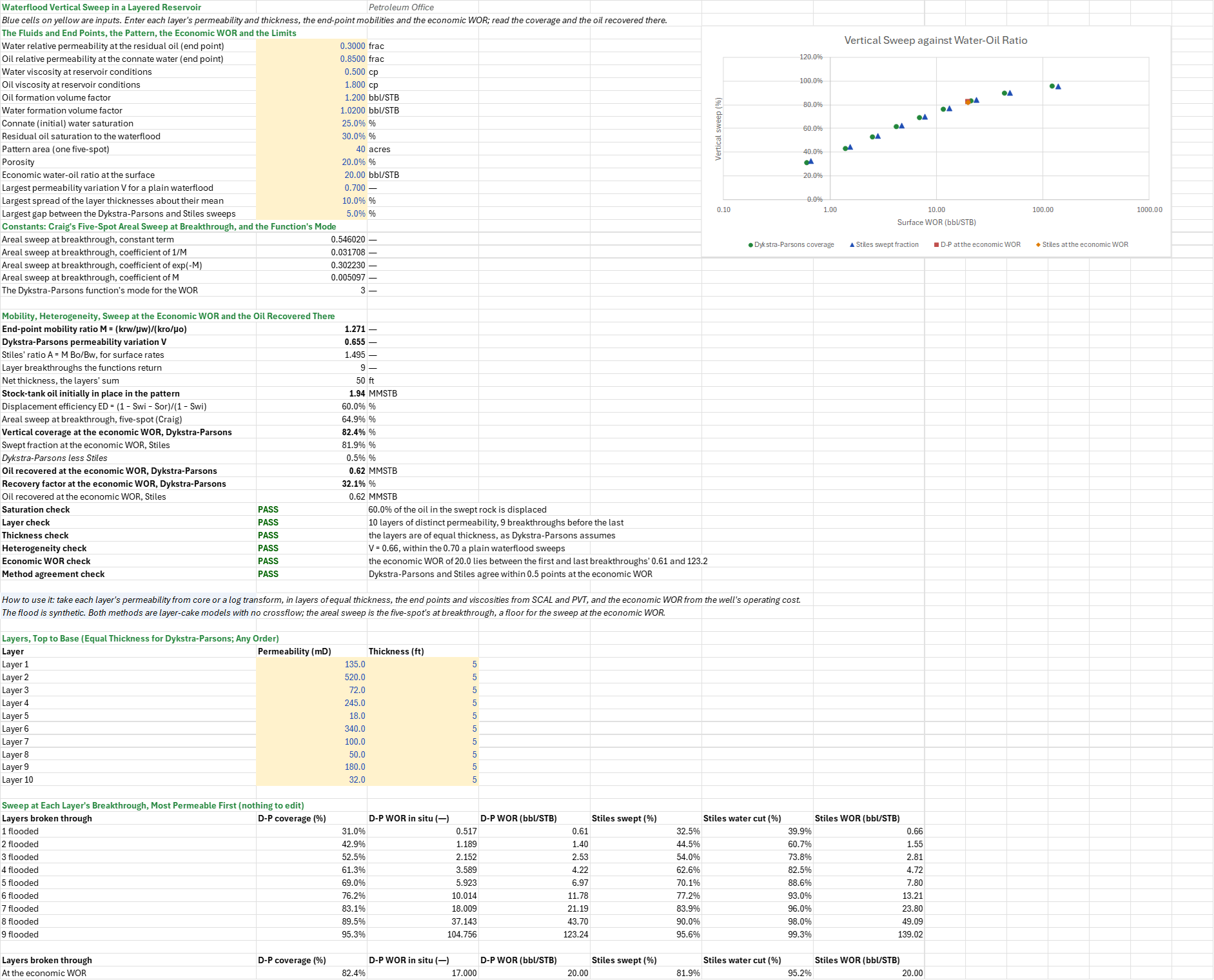
How much of a layered reservoir has a waterflood swept by the time the producer's water-oil ratio reaches the level at which it stops paying, and how much oil is that? You enter each layer's permeability and thickness, the end-point relative permeabilities and viscosities, the pattern and the economic WOR. You read off the Dykstra-Parsons permeability variation V, the vertical sweep by Dykstra-Parsons and by Stiles at the economic WOR, and the oil recovered there.
Parameters:
- Mobility: the end-point relative permeabilities
WFD_Krw(at the residual oil) andWFD_Kro(at the connate water), and the viscositiesWFD_MuwandWFD_Muo(cp) - Fluids and rock:
WFD_BoandWFD_Bw(bbl/STB), the connate waterWFD_Swi, the residual oilWFD_Sorand the porosityWFD_Phi - Pattern: the five-spot's area
WFD_Area(acres); its thickness is the layers' sum - Economic limit: the surface water-oil ratio
WFD_WorEcat which the producer stops paying - Limits:
WFD_VMaxfor V,WFD_HTolfor the spread of the layer thicknesses, andWFD_AgreeTolfor the gap between the methods - Layers: each layer's permeability (mD) and thickness (ft), top to base, in the layer table (
WFD_k,WFD_h)
How to use it: The flood is synthetic. Take each layer's permeability from core or a calibrated log transform, in layers of equal thickness; split a thick layer into several of the same permeability rather than enter one thick one, and give each a slightly different value. Take the end points from the SCAL, the viscosities and formation volume factors from PVT, and the economic WOR from the producer's operating cost (the Water-Oil Ratio Diagnostics sheet derives one).
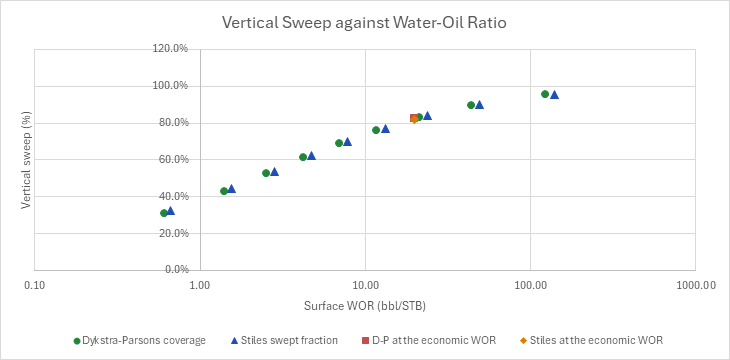
The sheet returns V and, at each layer's breakthrough, the Dykstra-Parsons vertical coverage and water-oil ratio, and beside them Stiles' swept fraction and water cut at the same breakthroughs. Both are read at the economic WOR, interpolated in log WOR between the breakthroughs that bracket it. The oil recovered there is the pattern's STOIIP times the displacement efficiency, Craig's five-spot areal sweep at breakthrough and the vertical coverage. A table lists every breakthrough, most permeable layer first, and the chart draws both methods' sweep against the surface WOR on a logarithmic axis, with each method's point at the economic WOR.
Six checks give PASS, WARN or FAIL. The saturation check fails when Swi and Sor leave no movable oil. The layer check fails on a permeability of zero or less, or on two layers of the same permeability, which share a breakthrough and leave the table a row short. The thickness check warns when the layers are not of equal thickness, as Dykstra-Parsons assumes. The heterogeneity check warns when V is above the limit. The economic WOR check warns when the economic WOR lies outside the breakthroughs' range. The method agreement check warns when the two methods' sweeps differ by more than the limit.
Method:
- Mobility and heterogeneity. The mobility ratio is M = (krw/μw)/(kro/μo). V = 1 − e^(−σ), where σ is the sample standard deviation of ln k: the log-normal line's (k₅₀ − k₈₄.₁)/k₅₀.
- Dykstra-Parsons. With the layers sorted so that k₁ ≥ … ≥ kₙ, when layer j breaks through every layer i > j is flooded to xᵢ = (M − √(M² + (kᵢ/kⱼ)(1 − M²)))/(M − 1). The vertical coverage is Cⱼ = (j + Σ xᵢ)/n and the reservoir WOR = Σᵢ≤ⱼ kᵢ / Σᵢ>ⱼ kᵢ/(M + xᵢ(1 − M)); the surface WOR is that times Bo/Bw.
- Stiles. Stiles treats the displacement as unit mobility: with Cⱼ the cumulative kh and Hⱼ the cumulative thickness, the swept fraction is (Hⱼ + (Cₜ − Cⱼ)/kⱼ)/Hₜ, and the surface water cut is A Cⱼ/(A Cⱼ + Cₜ − Cⱼ) with A = M Bo/Bw; its surface WOR is fw/(1 − fw).
- At the economic WOR. The sweep at the economic WOR interpolates linearly in ln WOR between the bracketing breakthroughs, and takes the nearest breakthrough's beyond either end.
- Oil recovered. The displacement efficiency is ED = (1 − Swi − Sor)/(1 − Swi). Craig's five-spot areal sweep at breakthrough is EA = 0.54602036 + 0.03170817/M + 0.30222997/e^M − 0.00509693 M. STOIIP = 7758 A h φ (1 − Swi)/Bo, and the oil recovered is STOIIP × ED × EA × C.
Example: The default case is one synthetic 40-acre five-spot over ten layers of 5 ft, 50 ft in all, at 20% porosity, 25% connate water and 30% residual oil. The layers, top to base, are 135, 520, 72, 245, 18, 340, 100, 50, 180 and 32 mD. The water's end point is 0.30 and its viscosity 0.50 cp; the oil's are 0.85 and 1.80 cp. Bo is 1.20 and Bw 1.02 bbl/STB, and the producer stops paying at a surface WOR of 20, a 95% water cut.
M is 1.271 and V 0.655, under the 0.70 limit: a moderately heterogeneous sand. Ten layers break through at surface WORs from 0.61 to 123; the economic WOR of 20 falls between the sixth and seventh. There the Dykstra-Parsons coverage is 82.4% and Stiles' swept fraction 81.9%, 0.5 points apart, inside the 5-point limit. The pattern holds 1.94 MMSTB; with ED 60% and EA 64.9%, the flood recovers 0.623 MMSTB at the economic WOR, 32.1% of the oil in place (0.619 MMSTB by Stiles). With a lighter oil of 0.50 cp, M falls to 0.353, EA rises to 84.6% and the coverage at the same WOR to 89.5%: 0.881 MMSTB, 45.4%. An economic WOR of 200, beyond the last breakthrough's 123, warns, and takes the last breakthrough's 95.3%. A residual oil of 80% fails the saturation check.
Functions used
None: the blueprint calculates with Excel's own functions.
Names (55)
| Name | Refers to | Comment |
|---|---|---|
PO.RES.Waterflood.DykstraParsonsLAMBDA |
=LAMBDA(k, Mob, Mode, LET(n, ROWS(k), Vdp, 1-EXP(-STDEV.S(LN(k))), ks, SORT(k, , -1), kr, TRANSPOSE(ks), ratio, kr/ks, below, IF(ratio<1, ratio, 1), x, IF(ratio>=1, 1, IF(Mob=1, below, (Mob-SQRT(Mob^2+below*(1-Mob^2)))/(Mob-1))), ones, SEQUENCE(n, 1, 1, 0), cov, MMULT(x, ones)/n, wat, MMULT((ratio>=1)*kr, ones), oil, MMULT((ratio<1)*kr/(Mob+x*(1-Mob)), ones), open, oil>0, IF(Mode=1, Vdp, IF(Mode=2, FILTER(cov, open), IF(Mode=3, FILTER(wat/IF(open, oil, 1), open), NA()))))) |
Dykstra-Parsons layered waterflood: Mode 1 permeability variation V, 2 vertical coverage, 3 reservoir WOR, at each layer breakthrough |
PO.RES.Waterflood.StilesLAMBDA |
=LAMBDA(k, h, A_wo, Mode, LET(f, (TRANSPOSE(k)>=k)*1, kh_cum, MMULT(f, k*h), h_cum, MMULT(f, h), kh_tot, SUM(k*h), h_tot, SUM(h), swept, (h_cum+(kh_tot-kh_cum)/k)/h_tot, fw, A_wo*kh_cum/(A_wo*kh_cum+kh_tot-kh_cum), IF(Mode=1, SORT(swept), IF(Mode=2, SORT(fw), NA())))) |
Stiles layered waterflood at each layer breakthrough, highest permeability first: Mode 1 fraction of the floodable volume swept, 2 surface water cut |
PO.RES.Vol.STOIIPLAMBDA |
=LAMBDA(GRV, NTG, Phi, Sw, Bo, 7758*GRV*NTG*Phi*(1-Sw)/Bo) |
Stock-tank oil initially in place, STB: 7758 x GRV (acre-ft) x NTG x porosity x (1 - Sw) / Bo (rb/STB). |
WFD_Krw |
$B$4 |
Water relative permeability at the residual oil (end point), frac |
WFD_Kro |
$B$5 |
Oil relative permeability at the connate water (end point), frac |
WFD_Muw |
$B$6 |
Water viscosity at reservoir conditions, cp |
WFD_Muo |
$B$7 |
Oil viscosity at reservoir conditions, cp |
WFD_Bo |
$B$8 |
Oil formation volume factor, bbl/STB |
WFD_Bw |
$B$9 |
Water formation volume factor, bbl/STB |
WFD_Swi |
$B$10 |
Connate (initial) water saturation, % |
WFD_Sor |
$B$11 |
Residual oil saturation to the waterflood, % |
WFD_Area |
$B$12 |
Pattern area (one five-spot), acres |
WFD_Phi |
$B$13 |
Porosity, % |
WFD_WorEc |
$B$14 |
Economic water-oil ratio at the surface, bbl/STB |
WFD_VMax |
$B$15 |
Largest permeability variation V for a plain waterflood |
WFD_HTol |
$B$16 |
Largest spread of the layer thicknesses about their mean, % |
WFD_AgreeTol |
$B$17 |
Largest gap between the Dykstra-Parsons and Stiles sweeps, % |
WFD_Inputs |
$B$4:$B$17 |
The end-point relative permeabilities and viscosities, Bo and Bw, the connate water and residual oil, the pattern's area and porosity, the economic surface WOR and the check limits |
WFD_EaA |
$B$19 |
Areal sweep at breakthrough, constant term |
WFD_EaB |
$B$20 |
Areal sweep at breakthrough, coefficient of 1/M |
WFD_EaC |
$B$21 |
Areal sweep at breakthrough, coefficient of exp(-M) |
WFD_EaD |
$B$22 |
Areal sweep at breakthrough, coefficient of M |
WFD_ModeWor |
$B$23 |
The Dykstra-Parsons function's mode for the WOR |
WFD_M |
$B$26 |
End-point mobility ratio M = (krw/μw)/(kro/μo) |
WFD_V |
$B$27 |
Dykstra-Parsons permeability variation V |
WFD_A |
$B$28 |
Stiles' ratio A = M Bo/Bw, for surface rates |
WFD_Bt |
$B$29 |
Layer breakthroughs the functions return |
WFD_Hnet |
$B$30 |
Net thickness, the layers' sum, ft |
WFD_N |
$B$31 |
Stock-tank oil initially in place in the pattern, MMSTB |
WFD_ED |
$B$32 |
Displacement efficiency ED = (1 − Swi − Sor)/(1 − Swi), % |
WFD_EA |
$B$33 |
Areal sweep at breakthrough, five-spot (Craig), % |
WFD_Cdp |
$B$34 |
Vertical coverage at the economic WOR, Dykstra-Parsons, % |
WFD_Rst |
$B$35 |
Swept fraction at the economic WOR, Stiles, % |
WFD_Gap |
$B$36 |
Dykstra-Parsons less Stiles, % |
WFD_Np |
$B$37 |
Oil recovered at the economic WOR, Dykstra-Parsons, MMSTB |
WFD_RF |
$B$38 |
Recovery factor at the economic WOR, Dykstra-Parsons, % |
WFD_NpSt |
$B$39 |
Oil recovered at the economic WOR, Stiles, MMSTB |
WFD_SatCheck |
$B$40 |
Saturation check verdict |
WFD_SatCheckNote |
$C$40 |
Saturation check comment |
WFD_LayerCheck |
$B$41 |
Layer check verdict |
WFD_LayerCheckNote |
$C$41 |
Layer check comment |
WFD_ThicknessCheck |
$B$42 |
Thickness check verdict |
WFD_ThicknessCheckNote |
$C$42 |
Thickness check comment |
WFD_HeterogeneityCheck |
$B$43 |
Heterogeneity check verdict |
WFD_HeterogeneityCheckNote |
$C$43 |
Heterogeneity check comment |
WFD_RangeCheck |
$B$44 |
Economic WOR check verdict |
WFD_RangeCheckNote |
$C$44 |
Economic WOR check comment |
WFD_AgreementCheck |
$B$45 |
Method agreement check verdict |
WFD_AgreementCheckNote |
$C$45 |
Method agreement check comment |
WFD_Results |
$B$26:$B$45 |
M, V, Stiles' A, the breakthroughs, the net thickness and STOIIP, the displacement and areal sweep, each method's sweep at the economic WOR, the oil recovered there and six checks |
WFD_Layers |
$A$52:$C$61 |
Each layer's permeability and thickness, top to base |
WFD_k |
$B$52:$B$61 |
Layer permeabilities, mD |
WFD_h |
$C$52:$C$61 |
Layer thicknesses, ft |
WFD_Curve |
$A$65:$G$73 |
At each layer breakthrough: the Dykstra-Parsons coverage and WOR, and Stiles' swept fraction, water cut and WOR |
WFD_Marker |
$A$76:$G$76 |
Both methods' sweep at the economic WOR, for the chart's markers |
Details
| Inserts | 76 rows × 7 columns |
| Category | Reservoir Engineering |
| For agents and tools | Descriptor (.md) |