Recovery Factor by Drive Mechanism
Description
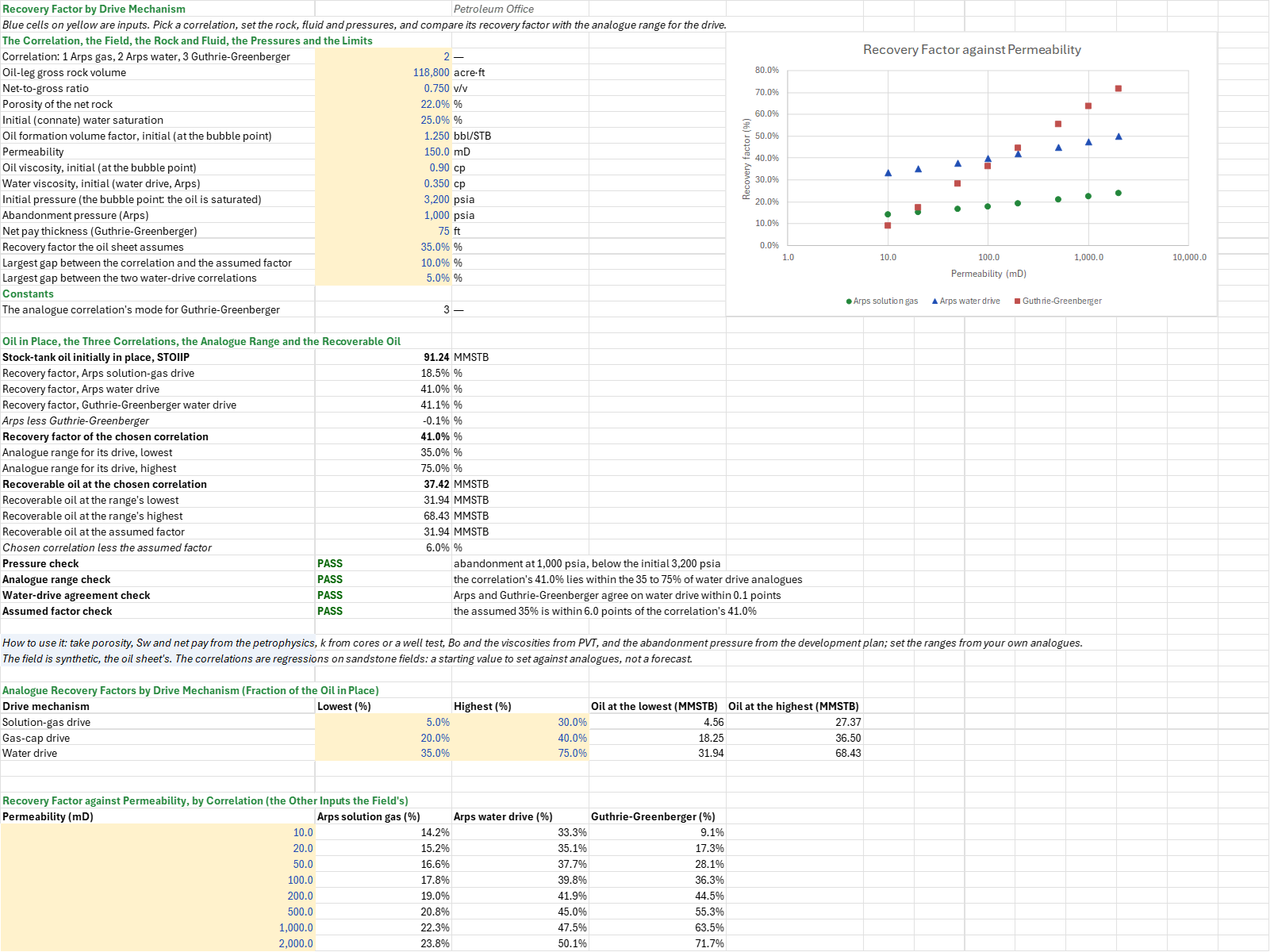
What share of the oil in place will come out before the field is abandoned, before there is any production to forecast from? You pick one of three correlations fitted to field histories, Arps and co-workers' for solution-gas or for water drive, or Guthrie and Greenberger's for water drive, and enter the oil leg's rock, fluids and pressures. You read off the oil in place, each correlation's recovery factor set against the analogue range for its drive, and the recoverable oil.
Parameters:
- Correlation:
RF_Mode, 1 Arps solution-gas drive, 2 Arps water drive, 3 Guthrie-Greenberger water drive - Oil in place: the oil leg's gross rock volume
RF_GRV(acre·ft),RF_NTG,RF_Phi,RF_SwandRF_Bo(bbl/STB) - Rock and fluid: the permeability
RF_K(mD), the oil viscosityRF_Muoand the water viscosityRF_Muw(cp), and the net payRF_H(ft) - Pressures: the initial pressure
RF_Pi(the bubble point, for saturated oil) and the abandonment pressureRF_Pa(psia) - Comparison: the recovery factor the oil sheet assumes,
RF_Assumed - Limits:
RF_Tolfor the gap to the assumed factor, andRF_AgreeTolfor the gap between the two water-drive correlations - Analogues: each drive's lowest and highest recovery factor, in the analogue table
How to use it: The field is synthetic. Take porosity, Sw and the net pay from the petrophysics of the oil leg, k from cores or a well test, Bo and the viscosities from PVT at the bubble point, and the abandonment pressure from the development plan. Replace the analogue ranges with those of fields of the same lithology and drive.
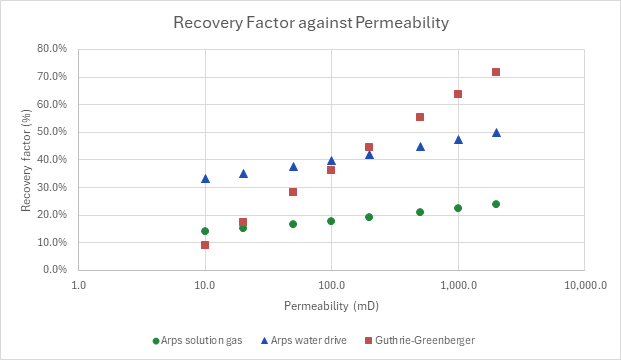
The sheet computes all three correlations, Arps and co-workers' API study for solution-gas drive (mode 1) and for water drive (mode 2) and Guthrie and Greenberger's water-drive regression (mode 3), and the mode picks the one set against the range analogues give for its drive mechanism. A table gives the lowest and highest analogue recovery factor for solution-gas, gas-cap and water drive, and the recoverable oil at each. A second table reads the three correlations across permeabilities from 10 to 2,000 mD, and the chart draws them on a logarithmic permeability axis.
Four checks give PASS, WARN or FAIL. The pressure check fails when the abandonment pressure is not below the initial pressure. The analogue range check warns when the chosen correlation lies outside its drive's range. The water-drive agreement check warns when Arps and Guthrie-Greenberger differ by more than the limit. The assumed factor check warns when the oil sheet's recovery factor is further from the correlation than the limit.
Method: With k in darcies in the Arps forms and in mD in Guthrie-Greenberger:
- Arps solution-gas drive. RF = 0.41815 [φ(1 − Sw)/Bob]^0.1611 (k/μob)^0.0979 Sw^0.3722 (pb/pa)^0.1741.
- Arps water drive. RF = 0.54898 [φ(1 − Sw)/Boi]^0.0422 (k μwi/μoi)^0.0770 Sw^(−0.1903) (pi/pa)^(−0.2159).
- Guthrie-Greenberger water drive. RF = 0.2719 log k + 0.25569 Sw − 0.1355 log μo − 1.5380 φ − 0.00035 h + 0.11403.
STOIIP = 7758 GRV NTG φ (1 − Sw)/Bo, and the recoverable oil is STOIIP × RF. The analogue range for mode 1 is solution-gas drive's, and for modes 2 and 3 water drive's.
Example: The default case is the oil leg of the volumetrics family's synthetic field, the one the Volumetric Oil in Place sheet computes: 118,800 acre·ft of rock at 75% net, 22% porosity and 25% water, with Bo 1.25 bbl/STB. The oil sits under a gas cap, so it is saturated at the initial pressure, the GOC's 3,200 psia. The sand is 150 mD, the oil 0.90 cp and the water 0.35 cp, the net pay 75 ft (the 100 ft oil column at 75% net), and the field is abandoned at 1,000 psia. The correlation is Arps water drive, for the aquifer below the OWC.
STOIIP is the oil sheet's 91.24 MMSTB. Arps gives 18.5% for solution-gas drive and 41.0% for water drive, and Guthrie-Greenberger 41.1%, so the two water-drive correlations agree within 0.1 points. The chosen Arps water drive lies within water drive's 35% to 75%, and recovers 37.42 MMSTB, against 31.94 to 68.43 MMSTB across the range. The oil sheet's 35%, 31.94 MMSTB, is 6.0 points below it, inside the 10-point limit. Solution-gas drive (mode 1) recovers 16.89 MMSTB, inside its 5% to 30%, and the assumed 35% then lies 16.5 points away and warns. Guthrie-Greenberger (mode 3) gives 37.52 MMSTB. In a tight sand with viscous oil, 10 mD and 3 cp, Arps water drive falls to 30.3%, outside the water-drive range, and Guthrie-Greenberger to 2.1%: both warn. An abandonment pressure of 3,500 psia, above the initial, fails the pressure check.
Functions used
None: the blueprint calculates with Excel's own functions.
Names (44)
| Name | Refers to | Comment |
|---|---|---|
PO.RES.RF.AnalogueLAMBDA |
=LAMBDA(Mode, Phi, Sw, Bo, k, Mu_o, Mu_w, P_ref, P_a, H, IF(Mode=1, 0.41815*(Phi*(1-Sw)/Bo)^0.1611*(k/1000/Mu_o)^0.0979*Sw^0.3722*(P_ref/P_a)^0.1741, IF(Mode=2, 0.54898*(Phi*(1-Sw)/Bo)^0.0422*(k/1000*Mu_w/Mu_o)^0.077*Sw^(-0.1903)*(P_ref/P_a)^(-0.2159), IF(Mode=3, 0.2719*LOG10(k)+0.25569*Sw-0.1355*LOG10(Mu_o)-1.538*Phi-0.00035*H+0.11403, NA())))) |
Oil recovery factor (fraction) from analogue correlations: Mode 1 Arps (API 1967) solution-gas drive, 2 Arps water drive, 3 Guthrie-Greenberger (1955) water drive. k in mD. |
PO.RES.Vol.STOIIPLAMBDA |
=LAMBDA(GRV, NTG, Phi, Sw, Bo, 7758*GRV*NTG*Phi*(1-Sw)/Bo) |
Stock-tank oil initially in place, STB: 7758 x GRV (acre-ft) x NTG x porosity x (1 - Sw) / Bo (rb/STB). |
PO.RES.Vol.RecoverableLAMBDA |
=LAMBDA(InPlace, RF, IF(OR(RF<0, RF>1), NA(), InPlace*RF)) |
Recoverable volume: a volume in place (STOIIP or GIIP, any unit) x a recovery factor between 0 and 1; same unit as the volume in place. |
RF_Mode |
$B$4 |
Correlation: 1 Arps gas, 2 Arps water, 3 Guthrie-Greenberger |
RF_GRV |
$B$5 |
Oil-leg gross rock volume, acre·ft |
RF_NTG |
$B$6 |
Net-to-gross ratio, v/v |
RF_Phi |
$B$7 |
Porosity of the net rock, % |
RF_Sw |
$B$8 |
Initial (connate) water saturation, % |
RF_Bo |
$B$9 |
Oil formation volume factor, initial (at the bubble point), bbl/STB |
RF_K |
$B$10 |
Permeability, mD |
RF_Muo |
$B$11 |
Oil viscosity, initial (at the bubble point), cp |
RF_Muw |
$B$12 |
Water viscosity, initial (water drive, Arps), cp |
RF_Pi |
$B$13 |
Initial pressure (the bubble point: the oil is saturated), psia |
RF_Pa |
$B$14 |
Abandonment pressure (Arps), psia |
RF_H |
$B$15 |
Net pay thickness (Guthrie-Greenberger), ft |
RF_Assumed |
$B$16 |
Recovery factor the oil sheet assumes, % |
RF_Tol |
$B$17 |
Largest gap between the correlation and the assumed factor, % |
RF_AgreeTol |
$B$18 |
Largest gap between the two water-drive correlations, % |
RF_Inputs |
$B$4:$B$18 |
The correlation, the oil leg's GRV, net-to-gross, porosity, water saturation and Bo, the permeability, the oil and water viscosities, the initial and abandonment pressures, the net pay, the assumed recovery factor and the check limits |
RF_ModeGG |
$B$20 |
The analogue correlation's mode for Guthrie-Greenberger |
RF_STOIIP |
$B$23 |
Stock-tank oil initially in place, STOIIP, MMSTB |
RF_Sgd |
$B$24 |
Recovery factor, Arps solution-gas drive, % |
RF_Wd |
$B$25 |
Recovery factor, Arps water drive, % |
RF_Gg |
$B$26 |
Recovery factor, Guthrie-Greenberger water drive, % |
RF_WdGap |
$B$27 |
Arps less Guthrie-Greenberger, % |
RF_Corr |
$B$28 |
Recovery factor of the chosen correlation, % |
RF_Low |
$B$29 |
Analogue range for its drive, lowest, % |
RF_High |
$B$30 |
Analogue range for its drive, highest, % |
RF_Rec |
$B$31 |
Recoverable oil at the chosen correlation, MMSTB |
RF_RecLow |
$B$32 |
Recoverable oil at the range's lowest, MMSTB |
RF_RecHigh |
$B$33 |
Recoverable oil at the range's highest, MMSTB |
RF_RecAssumed |
$B$34 |
Recoverable oil at the assumed factor, MMSTB |
RF_Gap |
$B$35 |
Chosen correlation less the assumed factor, % |
RF_PressureCheck |
$B$36 |
Pressure check verdict |
RF_PressureCheckNote |
$C$36 |
Pressure check comment |
RF_RangeCheck |
$B$37 |
Analogue range check verdict |
RF_RangeCheckNote |
$C$37 |
Analogue range check comment |
RF_AgreementCheck |
$B$38 |
Water-drive agreement check verdict |
RF_AgreementCheckNote |
$C$38 |
Water-drive agreement check comment |
RF_AssumedCheck |
$B$39 |
Assumed factor check verdict |
RF_AssumedCheckNote |
$C$39 |
Assumed factor check comment |
RF_Results |
$B$23:$B$39 |
STOIIP, the recovery factor by each correlation and the water-drive pair's gap, the chosen one, its drive's analogue range, the recoverable oil at each, the gap to the assumed factor and four checks |
RF_Analogues |
$A$46:$E$48 |
Each drive mechanism's lowest and highest analogue recovery factor, and the recoverable oil at each |
RF_Curve |
$A$53:$D$60 |
Permeabilities, and the recovery factor each correlation gives at each, the other inputs held at the field's |
Details
| Inserts | 60 rows × 5 columns |
| Category | Reservoir Engineering |
| For agents and tools | Descriptor (.md) |