Archie Water Saturation and Bulk Volume Water
Description
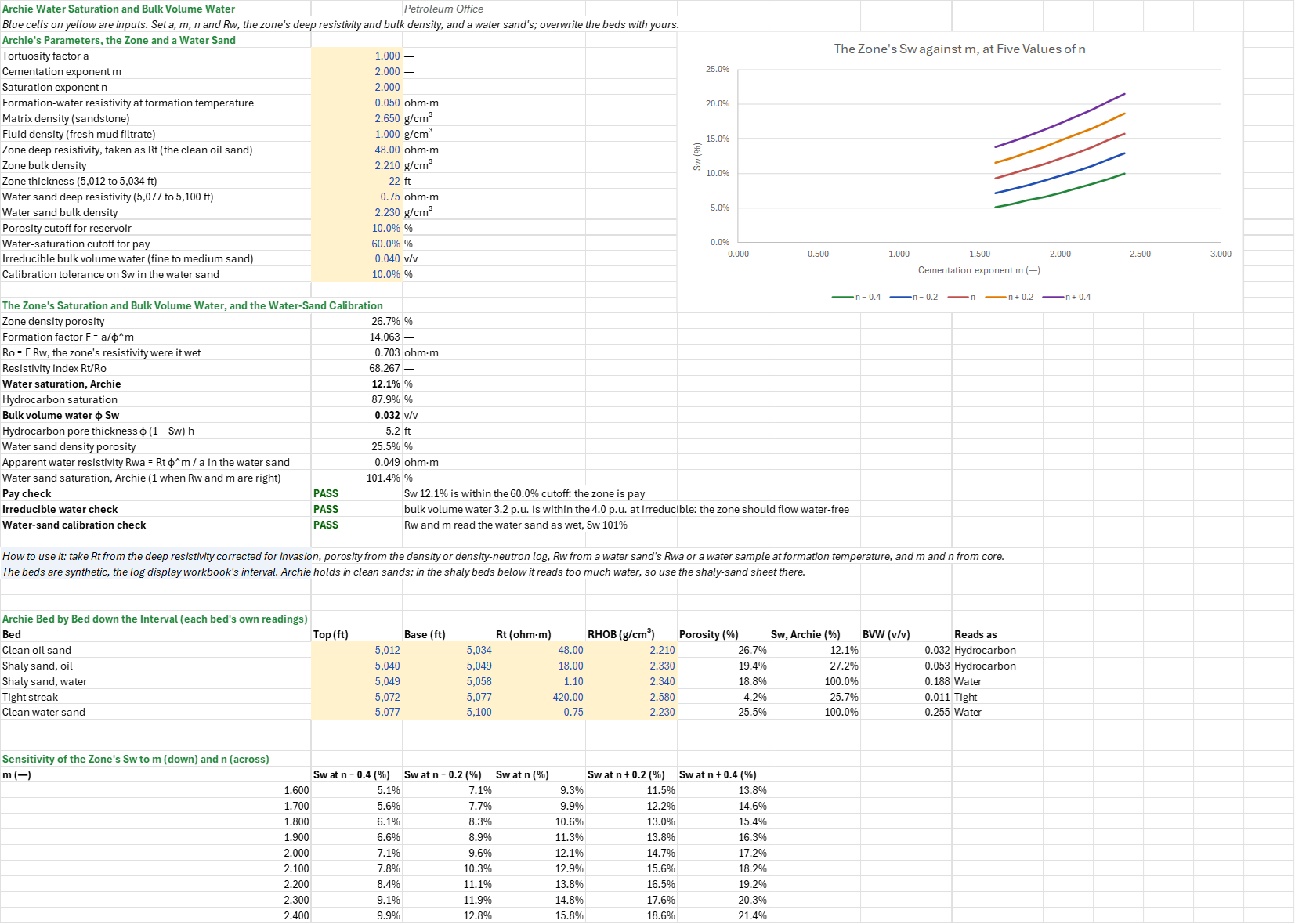
How much of a clean zone's pore space holds hydrocarbon, and will it flow water? You enter the zone's deep resistivity, bulk density and thickness, Archie's a, m, n and Rw, a clean water sand's readings and the beds of the interval. You read off the zone's porosity, Sw, bulk volume water against its irreducible value and hydrocarbon pore thickness, the water sand's Rwa as a check on Rw and m, Archie bed by bed, and how far Sw moves with m and n.
Parameters:
- Archie: the tortuosity factor
SA_a, the cementation exponentSA_m, the saturation exponentSA_n, and the formation-water resistivity at formation temperatureSA_Rw(ohm·m) - Matrix and fluid:
SA_RhoMa,SA_RhoF(g/cm³) - Zone: its deep resistivity
SA_Rt(ohm·m), bulk densitySA_RhoB(g/cm³) and thicknessSA_H(ft) - Water sand: its deep resistivity
SA_RtW(ohm·m) and bulk densitySA_RhoBW(g/cm³) - Cutoffs and limits: the porosity cutoff
SA_PhiCut, the Sw cutoffSA_SwCut, the bulk volume water at irreducible saturationSA_BvwIrr(v/v) and the calibration toleranceSA_Tol - Beds: each bed's top, base, deep resistivity and bulk density in the beds table
How to use it: The beds are synthetic. Take Rt from the deep resistivity corrected for invasion, porosity from the density or density-neutron log, and Rw from a water sand's Rwa or a produced-water sample corrected to formation temperature. Take a, m and n from core, and the irreducible bulk volume water from the zone's grain size or capillary-pressure data. Put a clean water sand on the same log in the water-sand cells: its Rwa should be Rw and its Archie Sw 100%. Archie holds in clean sands; in the shaly beds use the Shaly-Sand Water Saturation sheet.
Method:
- Porosity and Archie. φ = (ρma − ρb) / (ρma − ρf), the density porosity. The formation factor is F = a / φ^m, Ro = F Rw is the zone's resistivity if it were wet, and the resistivity index is Rt/Ro. Archie: Sw = (a Rw / (φ^m Rt))^(1/n), which is (Ro/Rt)^(1/n). The hydrocarbon saturation is 1 − Sw, the bulk volume water φ Sw and the hydrocarbon pore thickness φ (1 − Sw) h.
- Water sand. In the water sand Rwa = Rt φ^m / a, which is Rw when the sand is wet and the exponents are right.
- Beds. The beds table puts each bed's own readings through the same equations, with Sw shown at most 1. A bed below the porosity cutoff is tight; otherwise it reads as hydrocarbon at or below the Sw cutoff and as water above it.
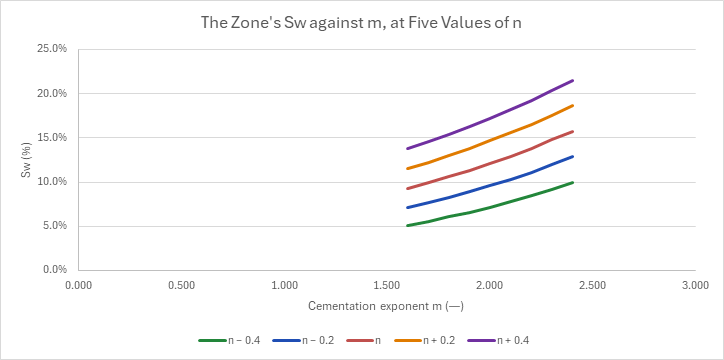
- Sweep. The sweep of the zone's Sw, drawn as a chart, runs m from 0.4 below to 0.4 above its input in steps of 0.1, at n from 0.4 below to 0.4 above its input in steps of 0.2.
- Checks. The pay check fails when the zone's porosity is below the reservoir cutoff or its Sw is above the pay cutoff. The irreducible water check warns when the bulk volume of water is above the value at irreducible saturation, where the zone will make some water. The calibration check warns when the water sand does not read wet within the tolerance.
Example: The default case is the Well-Log Display workbook's synthetic interval, 5,000 to 5,120 ft, at each bed's own readings without the log's ripple. The zone is the clean oil sand, 5,012 to 5,034 ft: 48 ohm·m and 2.21 g/cm³. The water sand is 5,077 to 5,100 ft: 0.75 ohm·m and 2.23 g/cm³. Archie's a, m and n are 1, 2 and 2, and Rw is the workbook's 0.05 ohm·m at formation temperature, with a 2.65 g/cm³ sandstone matrix and 1.0 g/cm³ filtrate. The cutoffs are the workbook's, 10% porosity and 60% Sw. A fine-to-medium sand is at irreducible water at a bulk volume water of about 0.04.
The oil sand's porosity is (2.65 − 2.21) / 1.65 = 26.7%, so F = 1 / 0.2667² = 14.06 and Ro = 0.703 ohm·m. At 48 ohm·m the resistivity index is 68.3 and Sw = √(1/68.3) = 12.1%, a hydrocarbon saturation of 87.9%. The bulk volume water is 0.032, under the 0.04 at irreducible, so the zone should flow water-free. Over the 22 ft the hydrocarbon pore thickness is 0.2667 × 0.879 × 22 = 5.16 ft. The water sand's porosity is 25.5%; its Rwa is 0.75 × 0.2545² = 0.0486 ohm·m, so Archie reads it 101% wet, within the calibration tolerance. Down the interval the shaly oil sand reads 27.2% water by Archie, which the Shaly-Sand Water Saturation sheet shows is too high. The tight streak reads 4.2% porosity, below the cutoff. In the sweep, m = 2.2 at n = 2 gives 13.8%, and m = 2.4 at n = 2.4 gives 21.4%. Put the shaly sand's 18 ohm·m and 2.33 g/cm³ in as the zone and its bulk volume water is 0.053, above irreducible: the check warns. The shaly water sand's 1.1 ohm·m and 2.34 g/cm³ read 113% water, so the pay check fails. An Rw of 0.08 ohm·m makes the water sand read 128% wet: the calibration check warns. The tight streak's 2.58 g/cm³ fails the porosity cutoff.
Functions used
None: the blueprint calculates with Excel's own functions.
Names (39)
| Name | Refers to | Comment |
|---|---|---|
PO.PP.Porosity.FromDensityLAMBDA |
=LAMBDA(Rho_ma, Rho_b, Rho_f, (Rho_ma-Rho_b)/(Rho_ma-Rho_f)) |
Porosity from a density log, (matrix density - bulk density) / (matrix density - fluid density). |
PO.PP.F.ArchieLAMBDA |
=LAMBDA(a, Phi, m, a/Phi^m) |
Archie formation factor, F = a / phi^m. |
PO.PP.Sw.ArchieLAMBDA |
=LAMBDA(a, m, n, Phi, Rw, Rt, ((a/Phi^m)*(Rw/Rt))^(1/n)) |
Water saturation from the general Archie equation, Sw = ((a/phi^m)*(Rw/Rt))^(1/n). |
SA_a |
$B$4 |
Tortuosity factor a |
SA_m |
$B$5 |
Cementation exponent m |
SA_n |
$B$6 |
Saturation exponent n |
SA_Rw |
$B$7 |
Formation-water resistivity at formation temperature, ohm·m |
SA_RhoMa |
$B$8 |
Matrix density (sandstone), g/cm³ |
SA_RhoF |
$B$9 |
Fluid density (fresh mud filtrate), g/cm³ |
SA_Rt |
$B$10 |
Zone deep resistivity, taken as Rt (the clean oil sand), ohm·m |
SA_RhoB |
$B$11 |
Zone bulk density, g/cm³ |
SA_H |
$B$12 |
Zone thickness (5,012 to 5,034 ft), ft |
SA_RtW |
$B$13 |
Water sand deep resistivity (5,077 to 5,100 ft), ohm·m |
SA_RhoBW |
$B$14 |
Water sand bulk density, g/cm³ |
SA_PhiCut |
$B$15 |
Porosity cutoff for reservoir, % |
SA_SwCut |
$B$16 |
Water-saturation cutoff for pay, % |
SA_BvwIrr |
$B$17 |
Irreducible bulk volume water (fine to medium sand), v/v |
SA_Tol |
$B$18 |
Calibration tolerance on Sw in the water sand, % |
SA_Inputs |
$B$4:$B$18 |
Archie's a, m and n, Rw, the matrix and fluid density, the zone's Rt, bulk density and thickness, the water sand's Rt and bulk density, the cutoffs, the irreducible bulk volume water and the calibration tolerance |
SA_Phi |
$B$21 |
Zone density porosity, % |
SA_FF |
$B$22 |
Formation factor F = a/φ^m |
SA_Ro |
$B$23 |
Ro = F Rw, the zone's resistivity were it wet, ohm·m |
SA_RI |
$B$24 |
Resistivity index Rt/Ro |
SA_Sw |
$B$25 |
Water saturation, Archie, % |
SA_Shc |
$B$26 |
Hydrocarbon saturation, % |
SA_BVW |
$B$27 |
Bulk volume water φ Sw, v/v |
SA_HCPT |
$B$28 |
Hydrocarbon pore thickness φ (1 − Sw) h, ft |
SA_PhiW |
$B$29 |
Water sand density porosity, % |
SA_Rwa |
$B$30 |
Apparent water resistivity Rwa = Rt φ^m / a in the water sand, ohm·m |
SA_SwW |
$B$31 |
Water sand saturation, Archie (1 when Rw and m are right), % |
SA_PayCheck |
$B$32 |
Pay check verdict |
SA_PayCheckNote |
$C$32 |
Pay check comment |
SA_BvwCheck |
$B$33 |
Irreducible water check verdict |
SA_BvwCheckNote |
$C$33 |
Irreducible water check comment |
SA_RwCheck |
$B$34 |
Water-sand calibration check verdict |
SA_RwCheckNote |
$C$34 |
Water-sand calibration check comment |
SA_Results |
$B$21:$B$34 |
The zone's porosity, formation factor, Ro, resistivity index, Archie Sw, hydrocarbon saturation, bulk volume water and hydrocarbon pore thickness, the water sand's porosity, Rwa and Sw, and the three checks |
SA_Beds |
$A$42:$I$46 |
Each bed's top, base, deep resistivity and bulk density, its density porosity, Archie Sw (at most 1), bulk volume water and what it reads as |
SA_Curve |
$A$51:$F$59 |
The zone's Archie Sw for each m from 0.4 below to 0.4 above the input, at n from 0.4 below to 0.4 above its input |
Details
| Inserts | 59 rows × 9 columns |
| Category | Petrophysics |
| For agents and tools | Descriptor (.md) |