Saturation-Height Function by Leverett J
Description
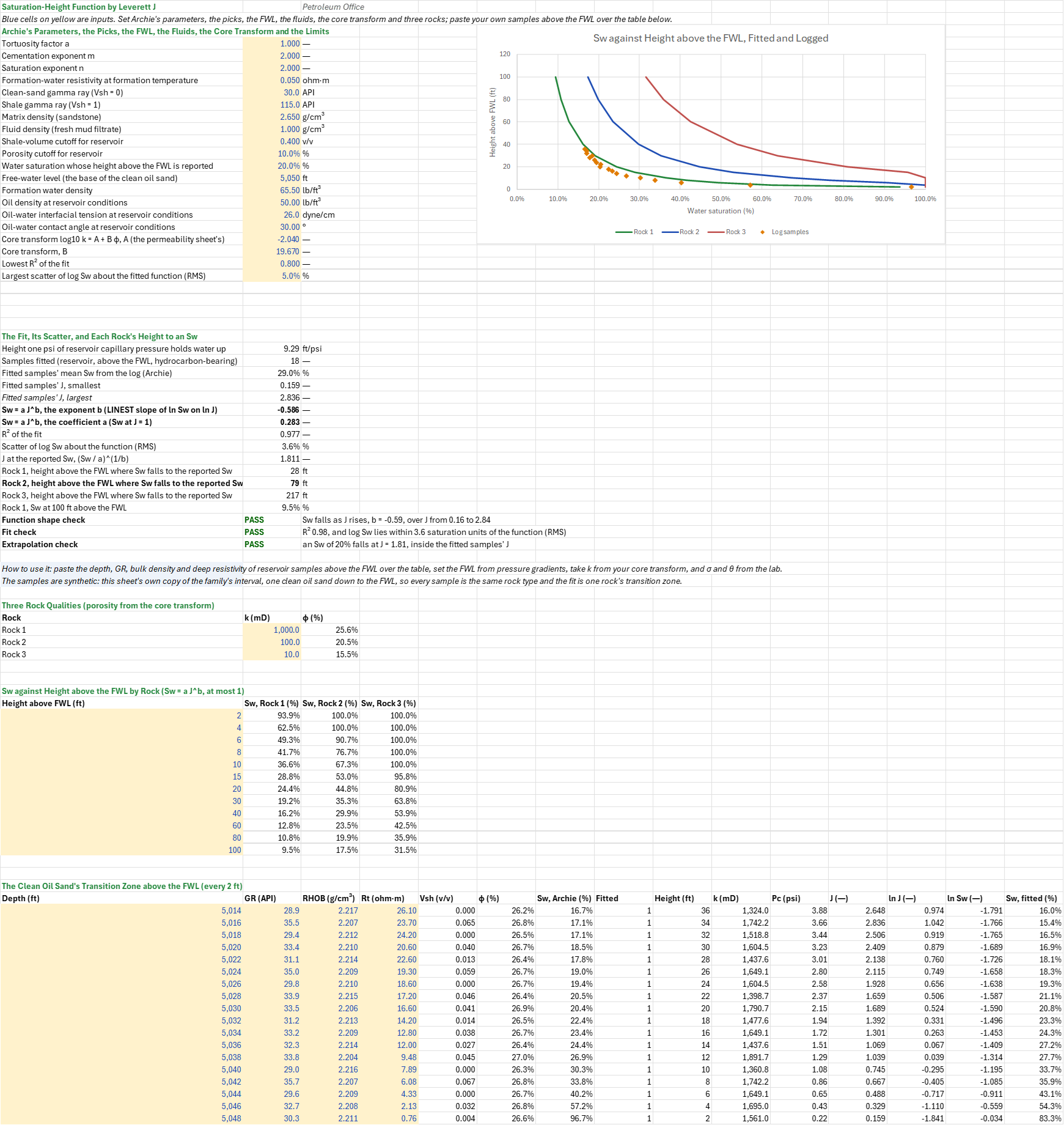
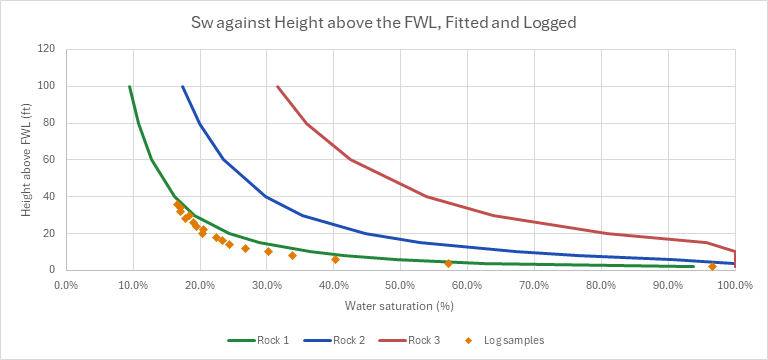
What water saturation does each rock hold at each height above the free-water level, between wells and in a model where there is no log? You enter log samples above the FWL, Archie's parameters, the FWL, the fluid densities, interfacial tension and contact angle, a core poro-perm transform and three rock permeabilities. You read off a power-law Leverett-J function fitted to the log's own Sw, Sw against height above the FWL for each rock, and each rock's height to a chosen Sw.
Parameters:
- Archie and picks:
SH_a,SH_m,SH_n,SH_Rw(ohm·m),SH_GRcl,SH_GRsh(API),SH_RhoMa,SH_RhoF(g/cm³), and the reservoir cutoffsSH_VshCutandSH_PhiCut - Sw reported: the water saturation
SH_SwHwhose height above the FWL each rock reaches - Contact and fluids: the free-water level
SH_FWL(ft), the water and oil densitiesSH_RhoW,SH_RhoO(lb/ft³), and the oil-water interfacial tensionSH_Ift(dyne/cm) and contact angleSH_Theta(°) at reservoir conditions - Core transform: log10 k =
SH_PermA+SH_PermBφ, from the Permeability from Logs sheet - Limits:
SH_R2Minand the largest scatterSH_SwTol - Rocks and samples: the three rocks' permeability in the rock table, and each sample's depth, GR, bulk density and deep resistivity in the sample table
How to use it: The samples are synthetic. Paste reservoir samples above the FWL from your wells over the sample table: depth, GR, bulk density and deep resistivity. Set the FWL from pressure gradients, not from the deepest oil on the log. Take the permeability from your core transform or the Permeability from Logs sheet, and σ and θ from the lab at reservoir conditions. Fit one rock type at a time. The chart draws the three rocks' curves, Sw from 2 to 100 ft above the FWL, over the log's samples: read the height a rock reaches a given Sw from its curve, and use the function only inside the J the samples span.
Method:
- Height to capillary pressure. Each reservoir sample above the FWL has a height, h = FWL − depth, and that height is a reservoir capillary pressure. One psi of reservoir capillary pressure holds water up 144 / (ρw − ρo) ft (the capillary-pressure-to-height conversion at 1 psi, with the reservoir's σ cos θ in both places), so Pc = h / that.
- Leverett J. J = 0.2166 Pc / (σ cos θ) √(k/φ), with Pc in psi, σ in dyne/cm and k in mD. The sample's φ is the density porosity, its k = 10^(A + B φ) from the core transform, and its Sw is Archie's, at most 1.
- The fit. A sample is fitted when it is reservoir by Vsh and porosity, above the FWL and below Sw = 1.
LINESTof ln Sw on ln J over those gives b, the slope, and ln a, the intercept, of the power law Sw = a J^b, with RSQ for R². The scatter is the RMS of the fitted Sw less the log's. - Rocks. A rock's φ is (log10 k − A)/B, and its Sw at a height is a J^b at that height's J, at most 1. The J at the reported Sw is (Sw / a)^(1/b); the Leverett capillary pressure turns that J into the rock's Pc, and the capillary-pressure-to-height conversion turns the Pc into its height.
- Checks. The shape check fails when Sw does not fall as J rises, which means the samples are not one rock's transition or the FWL is wrong. The fit check warns when the R² is below the limit or the log Sw scatters about the function by more than the limit. The extrapolation check warns when the chosen Sw falls outside the J the samples span.
Example: The default case is this sheet's own copy of the petrophysics family's synthetic interval, one clean oil sand whose base is the free-water level at 5,050 ft, so the sand carries a real transition zone and every sample is the same rock type. The samples are that sand, 5,014 to 5,048 ft, every 2 ft: eighteen samples, a foot inside the sand's top and a foot above the FWL. The transition zone is generated from the Brooks–Corey (Corey) saturation–capillary-pressure relation written in the Leverett J, Se(J) = min(1, (Jd/J)^λ) and Sw = Swirr + (1 − Swirr)·Se, with the irreducible water saturation Swirr = 0.12, the pore-size distribution index λ = 1.0 and the entry Leverett J, Jd = 0.16; the sand reads 32 API and 2.21 g/cm³, and each sample's deep resistivity is Archie inverted from the zone's Sw, so the sheet reads the zone back out of the log. Archie's a, m and n are 1, 2 and 2 with Rw 0.05 ohm·m, as on the Archie Water Saturation and Bulk Volume Water sheet. The water is 65.5 lb/ft³ and the oil 50 lb/ft³, with 26 dyne/cm and 30° between them. The core transform is the Permeability from Logs sheet's, log10 k = −2.04 + 19.67 φ. The rocks are 1,000, 100 and 10 mD, and the height is reported at 20% Sw.
One psi holds water up 144 / 15.5 = 9.29 ft. All eighteen samples are fitted: one clean sand, one rock type. Their mean Sw is 29.0% and their J runs from 0.159, at 5,048 ft, 2 ft above the FWL, to 2.836 at 5,014 ft, 36 ft above it. The fit is Sw = 0.2832 J^−0.5859 at an R² of 0.977, with the log Sw within 3.6 saturation units of it. The transition zone is the sand's 34 ft above the FWL: Sw falls from 96.6% two feet above the water level to 16.6% at 5,030 ft, where it is near the irreducible 12% the shape flattens to, and the deep resistivity falls with it, from 26 ohm·m at the top of the sand to 0.76 ohm·m at the FWL. At 20% Sw, J is 1.81, inside the samples' range. Rock 1, 1,000 mD at 25.6% porosity, reaches it 28.0 ft above the FWL; Rock 2, 100 mD at 20.5%, at 79.3 ft, and rock 3, 10 mD at 15.5%, at 217.4 ft: the J function's reach, a poorer rock holding far more water at the same height. Rock 1 holds 9.5% water at 100 ft. Report the height to 90% Sw and its J of 0.139 lies below the samples', so the extrapolation check warns; 50% Sw, at J 0.38, still falls inside.
Functions used
PO.SCAL.Leverett.Pc(J, K, porosity, IFT, theta)
Capillary pressure from J-function, [psi]. Pc = J × σcosθ × √(φ/k).
PO.SCAL.Leverett.J(Pc, K, porosity, IFT, theta)
Leverett J-function, [dimensionless]. J = (Pc/σcosθ) × √(k/φ).
Names (49)
| Name | Refers to | Comment |
|---|---|---|
PO.PP.Vsh.GammaRayIndexLAMBDA |
=LAMBDA(GR, GR_cl, GR_sh, (GR-GR_cl)/(GR_sh-GR_cl)) |
Linear gamma-ray shale index, IGR = (GR - GRclean) / (GRshale - GRclean). |
PO.PP.Porosity.FromDensityLAMBDA |
=LAMBDA(Rho_ma, Rho_b, Rho_f, (Rho_ma-Rho_b)/(Rho_ma-Rho_f)) |
Porosity from a density log, (matrix density - bulk density) / (matrix density - fluid density). |
PO.PP.Sw.ArchieLAMBDA |
=LAMBDA(a, m, n, Phi, Rw, Rt, ((a/Phi^m)*(Rw/Rt))^(1/n)) |
Water saturation from the general Archie equation, Sw = ((a/phi^m)*(Rw/Rt))^(1/n). |
PO.SCAL.PcToHeightLAMBDA |
=LAMBDA(Pc, ift_lab, theta_lab, ift_res, theta_res, rho_w, rho_o, LET(lab_term, ift_lab*COS(RADIANS(theta_lab)), res_term, ift_res*COS(RADIANS(theta_res)), drho, rho_w-rho_o, IF(OR(drho<=0, lab_term<=0, res_term<0), NA(), 144*Pc*res_term/lab_term/drho))) |
Height above the free water level of a laboratory capillary pressure: Pc_res = Pc·(σcosθ)res/(σcosθ)lab, h = 144·Pc_res/(ρw − ρo); #N/A when ρw ≤ ρo, [ft]. |
SH_a |
$B$4 |
Tortuosity factor a |
SH_m |
$B$5 |
Cementation exponent m |
SH_n |
$B$6 |
Saturation exponent n |
SH_Rw |
$B$7 |
Formation-water resistivity at formation temperature, ohm·m |
SH_GRcl |
$B$8 |
Clean-sand gamma ray (Vsh = 0), API |
SH_GRsh |
$B$9 |
Shale gamma ray (Vsh = 1), API |
SH_RhoMa |
$B$10 |
Matrix density (sandstone), g/cm³ |
SH_RhoF |
$B$11 |
Fluid density (fresh mud filtrate), g/cm³ |
SH_VshCut |
$B$12 |
Shale-volume cutoff for reservoir, v/v |
SH_PhiCut |
$B$13 |
Porosity cutoff for reservoir, % |
SH_SwH |
$B$14 |
Water saturation whose height above the FWL is reported, % |
SH_FWL |
$B$15 |
Free-water level (the base of the clean oil sand), ft |
SH_RhoW |
$B$16 |
Formation water density, lb/ft³ |
SH_RhoO |
$B$17 |
Oil density at reservoir conditions, lb/ft³ |
SH_Ift |
$B$18 |
Oil-water interfacial tension at reservoir conditions, dyne/cm |
SH_Theta |
$B$19 |
Oil-water contact angle at reservoir conditions, ° |
SH_PermA |
$B$20 |
Core transform log10 k = A + B φ, A (the permeability sheet's) |
SH_PermB |
$B$21 |
Core transform, B |
SH_R2Min |
$B$22 |
Lowest R² of the fit |
SH_SwTol |
$B$23 |
Largest scatter of log Sw about the fitted function (RMS), % |
SH_Inputs |
$B$4:$B$23 |
Archie's a, m, n and Rw, the gamma-ray picks, the matrix and fluid densities, the cutoffs, the Sw reported, the free-water level, the water and oil densities, the oil-water interfacial tension and contact angle, the core transform and the check limits |
SH_HPerPsi |
$B$29 |
Height one psi of reservoir capillary pressure holds water up, ft/psi |
SH_NFit |
$B$30 |
Samples fitted (reservoir, above the FWL, hydrocarbon-bearing) |
SH_MeanSw |
$B$31 |
Fitted samples' mean Sw from the log (Archie), % |
SH_JMin |
$B$32 |
Fitted samples' J, smallest |
SH_JMax |
$B$33 |
Fitted samples' J, largest |
SH_b |
$B$34 |
Sw = a J^b, the exponent b (LINEST slope of ln Sw on ln J) |
SH_aJ |
$B$35 |
Sw = a J^b, the coefficient a (Sw at J = 1) |
SH_R2 |
$B$36 |
R² of the fit |
SH_Rms |
$B$37 |
Scatter of log Sw about the function (RMS), % |
SH_JH |
$B$38 |
J at the reported Sw, (Sw / a)^(1/b) |
SH_H1 |
$B$39 |
Rock 1, height above the FWL where Sw falls to the reported Sw, ft |
SH_H2 |
$B$40 |
Rock 2, height above the FWL where Sw falls to the reported Sw, ft |
SH_H3 |
$B$41 |
Rock 3, height above the FWL where Sw falls to the reported Sw, ft |
SH_Sw100 |
$B$42 |
Rock 1, Sw at 100 ft above the FWL, % |
SH_ShapeCheck |
$B$43 |
Function shape check verdict |
SH_ShapeCheckNote |
$C$43 |
Function shape check comment |
SH_FitCheck |
$B$44 |
Fit check verdict |
SH_FitCheckNote |
$C$44 |
Fit check comment |
SH_RangeCheck |
$B$45 |
Extrapolation check verdict |
SH_RangeCheckNote |
$C$45 |
Extrapolation check comment |
SH_Results |
$B$29:$B$45 |
The height per psi, the samples fitted, their mean Sw and J range, the power law's b, a and R², its scatter, J at the reported Sw and each rock's height to it, rock 1's Sw at 100 ft, and three checks |
SH_Rocks |
$A$52:$C$54 |
Each rock's name, permeability and the porosity the core transform gives it |
SH_Curve |
$A$59:$D$70 |
Heights above the free-water level and the fitted Sw of each rock at them |
SH_Samples |
$A$75:$O$92 |
Each sample's depth, GR, bulk density and deep resistivity, its Vsh, porosity, Archie Sw and fit flag, its height above the FWL, k, reservoir Pc and J, ln J, ln Sw and the fitted Sw |
Details
| Inserts | 92 rows × 15 columns |
| Category | Petrophysics |
| For agents and tools | Descriptor (.md) |