Net Pay and Cutoffs over an Interval
Description
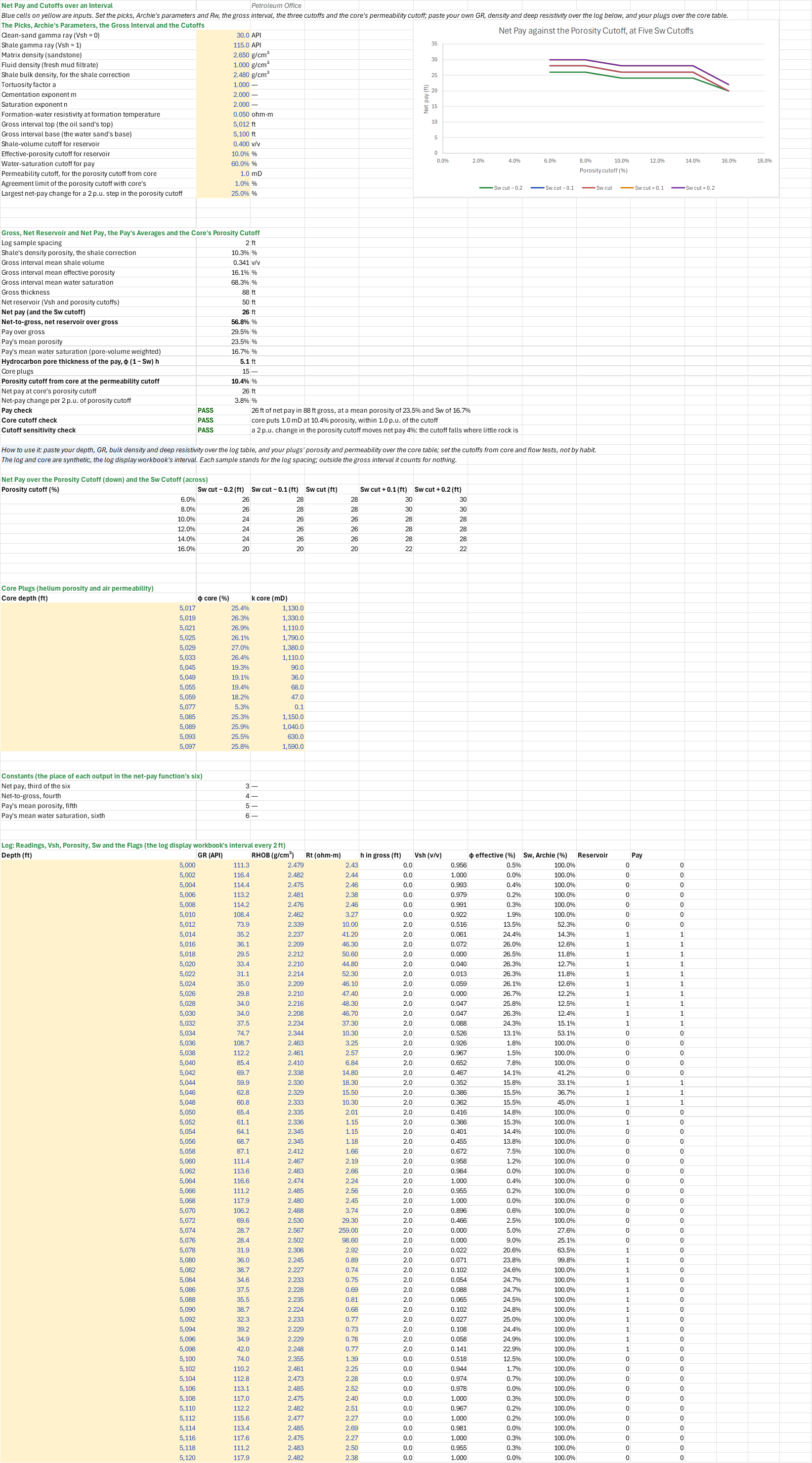
How much of the interval is reservoir, how much of it is pay, and how much does that depend on where the cutoffs sit? You enter a log of gamma ray, bulk density and deep resistivity, the picks and Archie's parameters, the gross interval, the Vsh, porosity and Sw cutoffs, and core plugs with a permeability cutoff. You read off the net reservoir, the net pay, the net-to-gross, the pay's mean porosity and Sw, its hydrocarbon pore thickness, the porosity cutoff core supports, and net pay over a range of cutoffs.
Parameters:
- Picks and rock: the clean and shale gamma ray
NP_GRcl,NP_GRsh(API), the matrix, fluid and shale densitiesNP_RhoMa,NP_RhoF,NP_RhoSh(g/cm³) - Archie:
NP_a,NP_m,NP_nandNP_Rw(ohm·m at formation temperature) - Gross interval: its top
NP_Topand baseNP_Base(ft) - Cutoffs:
NP_VshCut(v/v),NP_PhiCutandNP_SwCut, and the core permeability cutoffNP_KCut(mD) - Limits: the agreement with core
NP_CutTol(porosity) and the largest net-pay changeNP_SensMax - Log and core: each depth's GR, bulk density and deep resistivity in the log table, and each plug's depth, porosity and permeability in the core table
How to use it: The log and the core are synthetic. Paste your depth, GR, bulk density and deep resistivity over the log table, and your routine-core porosity and permeability over the core table. Set the cutoffs from core and flow tests, and the permeability cutoff from the lowest permeability that has flowed in this field. Where a shaly-sand model reads the shaly beds better than Archie, compute Sw with it and paste the Sw column in. Read the core check before trusting the porosity cutoff, and the sensitivity check before quoting net pay to the foot: when a 2 p.u. step in the porosity cutoff moves net pay by more than the limit, much rock sits near the cutoff.
Method:
- Curves. At every log sample the sheet works out three curves: the shale volume from the linear gamma-ray index, the density porosity corrected for shale, and Archie's water saturation on it. Vsh is the gamma-ray index (GR − GRcl)/(GRsh − GRcl), kept between 0 and 1. The effective porosity is the density porosity (ρma − ρb)/(ρma − ρf) less Vsh times the shale's density porosity, at least 0. Sw is Archie's (a Rw / (φ^m Rt))^(1/n) on it, at most 1.
- Sums. Each sample stands for the log spacing h inside the gross interval and for nothing outside it. A sample is reservoir when Vsh ≤ the Vsh cutoff and φ ≥ the porosity cutoff, and pay when also Sw ≤ the Sw cutoff. The net-pay function sums the gross Σ h, the net reservoir Σ h over reservoir, and the net pay Σ h over pay. The net-to-gross is the net reservoir over the gross. The pay's porosity is Σ h φ / Σ h over pay, and its Sw is Σ h φ Sw / Σ h φ over pay. The sheet adds the hydrocarbon pore thickness, net pay × φ × (1 − Sw).
- Porosity cutoff from core. log10 k = A + B φ is fitted by least squares over the plugs, and the porosity cutoff is the porosity at the permeability cutoff, (log10 kcut − A)/B.
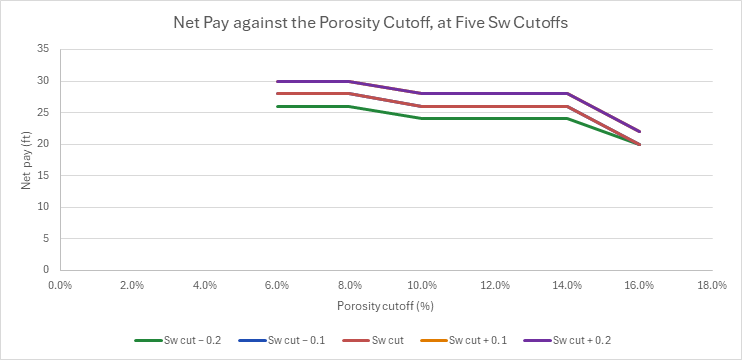
- Sensitivity. A table works out net pay over porosity cutoffs from 4 p.u. below to 6 p.u. above the input, at Sw cutoffs 0.2 either side of its input, and the chart draws it. The sensitivity is the net pay at the porosity cutoff 2 p.u. below less that at 2 p.u. above, halved and over the net pay.
- Checks. The pay check fails when no sample passes all three cutoffs. The core cutoff check warns when core's porosity cutoff differs from the one used by more than the limit, and gives the net pay at core's. The sensitivity check warns when the sensitivity is above the limit.
Example: The default case is the Well-Log Display workbook's synthetic interval, 5,000 to 5,120 ft, every 2 ft, with its picks of 30 and 115 API, Rw of 0.05 ohm·m and cutoffs of 0.40 Vsh, 10% porosity and 60% Sw. The gross interval runs from the oil sand's top at 5,012 ft to the water sand's base at 5,100 ft. Archie's a, m and n are 1, 2 and 2, and the shale's 2.48 g/cm³ makes the shale correction. The core is the interval's fifteen synthetic plugs, and the permeability cutoff is 1 mD.
The gross interval holds 44 samples, 88 ft. The shale's density porosity is (2.65 − 2.48)/1.65 = 10.3%. Over the gross the thickness-weighted Vsh is 0.341, the porosity 16.1% and the Sw 68.3%. Twenty-five samples, 50 ft, pass the Vsh and porosity cutoffs: a net-to-gross of 56.8%. The oil sand's ten and the shaly sand's three oil-bearing samples also pass the Sw cutoff, so the net pay is 26 ft, 29.5% of the gross. Its mean porosity is 23.5% and its Sw 16.7%, a hydrocarbon pore thickness of 26 × 0.2349 × 0.8333 = 5.09 ft. Core puts 1 mD at 10.4% porosity, within 1 p.u. of the 10% cutoff, and net pay at core's cutoff is the same 26 ft. A 2 p.u. step in the porosity cutoff moves net pay 4%: the beds are either well above or well below it. A 40% Sw cutoff drops the shaly sand's wettest sample and gives 24 ft. A 16% porosity cutoff drops the shaly sand's samples and leaves 20 ft, and the core check warns. A 10 mD permeability cutoff puts core's porosity cutoff at 15.5%, and the core check warns. A 5% Sw cutoff leaves no pay, and the pay check fails.
Functions used
None: the blueprint calculates with Excel's own functions.
Names (54)
| Name | Refers to | Comment |
|---|---|---|
PO.PP.Vsh.GammaRayIndexLAMBDA |
=LAMBDA(GR, GR_cl, GR_sh, (GR-GR_cl)/(GR_sh-GR_cl)) |
Linear gamma-ray shale index, IGR = (GR - GRclean) / (GRshale - GRclean). |
PO.PP.Porosity.FromDensityLAMBDA |
=LAMBDA(Rho_ma, Rho_b, Rho_f, (Rho_ma-Rho_b)/(Rho_ma-Rho_f)) |
Porosity from a density log, (matrix density - bulk density) / (matrix density - fluid density). |
PO.PP.Sw.ArchieLAMBDA |
=LAMBDA(a, m, n, Phi, Rw, Rt, ((a/Phi^m)*(Rw/Rt))^(1/n)) |
Water saturation from the general Archie equation, Sw = ((a/phi^m)*(Rw/Rt))^(1/n). |
PO.PP.Pay.NetPayLAMBDA |
=LAMBDA(H, Vsh, PhiEff_frac, Sw, Vsh_cut, Phi_cut, Sw_cut, LET(res, (Vsh<=Vsh_cut)*(PhiEff_frac>=Phi_cut), pay, res*(Sw<=Sw_cut), gross, SUM(H), net, SUM(H*res), np, SUM(H*pay), hp, SUM(H*PhiEff_frac*pay), HSTACK(gross, net, np, net/gross, IF(np>0, hp/np, 0), IF(hp>0, SUM(H*PhiEff_frac*Sw*pay)/hp, 0)))) |
Net reservoir and net pay over an interval from Vsh, porosity and Sw cut-offs: {gross, net reservoir, net pay, net-to-gross, pay porosity, pay Sw}. |
PO.PP.Cutoff.PermFromCoreLAMBDA |
=LAMBDA(Phi_core, K_core, K_cut, LET(lk, LOG10(K_core), b, SLOPE(lk, Phi_core), (LOG10(K_cut)-INTERCEPT(lk, Phi_core))/b)) |
Porosity cut-off at a permeability cut-off, from a least-squares fit of log10(k) on porosity to core points. |
NP_GRcl |
$B$4 |
Clean-sand gamma ray (Vsh = 0), API |
NP_GRsh |
$B$5 |
Shale gamma ray (Vsh = 1), API |
NP_RhoMa |
$B$6 |
Matrix density (sandstone), g/cm³ |
NP_RhoF |
$B$7 |
Fluid density (fresh mud filtrate), g/cm³ |
NP_RhoSh |
$B$8 |
Shale bulk density, for the shale correction, g/cm³ |
NP_a |
$B$9 |
Tortuosity factor a |
NP_m |
$B$10 |
Cementation exponent m |
NP_n |
$B$11 |
Saturation exponent n |
NP_Rw |
$B$12 |
Formation-water resistivity at formation temperature, ohm·m |
NP_Top |
$B$13 |
Gross interval top (the oil sand's top), ft |
NP_Base |
$B$14 |
Gross interval base (the water sand's base), ft |
NP_VshCut |
$B$15 |
Shale-volume cutoff for reservoir, v/v |
NP_PhiCut |
$B$16 |
Effective-porosity cutoff for reservoir, % |
NP_SwCut |
$B$17 |
Water-saturation cutoff for pay, % |
NP_KCut |
$B$18 |
Permeability cutoff, for the porosity cutoff from core, mD |
NP_CutTol |
$B$19 |
Agreement limit of the porosity cutoff with core's, % |
NP_SensMax |
$B$20 |
Largest net-pay change for a 2 p.u. step in the porosity cutoff, % |
NP_Inputs |
$B$4:$B$20 |
The gamma-ray picks, the matrix, fluid and shale densities, Archie's a, m and n and Rw, the gross interval, the shale-volume, porosity and Sw cutoffs, the core permeability cutoff and the check limits |
NP_Step |
$B$25 |
Log sample spacing, ft |
NP_PhiSh |
$B$26 |
Shale's density porosity, the shale correction, % |
NP_GVsh |
$B$27 |
Gross interval mean shale volume, v/v |
NP_GPhi |
$B$28 |
Gross interval mean effective porosity, % |
NP_GSw |
$B$29 |
Gross interval mean water saturation, % |
NP_Gross |
$B$30 |
Gross thickness, ft |
NP_Net |
$B$31 |
Net reservoir (Vsh and porosity cutoffs), ft |
NP_Pay |
$B$32 |
Net pay (and the Sw cutoff), ft |
NP_NTG |
$B$33 |
Net-to-gross, net reservoir over gross, % |
NP_PayG |
$B$34 |
Pay over gross, % |
NP_PayPhi |
$B$35 |
Pay's mean porosity, % |
NP_PaySw |
$B$36 |
Pay's mean water saturation (pore-volume weighted), % |
NP_HCPT |
$B$37 |
Hydrocarbon pore thickness of the pay, φ (1 − Sw) h, ft |
NP_Plugs |
$B$38 |
Core plugs |
NP_PhiCore |
$B$39 |
Porosity cutoff from core at the permeability cutoff, % |
NP_PayCore |
$B$40 |
Net pay at core's porosity cutoff, ft |
NP_Sens |
$B$41 |
Net-pay change per 2 p.u. of porosity cutoff, % |
NP_PayCheck |
$B$42 |
Pay check verdict |
NP_PayCheckNote |
$C$42 |
Pay check comment |
NP_CoreCheck |
$B$43 |
Core cutoff check verdict |
NP_CoreCheckNote |
$C$43 |
Core cutoff check comment |
NP_SensCheck |
$B$44 |
Cutoff sensitivity check verdict |
NP_SensCheckNote |
$C$44 |
Cutoff sensitivity check comment |
NP_Results |
$B$25:$B$44 |
Sample spacing, shale porosity, the gross interval's mean Vsh, porosity and Sw, gross, net reservoir, net pay, net-to-gross, pay over gross, the pay's porosity, Sw and HC pore thickness, the core porosity cutoff and its net pay, sensitivity, three checks |
NP_Curve |
$A$51:$F$56 |
Net pay for each porosity cutoff from 4 p.u. below to 6 p.u. above the input, at Sw cutoffs from 0.2 below to 0.2 above its input |
NP_Core |
$A$62:$C$76 |
Each plug's core depth, helium porosity and air permeability |
NP_OutPay |
$B$80 |
Net pay, third of the six |
NP_OutNTG |
$B$81 |
Net-to-gross, fourth |
NP_OutPhi |
$B$82 |
Pay's mean porosity, fifth |
NP_OutSw |
$B$83 |
Pay's mean water saturation, sixth |
NP_Log |
$A$88:$J$148 |
Each depth's GR, bulk density and deep resistivity, the thickness it stands for in the gross interval, its Vsh, effective porosity and Archie Sw, and whether it is reservoir and pay |
Details
| Inserts | 148 rows × 10 columns |
| Category | Petrophysics |
| For agents and tools | Descriptor (.md) |