Permeability from Logs
Description
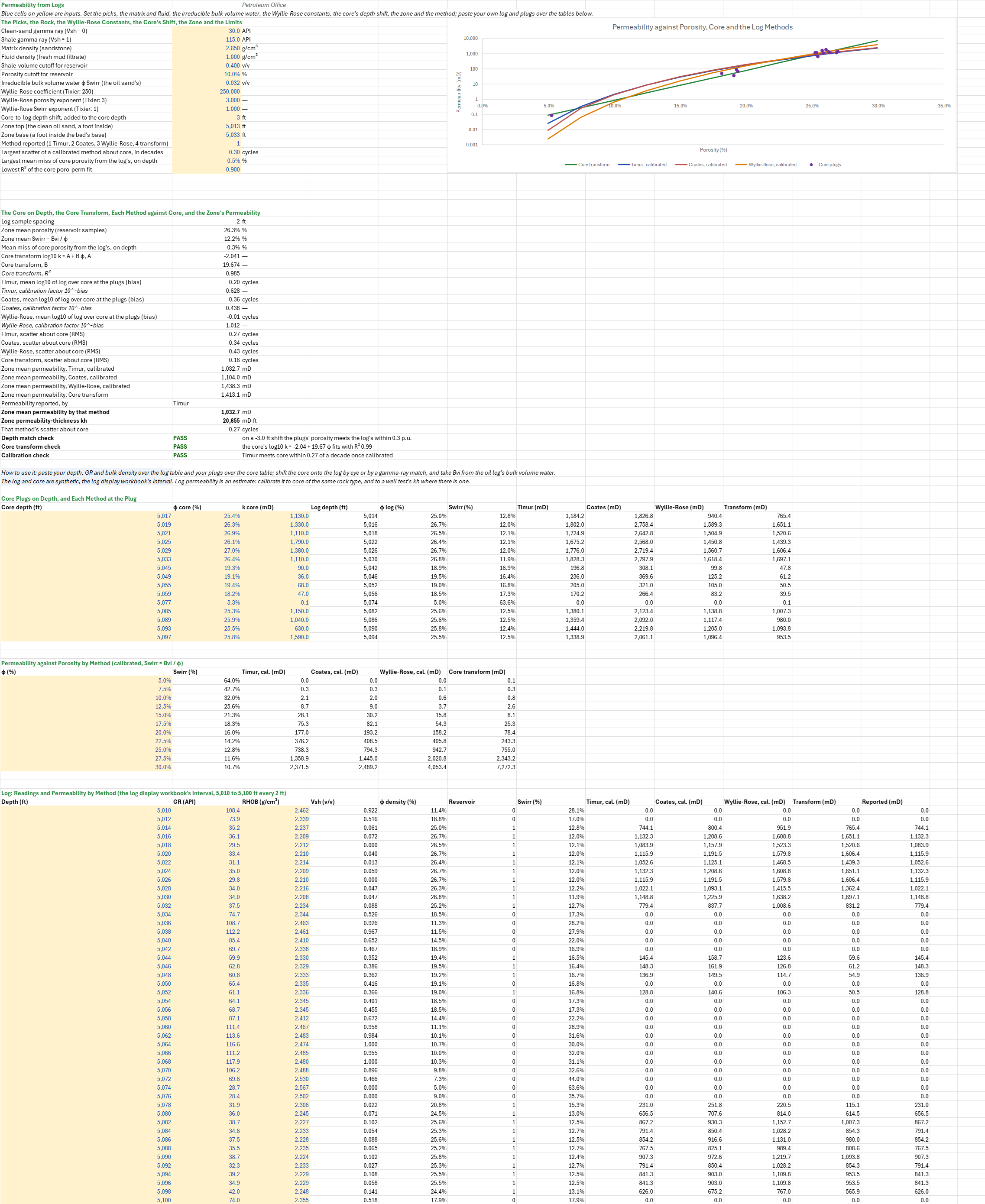
What is the zone's permeability, and how far can a log estimate of it be trusted? You enter a log of gamma ray and bulk density, the picks and cutoffs, the irreducible bulk volume water, core plugs with their core-to-log depth shift, and the zone. You read off permeability by Timur, Coates and Wyllie-Rose and by a core poro-perm transform, each method's bias and scatter about core once calibrated to it, and the zone's mean permeability and kh.
Parameters:
- Picks and rock:
PE_GRcl,PE_GRsh(API),PE_RhoMa,PE_RhoF(g/cm³), and the reservoir cutoffsPE_VshCutandPE_PhiCut - Irreducible water: the bulk volume water at irreducible saturation
PE_Bvi(v/v) - Wyllie-Rose: the coefficient
PE_WrC, the porosity exponentPE_WrPand the Swirr exponentPE_WrS - Core and zone: the core-to-log depth shift
PE_Shift(ft, added to the core depth), the zone topPE_ZTopand basePE_ZBase(ft), and the method reportedPE_Method(1 Timur, 2 Coates, 3 Wyllie-Rose, 4 core transform) - Limits: the scatter about core
PE_LogTol(decades), the porosity miss on depthPE_PhiToland the poro-perm fit'sPE_R2Min - Log and core: each depth's GR and bulk density in the log table, and each plug's core depth, porosity and permeability in the core table
How to use it: The log and the core are synthetic. Paste your depth, GR and bulk density over the log table, and your routine-core porosity and permeability over the core table at the core's depths. Shift the core onto the log by matching a core gamma or the porosity by eye; the sheet only checks the match. Take Bvi from the oil leg's bulk volume water well above the transition zone, or from NMR. Calibrate against core of the same rock type, and against a well test's kh where there is one. Pick the method to report from the calibration table: the smallest scatter about core, not the smallest bias.
Method:
- Porosity and Swirr. φ is the density porosity (ρma − ρb)/(ρma − ρf). Swirr is a constant irreducible bulk volume of water over porosity, Swirr = Bvi / φ, at most 1.
- The three forms. Timur: k = 0.136 φ^4.4 / Swirr^2, with φ and Swirr in percent. Coates: k = (100 φ² (1 − Swirr) / Swirr)². The general Wyllie-Rose form: k = (C φ^P / Swirr^Q)², by default with Tixier's constants, 250 φ³ / Swirr.
- The core transform. log10 k = A + B φ, the log-linear poro-perm transform fitted by least squares to the plugs' porosity and permeability, and applied to the log's porosity.
- Calibration. Each plug's log depth is its core depth plus the shift, and the log's porosity there is the sample at or above that depth. Each method is compared with the plugs on a log scale. Its bias is the mean of log10(k method / k core) over the plugs, its calibration factor 10^−bias, and its scatter √(mean (log10 ratio − bias)²), the RMS of what is left. The transform's scatter is about core with no bias removed.
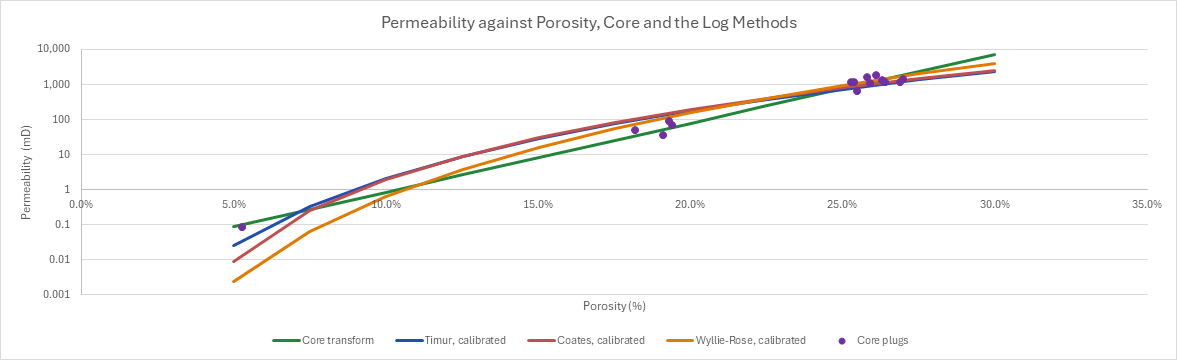
- The zone. The log's permeability is set to 0 outside reservoir. The zone's mean is over its reservoir samples, given by every method, calibrated, and by the one chosen, and kh is Σ k h over them. The chart draws permeability against porosity for the core plugs, the core transform and the three calibrated methods.
- Checks. The depth match check warns when the plugs' porosity misses the log's by more than the limit on the shift: the core is off depth. The core transform check warns when the poro-perm fit's R² is below the limit, a sign of several rock types. The calibration check warns when the chosen method still scatters about core by more than the limit after calibration.
Example: The default case is the Well-Log Display workbook's synthetic interval from 5,010 to 5,100 ft, every 2 ft, with its picks and cutoffs. The zone is the clean oil sand, 5,013 to 5,033 ft. The irreducible bulk volume water is 0.032, the oil sand's own φ Sw, and Wyllie-Rose takes Tixier's 250, 3 and 1. The core is the interval's fifteen synthetic plugs, marked 3 ft deeper than the log reads them, so the shift is −3 ft. Timur is reported, calibrated. The core may miss the log's porosity by half a porosity unit on depth, a calibrated method may scatter 0.3 of a decade about core, and the poro-perm fit needs an R² of 0.9.
On the −3 ft shift the plugs' porosity meets the log's within 0.3 porosity units on average. The core transform is log10 k = −2.04 + 19.67 φ at an R² of 0.985. At the plugs Timur reads 0.20 of a decade high, Coates 0.36 high and Wyllie-Rose 0.005 low. Their calibration factors are 0.628, 0.438 and 1.012, and calibrated, they scatter about core by 0.27, 0.34 and 0.43 of a decade. The transform scatters by 0.16. Wyllie-Rose has the smallest bias but the most scatter: it falls too steeply with porosity, too low in the tight streak and too high in the shaly sands. In the zone the porosity is 26.3% and Swirr 12.2%. Calibrated Timur gives 1,033 mD, Coates 1,104 mD and Wyllie-Rose 1,438 mD, and the transform 1,413 mD. The zone's kh by Timur is 20,655 mD·ft over 20 ft, and Timur meets core within 0.27 of a decade, inside the 0.3 allowed. With no shift the plugs miss the log's porosity by 0.9 porosity units on average, over the half unit allowed, and the depth check warns; the calibration made off depth gives the zone 923 mD by Timur. Reported by the core transform, the zone is 1,413 mD. Coates scatters 0.34 of a decade, over the 0.3 limit, and the calibration check warns.
Functions used
None: the blueprint calculates with Excel's own functions.
Names (59)
| Name | Refers to | Comment |
|---|---|---|
PO.PP.Vsh.GammaRayIndexLAMBDA |
=LAMBDA(GR, GR_cl, GR_sh, (GR-GR_cl)/(GR_sh-GR_cl)) |
Linear gamma-ray shale index, IGR = (GR - GRclean) / (GRshale - GRclean). |
PO.PP.Porosity.FromDensityLAMBDA |
=LAMBDA(Rho_ma, Rho_b, Rho_f, (Rho_ma-Rho_b)/(Rho_ma-Rho_f)) |
Porosity from a density log, (matrix density - bulk density) / (matrix density - fluid density). |
PO.PP.Perm.TimurLAMBDA |
=LAMBDA(Phi, Swirr, 0.136*(100*Phi)^4.4/(100*Swirr)^2) |
Timur (1968) permeability, k = 0.136 phi^4.4 / Swirr^2 with phi and Swirr in percent, mD (arguments as fractions). |
PO.PP.Perm.CoatesLAMBDA |
=LAMBDA(Phi, Swirr, 10000*Phi^4*((1-Swirr)/Swirr)^2) |
Coates free-fluid permeability, k = (100 phi^2 (1 - Swirr) / Swirr)^2, mD (fractions). |
PO.PP.Perm.WyllieRoseLAMBDA |
=LAMBDA(Phi, Swirr, Coef, Exp_Phi, Exp_Sw, Coef^2*Phi^(2*Exp_Phi)/Swirr^(2*Exp_Sw)) |
Wyllie-Rose (1950) general permeability form, k = (Coef phi^Exp_Phi / Swirr^Exp_Sw)^2, mD (fractions). |
PO.PP.Perm.PoroPermFitLAMBDA |
=LAMBDA(Phi_core, K_core, LET(lk, LOG10(K_core), HSTACK(INTERCEPT(lk, Phi_core), SLOPE(lk, Phi_core), RSQ(lk, Phi_core)))) |
Log-linear poro-perm transform fitted to core points, log10(k) = A + B phi: {A, B, R2}. |
PE_GRcl |
$B$4 |
Clean-sand gamma ray (Vsh = 0), API |
PE_GRsh |
$B$5 |
Shale gamma ray (Vsh = 1), API |
PE_RhoMa |
$B$6 |
Matrix density (sandstone), g/cm³ |
PE_RhoF |
$B$7 |
Fluid density (fresh mud filtrate), g/cm³ |
PE_VshCut |
$B$8 |
Shale-volume cutoff for reservoir, v/v |
PE_PhiCut |
$B$9 |
Porosity cutoff for reservoir, % |
PE_Bvi |
$B$10 |
Irreducible bulk volume water φ Swirr (the oil sand's), v/v |
PE_WrC |
$B$11 |
Wyllie-Rose coefficient (Tixier: 250) |
PE_WrP |
$B$12 |
Wyllie-Rose porosity exponent (Tixier: 3) |
PE_WrS |
$B$13 |
Wyllie-Rose Swirr exponent (Tixier: 1) |
PE_Shift |
$B$14 |
Core-to-log depth shift, added to the core depth, ft |
PE_ZTop |
$B$15 |
Zone top (the clean oil sand, a foot inside), ft |
PE_ZBase |
$B$16 |
Zone base (a foot inside the bed's base), ft |
PE_Method |
$B$17 |
Method reported (1 Timur, 2 Coates, 3 Wyllie-Rose, 4 transform) |
PE_LogTol |
$B$18 |
Largest scatter of a calibrated method about core, in decades, cycles |
PE_PhiTol |
$B$19 |
Largest mean miss of core porosity from the log's, on depth, % |
PE_R2Min |
$B$20 |
Lowest R² of the core poro-perm fit |
PE_Inputs |
$B$4:$B$20 |
The gamma-ray picks, matrix and fluid densities, the reservoir cutoffs, the irreducible bulk volume water, the Wyllie-Rose constants, the core's depth shift, the zone, the method reported and the check limits |
PE_Step |
$B$26 |
Log sample spacing, ft |
PE_ZPhi |
$B$27 |
Zone mean porosity (reservoir samples), % |
PE_ZSwi |
$B$28 |
Zone mean Swirr = Bvi / φ, % |
PE_PhiMiss |
$B$29 |
Mean miss of core porosity from the log's, on depth, % |
PE_A |
$B$30 |
Core transform log10 k = A + B φ, A |
PE_B |
$B$31 |
Core transform, B |
PE_R2 |
$B$32 |
Core transform, R² |
PE_BiasT |
$B$33 |
Timur, mean log10 of log over core at the plugs (bias), cycles |
PE_CalT |
$B$34 |
Timur, calibration factor 10^−bias |
PE_BiasC |
$B$35 |
Coates, mean log10 of log over core at the plugs (bias), cycles |
PE_CalC |
$B$36 |
Coates, calibration factor 10^−bias |
PE_BiasW |
$B$37 |
Wyllie-Rose, mean log10 of log over core at the plugs (bias), cycles |
PE_CalW |
$B$38 |
Wyllie-Rose, calibration factor 10^−bias |
PE_RmsT |
$B$39 |
Timur, scatter about core (RMS), cycles |
PE_RmsC |
$B$40 |
Coates, scatter about core (RMS), cycles |
PE_RmsW |
$B$41 |
Wyllie-Rose, scatter about core (RMS), cycles |
PE_RmsX |
$B$42 |
Core transform, scatter about core (RMS), cycles |
PE_ZKT |
$B$43 |
Zone mean permeability, Timur, calibrated, mD |
PE_ZKC |
$B$44 |
Zone mean permeability, Coates, calibrated, mD |
PE_ZKW |
$B$45 |
Zone mean permeability, Wyllie-Rose, calibrated, mD |
PE_ZKX |
$B$46 |
Zone mean permeability, Core transform, mD |
PE_MethodWords |
$B$47 |
Permeability reported, by |
PE_ZK |
$B$48 |
Zone mean permeability by that method, mD |
PE_KH |
$B$49 |
Zone permeability-thickness kh, mD·ft |
PE_Rms |
$B$50 |
That method's scatter about core, cycles |
PE_DepthCheck |
$B$51 |
Depth match check verdict |
PE_DepthCheckNote |
$C$51 |
Depth match check comment |
PE_FitCheck |
$B$52 |
Core transform check verdict |
PE_FitCheckNote |
$C$52 |
Core transform check comment |
PE_CalCheck |
$B$53 |
Calibration check verdict |
PE_CalCheckNote |
$C$53 |
Calibration check comment |
PE_Results |
$B$26:$B$53 |
The sample spacing, the zone's porosity and Swirr, the core's porosity miss on depth, the core transform, each method's bias, calibration factor and scatter about core, the zone's permeability by each and by the one reported, its kh and three checks |
PE_Core |
$A$60:$J$74 |
Each plug's core depth, porosity and permeability, its log depth on the shift, the log's porosity and Swirr there, and Timur, Coates, Wyllie-Rose and the core transform at it |
PE_Curve |
$A$79:$F$89 |
Porosities across the plot, Swirr at each, and the calibrated Timur, Coates and Wyllie-Rose permeability and the core transform's |
PE_Log |
$A$94:$L$139 |
Each depth's GR and bulk density, its Vsh, porosity and reservoir flag, Swirr, the calibrated Timur, Coates and Wyllie-Rose permeability, the core transform's and the one reported, 0 outside reservoir |
Details
| Inserts | 139 rows × 12 columns |
| Category | Petrophysics |
| For agents and tools | Descriptor (.md) |