Formation Water Resistivity
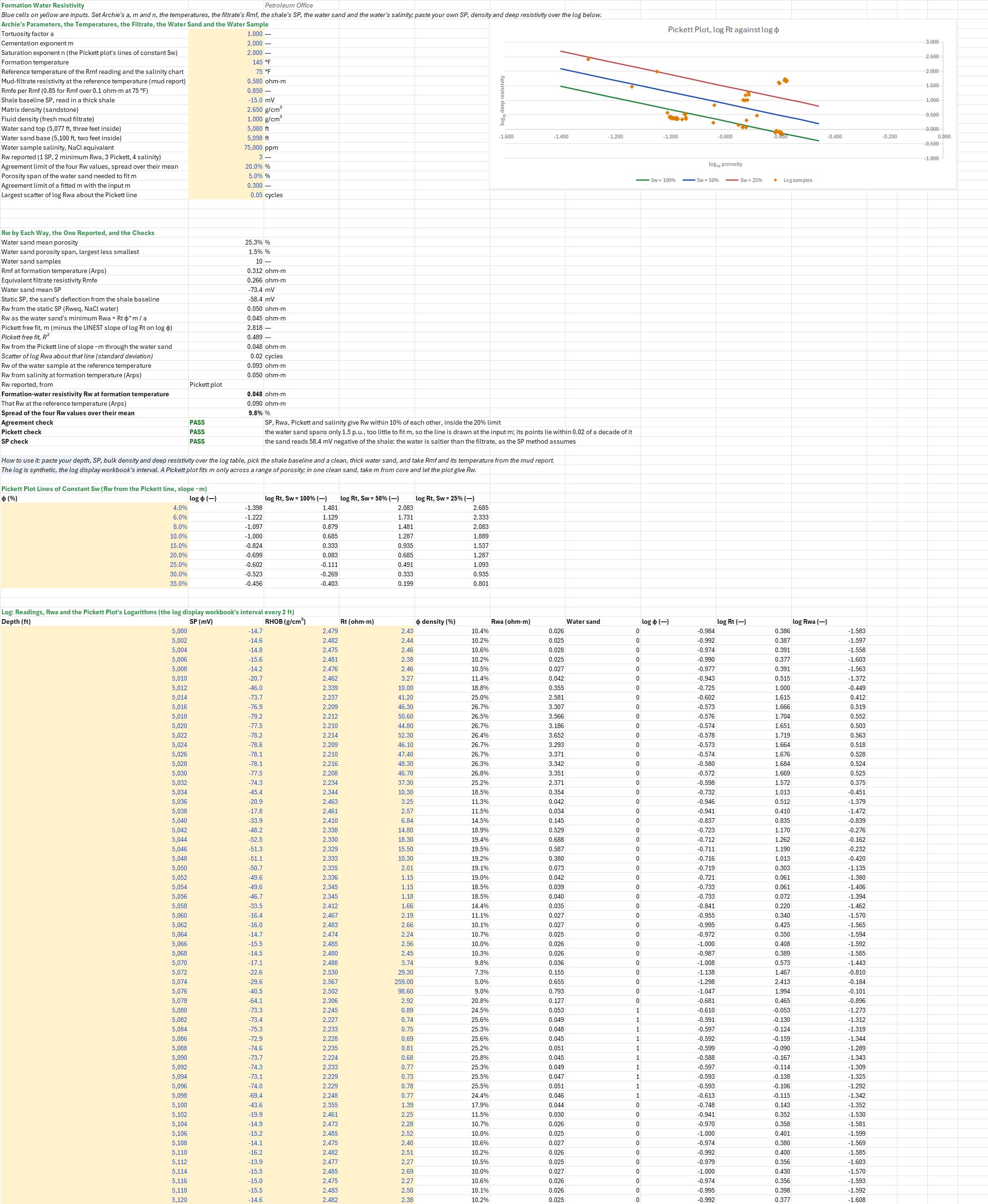
Description
What is the formation water resistivity Rw, on which every saturation on the log depends? You enter a log of SP, bulk density and deep resistivity, a clean water sand on it, the formation and reference temperatures, the mud filtrate's Rmf, the shale's SP baseline and a water sample's salinity. You read off Rw four ways, from the static SP, the minimum apparent water resistivity, a Pickett plot and the salinity, how far the four agree, and the one reported at formation and reference temperature.
Parameters:
- Archie: the tortuosity factor
RW_a, the cementation exponentRW_m, and the saturation exponentRW_nfor the Pickett plot's lines - Temperatures: the formation temperature
RW_Tfand the reference temperatureRW_Trefof the Rmf reading and the salinity chart (°F) - Filtrate and SP:
RW_Rmf(ohm·m at the reference temperature), the equivalent-resistivity factorRW_RmfeK, and the shale baselineRW_SPsh(mV) - Matrix and fluid:
RW_RhoMa,RW_RhoF(g/cm³) - Water sand: its top
RW_WTopand baseRW_WBase(ft) - Water sample: its NaCl-equivalent salinity
RW_Ppm(ppm) - Reported and limits: the method
RW_Method(1 SP, 2 minimum Rwa, 3 Pickett, 4 salinity), the agreement limitRW_Tol, the porosity spanRW_SpanMinneeded to fit m, the m toleranceRW_MToland the largest scatterRW_ScatMax(decades) - Log: each depth's SP, bulk density and deep resistivity in the log table
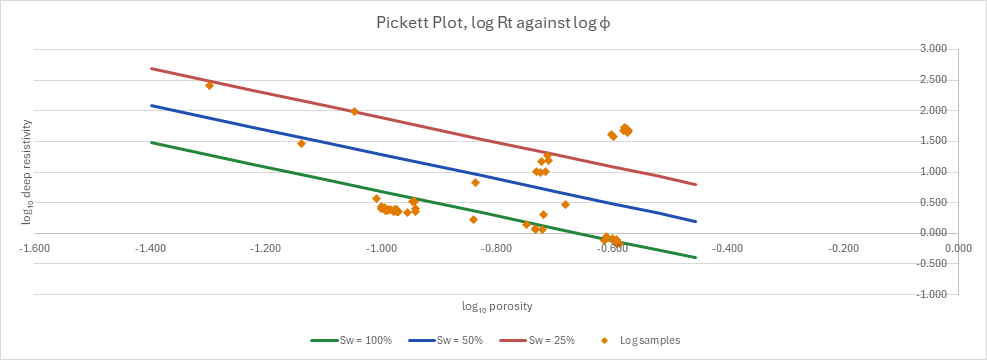
How to use it: The log is synthetic. Paste your depth, SP, bulk density and deep resistivity over the log table, environmentally corrected. Pick the shale baseline on a thick shale and the water sand where it is clean, thick and plainly wet, away from its shoulders. Take Rmf and its temperature from the mud report, and the formation temperature from a corrected bottom-hole temperature. A produced or tested water sample is the best Rw there is; correct its resistivity, or its salinity, to formation temperature. The chart is the Pickett plot: every log sample, with the lines of 100%, 50% and 25% water saturation that the Pickett Rw draws.
Method:
- Static SP. The water sand's mean SP less the shale baseline is the static SP. The mud filtrate's resistivity is carried from the mud report's temperature to formation temperature by Arps: R2 = R1 (T1 + 6.77) / (T2 + 6.77), °F. Rmf at formation temperature times 0.85 is Rmfe, the equivalent filtrate resistivity, for an Rmf above about 0.1 ohm·m at 75 °F. With K = 61 + 0.133 T, the SP equation gives Rweq = Rmfe 10^(SSP/K), taken as Rw for NaCl water.
- Minimum Rwa. The smallest apparent water resistivity Rwa = Rt φ^m / a over the water sand, with φ the density porosity (ρma − ρb)/(ρma − ρf).
- Pickett plot. A wet sand obeys log Rt = log(a Rw) − m log φ.
LINESTof log Rt on log φ over the water sand gives the free slope, −m, and its R². Rw at the input m is 10 to the mean log Rwa, the least-squares line of slope −m through the water points, and the scatter is the standard deviation of log Rwa. The plot's lines are log Rt = log(a Rw / φ^m / Sw^n) at Sw = 1, 0.5 and 0.25. - Salinity. The salinity chart's fit gives Rw at 75 °F, Rw = 0.0123 + 3647.5 / ppm^0.955, and Arps carries it to formation temperature.
- Reported Rw. One of the four is reported, at formation temperature and at the reference temperature. The spread is the largest less the smallest of the four over their mean.
- Checks. The agreement check warns when the spread is more than the limit. The Pickett check judges the free fit's m against the input m when the water sand spans enough porosity to fit it; when it does not, it judges the scatter of the water points about the line instead. The SP check warns when the SP is reversed or flat, which means the water is no saltier than the filtrate and the SP method does not hold.
Example: The default case is the Well-Log Display workbook's synthetic interval, 5,000 to 5,120 ft, every 2 ft. The water sand is its clean water sand, 5,077 to 5,100 ft, taken from 5,080 to 5,098 ft. The sample a foot inside its top still reads the tight streak above it at 2.9 ohm·m. The formation is at 145 °F, the mud report gives an Rmf of 0.58 ohm·m at 75 °F, the shale reads −15 mV, and the water sample is 75,000 ppm NaCl. Archie's a, m and n are 1, 2 and 2 on a 2.65 g/cm³ sandstone matrix with 1.0 g/cm³ filtrate. The Pickett plot is reported, and the four ways are allowed 20% of spread.
Arps carries the Rmf of 0.58 ohm·m at 75 °F to 0.58 × 81.77 / 151.77 = 0.3125 ohm·m at 145 °F, and Rmfe is 0.85 × 0.3125 = 0.2656 ohm·m. The water sand's ten samples average −73.4 mV, so the static SP is −73.4 − (−15) = −58.4 mV. K is 61 + 0.133 × 145 = 80.29, and Rw from SP is 0.2656 × 10^(−58.4/80.29) = 0.0498 ohm·m. The smallest Rwa in the sand is 0.0453 ohm·m, at 5,086 ft. The Pickett line at m = 2 gives 0.0484 ohm·m, with the points within 0.025 of a decade of it. The free fit reads m = 2.82 at an R² of 0.49, because the sand spans only 1.5 porosity units, so the check judges the scatter instead, which is within its limit. The 75,000 ppm sample is 0.0929 ohm·m at 75 °F and 0.0501 ohm·m at 145 °F. The four spread 10% over their mean of 0.0484, inside the 20% limit, and the Pickett Rw of 0.0484 ohm·m is 0.0899 ohm·m at 75 °F. A 40,000 ppm sample would read 0.0857 ohm·m and spread the four 71%, so the agreement check warns. A shale baseline of −80 mV makes the SP reversed and the SP check warns. Lower the span the fit needs to 1 porosity unit and the check judges the free fit instead: m = 2.82 is not the input 2, so it warns.
Functions used
None: the blueprint calculates with Excel's own functions.
Names (52)
| Name | Refers to | Comment |
|---|---|---|
PO.PP.Porosity.FromDensityLAMBDA |
=LAMBDA(Rho_ma, Rho_b, Rho_f, (Rho_ma-Rho_b)/(Rho_ma-Rho_f)) |
Porosity from a density log, (matrix density - bulk density) / (matrix density - fluid density). |
PO.PP.Rw.TemperatureLAMBDA |
=LAMBDA(R_ref, T_ref_F, T_F, R_ref*(T_ref_F+6.77)/(T_F+6.77)) |
Arps (1953) temperature correction of a water or mud resistivity, R = R_ref (T_ref + 6.77) / (T + 6.77), degF. |
PO.PP.Rw.FromSspLAMBDA |
=LAMBDA(SSP, Rmf_eq, T_F, Rmf_eq*10^(SSP/(61+0.133*T_F))) |
Equivalent formation-water resistivity from the static SP, for NaCl-dominant water. |
PO.PP.Rw.FromRwaLAMBDA |
=LAMBDA(Rt_ohmm, Phi_frac, a_tort, m_cem, MIN(Rt_ohmm*Phi_frac^m_cem/a_tort)) |
Rw as the minimum apparent water resistivity, Rwa = Rt phi^m / a, over a clean water-bearing interval. |
PO.PP.Rw.FromSalinityLAMBDA |
=LAMBDA(NaCl_ppm, 0.0123+3647.5/NaCl_ppm^0.955) |
NaCl solution resistivity at 75 degF from salinity in ppm, Rw75 = 0.0123 + 3647.5 / ppm^0.955 (the fitted form of the resistivity-salinity chart). |
RW_a |
$B$4 |
Tortuosity factor a |
RW_m |
$B$5 |
Cementation exponent m |
RW_n |
$B$6 |
Saturation exponent n (the Pickett plot's lines of constant Sw) |
RW_Tf |
$B$7 |
Formation temperature, °F |
RW_Tref |
$B$8 |
Reference temperature of the Rmf reading and the salinity chart, °F |
RW_Rmf |
$B$9 |
Mud-filtrate resistivity at the reference temperature (mud report), ohm·m |
RW_RmfeK |
$B$10 |
Rmfe per Rmf (0.85 for Rmf over 0.1 ohm·m at 75 °F) |
RW_SPsh |
$B$11 |
Shale baseline SP, read in a thick shale, mV |
RW_RhoMa |
$B$12 |
Matrix density (sandstone), g/cm³ |
RW_RhoF |
$B$13 |
Fluid density (fresh mud filtrate), g/cm³ |
RW_WTop |
$B$14 |
Water sand top (5,077 ft, three feet inside), ft |
RW_WBase |
$B$15 |
Water sand base (5,100 ft, two feet inside), ft |
RW_Ppm |
$B$16 |
Water sample salinity, NaCl equivalent, ppm |
RW_Method |
$B$17 |
Rw reported (1 SP, 2 minimum Rwa, 3 Pickett, 4 salinity) |
RW_Tol |
$B$18 |
Agreement limit of the four Rw values, spread over their mean, % |
RW_SpanMin |
$B$19 |
Porosity span of the water sand needed to fit m, % |
RW_MTol |
$B$20 |
Agreement limit of a fitted m with the input m |
RW_ScatMax |
$B$21 |
Largest scatter of log Rwa about the Pickett line, cycles |
RW_Inputs |
$B$4:$B$21 |
Archie's a, m and n, the formation and reference temperatures, Rmf and its equivalent factor, the shale SP baseline, the matrix and fluid densities, the water sand's top and base, the water's salinity, the Rw reported and the check limits |
RW_WPhi |
$B$26 |
Water sand mean porosity, % |
RW_Span |
$B$27 |
Water sand porosity span, largest less smallest, % |
RW_WN |
$B$28 |
Water sand samples |
RW_RmfT |
$B$29 |
Rmf at formation temperature (Arps), ohm·m |
RW_Rmfe |
$B$30 |
Equivalent filtrate resistivity Rmfe, ohm·m |
RW_WSP |
$B$31 |
Water sand mean SP, mV |
RW_SSP |
$B$32 |
Static SP, the sand's deflection from the shale baseline, mV |
RW_RwSP |
$B$33 |
Rw from the static SP (Rweq, NaCl water), ohm·m |
RW_RwRwa |
$B$34 |
Rw as the water sand's minimum Rwa = Rt φ^m / a, ohm·m |
RW_PkM |
$B$35 |
Pickett free fit, m (minus the LINEST slope of log Rt on log φ) |
RW_PkR2 |
$B$36 |
Pickett free fit, R² |
RW_RwPk |
$B$37 |
Rw from the Pickett line of slope −m through the water sand, ohm·m |
RW_Scatter |
$B$38 |
Scatter of log Rwa about that line (standard deviation), cycles |
RW_RwRef |
$B$39 |
Rw of the water sample at the reference temperature, ohm·m |
RW_RwSal |
$B$40 |
Rw from salinity at formation temperature (Arps), ohm·m |
RW_MethodWords |
$B$41 |
Rw reported, from |
RW_Rw |
$B$42 |
Formation-water resistivity Rw at formation temperature, ohm·m |
RW_Rw75 |
$B$43 |
That Rw at the reference temperature (Arps), ohm·m |
RW_Spread |
$B$44 |
Spread of the four Rw values over their mean, % |
RW_AgreeCheck |
$B$45 |
Agreement check verdict |
RW_AgreeCheckNote |
$C$45 |
Agreement check comment |
RW_PickettCheck |
$B$46 |
Pickett check verdict |
RW_PickettCheckNote |
$C$46 |
Pickett check comment |
RW_SpCheck |
$B$47 |
SP check verdict |
RW_SpCheckNote |
$C$47 |
SP check comment |
RW_Results |
$B$26:$B$47 |
The water sand's porosity, span and samples, Rmf at temperature, Rmfe, the static SP and Rw from it, the minimum Rwa, the Pickett fit, its Rw and scatter, Rw from salinity, the Rw reported at formation and reference temperature, spread and three checks |
RW_Curve |
$A$54:$E$62 |
Porosities across the plot, their logarithm, and the log of Rt on the Pickett lines of 100%, 50% and 25% water saturation |
RW_Log |
$A$67:$J$127 |
Each depth's SP, bulk density and deep resistivity, its density porosity and Rwa, whether it is in the water sand, and log φ, log Rt and log Rwa |
Details
| Inserts | 127 rows × 10 columns |
| Category | Petrophysics |
| For agents and tools | Descriptor (.md) |