Porosity from Logs
Description
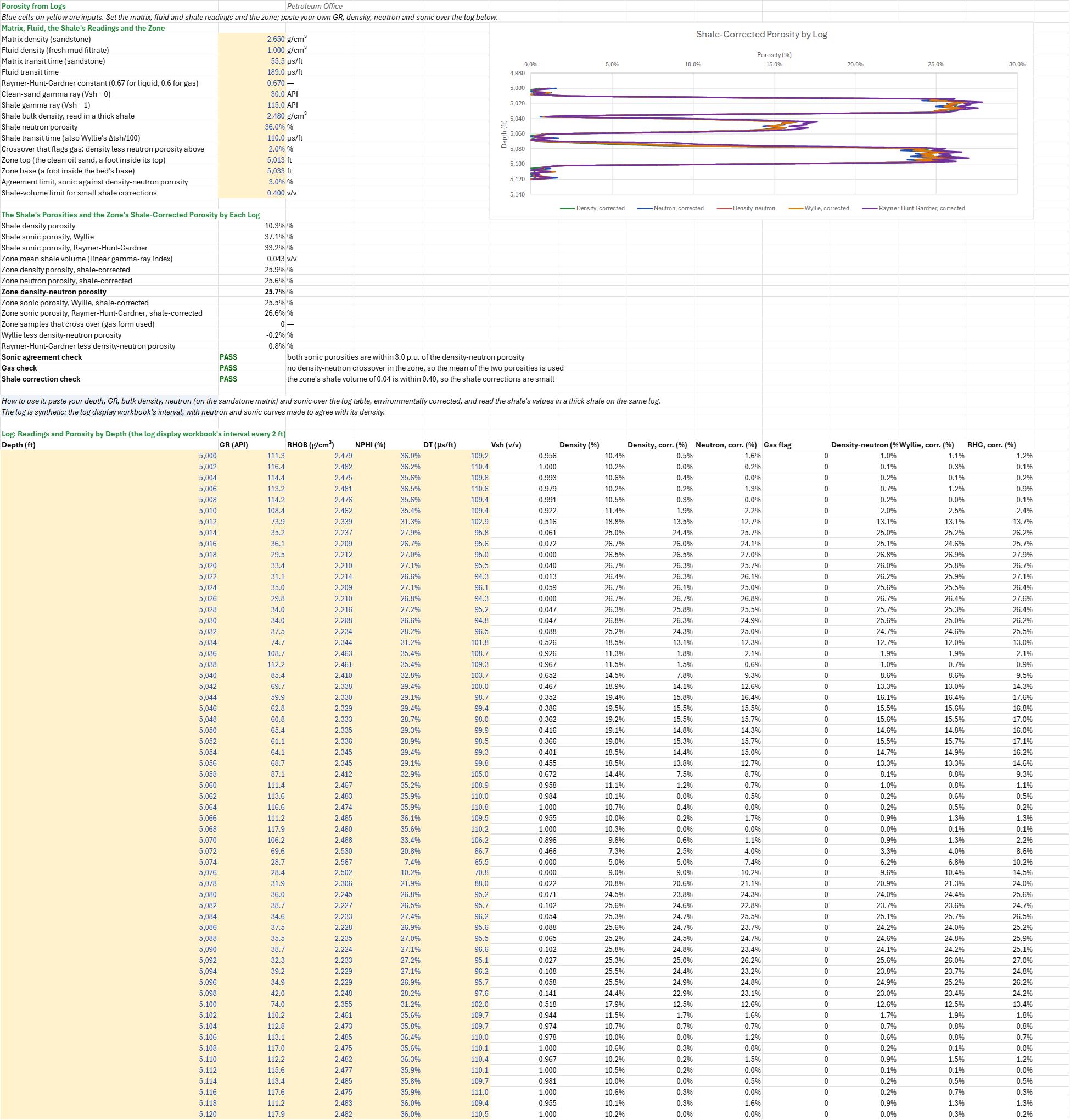
What is the zone's porosity, and do the density, neutron and sonic logs agree on it? You enter a log of gamma ray, bulk density, neutron and sonic, the matrix and fluid, the shale's readings and the zone. You read off each log's shale-corrected porosity at every depth and over the zone: density, neutron, density-neutron with a gas correction where the two cross over, and sonic by the Wyllie time average and by Raymer-Hunt-Gardner.
Parameters:
- Matrix and fluid: the matrix and fluid densities
PL_RhoMa,PL_RhoF(g/cm³), their transit timesPL_DtMa,PL_DtF(µs/ft), and the Raymer-Hunt-Gardner constantPL_C - Shale: the gamma-ray picks
PL_GRcl,PL_GRsh(API), and the shale's bulk densityPL_RhoSh(g/cm³), neutron porosityPL_NphiShand transit timePL_DtSh(µs/ft), which is also Wyllie's compaction correction - Zone and limits: the gas crossover
PL_GasX, the zone's top and basePL_ZTop,PL_ZBase(ft), the sonic agreement limitPL_Agreeand the shale-volume limitPL_VshCut - Log: depth, GR, bulk density, neutron and sonic in the log table, every 2 ft
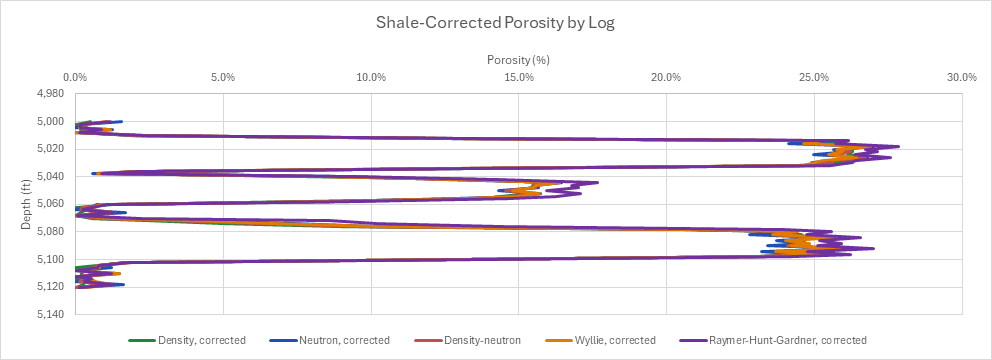
How to use it: The neutron and sonic curves are made up; the gamma ray and density are the Well-Log Display workbook's synthetic log. Paste your depth, gamma ray, bulk density, neutron (on the sandstone matrix, or converted to it) and sonic over the log table, each environmentally corrected. Read the shale's density, neutron and transit time in a thick shale on the same log, and take the matrix from core or the lithology. The log track draws the five corrected porosities against depth: read where the sonic departs from the density-neutron and where the density reads above the neutron.
Method:
- Shale volume. IGR = (GR − GRcl) / (GRsh − GRcl), the linear gamma-ray index between the picks, kept between 0 and 1. The Shale Volume from Gamma Ray sheet compares the transforms.
- Shale corrections. Each log's shale correction takes off the shale volume times the shale's own porosity on that log, read in a thick shale. Density porosity is φD = (ρma − ρb) / (ρma − ρf). The neutron reads porosity directly on the sandstone matrix. The shale-corrected porosities are φD − Vsh φDsh and φN − Vsh φNsh, kept at or above 0, with φDsh = (ρma − ρsh) / (ρma − ρf).
- Density-neutron. A sample is flagged as gas when the corrected density porosity is more than the crossover above the corrected neutron, as gas makes them read. The density-neutron porosity is then the root-mean-square form √((φN² + φD²)/2), and elsewhere the mean (φN + φD)/2.
- Sonic. Wyllie's time average is φ = (Δt − Δtma) / (Δtf − Δtma) / Cp, with the compaction correction Cp = Δtsh/100. Raymer-Hunt-Gardner is φ = C (Δt − Δtma) / Δt. Each sonic porosity is corrected for shale with the shale's own porosity on the same transform.
- Zone. The zone's values are the means of its samples.
- Checks. The sonic agreement check warns when either sonic porosity is further from the density-neutron porosity than the agreement limit. The gas check warns when any of the zone's samples cross over. The shale correction check warns when the zone's shale volume is above the limit, where the corrections carry the answer.
Example: The default case is the Well-Log Display workbook's synthetic interval, 5,000 to 5,120 ft, sampled every 2 ft, with its gamma ray and bulk density. The workbook has no neutron or sonic log, so the sheet adds both, bed by bed, made to agree with the density once each is corrected for shale. The matrix is sandstone, 2.65 g/cm³ and 55.5 µs/ft, with 1.0 g/cm³ mud filtrate at 189 µs/ft. The shale reads 2.48 g/cm³, 36% neutron porosity and 110 µs/ft. The zone is the clean oil sand a foot inside its top and base, 5,013 to 5,033 ft. A crossover above 2 p.u. flags gas, and the sonic has to agree within 3 p.u.
The shale's density porosity is (2.65 − 2.48) / 1.65 = 10.3%. Its Wyllie porosity is (110 − 55.5) / 133.5 / 1.1 = 37.1%, and its Raymer-Hunt-Gardner porosity 0.67 × 54.5 / 110 = 33.2%. At 5,018 ft the gamma ray reads 29.5 API, under the clean line, so no shale is taken off. The density reads 2.212 g/cm³, a porosity of 0.438 / 1.65 = 26.5%. The neutron reads 27.0%, so the mean is 26.8%. The sonic reads 95 µs/ft: Wyllie gives 39.5 / 146.85 = 26.9% and Raymer-Hunt-Gardner 0.67 × 39.5 / 95 = 27.9%. Over the zone the mean shale volume is 0.043. The corrected density porosity is 25.9%, the neutron 25.6% and the density-neutron 25.7%. Wyllie reads 25.5% and Raymer-Hunt-Gardner 26.6%, both within 3 p.u., and no sample crosses over. Drop the crossover to 0 and the samples where the density reads above the neutron take the gas form: the gas check warns. In the shaly sand from 5,041 to 5,048 ft the mean shale volume is 0.39; against a 0.30 limit the shale check warns. A 0.5 p.u. agreement limit fails Raymer-Hunt-Gardner, 0.8 p.u. above.
Functions used
None: the blueprint calculates with Excel's own functions.
Names (41)
| Name | Refers to | Comment |
|---|---|---|
PO.PP.Vsh.GammaRayIndexLAMBDA |
=LAMBDA(GR, GR_cl, GR_sh, (GR-GR_cl)/(GR_sh-GR_cl)) |
Linear gamma-ray shale index, IGR = (GR - GRclean) / (GRshale - GRclean). |
PO.PP.Porosity.FromDensityLAMBDA |
=LAMBDA(Rho_ma, Rho_b, Rho_f, (Rho_ma-Rho_b)/(Rho_ma-Rho_f)) |
Porosity from a density log, (matrix density - bulk density) / (matrix density - fluid density). |
PO.PP.Porosity.FromNeutronDensityLAMBDA |
=LAMBDA(Phi_N, Phi_D, Mode, IF(Mode=1, (Phi_N+Phi_D)/2, IF(Mode=2, SQRT((Phi_N^2+Phi_D^2)/2), NA()))) |
Density-neutron crossplot porosity: Mode 1 the arithmetic mean (liquid-filled), Mode 2 the root-mean-square gas form sqrt((phiN^2 + phiD^2)/2). |
PO.PP.Porosity.FromSonic.WyllieLAMBDA |
=LAMBDA(Dt, Dt_ma, Dt_f, Dt_sh, ((Dt-Dt_ma)/(Dt_f-Dt_ma))/(Dt_sh/100)) |
Wyllie time-average sonic porosity divided by the shale compaction factor Dt_sh/100. |
PO.PP.Porosity.FromSonic.RHGLAMBDA |
=LAMBDA(Dt, Dt_ma, C, C*(Dt-Dt_ma)/Dt) |
Raymer-Hunt-Gardner sonic porosity, C times (transit time minus matrix) over transit time. |
PL_RhoMa |
$B$4 |
Matrix density (sandstone), g/cm³ |
PL_RhoF |
$B$5 |
Fluid density (fresh mud filtrate), g/cm³ |
PL_DtMa |
$B$6 |
Matrix transit time (sandstone), µs/ft |
PL_DtF |
$B$7 |
Fluid transit time, µs/ft |
PL_C |
$B$8 |
Raymer-Hunt-Gardner constant (0.67 for liquid, 0.6 for gas) |
PL_GRcl |
$B$9 |
Clean-sand gamma ray (Vsh = 0), API |
PL_GRsh |
$B$10 |
Shale gamma ray (Vsh = 1), API |
PL_RhoSh |
$B$11 |
Shale bulk density, read in a thick shale, g/cm³ |
PL_NphiSh |
$B$12 |
Shale neutron porosity, % |
PL_DtSh |
$B$13 |
Shale transit time (also Wyllie's Δtsh/100), µs/ft |
PL_GasX |
$B$14 |
Crossover that flags gas: density less neutron porosity above, % |
PL_ZTop |
$B$15 |
Zone top (the clean oil sand, a foot inside its top), ft |
PL_ZBase |
$B$16 |
Zone base (a foot inside the bed's base), ft |
PL_Agree |
$B$17 |
Agreement limit, sonic against density-neutron porosity, % |
PL_VshCut |
$B$18 |
Shale-volume limit for small shale corrections, v/v |
PL_Inputs |
$B$4:$B$18 |
The matrix and fluid density and transit time, the RHG constant, the gamma-ray picks, the shale's density, neutron and transit time, the gas crossover, the zone and the two limits |
PL_PhiDsh |
$B$21 |
Shale density porosity, % |
PL_PhiWsh |
$B$22 |
Shale sonic porosity, Wyllie, % |
PL_PhiRsh |
$B$23 |
Shale sonic porosity, Raymer-Hunt-Gardner, % |
PL_Vsh |
$B$24 |
Zone mean shale volume (linear gamma-ray index), v/v |
PL_PhiD |
$B$25 |
Zone density porosity, shale-corrected, % |
PL_PhiN |
$B$26 |
Zone neutron porosity, shale-corrected, % |
PL_PhiND |
$B$27 |
Zone density-neutron porosity, % |
PL_PhiW |
$B$28 |
Zone sonic porosity, Wyllie, shale-corrected, % |
PL_PhiR |
$B$29 |
Zone sonic porosity, Raymer-Hunt-Gardner, shale-corrected, % |
PL_Gas |
$B$30 |
Zone samples that cross over (gas form used) |
PL_DiffW |
$B$31 |
Wyllie less density-neutron porosity, % |
PL_DiffR |
$B$32 |
Raymer-Hunt-Gardner less density-neutron porosity, % |
PL_AgreeCheck |
$B$33 |
Sonic agreement check verdict |
PL_AgreeCheckNote |
$C$33 |
Sonic agreement check comment |
PL_GasCheck |
$B$34 |
Gas check verdict |
PL_GasCheckNote |
$C$34 |
Gas check comment |
PL_ShaleCheck |
$B$35 |
Shale correction check verdict |
PL_ShaleCheckNote |
$C$35 |
Shale correction check comment |
PL_Results |
$B$21:$B$35 |
The shale's density and sonic porosities, the zone's shale volume and its shale-corrected density, neutron, density-neutron and sonic porosities, the gas count, the sonic differences and three checks |
PL_Curve |
$A$42:$M$102 |
Each depth's GR, density, neutron and sonic, its shale volume, its density, shale-corrected density and neutron porosities, the gas flag, the density-neutron porosity and the shale-corrected sonic porosities |
Details
| Inserts | 102 rows × 13 columns |
| Category | Petrophysics |
| For agents and tools | Descriptor (.md) |