Pore-Volume and Effective Compressibility
Estimates pore-volume compressibility from porosity and builds the effective and total compressibilities for material balance and well tests.
Material Balance Equation 43 rows × 3 columns
Use this blueprint
How to use this blueprint
- In Excel, go to the Petroleum Office ribbon tab and click Blueprint Manager
- Search for Pore-Volume and Effective Compressibility
- Click on the blueprint to preview
- Click Insert to place it into your worksheet. Modify the input values to match your data.
Requires the Petroleum Office add-in for Excel.
Description
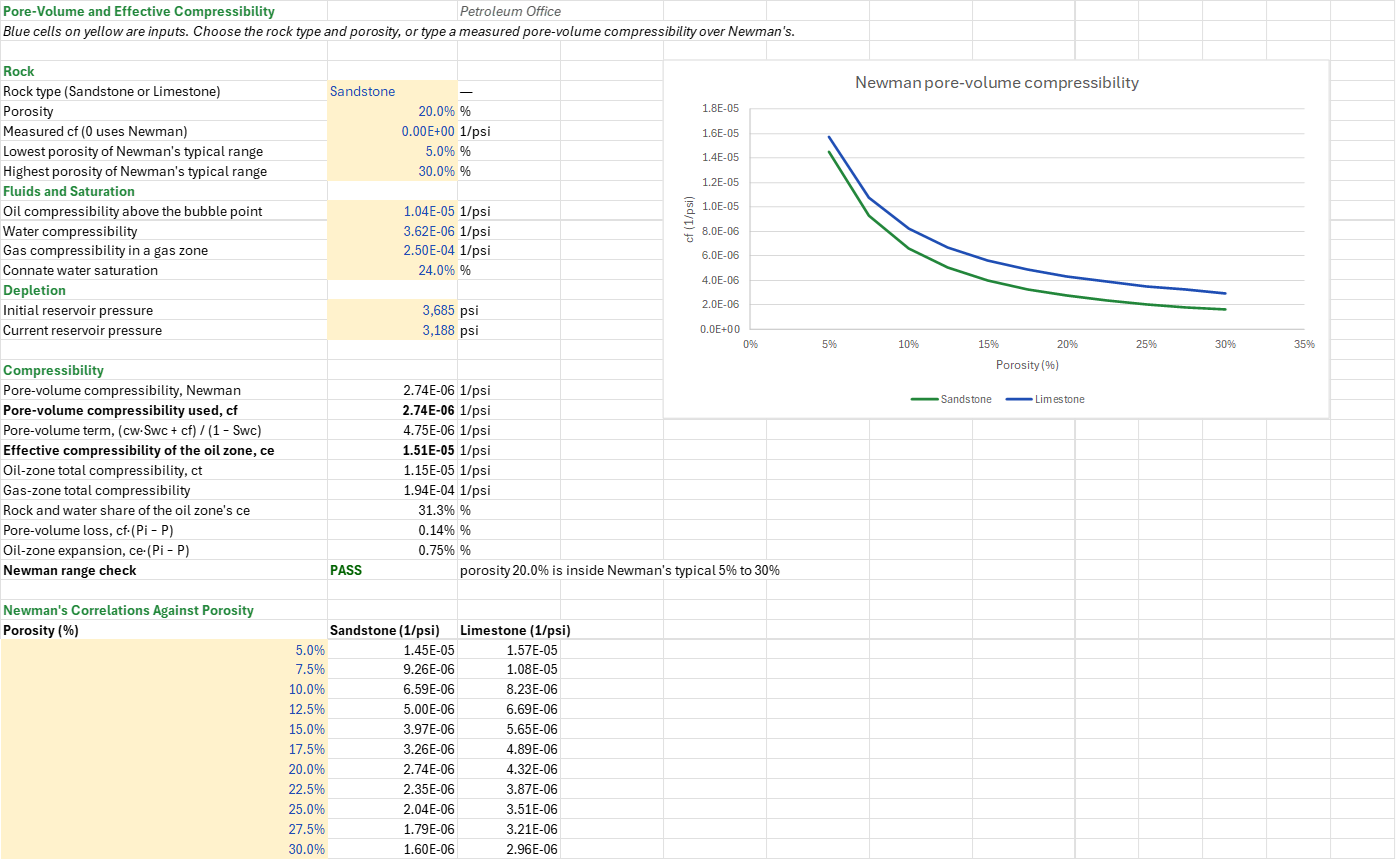
What compressibilities do a material balance and a well test need for this rock and its fluids? You enter the rock type and porosity (or a measured pore-volume compressibility), the oil, water and gas compressibilities, the connate water saturation and a depletion. You read off the pore-volume compressibility cf by Newman's correlations, the pore-volume term, the effective compressibility ce of an undersaturated oil zone, the total compressibility ct of an oil zone and of a gas zone, and the pore-volume loss and oil-zone expansion over the depletion.
Parameters:
- Rock: the rock type, Sandstone or Limestone, from a list (
CE_Rock), the porosity (CE_phi), and a measured pore-volume compressibility that replaces Newman's when it is above 0 (CE_cfMeasured) - Newman's range: the porosities the check accepts (
CE_PhiMin,CE_PhiMax, 5 % to 30 %) - Fluids: the oil compressibility above the bubble point, the water compressibility and the gas compressibility of a gas zone (
CE_co,CE_cw,CE_cg), and the connate water saturation (CE_Swc) - Depletion: the initial and current reservoir pressure (
CE_Pi,CE_P)
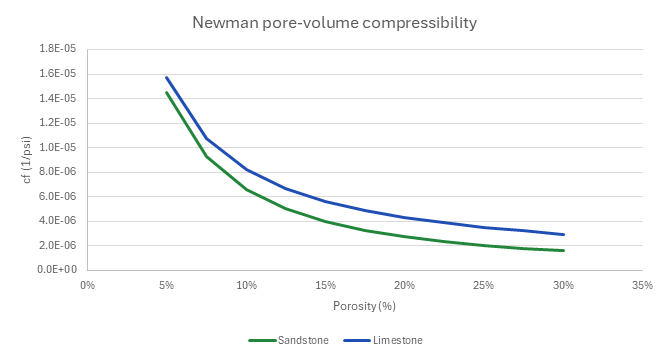
How to use it: Type the measured pore-volume compressibility from a core test at reservoir net stress into the measured-compressibility cell. Newman's correlations stand in only when there is no core. Take co from the oil's PVT report: the undersaturated relative volume, or (1/Bo)·ΔBo/ΔP between two pressures above the bubble point. Take cw from a water correlation at reservoir pressure, temperature and salinity, and cg as roughly 1/p for a gas zone. The chart draws both Newman correlations against porosity.
Method: Newman (1973) fitted cf = a / (1 + b·c·φ)^(1/b) to his laboratory measurements of consolidated sandstones and limestones, with one set of constants for each. The sheet picks the set by the rock type, and uses the measured value instead when it is above 0. Then:
- Pore-volume term: cpv = (cw·Swc + cf)/(1 − Swc). It is the oil material balance's Efw per unit of Boi and pressure drop: Efw = (1 + m)·Boi·cpv·ΔP.
- Effective compressibility of an undersaturated oil zone: ce = (co·So + cw·Swc + cf)/So = co + cpv, with So = 1 − Swc. Above the bubble point the material balance reduces to F = N·Boi·ce·ΔP.
- Total compressibility of the oil zone: ct = So·co + Swc·cw + cf, the ct of the diffusivity equation.
- Total compressibility of a gas zone: Sg·cg + Swc·cw + cf with Sg = 1 − Swc.
The rock-and-water share cpv/ce says how much of the oil zone's expansion a material balance loses if it leaves out cw and cf. The pore-volume loss over the depletion is cf·(Pi − P), and the oil zone's volume expansion is ce·(Pi − P).
Example: A sandstone of 20 % porosity, Ahmed's Newman example, has cf = 2.74 × 10⁻⁶ 1/psi. The fluids and pressures are the Virginia Hills field's from the Oil Material Balance (Havlena-Odeh) sheet: Swc 24 %, cw 3.62 × 10⁻⁶ 1/psi, and a depletion from 3,685 to 3,188 psi. Its co of 1.04 × 10⁻⁵ 1/psi is the field's Bo history, (1.3170 − 1.3102)/(1.3102 × 497 psi). The pore-volume term is 4.75 × 10⁻⁶ 1/psi, so ce = 1.51 × 10⁻⁵ 1/psi, and rock and water supply 31 % of it. The oil zone's ct is 1.15 × 10⁻⁵ 1/psi, and a gas zone's is 1.94 × 10⁻⁴ 1/psi. Over the 497 psi depletion the pore volume shrinks 0.14 % and the oil zone expands 0.75 %. A porosity of 20 % is inside Newman's 5–30 % range, so the range check passes. As a limestone, the same porosity gives cf = 4.32 × 10⁻⁶ 1/psi. The Virginia Hills field's measured cf of 4.95 × 10⁻⁶ 1/psi gives a pore-volume term of 7.66 × 10⁻⁶ 1/psi, the Efw the Oil Material Balance (Havlena-Odeh) sheet uses per unit of Boi and pressure drop.
Functions used
PO.SCAL.Cf.Lime.ByNewmanCalculates rock pore volume compressibility in limestones using Newman correlation, [1/psi].PO.SCAL.Cf.Sand.ByNewmanCalculates rock pore volume compressibility in sandstones using Newman correlation, [1/psi].PO.MBE.Ce.PoreVolCalculates pore volume compressibility term, [1/psi]. cpv = (cw*Swc + cf) / (1 - Swc).PO.MBE.Ce.UnSat.OilCalculates effective compressibility for undersaturated oil reservoir, [1/psi].PO.MBE.Ce.TotalCalculates total system compressibility, [1/psi]. ct = Sg*cg + Sw*cw + cf.
Names it defines (23)
| Name | Refers to | Comment |
|---|---|---|
CE_Rock |
$B$5 |
Rock type for Newman's correlation, Sandstone or Limestone |
CE_phi |
$B$6 |
Porosity, % |
CE_cfMeasured |
$B$7 |
Measured cf (0 uses Newman), 1/psi |
CE_PhiMin |
$B$8 |
Lowest porosity of Newman's typical range, % |
CE_PhiMax |
$B$9 |
Highest porosity of Newman's typical range, % |
CE_co |
$B$11 |
Oil compressibility above the bubble point, 1/psi |
CE_cw |
$B$12 |
Water compressibility, 1/psi |
CE_cg |
$B$13 |
Gas compressibility in a gas zone, 1/psi |
CE_Swc |
$B$14 |
Connate water saturation, % |
CE_Pi |
$B$16 |
Initial reservoir pressure, psi |
CE_P |
$B$17 |
Current reservoir pressure, psi |
CE_Inputs |
$B$5:$B$17 |
Rock type, porosity and a measured Cf, the fluids' compressibilities and saturation, and the depletion |
CE_cfNewman |
$B$20 |
Pore-volume compressibility, Newman, 1/psi |
CE_cf |
$B$21 |
Pore-volume compressibility used, cf, 1/psi |
CE_cpv |
$B$22 |
Pore-volume term, (cw·Swc + cf) / (1 − Swc), 1/psi |
CE_ce |
$B$23 |
Effective compressibility of the oil zone, ce, 1/psi |
CE_ctOil |
$B$24 |
Oil-zone total compressibility, ct, 1/psi |
CE_ctGas |
$B$25 |
Gas-zone total compressibility, 1/psi |
CE_RockShare |
$B$26 |
Rock and water share of the oil zone's ce, % |
CE_dVp |
$B$27 |
Pore-volume loss, cf·(Pi − P), % |
CE_dVo |
$B$28 |
Oil-zone expansion, ce·(Pi − P), % |
CE_Results |
$B$20:$B$29 |
Newman's and the used cf, the pore-volume term, ce and ct, the depletion's volume changes and the check |
CE_Curve |
$A$33:$C$43 |
Newman pore-volume compressibility |
Details
| Inserts | 43 rows × 3 columns |
| Category | Material Balance Equation |
| For agents and tools | Descriptor (.md) |
| Tags | MBE · SCAL · compressibility · pore-volume · undersaturated · Newman · rock |
Need a custom calculation? Request a blueprint