Surge and Swab Trip Speed
Description
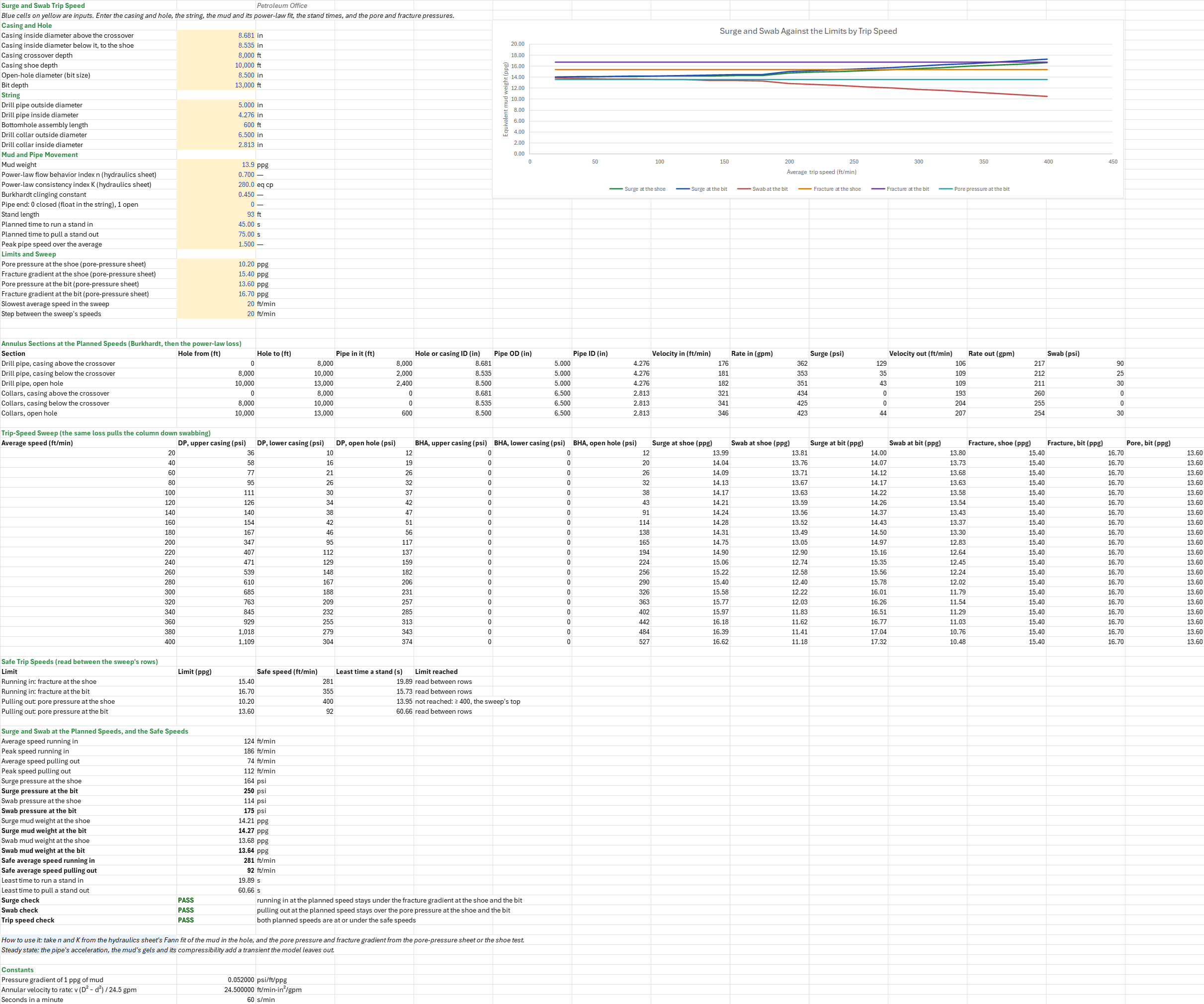
How fast can the string go in and out of the hole without breaking the shoe down or swabbing in a kick? Running pipe in pushes mud up the annulus and raises the bottomhole pressure (surge); pulling it out lowers it (swab). You enter the casing and hole, the string, the mud's power-law rheology, the stand times and the pore and fracture limits at the shoe and the bit. You read off the surge and swab at the shoe and the bit as mud weights, and the fastest safe trip speed in and out with the least time per stand.
Parameters:
- Casing and hole: the casing ID above and below the crossover
SRG_IdTop,SRG_IdBotand the open holeSRG_Hole(in); the crossoverSRG_Xover, the shoeSRG_Shoeand the bit depthSRG_Bit(ft) - String: the drill pipe OD and ID
SRG_DpOD,SRG_DpID(in), the bottomhole assembly's lengthSRG_BhaL(ft) and the collars' OD and IDSRG_BhaOD,SRG_BhaID(in) - Mud and pipe movement: the mud weight
SRG_MW(ppg), its power-lawSRG_nandSRG_K(eq cp), the clinging constantSRG_Kc, the pipe endSRG_Mode(0 closed, 1 open), the stand lengthSRG_Stand(ft), the planned times to run a stand in and pull one outSRG_TimeIn,SRG_TimeOut(s), and the peak-to-average speedSRG_Peak - Limits and sweep: the pore pressure and fracture gradient at the shoe and at the bit
SRG_PpShoe,SRG_FgShoe,SRG_PpBit,SRG_FgBit(ppg), and the sweep's slowest speedSRG_Startand stepSRG_StepV(ft/min)
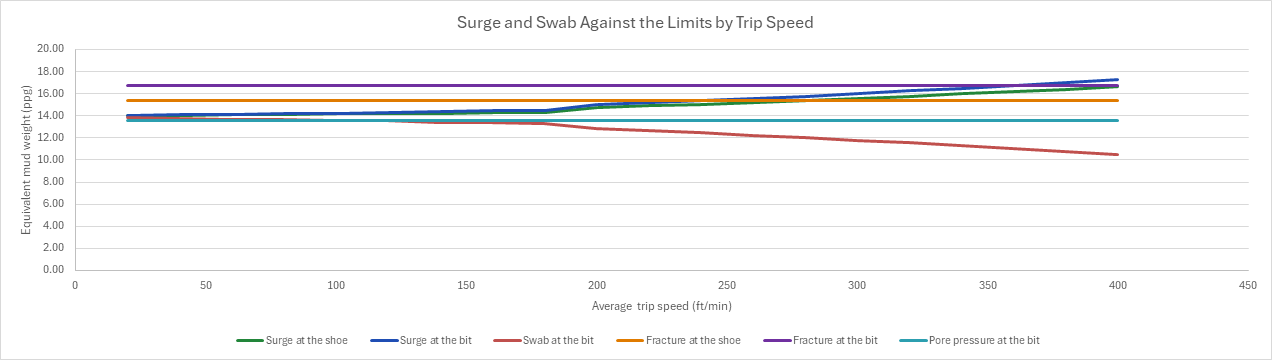
How to use it: The rheology is made up for the example. Take n and K from the hydraulics sheet's Fann fit of the mud in the hole (the annulus fit, at the shear rates the trip makes), the pore pressure and fracture gradient from the pore-pressure sheet or the shoe test, the clinging constant from Burkhardt's chart for the pipe-to-hole ratio, and the peak factor from the driller's stand times or the rig's block-speed log. The sheet works each section in turn, the drill pipe and then the collars against the casing above its crossover, the casing below it and the open hole: the effective annular velocity of the mud the moving pipe displaces and drags along, the equivalent flow rate, and the friction loss over the length of pipe in the section. The losses above the shoe give the surge or swab at the shoe, and all of them the surge or swab at the bit, each as a mud weight. A sweep of average trip speeds repeats the losses at each speed, and a table reads the fastest speed that keeps the surge under the fracture gradient and the swab over the pore pressure at the shoe and at the bit, with the least time per stand that speed means; a chart draws the surge and swab mud weights against trip speed beside the limits. Running in is unsafe when the surge at the planned stand time reaches the fracture gradient at the shoe or at the bit, and pulling out when the swab takes the bottom under the pore pressure at either; a planned average speed over its safe speed is flagged with the seconds a stand should take instead.
Method: Burkhardt's effective annular velocity for a pipe moving at vp is v = vp (A/(Dh² − Dp²) + Kc), where A is Dp² for a closed pipe and Dp² − Di² for an open one: the mud the pipe displaces plus the mud that clings to it. The pipe speed is the peak, the stand length × 60 over its time times the peak factor. The equivalent flow rate is Q = v (Dh² − Dp²)/24.5 gpm, and the loss over the length of pipe in the section is the power-law slot loss at that rate, laminar below the API RP 13D Reynolds number 3,470 − 1,370 n and Blasius turbulent above it. The length of pipe in each section is where the pipe (the drill pipe from surface to the top of the collars, the collars from there to the bit) overlaps the hole section. The surge at the shoe is the sum over the four cased sections, and at the bit the sum over all six; as a mud weight it is MW + ΔP/(0.052 × depth), and the swab is the same loss taken off. Burkhardt's velocity is in proportion to the pipe speed, so the sweep scales each section's rate by the speed and takes the loss again. Surge rises and swab falls with speed, so the number of sweep speeds that hold a limit is the row of the last one that does, and the safe speed is read straight between that row and the next.
Example: The drilling family's reference well, the one the pore-pressure, casing-design and cement sheets use, vertical: the 9⅝-in. intermediate string, ID 8.681 in. above the crossover at 8,000 ft and 8.535 in. below it, set at 10,000 ft, and the 8½-in. production hole to 13,000 ft, with the bit on bottom. The string is 5-in. drill pipe (ID 4.276 in.) over 600 ft of 6½-in. collars (ID 2-13/16 in.) with a float in it, so the pipe is closed. The mud is the production hole's 13.9 ppg, with a power-law n of 0.70 and K of 280 eq cp and Burkhardt's clinging constant 0.45. The stands are 93 ft, run in at 45 s and pulled at 75 s, and the peak speed is 1.5 times the average. The pore-pressure sheet gives 10.2 ppg of pore pressure and 15.4 ppg of fracture gradient at the shoe, and 13.6 and 16.7 ppg at TD. The sweep runs from 20 to 400 ft/min in steps of 20.
Run in at 45 s a stand, the string averages 124 ft/min with a 186 ft/min peak. Past the drill pipe in the upper casing the mud moves at 176.0 ft/min, 361.8 gpm, and loses 128.5 psi over 8,000 ft; in the lower casing 35.1 psi and in the open hole 43.0 psi; past the collars in the open hole it moves at 345.7 ft/min, turbulent, and loses 43.6 psi. That is a surge of 163.6 psi at the shoe and 250.2 psi at the bit, 14.21 and 14.27 ppg, well under the 15.4 and 16.7 ppg fracture gradients. Pulled at 75 s a stand, 74.4 ft/min, the swab is 114.4 psi at the shoe and 175.0 psi at the bit, which leaves 13.68 and 13.64 ppg, over the 10.2 and 13.6 ppg pore pressures. The sweep holds the shoe's fracture gradient up to 280.5 ft/min and the bit's to 354.7 ft/min, so the string can run in as fast as 19.9 s a stand. Swabbing at the bit governs pulling out: the bottom stays over 13.6 ppg up to 92.0 ft/min, 60.7 s a stand. Both planned speeds are inside. The 0.3 ppg trip margin is what sets the pulling speed: a 60 s stand would swab the bottom to 13.60 ppg. Run open-ended, the pipe sends only its steel up the annulus and the surge at the bit falls to 185.8 psi. Set to one 10,000 ft section of 8.5-in. hole with 4½-in. pipe (ID 3.826 in.) at 270 ft/min in a 10 ppg mud of n 0.6 and K 400 eq cp, the sheet gives 149.5 psi (149.47), the value the Burkhardt surge function documents for its first case, composed with the power-law annulus loss.
Functions used
None: the blueprint calculates with Excel's own functions.
Names (59)
| Name | Refers to | Comment |
|---|---|---|
PO.DE.Surge.BurkhardtLAMBDA |
=LAMBDA(Vp_ftmin, Dh_in, Dp_in, Di_in, Kc, Mode, Vp_ftmin*(IF(Mode=1, Dp_in^2 - Di_in^2, Dp_in^2)/(Dh_in^2 - Dp_in^2) + Kc)) |
Burkhardt effective annular velocity, ft/min, of the mud a moving pipe displaces, with the clinging constant; closed-end (Mode 0) or open-end (Mode 1) pipe. |
PO.DE.Hyd.AnnulusLossLAMBDA |
=LAMBDA(Q_gpm, Dh_in, Dp_in, L_ft, MW_ppg, n, K_cp, LET(v, Q_gpm / (2.448 * (Dh_in^2 - Dp_in^2)), gap, Dh_in - Dp_in, re, 109000 * MW_ppg * v^(2 - n) / K_cp * (0.0208 * (Dh_in - Dp_in) / (2 + 1 / n))^n, L_ft * IF(re < 3470 - 1370 * n, K_cp * v^n * ((2 + 1 / n) / 0.0208)^n / (144000 * gap^(1 + n)), 0.0791 / re^0.25 * MW_ppg * v^2 / (21.1 * gap)))) |
Frictional pressure loss, psi, in an annulus for a power-law mud: laminar below the API RP 13D limit 3470 - 1370n, Blasius turbulent above (Bourgoyne et al.). |
_PO.DE.IntervalOverlapLAMBDA |
=LAMBDA(top_ft, bottom_ft, from_ft, to_ft, MAX(0, MIN(bottom_ft, to_ft) - MAX(top_ft, from_ft))) |
Length, ft, of the interval top..bottom that lies inside from..to (0 when they do not overlap). |
SRG_IdTop |
$B$4 |
Casing inside diameter above the crossover, in |
SRG_IdBot |
$B$5 |
Casing inside diameter below it, to the shoe, in |
SRG_Xover |
$B$6 |
Casing crossover depth, ft |
SRG_Shoe |
$B$7 |
Casing shoe depth, ft |
SRG_Hole |
$B$8 |
Open-hole diameter (bit size), in |
SRG_Bit |
$B$9 |
Bit depth, ft |
SRG_DpOD |
$B$11 |
Drill pipe outside diameter, in |
SRG_DpID |
$B$12 |
Drill pipe inside diameter, in |
SRG_BhaL |
$B$13 |
Bottomhole assembly length, ft |
SRG_BhaOD |
$B$14 |
Drill collar outside diameter, in |
SRG_BhaID |
$B$15 |
Drill collar inside diameter, in |
SRG_MW |
$B$17 |
Mud weight, ppg |
SRG_n |
$B$18 |
Power-law flow behavior index n (hydraulics sheet) |
SRG_K |
$B$19 |
Power-law consistency index K (hydraulics sheet), eq cp |
SRG_Kc |
$B$20 |
Burkhardt clinging constant |
SRG_Mode |
$B$21 |
Pipe end: 0 closed (float in the string), 1 open |
SRG_Stand |
$B$22 |
Stand length, ft |
SRG_TimeIn |
$B$23 |
Planned time to run a stand in, s |
SRG_TimeOut |
$B$24 |
Planned time to pull a stand out, s |
SRG_Peak |
$B$25 |
Peak pipe speed over the average |
SRG_PpShoe |
$B$27 |
Pore pressure at the shoe (pore-pressure sheet), ppg |
SRG_FgShoe |
$B$28 |
Fracture gradient at the shoe (pore-pressure sheet), ppg |
SRG_PpBit |
$B$29 |
Pore pressure at the bit (pore-pressure sheet), ppg |
SRG_FgBit |
$B$30 |
Fracture gradient at the bit (pore-pressure sheet), ppg |
SRG_Start |
$B$31 |
Slowest average speed in the sweep, ft/min |
SRG_StepV |
$B$32 |
Step between the sweep's speeds, ft/min |
SRG_Inputs |
$B$4:$B$32 |
The casing, its crossover and shoe, the hole and bit depth, the drill pipe and collars, the mud and its power-law n and K, the clinging constant, the pipe end, the stands and their times, the peak factor, the pore and fracture pressures, and the sweep |
SRG_Sections |
$A$37:$M$42 |
Each annulus section: the hole section's depths, the pipe in it, the diameters, and running in and pulling out, Burkhardt's velocity, the equivalent rate and the loss |
SRG_Curve |
$A$46:$N$65 |
Each average trip speed: the six sections' losses at its peak, the surge and swab mud weights at the shoe and the bit, and the limits |
SRG_SafeSpeeds |
$A$69:$E$72 |
Each limit, its mud weight, the fastest average speed that holds it, read between the sweep rows (0 when none does), the least time per stand at that speed, and whether the sweep reached the limit |
SRG_VavgIn |
$B$75 |
Average speed running in, ft/min |
SRG_VpIn |
$B$76 |
Peak speed running in, ft/min |
SRG_VavgOut |
$B$77 |
Average speed pulling out, ft/min |
SRG_VpOut |
$B$78 |
Peak speed pulling out, ft/min |
SRG_SurgeShoe |
$B$79 |
Surge pressure at the shoe, psi |
SRG_SurgeBit |
$B$80 |
Surge pressure at the bit, psi |
SRG_SwabShoe |
$B$81 |
Swab pressure at the shoe, psi |
SRG_SwabBit |
$B$82 |
Swab pressure at the bit, psi |
SRG_EmwSurgeShoe |
$B$83 |
Surge mud weight at the shoe, ppg |
SRG_EmwSurgeBit |
$B$84 |
Surge mud weight at the bit, ppg |
SRG_EmwSwabShoe |
$B$85 |
Swab mud weight at the shoe, ppg |
SRG_EmwSwabBit |
$B$86 |
Swab mud weight at the bit, ppg |
SRG_SafeIn |
$B$87 |
Safe average speed running in, ft/min |
SRG_SafeOut |
$B$88 |
Safe average speed pulling out, ft/min |
SRG_LeastIn |
$B$89 |
Least time to run a stand in, s |
SRG_LeastOut |
$B$90 |
Least time to pull a stand out, s |
SRG_SurgeCheck |
$B$91 |
Surge check verdict |
SRG_SurgeCheckNote |
$C$91 |
Surge check comment |
SRG_SwabCheck |
$B$92 |
Swab check verdict |
SRG_SwabCheckNote |
$C$92 |
Swab check comment |
SRG_SpeedCheck |
$B$93 |
Trip speed check verdict |
SRG_SpeedCheckNote |
$C$93 |
Trip speed check comment |
SRG_Results |
$B$75:$B$93 |
The planned average and peak speeds, the surge and swab pressures and mud weights at the shoe and the bit, the safe speeds and least stand times, and the three checks |
SRG_Psi |
$B$99 |
Pressure gradient of 1 ppg of mud, psi/ft/ppg |
SRG_AvQ |
$B$100 |
Annular velocity to rate: v (D² − d²) / 24.5 gpm, ft/min·in²/gpm |
SRG_SecMin |
$B$101 |
Seconds in a minute, s/min |
Details
| Inserts | 101 rows × 14 columns |
| Category | Drilling Engineering |
| For agents and tools | Descriptor (.md) |