Casing Design
Description
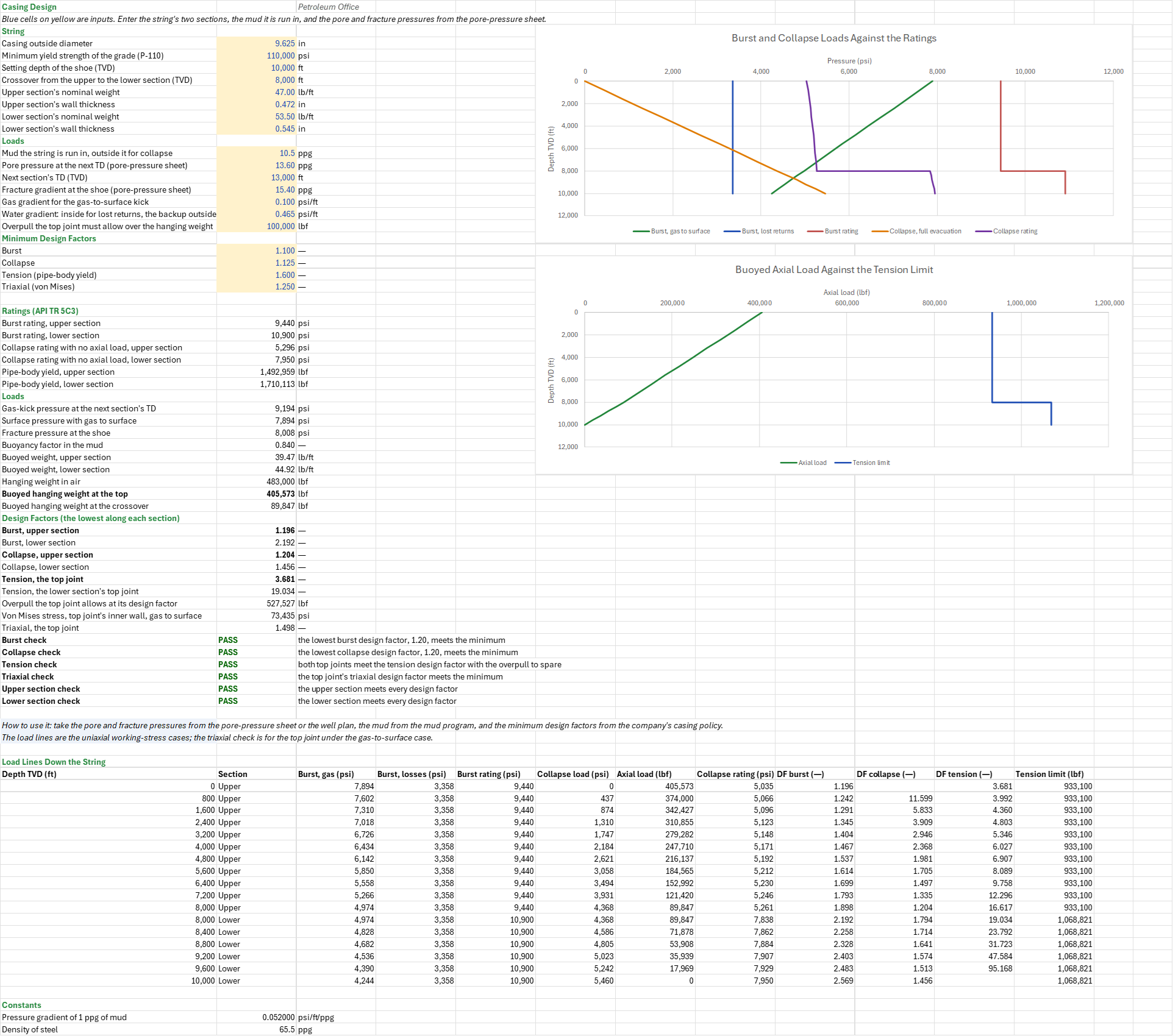
Will a two-section casing string hold the loads it is designed for? You enter the string's diameter, grade, shoe and crossover, each section's weight and wall, the mud, pore and fracture pressures, and the minimum design factors. You read off each section's API TR 5C3 burst, collapse and pipe-body yield ratings, the lowest burst, collapse and tension design factors along each section, and the top joint's overpull and triaxial design factor.
Parameters:
- String: outside diameter
CSG_OD(in), the grade's minimum yield strengthCSG_Yp(psi), the shoeCSG_Shoeand the crossoverCSG_Xover(ft TVD), and each section's nominal weight and wall,CSG_W1/CSG_T1above andCSG_W2/CSG_T2below (lb/ft, in) - Loads: the mud the string is run in
CSG_MW(ppg), the pore pressure at the next section's TDCSG_PpTD(ppg) and that TDCSG_TD(ft), the fracture gradient at the shoeCSG_FgShoe(ppg), the gas gradientCSG_Ggasand the water gradientCSG_Gw(psi/ft), and the overpullCSG_Overpull(lbf) - Minimum design factors: burst
CSG_DFb, collapseCSG_DFc, tensionCSG_DFtand triaxialCSG_DFvm
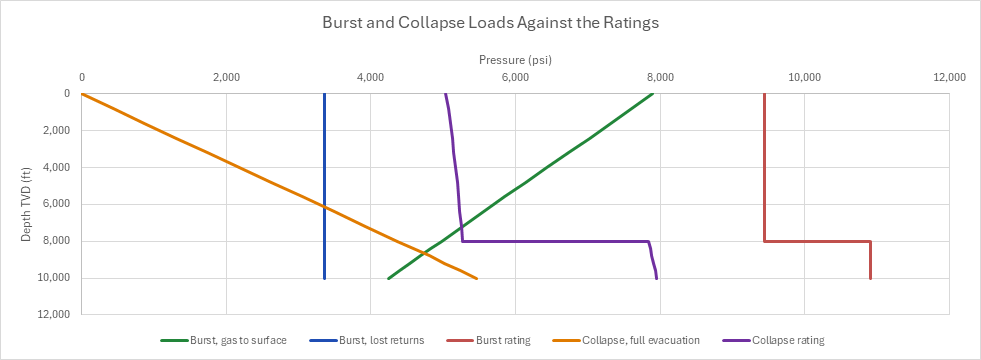
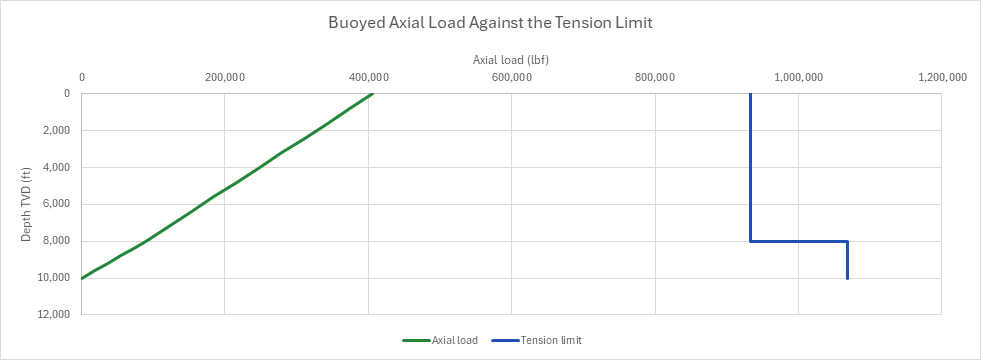
How to use it: The default well is made up. Take the pore and fracture pressures from the pore-pressure sheet or the well plan, the mud from the mud program, the sections from the casing tally, and the minimum design factors from the company's casing policy. Rate the connections separately: the sheet rates the pipe body only. Down the string the sheet draws the standard load lines. Burst is taken two ways: gas to surface from a kick at the next section's TD, and lost returns with water from the fracture pressure at the shoe, both against a water backup. Collapse is full evacuation against the mud the string was run in. The axial load at each depth is the buoyed weight of the string below it, and it lowers the collapse rating. Compare the design factor of each load at each depth, and the lowest along each section, with the minimums for burst, collapse, tension with the overpull, and triaxial; each section passes only when it meets every one. One chart draws the burst and collapse loads against the ratings down the string, and another the axial load against the tension limit.
Method: Burst is 0.875 × 2 Yp t/D, Barlow's equation at the API minimum wall. Collapse is API's yield, plastic, transition or elastic equation, picked by D/t and the grade, with the yield strength replaced by the axial-stress equivalent grade Ypa = [√(1 − 0.75 (σa/Yp)²) − 0.5 σa/Yp] Yp. Pipe-body yield is (π/4)(D² − d²) Yp. Gas to surface puts Pp,TD − Ggas (TD − z) inside, lost returns Pfrac,shoe − Gw (shoe − z), each less Gw z outside. Full evacuation puts the mud's 0.052 MW z outside and nothing in. The buoyancy factor is 1 − MW/65.5 with the mud inside and out. The axial load at a depth is the buoyed weight per foot of each section times its length below that depth, and its stress is that load over the section's steel area, Fy/Yp. A design factor is the rating over the load at the same depth. Burst takes the larger of the two burst loads, and collapse and tension are skipped where their load is zero. The tension limit is the yield over the tension design factor, and the overpull the top joint allows is that limit less the hanging weight. The top joint's triaxial stress is von Mises over Lamé's radial and hoop stresses at the inner wall, with the gas-to-surface pressure inside, nothing outside and the hanging weight's axial stress. Its design factor is Yp over that stress.
Example: The default case is the drilling family's reference well, the one the pore-pressure and cement-volume sheets use: a vertical onshore well with 13⅜-in. surface casing at 4,000 ft, a 12¼-in. intermediate hole to 10,000 ft cased with 9⅝-in. P-110, 47 lb/ft above 53.5 lb/ft from 8,000 ft, and an 8½-in. production hole to 13,000 ft. The walls are 0.472 and 0.545 in.; the plain-end weight 10.68 (D − t) t lb/ft checks them at 46.1 and 52.9 lb/ft. The string is run in the 10.5 ppg intermediate mud. The pore-pressure sheet gives 13.6 ppg at the 13,000 ft TD and a 15.4 ppg fracture gradient at the shoe. The gas is 0.1 psi/ft, the water 0.465 psi/ft, and the overpull 100,000 lbf. The minimum design factors are 1.1 for burst, 1.125 for collapse, 1.6 for tension and 1.25 for triaxial.
The upper section rates 9,440 psi in burst and 5,296 psi in collapse, with a pipe-body yield of 1,493,000 lbf. The lower section rates 10,900 psi in burst and 7,950 psi in collapse. A 13.6 ppg kick at 13,000 ft is 9,194 psi, so gas to surface leaves 7,894 psi at the wellhead: a burst design factor of 9,440/7,894 = 1.196, the string's lowest. Lost returns from the 8,008 psi fracture pressure at the shoe give 3,358 psi of net burst all the way down. Full evacuation loads the 47 lb/ft pipe with 4,368 psi at the 8,000 ft crossover, where the 89,847 lbf of lower section hanging below lowers its rating to 5,261 psi: a collapse design factor of 1.20. The 53.5 lb/ft pipe's lowest is 1.46, at the shoe. The buoyancy factor in 10.5 ppg mud is 0.8397, so the 483,000 lbf string hangs 405,573 lbf at the top, a tension design factor of 3.68, with 527,527 lbf of overpull to spare at 1.6. The top joint's von Mises stress under gas to surface is 73,435 psi, a triaxial design factor of 1.50. The string meets every minimum. Run the 47 lb/ft to 9,500 ft and its collapse design factor at the crossover falls to 1.02, under the 1.125 minimum. Run N-80 in place of P-110 and the top joint fails in burst (0.87), collapse (1.07) and triaxial (1.09); a 15 ppg kick at TD puts 8,840 psi at the wellhead, a burst design factor of 1.07.
Functions used
None: the blueprint calculates with Excel's own functions.
Names (67)
| Name | Refers to | Comment |
|---|---|---|
PO.DE.Casing.Burst.API5C3LAMBDA |
=LAMBDA(OD_in, t_in, Yp_psi, 0.875*2*Yp_psi*t_in/OD_in) |
API TR 5C3 pipe-body internal yield (burst) pressure, Barlow with the 0.875 wall tolerance, [psi]. |
PO.DE.Casing.Collapse.API5C3LAMBDA |
=LAMBDA(OD_in, t_in, Yp_psi, Sa_psi, Output, LET(s, Sa_psi/Yp_psi, Ya, (SQRT(1-0.75*s^2)-0.5*s)*Yp_psi, kA, 2.8762+0.10679E-5*Ya+0.21301E-10*Ya^2-0.53132E-16*Ya^3, kB, 0.026233+0.50609E-6*Ya, kC, -465.93+0.030867*Ya-0.10483E-7*Ya^2+0.36989E-13*Ya^3, ba, kB/kA, xa, 3*ba/(2+ba), kF, 46950000*xa^3/(Ya*(xa-ba)*(1-xa)^2), kG, kF*ba, dtYP, (SQRT((kA-2)^2+8*(kB+kC/Ya))+(kA-2))/(2*(kB+kC/Ya)), dtPT, Ya*(kA-kF)/(kC+Ya*(kB-kG)), dtTE, (2+ba)/(3*ba), dt, OD_in/t_in, reg, IF(dt<=dtYP, 1, IF(dt<=dtPT, 2, IF(dt<=dtTE, 3, 4))), pc, IF(reg=1, 2*Ya*(dt-1)/dt^2, IF(reg=2, Ya*(kA/dt-kB)-kC, IF(reg=3, Ya*(kF/dt-kG), 46950000/(dt*(dt-1)^2)))), IF(Output=2, HSTACK(dtYP, dtPT, dtTE), IF(Output=1, HSTACK(pc, reg), pc)))) |
API TR 5C3 collapse pressure in the yield, plastic, transition or elastic regime chosen from D/t, with the axial-stress equivalent grade; Output 1 adds the regime, 2 returns the regime D/t limits, [psi]. |
PO.DE.Casing.Axial.YieldLAMBDA |
=LAMBDA(BodyOD_in, BodyWall_in, BodyYp_psi, PI()/4*(BodyOD_in^2-(BodyOD_in-2*BodyWall_in)^2)*BodyYp_psi) |
API TR 5C3 pipe-body yield strength, Fy = (pi/4)(D^2 - d^2) Yp, [lbf]. |
PO.DE.Casing.LoadCaseLAMBDA |
=LAMBDA(Case, D_ft, Pref_psi, Dref_ft, Gin_psift, Gout_psift, Level_ft, LET(pout, Gout_psift*D_ft, pburst, Pref_psi-Gin_psift*(Dref_ft-D_ft), pevac, IF(Case=3, 0, IF(D_ft>Level_ft, Gin_psift*(D_ft-Level_ft), 0)), IF(OR(Case<1, Case>4), NA(), IF(Case<=2, pburst-pout, pout-pevac)))) |
Casing load line at a depth: net burst (1 gas to surface, 2 lost returns with water) or net collapse (3 full evacuation, 4 partial evacuation) pressure with the external backup, [psi]. |
PO.DE.Casing.DesignFactorLAMBDA |
=LAMBDA(Rating, Load, DF_min, LET(df, Rating/Load, HSTACK(df, IF(df>=DF_min, 1, 0)))) |
Casing design factor, rating / load, and whether it meets the named minimum design factor (1 pass, 0 fail). |
PO.DE.Casing.VonMisesLAMBDA |
=LAMBDA(WallOD_in, t_in, Pi_psi, Po_psi, Sa_psi, r_in, LET(ro, WallOD_in/2, ri, ro-t_in, k, ro^2-ri^2, mean, (Pi_psi*ri^2-Po_psi*ro^2)/k, dev, (Pi_psi-Po_psi)*ri^2*ro^2/(k*r_in^2), sr, mean-dev, sh, mean+dev, SQRT(((Sa_psi-sr)^2+(sr-sh)^2+(sh-Sa_psi)^2)/2))) |
Triaxial (von Mises) equivalent stress at radius r of a casing wall: Lame radial and hoop stress from internal and external pressure plus the axial stress, [psi]. |
PO.DE.TD.BuoyancyLAMBDA |
=LAMBDA(PipeW_lbft, PipeOD_in, PipeID_in, MWi_ppg, MWo_ppg, RhoSteel_ppg, LET(bf, 1 - (MWo_ppg*PipeOD_in^2 - MWi_ppg*PipeID_in^2) / (RhoSteel_ppg*(PipeOD_in^2 - PipeID_in^2)), HSTACK(bf, PipeW_lbft*bf))) |
Buoyancy factor of a pipe with different fluids inside and outside, and its buoyed weight per foot: {BF, lb/ft}. |
CSG_OD |
$B$4 |
Casing outside diameter, in |
CSG_Yp |
$B$5 |
Minimum yield strength of the grade (P-110), psi |
CSG_Shoe |
$B$6 |
Setting depth of the shoe (TVD), ft |
CSG_Xover |
$B$7 |
Crossover from the upper to the lower section (TVD), ft |
CSG_W1 |
$B$8 |
Upper section's nominal weight, lb/ft |
CSG_T1 |
$B$9 |
Upper section's wall thickness, in |
CSG_W2 |
$B$10 |
Lower section's nominal weight, lb/ft |
CSG_T2 |
$B$11 |
Lower section's wall thickness, in |
CSG_MW |
$B$13 |
Mud the string is run in, outside it for collapse, ppg |
CSG_PpTD |
$B$14 |
Pore pressure at the next TD (pore-pressure sheet), ppg |
CSG_TD |
$B$15 |
Next section's TD (TVD), ft |
CSG_FgShoe |
$B$16 |
Fracture gradient at the shoe (pore-pressure sheet), ppg |
CSG_Ggas |
$B$17 |
Gas gradient for the gas-to-surface kick, psi/ft |
CSG_Gw |
$B$18 |
Water gradient: inside for lost returns, the backup outside, psi/ft |
CSG_Overpull |
$B$19 |
Overpull the top joint must allow over the hanging weight, lbf |
CSG_DFb |
$B$21 |
Burst |
CSG_DFc |
$B$22 |
Collapse |
CSG_DFt |
$B$23 |
Tension (pipe-body yield) |
CSG_DFvm |
$B$24 |
Triaxial (von Mises) |
CSG_Inputs |
$B$4:$B$24 |
The string's diameter, grade, shoe, crossover and two sections, the mud, the pore and fracture pressures, the gas and water gradients, the overpull and the four minimum design factors |
CSG_Pb1 |
$B$27 |
Burst rating, upper section, psi |
CSG_Pb2 |
$B$28 |
Burst rating, lower section, psi |
CSG_Pc1 |
$B$29 |
Collapse rating with no axial load, upper section, psi |
CSG_Pc2 |
$B$30 |
Collapse rating with no axial load, lower section, psi |
CSG_Fy1 |
$B$31 |
Pipe-body yield, upper section, lbf |
CSG_Fy2 |
$B$32 |
Pipe-body yield, lower section, lbf |
CSG_Pref |
$B$34 |
Gas-kick pressure at the next section's TD, psi |
CSG_Psurf |
$B$35 |
Surface pressure with gas to surface, psi |
CSG_Pfrac |
$B$36 |
Fracture pressure at the shoe, psi |
CSG_BF |
$B$37 |
Buoyancy factor in the mud |
CSG_Wb1 |
$B$38 |
Buoyed weight, upper section, lb/ft |
CSG_Wb2 |
$B$39 |
Buoyed weight, lower section, lb/ft |
CSG_Hair |
$B$40 |
Hanging weight in air, lbf |
CSG_Htop |
$B$41 |
Buoyed hanging weight at the top, lbf |
CSG_Hx |
$B$42 |
Buoyed hanging weight at the crossover, lbf |
CSG_DFb1 |
$B$44 |
Burst, upper section |
CSG_DFb2 |
$B$45 |
Burst, lower section |
CSG_DFc1 |
$B$46 |
Collapse, upper section |
CSG_DFc2 |
$B$47 |
Collapse, lower section |
CSG_DFt1 |
$B$48 |
Tension, the top joint |
CSG_DFt2 |
$B$49 |
Tension, the lower section's top joint |
CSG_Pull |
$B$50 |
Overpull the top joint allows at its design factor, lbf |
CSG_VM |
$B$51 |
Von Mises stress, top joint's inner wall, gas to surface, psi |
CSG_DFvm1 |
$B$52 |
Triaxial, the top joint |
CSG_BurstCheck |
$B$53 |
Burst check verdict |
CSG_BurstCheckNote |
$C$53 |
Burst check comment |
CSG_CollapseCheck |
$B$54 |
Collapse check verdict |
CSG_CollapseCheckNote |
$C$54 |
Collapse check comment |
CSG_TensionCheck |
$B$55 |
Tension check verdict |
CSG_TensionCheckNote |
$C$55 |
Tension check comment |
CSG_TriaxialCheck |
$B$56 |
Triaxial check verdict |
CSG_TriaxialCheckNote |
$C$56 |
Triaxial check comment |
CSG_UpperCheck |
$B$57 |
Upper section check verdict |
CSG_UpperCheckNote |
$C$57 |
Upper section check comment |
CSG_LowerCheck |
$B$58 |
Lower section check verdict |
CSG_LowerCheckNote |
$C$58 |
Lower section check comment |
CSG_Results |
$B$27:$B$58 |
Each section's ratings, the kick, surface and fracture pressures, the buoyed weights and hanging weights, the lowest design factors, the overpull, the top joint's von Mises stress, and the six checks |
CSG_Curve |
$A$65:$L$81 |
Depth, section, the burst loads for gas to surface and lost returns, the burst rating, the collapse load for full evacuation, the axial load, the collapse rating under it, the three design factors and the tension limit |
CSG_Psi |
$B$84 |
Pressure gradient of 1 ppg of mud, psi/ft/ppg |
CSG_Steel |
$B$85 |
Density of steel, ppg |
Details
| Inserts | 85 rows × 12 columns |
| Category | Drilling Engineering |
| For agents and tools | Descriptor (.md) |