Primary Cement Job Design
Description
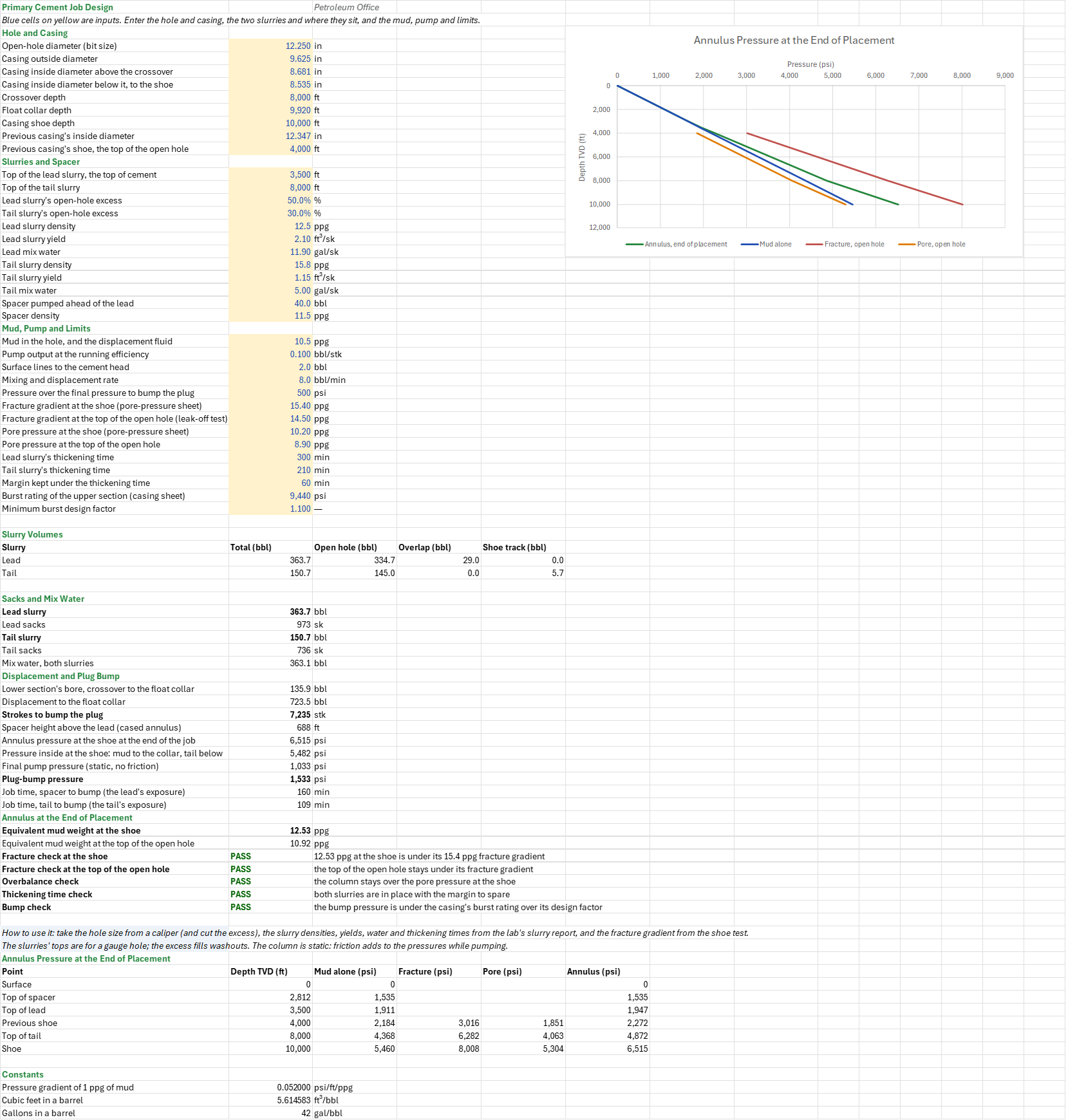
How much cement does a two-slurry primary cement job take, how many strokes bump the plug, and will the column break the formation down? You enter the hole and casing, the lead and tail slurries and the spacer, the mud, the pump and the limits. You read off each slurry's volume, sacks and mix water, the displacement and strokes to bump, the bump pressure against the burst rating, and the annulus pressure at the end of placement against the fracture and pore pressure.
Parameters:
- Hole and casing: the open hole
CMT_Hole, the casing ODCMT_OD, its ID above and below the crossoverCMT_IdTop/CMT_IdBot, and the previous casing's IDCMT_PrevId(in); the crossoverCMT_Xover, the float collarCMT_FC, the shoeCMT_Shoeand the previous shoeCMT_PrevShoe(ft) - Slurries and spacer: the tops of the lead and the tail
CMT_LeadTop,CMT_TailTop(ft), their open-hole excessCMT_LeadEx,CMT_TailEx, densityCMT_LeadW,CMT_TailW(ppg), yieldCMT_LeadY,CMT_TailY(ft³/sk) and mix waterCMT_LeadWat,CMT_TailWat(gal/sk); the spacer's volumeCMT_SpV(bbl) and densityCMT_SpW(ppg) - Mud, pump and limits: the mud
CMT_MW(ppg), the pump outputCMT_PumpOut(bbl/stk), the surface linesCMT_Lines(bbl), the rateCMT_Rate(bbl/min), the bump overpressureCMT_Bump(psi), the fracture and pore pressure at the shoe and at the top of the open holeCMT_FgShoe,CMT_FgTop,CMT_PpShoe,CMT_PpTop(ppg), the thickening timesCMT_LeadTT,CMT_TailTTand the margin under themCMT_TTMargin(min), and the casing's burst ratingCMT_Pburst(psi) and design factorCMT_DFb
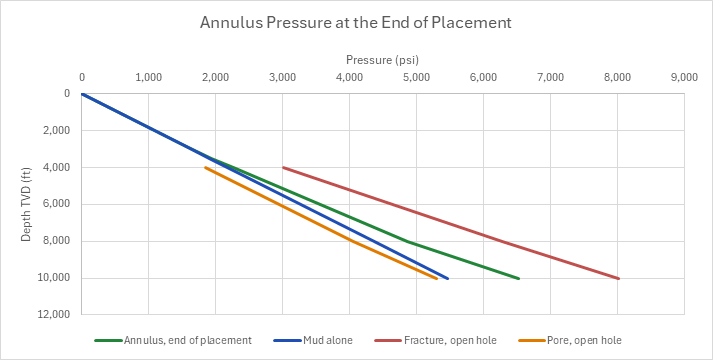
How to use it: The slurries are made up for the example. Take each slurry's density, yield, mix water and thickening time from the lab's slurry report for this job's temperature, and the hole size from a caliper: with a caliper average for the hole, cut the excess to what the caliper does not see. Take the fracture gradient from the shoe test above and the pore-pressure sheet below, and the pump output from the rig's pump at its running efficiency. The lead and the tail are sized one volume each, with the open hole and its excess, the overlap inside the previous casing and the shoe track, and their sacks and mix water follow from each slurry's yield and water. The displacement runs to the float collar through a tapered string. The job time is set against each slurry's thickening time. The annulus pressure at the end of placement, the highest static pressure the open hole sees while the heavier slurries go in, is checked against the fracture gradient at the shoe and at the top of the open hole, and against the pore pressure at the shoe: the column fails at or over the fracture gradient at either point, and under the pore pressure at the shoe. A slurry that is not in place a margin before its thickening time fails, and so does a bump pressure over the casing's burst rating divided by its design factor. A depth chart draws the annulus column at each fluid boundary against the mud alone and the open hole's fracture and pore pressure.
Method: Each slurry's volume is a capacity times a length: (Dh² − OD²)/1029.4 bbl/ft for the open hole, times (1 + excess); (IDprev² − OD²)/1029.4 for the overlap; and ID²/1029.4 for the shoe track. The lead fills the open hole from the tail's top up to the previous shoe and the overlap above it, and the tail fills the open hole from the shoe to its top, plus the shoe track. Sacks are the volume × 5.6146 ft³/bbl over the yield, and mix water the sacks × water over 42 gal/bbl. The displacement is the upper bore, IDupper²/1029.4 × crossover depth, plus the lower bore to the float collar and the lines, which the cement displacement function takes as its extra volume; the strokes are that over the pump output. The spacer rises above the lead in the cased annulus, a height of its volume over (IDprev² − OD²)/1029.4. At the end of placement the annulus holds, from the top, mud, spacer, lead and tail, each at its height for a gauge hole. Its pressure at each boundary is the sum of 0.052 × density × height above. Inside the casing is mud to the float collar and tail in the shoe track. The final pump pressure is the static difference between the annulus and the inside at the shoe, and the bump pressure adds the bump overpressure. The lead is pumped from the start, so its exposure is the whole job, spacer to bump, at the rate; the tail's runs from its own start. The fracture and pore pressure across the open hole are drawn as a mud weight straight between the two shoes.
Example: The drilling family's reference well, the one the pore-pressure and casing-design sheets use: the 9⅝-in. string of the casing sheet, 47 lb/ft (ID 8.681 in.) above 53.5 lb/ft (ID 8.535 in.) from 8,000 ft, in a 12¼-in. hole from below the 13⅜-in. 72 lb/ft surface shoe (ID 12.347 in.) at 4,000 ft to the shoe at 10,000 ft, with the float collar at 9,920 ft. The lead rises from 8,000 ft to 3,500 ft, 500 ft inside the surface casing, at 50 % excess; the tail fills the last 2,000 ft at 30 % excess and the 80 ft shoe track. The lead is 12.5 ppg (2.10 ft³/sk, 11.9 gal/sk) and the tail 15.8 ppg (1.15 ft³/sk, 5.0 gal/sk), behind 40 bbl of 11.5 ppg spacer, and the job is displaced with the 10.5 ppg intermediate mud at 8 bbl/min through 2 bbl of lines with a 0.1 bbl/stk pump. The plug is bumped 500 psi over the final pressure. The pore-pressure sheet gives 15.4 ppg of fracture gradient and 10.2 ppg of pore pressure at the shoe. At the surface shoe the offset leak-off test is 14.5 ppg and the pore pressure 8.9 ppg. The thickening times are 300 min for the lead and 210 min for the tail, kept 60 min clear, and the upper casing bursts at 9,440 psi with a design factor of 1.1.
The lead takes 334.7 bbl of open hole at 50 % excess and 29.0 bbl of overlap, 363.7 bbl or 973 sacks. The tail takes 145.0 bbl at 30 % and 5.7 bbl of shoe track, 150.7 bbl or 736 sacks. Together they need 363 bbl of mix water. Displacement is 585.7 bbl down the upper bore, 135.9 bbl down the lower bore to the collar and 2 bbl of lines, 723.5 bbl or 7,235 strokes. The spacer stands 688 ft tall above the lead. At the end of the job the annulus puts 6,515 psi on the shoe, 12.53 ppg against a 15.4 ppg fracture gradient and 10.2 ppg of pore pressure. At the top of the open hole it is 10.92 ppg against the 14.5 ppg leak-off test. Inside, mud to the collar and tail in the shoe track make 5,482 psi, so the final pump pressure is 1,033 psi and the plug bumps at 1,533 psi, well under the 9,440 psi burst rating over 1.1. The whole job takes 160 min at 8 bbl/min, and the tail is in place 109 min after it starts, both inside their thickening times by more than the 60 min margin.
Functions used
None: the blueprint calculates with Excel's own functions.
Names (74)
| Name | Refers to | Comment |
|---|---|---|
PO.DE.Cement.VolumeLAMBDA |
=LAMBDA(Dh_in, OD_in, ID_in, PrevID_in, OH_ft, CH_ft, Shoe_ft, Excess, LET(voh, (Dh_in^2 - OD_in^2)/1029.4*OH_ft*(1 + Excess), vch, (PrevID_in^2 - OD_in^2)/1029.4*CH_ft, vsh, ID_in^2/1029.4*Shoe_ft, HSTACK(voh + vch + vsh, voh, vch, vsh))) |
Slurry volume of one cement stage, bbl: open-hole annulus with excess, cased overlap and shoe track, as {total, open hole, overlap, shoe track}. |
PO.DE.Cement.DisplacementLAMBDA |
=LAMBDA(CasingID_in, FC_ft, Extra_bbl, PumpOut_bblstk, LET(vol, CasingID_in^2/1029.4*FC_ft + Extra_bbl, HSTACK(vol, vol/PumpOut_bblstk))) |
Cement displacement volume to the float collar, bbl, and the pump strokes to bump the plug: {bbl, strokes}. |
PO.DE.PipeCapacityLAMBDA |
=LAMBDA(ID_in, ID_in^2 / 1029.4) |
Internal capacity of a pipe, bbl/ft, from its inside diameter. |
PO.DE.AnnularCapacityLAMBDA |
=LAMBDA(Dh_in, Dp_in, (Dh_in^2 - Dp_in^2) / 1029.4) |
Annular capacity, bbl/ft, from the hole and pipe diameters. |
PO.DE.HydrostaticLAMBDA |
=LAMBDA(MW_ppg, TVD_ft, 0.052 * MW_ppg * TVD_ft) |
Hydrostatic pressure, psi, of a mud column of the given weight and true vertical depth. |
CMT_Hole |
$B$4 |
Open-hole diameter (bit size), in |
CMT_OD |
$B$5 |
Casing outside diameter, in |
CMT_IdTop |
$B$6 |
Casing inside diameter above the crossover, in |
CMT_IdBot |
$B$7 |
Casing inside diameter below it, to the shoe, in |
CMT_Xover |
$B$8 |
Crossover depth, ft |
CMT_FC |
$B$9 |
Float collar depth, ft |
CMT_Shoe |
$B$10 |
Casing shoe depth, ft |
CMT_PrevId |
$B$11 |
Previous casing's inside diameter, in |
CMT_PrevShoe |
$B$12 |
Previous casing's shoe, the top of the open hole, ft |
CMT_LeadTop |
$B$14 |
Top of the lead slurry, the top of cement, ft |
CMT_TailTop |
$B$15 |
Top of the tail slurry, ft |
CMT_LeadEx |
$B$16 |
Lead slurry's open-hole excess, % |
CMT_TailEx |
$B$17 |
Tail slurry's open-hole excess, % |
CMT_LeadW |
$B$18 |
Lead slurry density, ppg |
CMT_LeadY |
$B$19 |
Lead slurry yield, ft³/sk |
CMT_LeadWat |
$B$20 |
Lead mix water, gal/sk |
CMT_TailW |
$B$21 |
Tail slurry density, ppg |
CMT_TailY |
$B$22 |
Tail slurry yield, ft³/sk |
CMT_TailWat |
$B$23 |
Tail mix water, gal/sk |
CMT_SpV |
$B$24 |
Spacer pumped ahead of the lead, bbl |
CMT_SpW |
$B$25 |
Spacer density, ppg |
CMT_MW |
$B$27 |
Mud in the hole, and the displacement fluid, ppg |
CMT_PumpOut |
$B$28 |
Pump output at the running efficiency, bbl/stk |
CMT_Lines |
$B$29 |
Surface lines to the cement head, bbl |
CMT_Rate |
$B$30 |
Mixing and displacement rate, bbl/min |
CMT_Bump |
$B$31 |
Pressure over the final pressure to bump the plug, psi |
CMT_FgShoe |
$B$32 |
Fracture gradient at the shoe (pore-pressure sheet), ppg |
CMT_FgTop |
$B$33 |
Fracture gradient at the top of the open hole (leak-off test), ppg |
CMT_PpShoe |
$B$34 |
Pore pressure at the shoe (pore-pressure sheet), ppg |
CMT_PpTop |
$B$35 |
Pore pressure at the top of the open hole, ppg |
CMT_LeadTT |
$B$36 |
Lead slurry's thickening time, min |
CMT_TailTT |
$B$37 |
Tail slurry's thickening time, min |
CMT_TTMargin |
$B$38 |
Margin kept under the thickening time, min |
CMT_Pburst |
$B$39 |
Burst rating of the upper section (casing sheet), psi |
CMT_DFb |
$B$40 |
Minimum burst design factor |
CMT_Inputs |
$B$4:$B$40 |
The hole and the tapered casing, the previous shoe, the two slurries and the spacer, the mud, the pump, the bump pressure, the pore and fracture pressures, the thickening times and the casing's burst rating |
CMT_Slurries |
$A$44:$E$45 |
Each slurry's total volume and its open-hole (with excess), overlap and shoe-track parts |
CMT_LeadV |
$B$48 |
Lead slurry, bbl |
CMT_LeadSk |
$B$49 |
Lead sacks, sk |
CMT_TailV |
$B$50 |
Tail slurry, bbl |
CMT_TailSk |
$B$51 |
Tail sacks, sk |
CMT_Water |
$B$52 |
Mix water, both slurries, bbl |
CMT_BoreLow |
$B$54 |
Lower section's bore, crossover to the float collar, bbl |
CMT_DispV |
$B$55 |
Displacement to the float collar, bbl |
CMT_Strokes |
$B$56 |
Strokes to bump the plug, stk |
CMT_SpH |
$B$57 |
Spacer height above the lead (cased annulus), ft |
CMT_Pann |
$B$58 |
Annulus pressure at the shoe at the end of the job, psi |
CMT_Pin |
$B$59 |
Pressure inside at the shoe: mud to the collar, tail below, psi |
CMT_Pfinal |
$B$60 |
Final pump pressure (static, no friction), psi |
CMT_Pbump |
$B$61 |
Plug-bump pressure, psi |
CMT_LeadTime |
$B$62 |
Job time, spacer to bump (the lead's exposure), min |
CMT_TailTime |
$B$63 |
Job time, tail to bump (the tail's exposure), min |
CMT_EmwShoe |
$B$65 |
Equivalent mud weight at the shoe, ppg |
CMT_EmwTop |
$B$66 |
Equivalent mud weight at the top of the open hole, ppg |
CMT_FracShoeCheck |
$B$67 |
Fracture check at the shoe verdict |
CMT_FracShoeCheckNote |
$C$67 |
Fracture check at the shoe comment |
CMT_FracTopCheck |
$B$68 |
Fracture check at the top of the open hole verdict |
CMT_FracTopCheckNote |
$C$68 |
Fracture check at the top of the open hole comment |
CMT_OverbalanceCheck |
$B$69 |
Overbalance check verdict |
CMT_OverbalanceCheckNote |
$C$69 |
Overbalance check comment |
CMT_TimeCheck |
$B$70 |
Thickening time check verdict |
CMT_TimeCheckNote |
$C$70 |
Thickening time check comment |
CMT_BumpCheck |
$B$71 |
Bump check verdict |
CMT_BumpCheckNote |
$C$71 |
Bump check comment |
CMT_Results |
$B$48:$B$71 |
The slurry volumes, sacks and mix water, the displacement and strokes, the spacer height, the annulus and inside pressures, the final and bump pressures, the job times, the equivalent mud weights and the five checks |
CMT_Profile |
$A$77:$F$82 |
Each fluid boundary in the annulus at the end of placement, its depth, the mud alone, the open hole's fracture and pore pressure, and the annulus pressure |
CMT_Psi |
$B$85 |
Pressure gradient of 1 ppg of mud, psi/ft/ppg |
CMT_Ft3Bbl |
$B$86 |
Cubic feet in a barrel, ft³/bbl |
CMT_GalBbl |
$B$87 |
Gallons in a barrel, gal/bbl |
Details
| Inserts | 87 rows × 6 columns |
| Category | Drilling Engineering |
| For agents and tools | Descriptor (.md) |