Saturation-Height Model
Description
What water saturation does each rock hold at each height above the free-water level, and how much oil is that? Between wells, and in a model where there is no log, the answer is a saturation-height function. You enter the log's transition zone, the core plugs of each rock type, the fluids and the free-water level. You read off one Leverett-J fit per rock type, the water saturation by height from each, the height at which each reaches a chosen saturation, and the oil in place over the column.
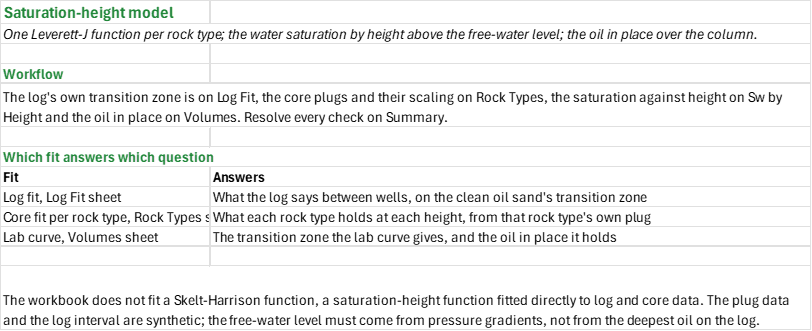
How to use it: Enter Archie's parameters, the gamma-ray picks, the free-water level (from pressure gradients, not from the deepest oil on the log), the reservoir fluids and the core porosity-permeability transform on the Log Fit sheet, and paste the transition zone's depth, gamma ray, bulk density and deep resistivity below them. Enter the plugs of each rock type, their laboratory fluids and the irreducible water on the Rock Types sheet; each rock type is fitted on its own rows, so never mix rock types in one fit. Read the saturation against height on the Sw by Height sheet. Enter the column's area and oil formation volume factor, and the lab curve's Brooks-Corey parameters, on the Volumes sheet. Resolve every check on the Summary.
Method: Height above the free-water level h = FWL - depth. One psi of reservoir capillary pressure holds water up 144/(rho w - rho o) ft, so Pc = h divided by that. The J of a sample is 0.2166 Pc/(sigma cos theta) times the square root of k/phi, at its density porosity and the permeability the core transform gives it. The log fit is a power law Sw = a J^b, a straight line fitted on ln Sw against ln J, with the scatter as the RMS of the fitted minus the logged Sw. Each core rock type's fit is the same power law on that rock type's own plug points. The reference J curve J = a Sw*^b, fitted over all thirteen plugs, is what scales plug A's capillary pressure to rock B. The height at which a chosen saturation is reached comes back through the Leverett capillary pressure and the height conversion. The lab curve is a Brooks-Corey capillary pressure, Pc = Pd Sw*^(-1/lambda). The oil in place over the column is 7758 times the area, the porosity, the band height and the mean hydrocarbon saturation of the band, over the oil formation volume factor.
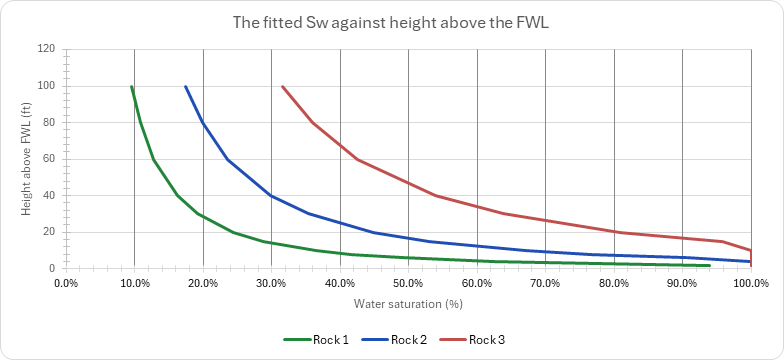
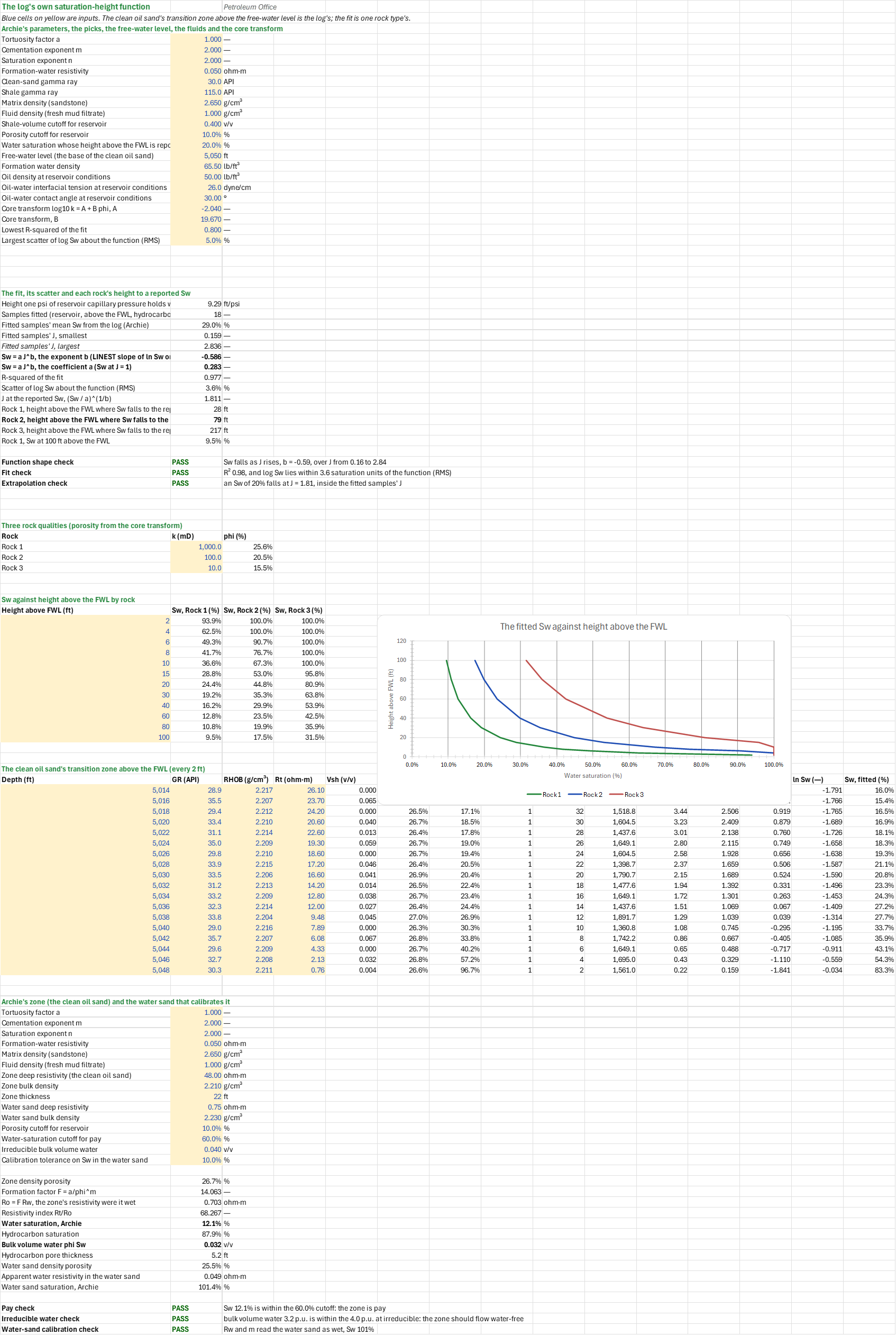
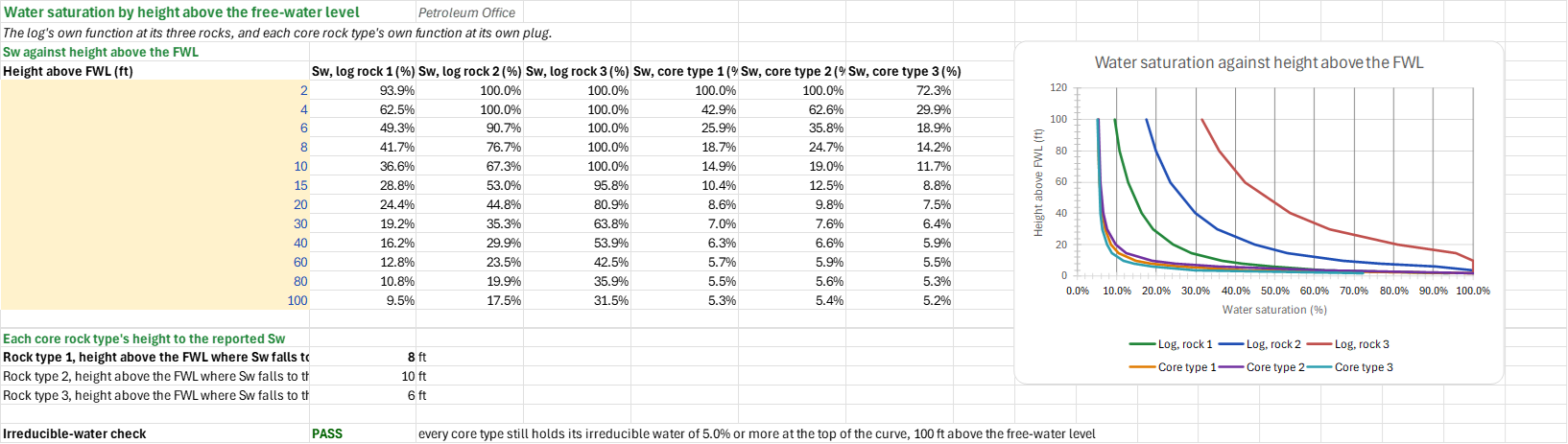
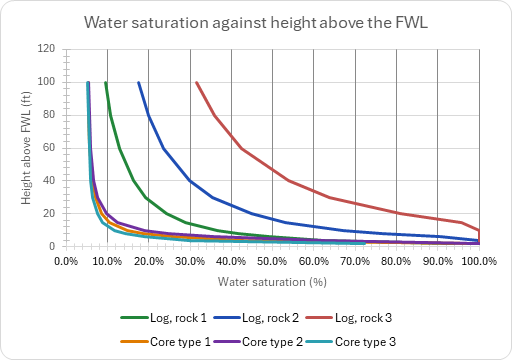
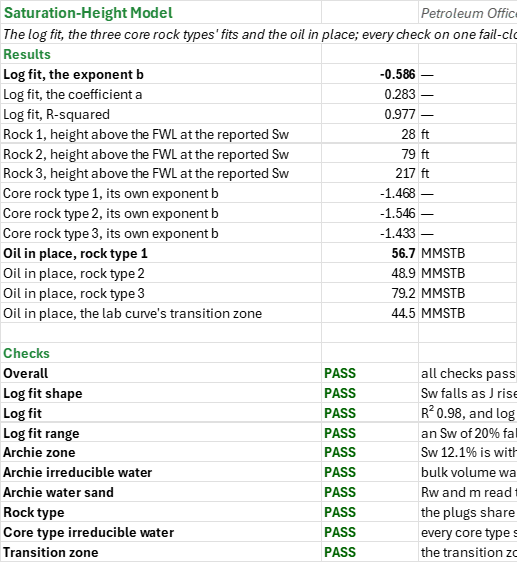
Example: The log's own fit, over the clean oil sand's transition zone from 5,014 to 5,048 ft above a free-water level at 5,050 ft: a power law Sw = a J^b with b = -0.5859 and a = 0.2832, an R-squared of 0.9771 and an RMS scatter of 0.0357 saturation units. Rock 1 (1,000 mD) reaches the reported 20 % water saturation 27.99 ft above the FWL, rock 2 (100 mD) at 79.25 ft and rock 3 (10 mD) at 217.40 ft; rock 1 still holds 0.0949 water at 100 ft above the FWL.
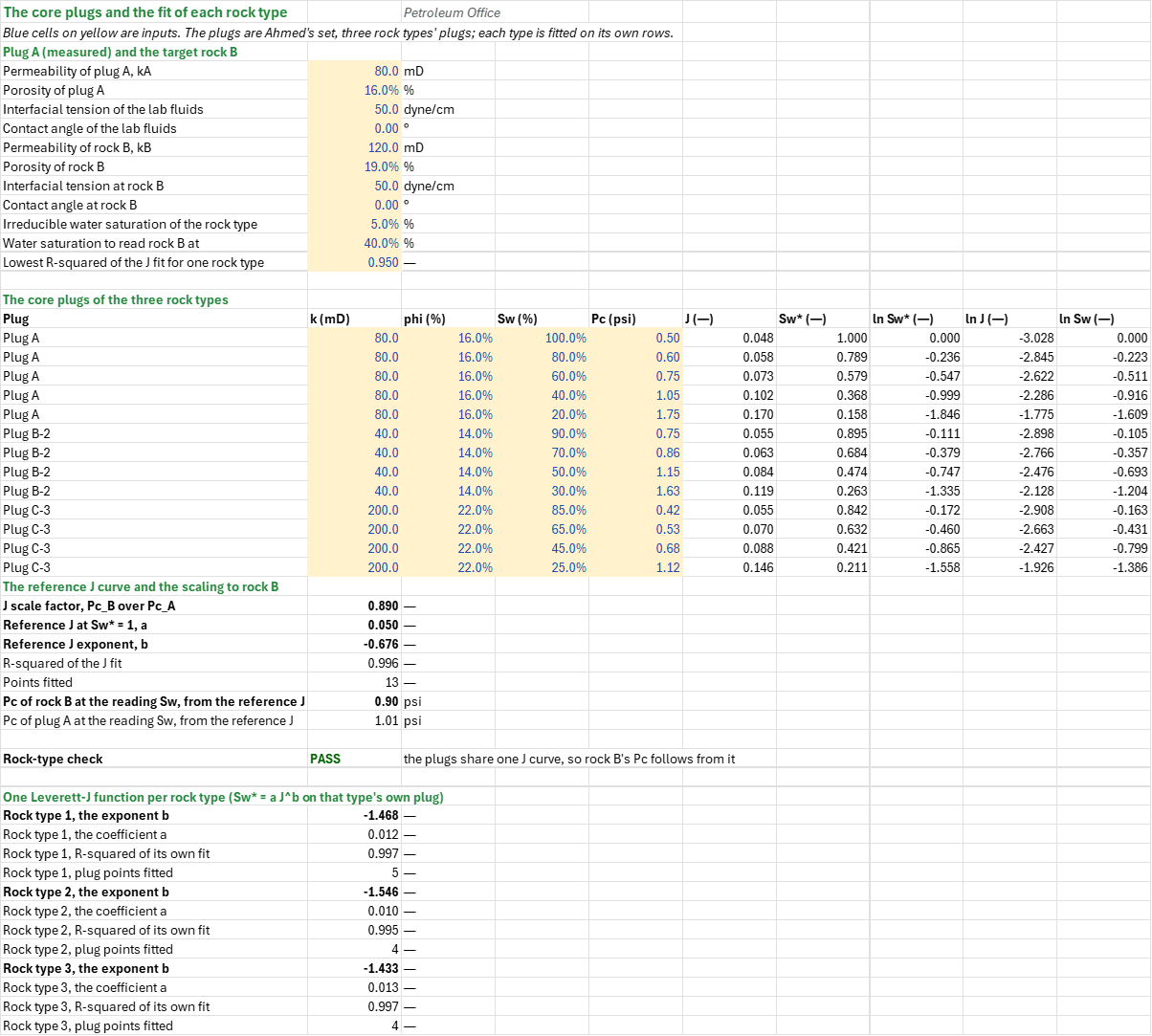
The scaling of plug A to rock B is Ahmed's Example 4-7: a scale factor of 0.8898, a reference J curve of a = 0.0498 and b = -0.6765 at an R-squared of 0.9961, and rock B's capillary pressure of 0.898 psi at 40 % water saturation against plug A's 1.009 psi.
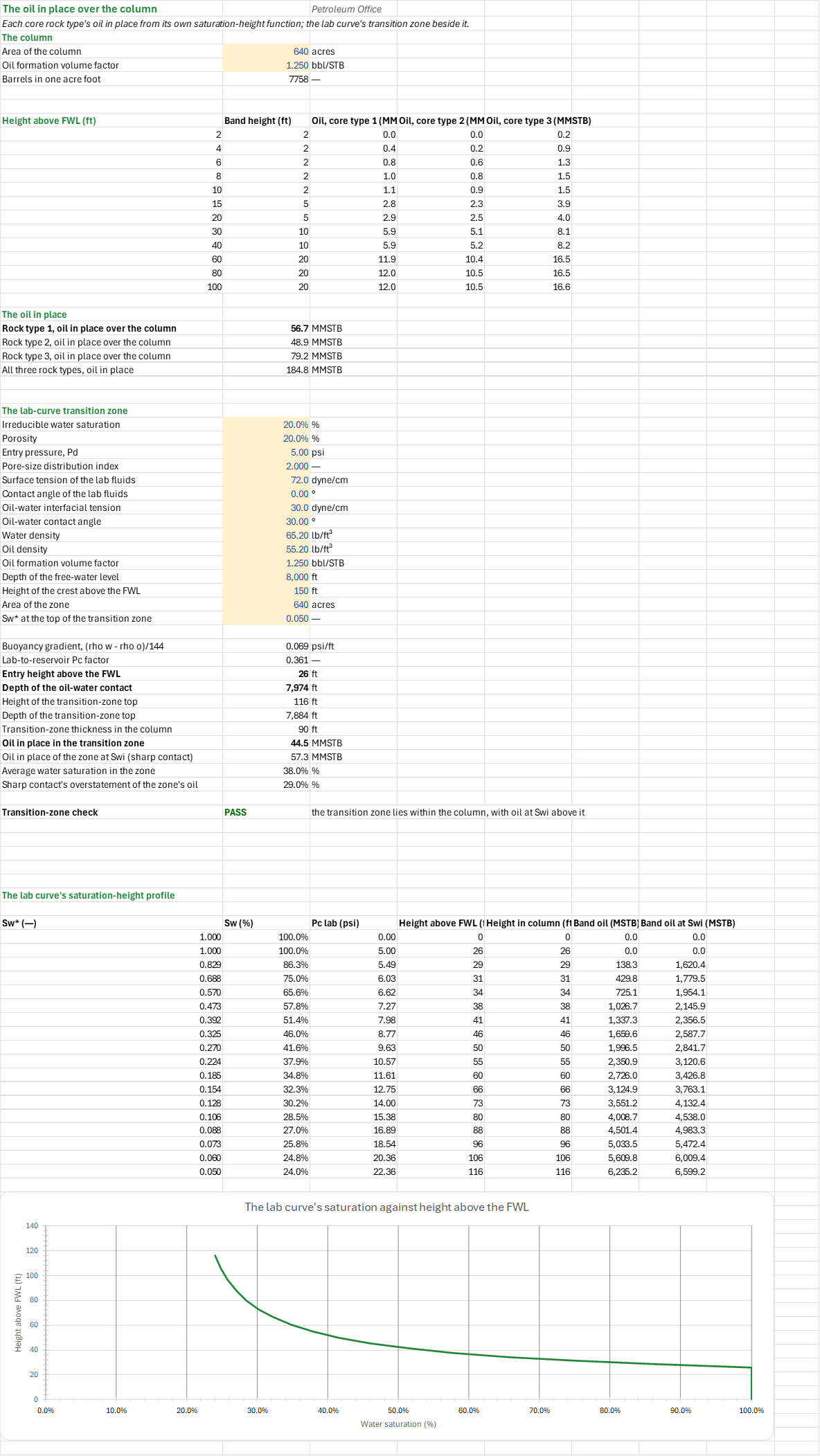
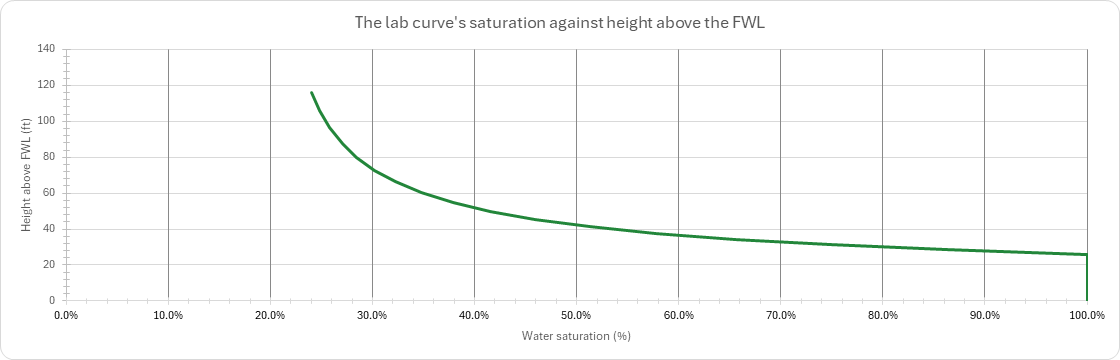
The three core rock types are fitted on their own plugs, each on its normalised saturation Sw* = (Sw - Swi)/(1 - Swi), so each curve flattens at the irreducible water instead of falling through it: rock type 1 (plug A, five points) b = -1.4684 and a = 0.0121 at an R-squared of 0.9994, rock type 2 (plug B-2, four points) b = -1.5461 and rock type 3 (plug C-3, four points) b = -1.4332. Rock type 1 reaches the reported 20 % water saturation 7.52 ft above the free-water level, rock type 2 at 9.55 ft and rock type 3 at 5.70 ft, and each still holds its 5 % irreducible water at 100 ft. Their oil in place over the column is 56.66, 48.90 and 79.22 MMSTB, 184.79 MMSTB together. The lab curve's transition zone has a buoyancy gradient of 0.0694 psi/ft, an entry height of 25.98 ft, a contact at 7,974.0 ft and a zone 90.21 ft thick, and holds 44.46 MMSTB over the zone's 640 acres against a sharp contact's 57.33 MMSTB: the sharp contact overstates the zone's oil by 29.0 %. Every one of these numbers matches its source calculation on the same inputs.
Validity
A Leverett-J function holds within one rock type, and each rock type needs its own fit: the workbook fits three core rock types separately for that reason. The J basis: the plugs' J is the laboratory one, the Leverett J at the plug's own k and phi with the laboratory fluids (50 dyne/cm, 0 deg), and the reservoir's J at the same saturation is the same number, because the reservoir capillary pressure at a given saturation is the laboratory one times the sigma-cos-theta ratio (22.5167/50 here). The curve therefore reads J from the height above the free-water level at the plug's k and phi and the reservoir's fluids (26 dyne/cm, 30 deg), the same J the fit was made on, and the plug saturations are normalised by the irreducible water before the fit, so a curve flattens at Swi rather than at zero. The log's fit is one rock type's transition zone, and its samples are the family's synthetic interval, not field data. The power law Sw = a J^b has no entry pressure and no irreducible water: it never reaches 100 % at the free-water level and it falls without limit with height. Use it between the lowest and the highest J the samples span. The log's water saturation is Archie's, which reads too wet in shaly beds. The core plugs are Ahmed's published plug A with two synthetic plugs of the same rock type; the further plugs are points on the power law fitted to plug A, with a few percent of scatter, so the three core fits agree closely. The oil in place assumes the column's area and porosity and one saturation-height function throughout the column: a layered reservoir needs one profile per layer. The workbook does not fit a Skelt-Harrison function, a saturation-height function fitted directly to log and core data. Field units.
References
- Leverett, M.C. (1941). Capillary Behavior in Porous Solids. Transactions of the AIME 142(1), 152-169.
- Archie, G.E. (1942). The Electrical Resistivity Log as an Aid in Determining Some Reservoir Characteristics. Trans. AIME 146, 54-62.
- Brooks, R.H. and Corey, A.T. (1964). Hydraulic Properties of Porous Media. Hydrology Papers 3, Colorado State University.
- Ahmed, T. Reservoir Engineering Handbook. Gulf Professional Publishing, ch. 4, Example 4-7.
Inputs
| Input | Unit | Default | Name |
|---|---|---|---|
| Tortuosity factor a | — | 1 | SHM_a |
| Cementation exponent m | — | 2 | SHM_m |
| Saturation exponent n | — | 2 | SHM_n |
| Formation-water resistivity | ohm m | 0.05 | SHM_Rw |
| Clean-sand gamma ray | API | 30 | SHM_GRcl |
| Shale gamma ray | API | 115 | SHM_GRsh |
| Matrix density (sandstone) | g/cm3 | 2.65 | SHM_RhoMa |
| Fluid density (fresh mud filtrate) | g/cm3 | 1.0 | SHM_RhoF |
| Shale-volume cutoff for reservoir | fraction | 0.4 | SHM_VshCut |
| Porosity cutoff for reservoir | fraction | 0.1 | SHM_PhiCut |
| Water saturation whose height above the FWL is reported | fraction | 0.2 | SHM_SwH |
| Free-water level (the base of the clean oil sand) | ft | 5050 | SHM_FWL |
| Formation water density | lb/ft3 | 65.5 | SHM_RhoW |
| Oil density at reservoir conditions | lb/ft3 | 50 | SHM_RhoO |
| Oil-water interfacial tension at reservoir conditions | dyne/cm | 26 | SHM_Ift |
| Oil-water contact angle at reservoir conditions | deg | 30 | SHM_Theta |
| Core transform log10 k = A + B phi, A | — | -2.04 | SHM_PermA |
| Core transform, B | — | 19.67 | SHM_PermB |
| Permeability of plug A, kA | mD | 80 | SHR_KA |
| Porosity of plug A | fraction | 0.16 | SHR_PhiA |
| Interfacial tension of the lab fluids | dyne/cm | 50 | SHR_IftA |
| Contact angle of the lab fluids | deg | 0 | SHR_ThetaA |
| Permeability of rock B, kB | mD | 120 | SHR_KB |
| Porosity of rock B | fraction | 0.19 | SHR_PhiB |
| Interfacial tension at rock B | dyne/cm | 50 | SHR_IftB |
| Contact angle at rock B | deg | 0 | SHR_ThetaB |
| Irreducible water saturation of the rock type | fraction | 0.05 | SHR_Swi |
| Water saturation to read rock B at | fraction | 0.4 | SHR_Sw |
| Area of the column | acres | 640 | SHV_Area |
| Oil formation volume factor | bbl/STB | 1.25 | SHV_Bo |
| Barrels in one acre foot (constant) | bbl/acre ft | 7758 | SHV_AcFt |
| Lab curve: irreducible water saturation | fraction | 0.2 | SHV_Swi |
| Lab curve: porosity | fraction | 0.2 | SHV_Phi |
| Lab curve: entry pressure, Pd | psi | 5 | SHV_Pd |
| Lab curve: pore-size distribution index | — | 2 | SHV_Lambda |
| Lab curve: surface tension of the lab fluids | dyne/cm | 72 | SHV_IftLab |
| Lab curve: contact angle of the lab fluids | deg | 0 | SHV_ThetaLab |
| Lab curve: oil-water interfacial tension | dyne/cm | 30 | SHV_IftRes |
| Lab curve: oil-water contact angle | deg | 30 | SHV_ThetaRes |
| Lab curve: water density | lb/ft3 | 65.2 | SHV_RhoW |
| Lab curve: oil density | lb/ft3 | 55.2 | SHV_RhoO |
Sheets
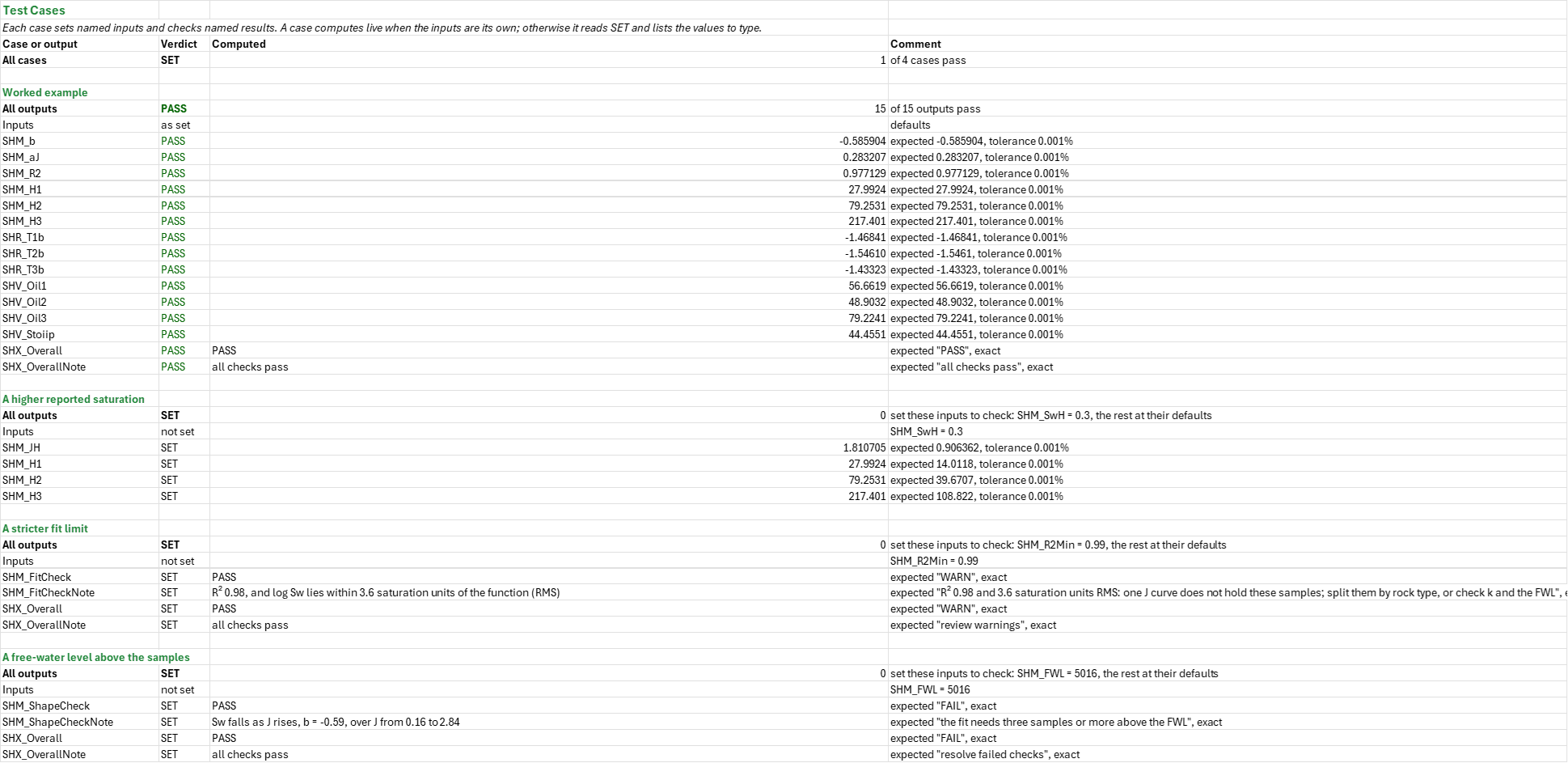
Guide— the workflow and which fit answers which question.Log Fit— the log's own fit on the clean oil sand's transition zone, the family's synthetic interval from 5,014 to 5,048 ft above a free-water level at 5,050 ft: eighteen samples of one rock type, each with its water saturation by Archie, its height, its reservoir capillary pressure and its Leverett J; the power-law fit and its scatter; the Sw against height chart; and the clean oil sand's Archie saturation with the water-sand calibration.Rock Types— Ahmed's thirteen core plugs (plug A, plug B-2 and plug C-3 rock types), the reference J curve and the scaling of plug A to rock B, and one Leverett-J fit per rock type on its own plugs.Sw by Height— the log function at its three rocks and each core rock type's function against height above the free-water level, each rock type's height to the reported Sw, and the chart.Volumes— each core rock type's oil in place over the column, band by band, and the lab curve's Brooks-Corey transition zone with its own oil in place against a sharp contact and its saturation-height profile.Summary— the log fit, the three core rock types' fits, the oil in place and every check under one verdict.Test Cases— the worked example and other cases, with expected and computed results.
Functions used
Names (187)
| Name | Refers to | Comment |
|---|---|---|
PO.PP.F.ArchieLAMBDA |
=LAMBDA(a, Phi, m, a/Phi^m) |
Archie formation factor, F = a / phi^m. |
PO.PP.Porosity.FromDensityLAMBDA |
=LAMBDA(Rho_ma, Rho_b, Rho_f, (Rho_ma-Rho_b)/(Rho_ma-Rho_f)) |
Porosity from a density log, (matrix density - bulk density) / (matrix density - fluid density). |
PO.PP.Sw.ArchieLAMBDA |
=LAMBDA(a, m, n, Phi, Rw, Rt, ((a/Phi^m)*(Rw/Rt))^(1/n)) |
Water saturation from the general Archie equation, Sw = ((a/phi^m)*(Rw/Rt))^(1/n). |
PO.PP.Vsh.GammaRayIndexLAMBDA |
=LAMBDA(GR, GR_cl, GR_sh, (GR-GR_cl)/(GR_sh-GR_cl)) |
Linear gamma-ray shale index, IGR = (GR - GRclean) / (GRshale - GRclean). |
PO.SCAL.PcToHeightLAMBDA |
=LAMBDA(Pc, ift_lab, theta_lab, ift_res, theta_res, rho_w, rho_o, LET(lab_term, ift_lab*COS(RADIANS(theta_lab)), res_term, ift_res*COS(RADIANS(theta_res)), drho, rho_w-rho_o, IF(OR(drho<=0, lab_term<=0, res_term<0), NA(), 144*Pc*res_term/lab_term/drho))) |
Height above the free water level of a laboratory capillary pressure: Pc_res = Pc·(σcosθ)res/(σcosθ)lab, h = 144·Pc_res/(ρw − ρo); #N/A when ρw ≤ ρo, [ft]. |
SHA_BVW |
'Log Fit'!$B$118 |
Bulk volume water phi Sw, v/v |
SHA_BvwCheck |
'Log Fit'!$B$125 |
Irreducible water check verdict |
SHA_BvwCheckNote |
'Log Fit'!$C$125 |
Irreducible water check comment |
SHA_BvwIrr |
'Log Fit'!$B$109 |
Irreducible bulk volume water, v/v |
SHA_FF |
'Log Fit'!$B$113 |
Formation factor F = a/phi^m |
SHA_H |
'Log Fit'!$B$104 |
Zone thickness, ft |
SHA_HCPT |
'Log Fit'!$B$119 |
Hydrocarbon pore thickness, ft |
SHA_Inputs |
'Log Fit'!$B$96:$B$110 |
Archie's parameters, the zone, the water sand and the cutoffs |
SHA_PayCheck |
'Log Fit'!$B$124 |
Pay check verdict |
SHA_PayCheckNote |
'Log Fit'!$C$124 |
Pay check comment |
SHA_Phi |
'Log Fit'!$B$112 |
Zone density porosity, % |
SHA_PhiCut |
'Log Fit'!$B$107 |
Porosity cutoff for reservoir, % |
SHA_PhiW |
'Log Fit'!$B$120 |
Water sand density porosity, % |
SHA_RI |
'Log Fit'!$B$115 |
Resistivity index Rt/Ro |
SHA_Results |
'Log Fit'!$B$112:$B$126 |
The zone's porosity, formation factor, Ro, resistivity index, Archie Sw, bulk volume water and hydrocarbon pore thickness, the water sand's porosity, Rwa and Sw, and the three checks |
SHA_RhoB |
'Log Fit'!$B$103 |
Zone bulk density, g/cm³ |
SHA_RhoBW |
'Log Fit'!$B$106 |
Water sand bulk density, g/cm³ |
SHA_RhoF |
'Log Fit'!$B$101 |
Fluid density (fresh mud filtrate), g/cm³ |
SHA_RhoMa |
'Log Fit'!$B$100 |
Matrix density (sandstone), g/cm³ |
SHA_Ro |
'Log Fit'!$B$114 |
Ro = F Rw, the zone's resistivity were it wet, ohm·m |
SHA_Rt |
'Log Fit'!$B$102 |
Zone deep resistivity (the clean oil sand), ohm·m |
SHA_RtW |
'Log Fit'!$B$105 |
Water sand deep resistivity, ohm·m |
SHA_Rw |
'Log Fit'!$B$99 |
Formation-water resistivity, ohm·m |
SHA_RwCheck |
'Log Fit'!$B$126 |
Water-sand calibration check verdict |
SHA_RwCheckNote |
'Log Fit'!$C$126 |
Water-sand calibration check comment |
SHA_Rwa |
'Log Fit'!$B$121 |
Apparent water resistivity in the water sand, ohm·m |
SHA_Shc |
'Log Fit'!$B$117 |
Hydrocarbon saturation, % |
SHA_Sw |
'Log Fit'!$B$116 |
Water saturation, Archie, % |
SHA_SwCut |
'Log Fit'!$B$108 |
Water-saturation cutoff for pay, % |
SHA_SwW |
'Log Fit'!$B$122 |
Water sand saturation, Archie, % |
SHA_Tol |
'Log Fit'!$B$110 |
Calibration tolerance on Sw in the water sand, % |
SHA_a |
'Log Fit'!$B$96 |
Tortuosity factor a |
SHA_m |
'Log Fit'!$B$97 |
Cementation exponent m |
SHA_n |
'Log Fit'!$B$98 |
Saturation exponent n |
SHH_Checks |
'Sw by Height'!$B$23 |
The irreducible-water check |
SHH_ChecksNote |
'Sw by Height'!$C$23 |
The irreducible-water check comment |
SHH_Curve |
'Sw by Height'!$A$5:$G$16 |
Heights above the free-water level, the log fit at its three rocks and each core rock type's own fit |
SHH_IrrCheck |
'Sw by Height'!$B$23 |
Irreducible-water check verdict |
SHH_IrrCheckNote |
'Sw by Height'!$C$23 |
Irreducible-water check comment |
SHH_Results |
'Sw by Height'!$B$19:$B$21 |
Each core rock type's height to the reported Sw |
SHH_T1H |
'Sw by Height'!$B$19 |
Rock type 1, height above the FWL where Sw falls to the reported Sw, ft |
SHH_T2H |
'Sw by Height'!$B$20 |
Rock type 2, height above the FWL where Sw falls to the reported Sw, ft |
SHH_T3H |
'Sw by Height'!$B$21 |
Rock type 3, height above the FWL where Sw falls to the reported Sw, ft |
SHM_Curve |
'Log Fit'!$A$59:$D$70 |
Heights above the free-water level and the fitted Sw of each rock at them |
SHM_FWL |
'Log Fit'!$B$15 |
Free-water level (the base of the clean oil sand), ft |
SHM_FitCheck |
'Log Fit'!$B$45 |
Fit check verdict |
SHM_FitCheckNote |
'Log Fit'!$C$45 |
Fit check comment |
SHM_GRcl |
'Log Fit'!$B$8 |
Clean-sand gamma ray, API |
SHM_GRsh |
'Log Fit'!$B$9 |
Shale gamma ray, API |
SHM_H1 |
'Log Fit'!$B$39 |
Rock 1, height above the FWL where Sw falls to the reported Sw, ft |
SHM_H2 |
'Log Fit'!$B$40 |
Rock 2, height above the FWL where Sw falls to the reported Sw, ft |
SHM_H3 |
'Log Fit'!$B$41 |
Rock 3, height above the FWL where Sw falls to the reported Sw, ft |
SHM_HPerPsi |
'Log Fit'!$B$29 |
Height one psi of reservoir capillary pressure holds water up, ft/psi |
SHM_Ift |
'Log Fit'!$B$18 |
Oil-water interfacial tension at reservoir conditions, dyne/cm |
SHM_Inputs |
'Log Fit'!$B$4:$B$23 |
Archie's parameters, the picks, the free-water level, the fluids, the core transform and the check limits |
SHM_JH |
'Log Fit'!$B$38 |
J at the reported Sw, (Sw / a)^(1/b) |
SHM_JMax |
'Log Fit'!$B$33 |
Fitted samples' J, largest |
SHM_JMin |
'Log Fit'!$B$32 |
Fitted samples' J, smallest |
SHM_MeanSw |
'Log Fit'!$B$31 |
Fitted samples' mean Sw from the log (Archie), % |
SHM_NFit |
'Log Fit'!$B$30 |
Samples fitted (reservoir, above the FWL, hydrocarbon-bearing) |
SHM_PermA |
'Log Fit'!$B$20 |
Core transform log10 k = A + B phi, A |
SHM_PermB |
'Log Fit'!$B$21 |
Core transform, B |
SHM_PhiCut |
'Log Fit'!$B$13 |
Porosity cutoff for reservoir, % |
SHM_R2 |
'Log Fit'!$B$36 |
R-squared of the fit |
SHM_R2Min |
'Log Fit'!$B$22 |
Lowest R-squared of the fit |
SHM_RangeCheck |
'Log Fit'!$B$46 |
Extrapolation check verdict |
SHM_RangeCheckNote |
'Log Fit'!$C$46 |
Extrapolation check comment |
SHM_Results |
'Log Fit'!$B$29:$B$46 |
The height per psi, the samples fitted, their mean Sw and J range, the power law's b, a and R-squared, its scatter, J at the reported Sw, each rock's height to it, rock 1's Sw at 100 ft and the three checks |
SHM_RhoF |
'Log Fit'!$B$11 |
Fluid density (fresh mud filtrate), g/cm³ |
SHM_RhoMa |
'Log Fit'!$B$10 |
Matrix density (sandstone), g/cm³ |
SHM_RhoO |
'Log Fit'!$B$17 |
Oil density at reservoir conditions, lb/ft³ |
SHM_RhoW |
'Log Fit'!$B$16 |
Formation water density, lb/ft³ |
SHM_Rms |
'Log Fit'!$B$37 |
Scatter of log Sw about the function (RMS), % |
SHM_Rocks |
'Log Fit'!$A$52:$C$54 |
Each rock's name, permeability and the porosity the core transform gives it |
SHM_Rw |
'Log Fit'!$B$7 |
Formation-water resistivity, ohm·m |
SHM_Samples |
'Log Fit'!$A$75:$O$92 |
Each sample's depth, GR, bulk density and deep resistivity, its Vsh, porosity, Archie Sw and fit flag, its height above the FWL, k, reservoir Pc and J, ln J, ln Sw and the fitted Sw |
SHM_ShapeCheck |
'Log Fit'!$B$44 |
Function shape check verdict |
SHM_ShapeCheckNote |
'Log Fit'!$C$44 |
Function shape check comment |
SHM_Sw100 |
'Log Fit'!$B$42 |
Rock 1, Sw at 100 ft above the FWL, % |
SHM_SwH |
'Log Fit'!$B$14 |
Water saturation whose height above the FWL is reported, % |
SHM_SwTol |
'Log Fit'!$B$23 |
Largest scatter of log Sw about the function (RMS), % |
SHM_Theta |
'Log Fit'!$B$19 |
Oil-water contact angle at reservoir conditions, ° |
SHM_VshCut |
'Log Fit'!$B$12 |
Shale-volume cutoff for reservoir, v/v |
SHM_a |
'Log Fit'!$B$4 |
Tortuosity factor a |
SHM_aJ |
'Log Fit'!$B$35 |
Sw = a J^b, the coefficient a (Sw at J = 1) |
SHM_b |
'Log Fit'!$B$34 |
Sw = a J^b, the exponent b (LINEST slope of ln Sw on ln J) |
SHM_m |
'Log Fit'!$B$5 |
Cementation exponent m |
SHM_n |
'Log Fit'!$B$6 |
Saturation exponent n |
SHR_IftA |
'Rock Types'!$B$6 |
Interfacial tension of the lab fluids, dyne/cm |
SHR_IftB |
'Rock Types'!$B$10 |
Interfacial tension at rock B, dyne/cm |
SHR_Inputs |
'Rock Types'!$B$4:$B$14 |
Plug A's and rock B's k, porosity, interfacial tension and contact angle, the rock type's Swi, the reading saturation and the fit limit |
SHR_Ja |
'Rock Types'!$B$33 |
Reference J at Sw* = 1, a |
SHR_Jb |
'Rock Types'!$B$34 |
Reference J exponent, b |
SHR_KA |
'Rock Types'!$B$4 |
Permeability of plug A, kA, mD |
SHR_KB |
'Rock Types'!$B$8 |
Permeability of rock B, kB, mD |
SHR_PcA |
'Rock Types'!$B$38 |
Pc of plug A at the reading Sw, from the reference J, psi |
SHR_PcB |
'Rock Types'!$B$37 |
Pc of rock B at the reading Sw, from the reference J, psi |
SHR_PhiA |
'Rock Types'!$B$5 |
Porosity of plug A, % |
SHR_PhiB |
'Rock Types'!$B$9 |
Porosity of rock B, % |
SHR_Plugs |
'Rock Types'!$A$18:$J$30 |
Each plug's k, porosity, saturation and lab capillary pressure, its J, its normalised saturation and the three logarithms the fits take |
SHR_Points |
'Rock Types'!$B$36 |
Points fitted |
SHR_R2 |
'Rock Types'!$B$35 |
R-squared of the J fit |
SHR_R2Min |
'Rock Types'!$B$14 |
Lowest R-squared of the J fit for one rock type |
SHR_Results |
'Rock Types'!$B$32:$B$40 |
The scale factor, the reference J fit, rock B's and plug A's Pc at the reading Sw and the check |
SHR_Results2 |
'Rock Types'!$B$43:$B$54 |
Each rock type's own exponent, coefficient, R-squared and point count |
SHR_RockTypeCheck |
'Rock Types'!$B$40 |
Rock-type check verdict |
SHR_RockTypeCheckNote |
'Rock Types'!$C$40 |
Rock-type check comment |
SHR_Scale |
'Rock Types'!$B$32 |
J scale factor, Pc_B over Pc_A |
SHR_Sw |
'Rock Types'!$B$13 |
Water saturation to read rock B at, % |
SHR_Swi |
'Rock Types'!$B$12 |
Irreducible water saturation of the rock type, % |
SHR_T1N |
'Rock Types'!$B$46 |
Rock type 1, plug points fitted |
SHR_T1R2 |
'Rock Types'!$B$45 |
Rock type 1, R-squared of its own fit |
SHR_T1a |
'Rock Types'!$B$44 |
Rock type 1, the coefficient a |
SHR_T1b |
'Rock Types'!$B$43 |
Rock type 1, the exponent b |
SHR_T2N |
'Rock Types'!$B$50 |
Rock type 2, plug points fitted |
SHR_T2R2 |
'Rock Types'!$B$49 |
Rock type 2, R-squared of its own fit |
SHR_T2a |
'Rock Types'!$B$48 |
Rock type 2, the coefficient a |
SHR_T2b |
'Rock Types'!$B$47 |
Rock type 2, the exponent b |
SHR_T3N |
'Rock Types'!$B$54 |
Rock type 3, plug points fitted |
SHR_T3R2 |
'Rock Types'!$B$53 |
Rock type 3, R-squared of its own fit |
SHR_T3a |
'Rock Types'!$B$52 |
Rock type 3, the coefficient a |
SHR_T3b |
'Rock Types'!$B$51 |
Rock type 3, the exponent b |
SHR_ThetaA |
'Rock Types'!$B$7 |
Contact angle of the lab fluids, ° |
SHR_ThetaB |
'Rock Types'!$B$11 |
Contact angle at rock B, ° |
SHV_AcFt |
Volumes!$B$6 |
Barrels in one acre foot |
SHV_Area |
Volumes!$B$4 |
Area of the column, acres |
SHV_AreaLab |
Volumes!$B$44 |
Area of the zone, acres |
SHV_Bands |
Volumes!$A$10:$E$21 |
Each height band above the free-water level and the oil each core rock type holds in it |
SHV_Bo |
Volumes!$B$5 |
Oil formation volume factor, bbl/STB |
SHV_BoLab |
Volumes!$B$41 |
Oil formation volume factor, bbl/STB |
SHV_Column |
Volumes!$B$43 |
Height of the crest above the FWL, ft |
SHV_Conv |
Volumes!$B$48 |
Lab-to-reservoir Pc factor |
SHV_Fwl |
Volumes!$B$42 |
Depth of the free-water level, ft |
SHV_Grad |
Volumes!$B$47 |
Buoyancy gradient, (rho w - rho o)/144, psi/ft |
SHV_Hd |
Volumes!$B$49 |
Entry height above the FWL, ft |
SHV_Ht |
Volumes!$B$51 |
Height of the transition-zone top, ft |
SHV_IftLab |
Volumes!$B$35 |
Surface tension of the lab fluids, dyne/cm |
SHV_IftRes |
Volumes!$B$37 |
Oil-water interfacial tension, dyne/cm |
SHV_Inputs |
Volumes!$B$4:$B$5 |
The column's area and the oil formation volume factor |
SHV_Inputs2 |
Volumes!$B$31:$B$45 |
The rock, the lab Brooks-Corey curve and fluids, the reservoir fluids, the structure and the zone-top cut-off |
SHV_Lambda |
Volumes!$B$34 |
Pore-size distribution index |
SHV_Oil1 |
Volumes!$B$24 |
Rock type 1, oil in place over the column, MMSTB |
SHV_Oil2 |
Volumes!$B$25 |
Rock type 2, oil in place over the column, MMSTB |
SHV_Oil3 |
Volumes!$B$26 |
Rock type 3, oil in place over the column, MMSTB |
SHV_OilTotal |
Volumes!$B$27 |
All three rock types, oil in place, MMSTB |
SHV_Over |
Volumes!$B$57 |
Sharp contact's overstatement of the zone's oil, % |
SHV_Owc |
Volumes!$B$50 |
Depth of the oil-water contact, ft |
SHV_Pd |
Volumes!$B$33 |
Entry pressure, Pd, psi |
SHV_Phi |
Volumes!$B$32 |
Porosity, % |
SHV_Profile |
Volumes!$A$68:$G$85 |
The FWL, then Sw* from 1 to the cut-off: Sw, lab Pc, height, the height inside the column and each band's oil as it is and at Swi |
SHV_Results |
Volumes!$B$24:$B$27 |
Each rock type's oil in place and the three together |
SHV_Results2 |
Volumes!$B$47:$B$59 |
The gradient, the Pc factor, the entry height and contact, the zone top and thickness, its oil in place against a sharp contact's and the check |
SHV_RhoO |
Volumes!$B$40 |
Oil density, lb/ft³ |
SHV_RhoW |
Volumes!$B$39 |
Water density, lb/ft³ |
SHV_SnCut |
Volumes!$B$45 |
Sw* at the top of the transition zone |
SHV_Stoiip |
Volumes!$B$54 |
Oil in place in the transition zone, MMSTB |
SHV_StoiipSwi |
Volumes!$B$55 |
Oil in place of the zone at Swi (sharp contact), MMSTB |
SHV_StzCheck |
Volumes!$B$59 |
Transition-zone check verdict |
SHV_StzCheckNote |
Volumes!$C$59 |
Transition-zone check comment |
SHV_SwAvg |
Volumes!$B$56 |
Average water saturation in the zone, % |
SHV_Swi |
Volumes!$B$31 |
Irreducible water saturation, % |
SHV_ThetaLab |
Volumes!$B$36 |
Contact angle of the lab fluids, ° |
SHV_ThetaRes |
Volumes!$B$38 |
Oil-water contact angle, ° |
SHV_Thick |
Volumes!$B$53 |
Transition-zone thickness in the column, ft |
SHV_TopDepth |
Volumes!$B$52 |
Depth of the transition-zone top, ft |
SHX_Checks |
Summary!$B$20:$B$28 |
Every check |
SHX_H1 |
Summary!$B$7 |
Rock 1, height above the FWL at the reported Sw, ft |
SHX_H2 |
Summary!$B$8 |
Rock 2, height above the FWL at the reported Sw, ft |
SHX_H3 |
Summary!$B$9 |
Rock 3, height above the FWL at the reported Sw, ft |
SHX_Oil1 |
Summary!$B$13 |
Oil in place, rock type 1, MMSTB |
SHX_Oil2 |
Summary!$B$14 |
Oil in place, rock type 2, MMSTB |
SHX_Oil3 |
Summary!$B$15 |
Oil in place, rock type 3, MMSTB |
SHX_Overall |
Summary!$B$19 |
Overall verdict |
SHX_OverallNote |
Summary!$C$19 |
Overall comment |
SHX_R2 |
Summary!$B$6 |
Log fit, R-squared |
SHX_Results |
Summary!$B$4:$B$19 |
The results and the overall verdict |
SHX_Stoiip |
Summary!$B$16 |
Oil in place, the lab curve's transition zone, MMSTB |
SHX_T1b |
Summary!$B$10 |
Core rock type 1, its own exponent b |
SHX_T2b |
Summary!$B$11 |
Core rock type 2, its own exponent b |
SHX_T3b |
Summary!$B$12 |
Core rock type 3, its own exponent b |
SHX_aJ |
Summary!$B$5 |
Log fit, the coefficient a |
SHX_b |
Summary!$B$4 |
Log fit, the exponent b |
Details
| Opens in | Needs the Petroleum Office add-in: its PO functions show #NAME? without it once Excel recalculates. Needs Microsoft 365 or Excel 2024: it uses functions Excel 2016 doesn't have, such as named LAMBDAs, which show #NAME? there. |
| File | SaturationHeight.xlsx, 71 KB |
| Category | Petrophysics |
| For agents and tools | Descriptor (.md) |