Formation-Pressure Gradients and Fluid Contacts
Description
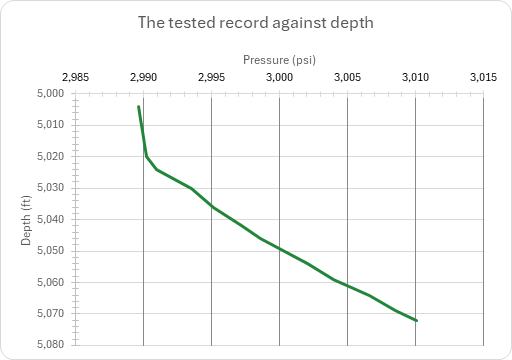
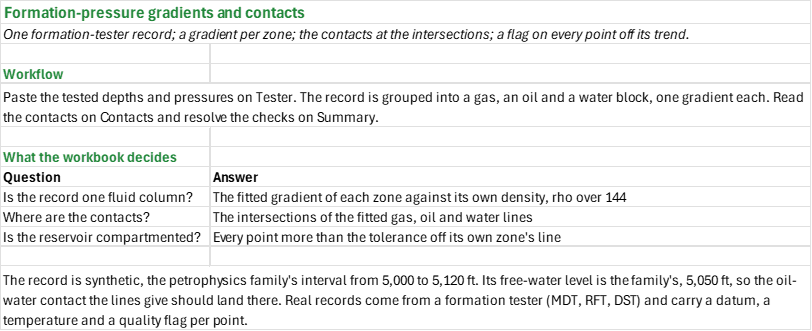
What fluid is in the rock between the wells, and where are the contacts? You paste a formation-tester record of depths and pressures grouped into gas, oil and water zones, and enter the three fluid densities. You read off each zone's fitted gradient against its fluid's density, the gas-oil and oil-water contacts where those lines cross, and every point that sits off its own zone's line as a compartment candidate. Field units.
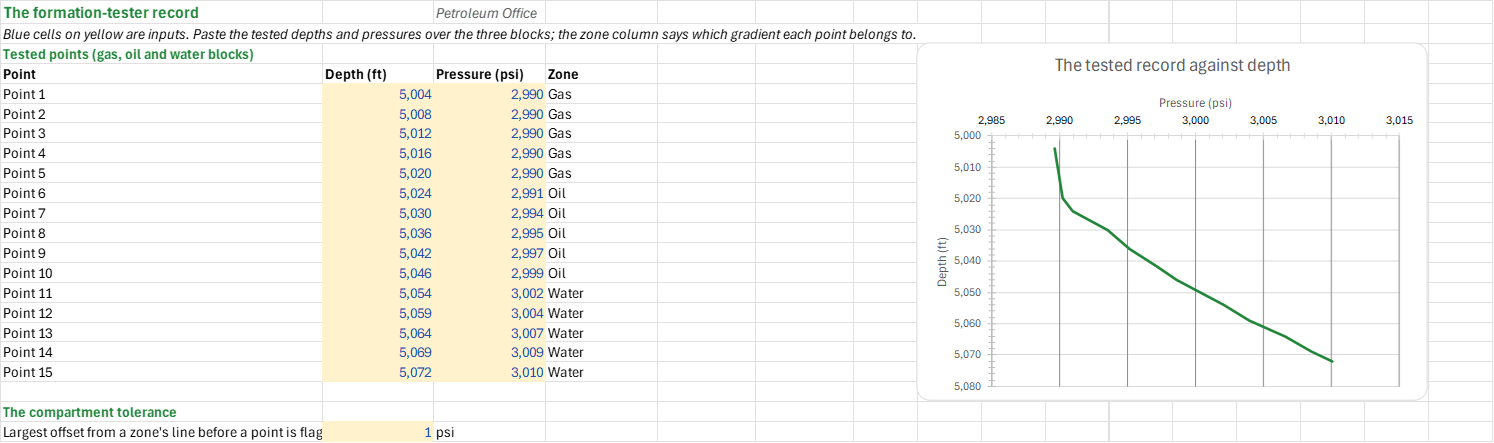
How to use it: Paste the tested depths and pressures over the gas, oil and water blocks on the Tester sheet; the zone column says which gradient each point belongs to. Correct the pressures to one datum and remove the failed points before pasting. Enter the gas, oil and formation-water densities on the Gradients sheet and check each fitted gradient against its fluid: a gradient that does not match its fluid's density means a zone is mislabelled or a depth is wrong. Read the contacts and the compartment candidates on the Contacts sheet, set the free-water level to compare with, and resolve the checks on the Summary.
Method: Each zone's gradient is a least-squares fit of pressure on depth over that zone's fixed block of the tester sheet: the slope and the intercept from LINEST, the R-squared from RSQ. The expected gradient of a fluid is its density over 144, the hydrostatic gradient of that fluid. The gas-oil contact is where the gas and oil lines cross, depth = (b oil - b gas) / (m gas - m oil), and the oil-water contact is where the oil and water lines cross. Each point's offset from its zone's line is the residual; a residual larger than the tolerance is a compartment candidate, a point that does not belong to the same fluid column as its neighbours, and the compartment count is the number of such points.
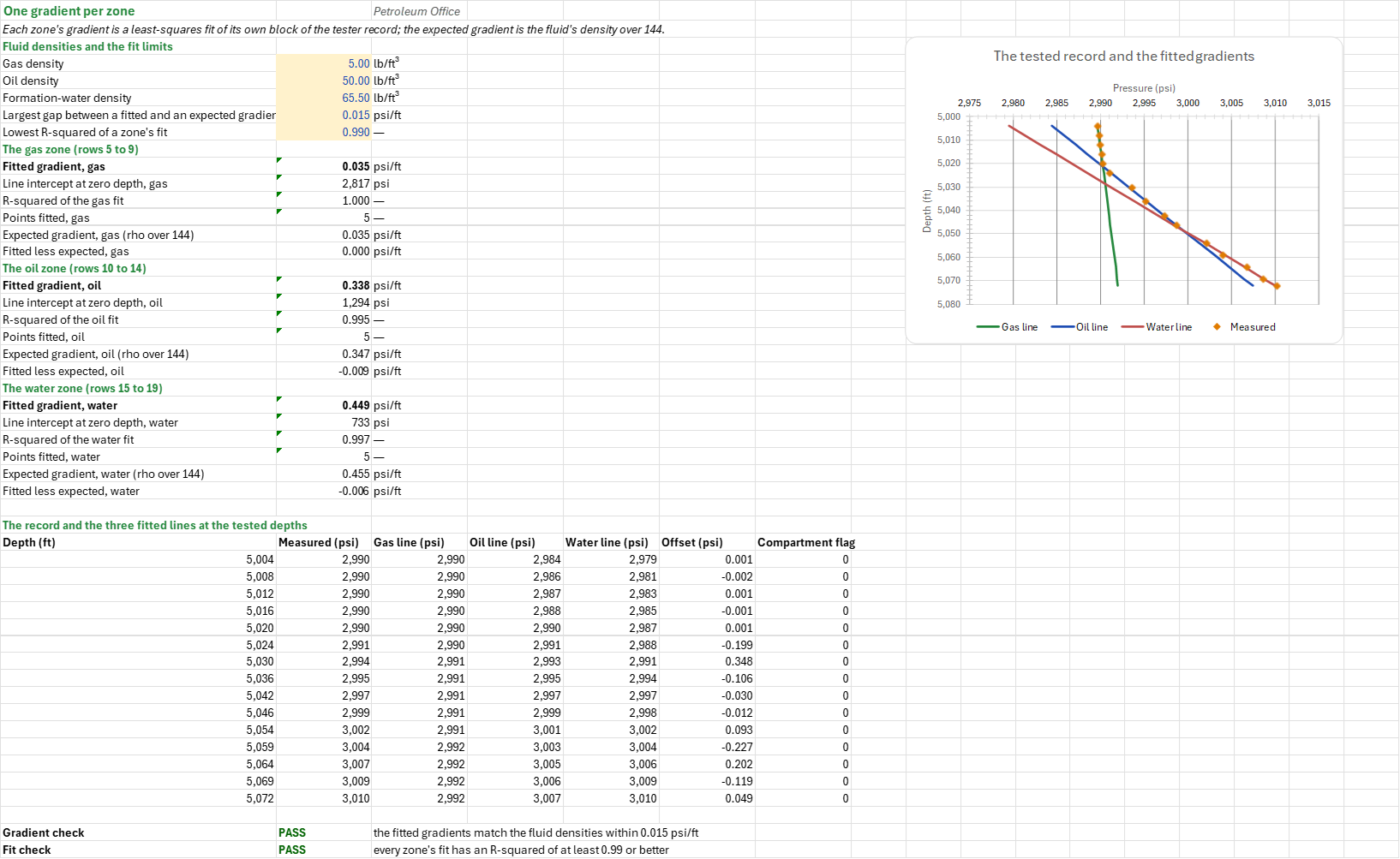
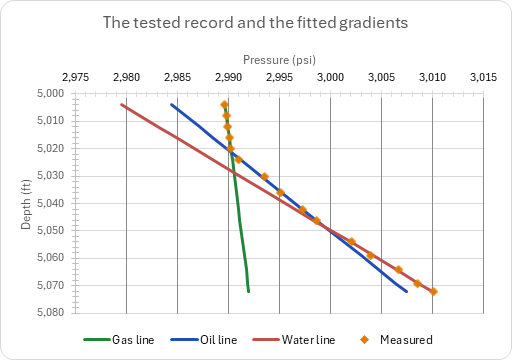
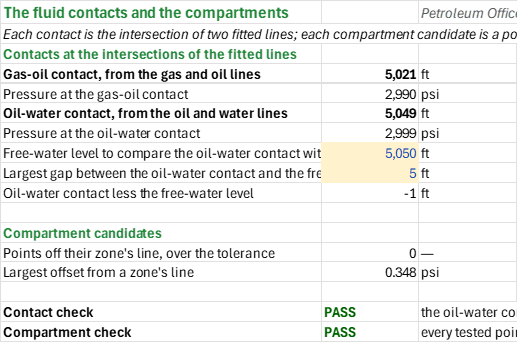
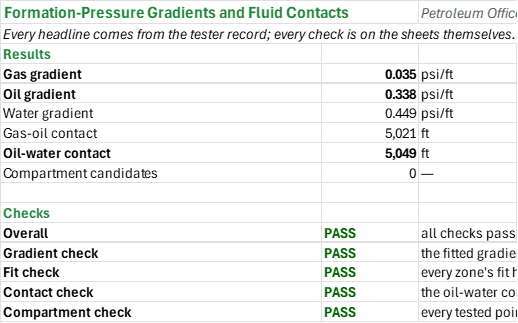
Example: With the default record, the fitted gas gradient is 0.0346 psi/ft (R-squared 0.9999), the oil gradient 0.3378 psi/ft (0.9952) and the water gradient 0.4490 psi/ft (0.9973), each within 0.0094 psi/ft of its fluid's density over 144. The gas-oil contact comes out at 5,021.2 ft and the oil-water contact at 5,048.5 ft, 1.5 ft from the petrophysics family's 5,050 ft free-water level, the level a saturation-height model needs. The largest offset in the record, 0.35 psi at the 5,030 ft oil point, is inside the 1.0 psi tolerance, so there is no compartment; at a 0.05 psi tolerance that point is flagged.
Validity
A gradient per zone assumes one fluid column per zone, with no compartmentalisation, and that the tested points are at the same pressure datum. A formation tester's pressures (MDT, RFT or DST records) carry a datum, a temperature and a quality flag; correct them and remove the failed points before pasting. A single offset point inside a zone is evidence of a compartment, not proof of one: check the point's datum and its quality flag before believing it. The contacts are the intersections of straight lines, so they are only as good as the straightness of the fits. The record is synthetic, the petrophysics family's interval from 5,000 to 5,120 ft. Field units.
References
- Dake, L.P. (1978). Fundamentals of Reservoir Engineering. Elsevier, chapter 1 (pressure regimes and fluid contacts).
- Archer, J.S. and Wall, C.G. (1986). Petroleum Engineering: Principles and Practice. Graham & Trotman.
Inputs
| Input | Unit | Default | Name |
|---|---|---|---|
| Largest offset from a zone's line before a point is flagged | psi | 1.0 | PGT_Tol |
| Gas density, oil density, formation-water density | lb/ft3 | 5.0, 50.0, 65.5 | PGD_RhoGas, PGD_RhoOil, PGD_RhoWater |
| Largest gap between a fitted and an expected gradient | psi/ft | 0.015 | PGD_GradTol |
| Lowest R-squared of a zone's fit | — | 0.99 | PGD_R2Min |
| Free-water level to compare the oil-water contact with | ft | 5,050 | PGC_Fwl |
| Largest gap between the oil-water contact and the free-water level | ft | 5 | PGC_FwlTol |
Sheets
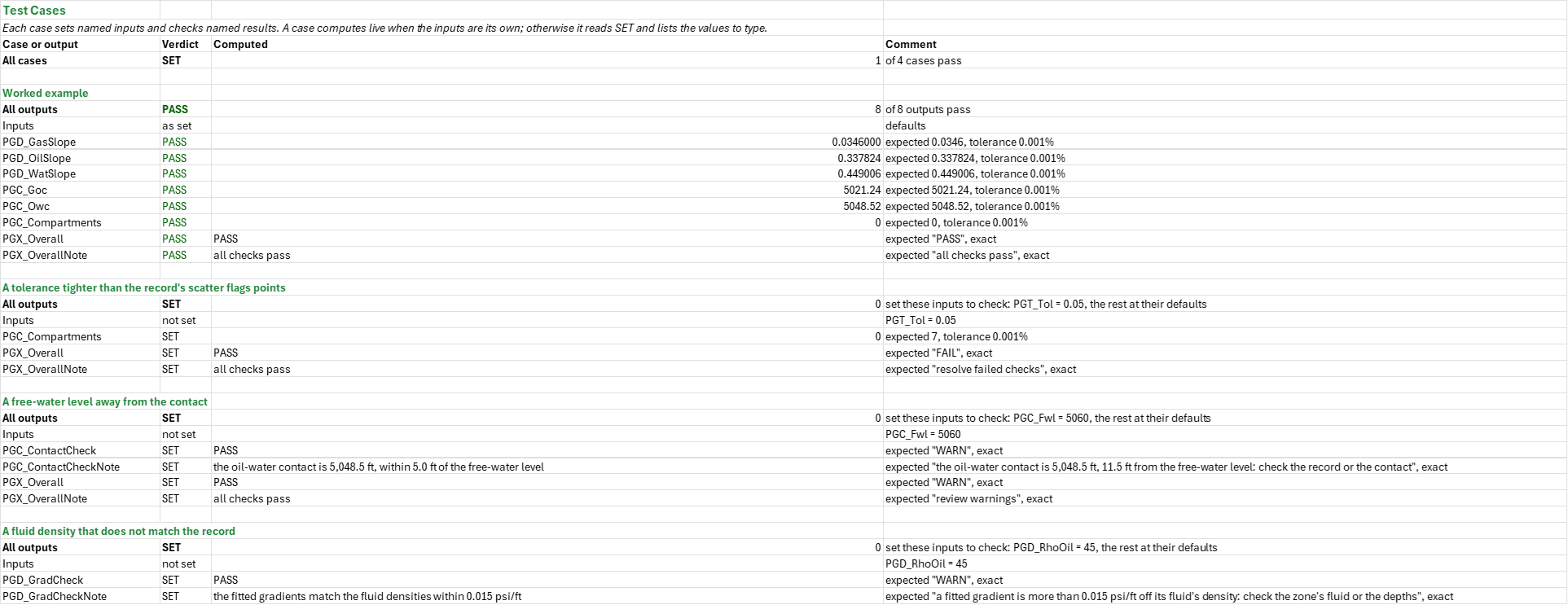
Guide— what the workbook answers, the order to work through its sheets and where the example record comes from.Tester— the tested points in gas, oil and water blocks, each with its depth, pressure and zone, the compartment tolerance, and the record plotted against depth.Gradients— the three fluid densities and fit limits, each zone's fitted gradient, intercept and R-squared against its expected gradient, and the record with the three fitted lines at the tested depths.Contacts— the gas-oil and oil-water contacts at the intersections of the fitted lines, the oil-water contact against the free-water level, and each point's residual from its zone's line with the compartment candidates.Summary— the gradients, contacts and compartment count and every check under one verdict.Test Cases— the worked example and other cases, with expected and computed results.
Two charts: the tested record against depth, and the record with the three fitted gradients.
Functions used
None: the workbook calculates with Excel's own functions.
Names (59)
| Name | Refers to | Comment |
|---|---|---|
PGC_CompartCheck |
Contacts!$B$17 |
Compartment check verdict |
PGC_CompartCheckNote |
Contacts!$C$17 |
Compartment check comment |
PGC_Compartments |
Contacts!$B$13 |
Points off their zone's line, over the tolerance |
PGC_ContactCheck |
Contacts!$B$16 |
Contact check verdict |
PGC_ContactCheckNote |
Contacts!$C$16 |
Contact check comment |
PGC_Fwl |
Contacts!$B$8 |
Free-water level to compare the oil-water contact with, ft |
PGC_FwlDiff |
Contacts!$B$10 |
Oil-water contact less the free-water level, ft |
PGC_FwlTol |
Contacts!$B$9 |
Largest gap between the oil-water contact and the free-water level, ft |
PGC_Goc |
Contacts!$B$4 |
Gas-oil contact, from the gas and oil lines, ft |
PGC_GocP |
Contacts!$B$5 |
Pressure at the gas-oil contact, psi |
PGC_Inputs |
Contacts!$B$8:$B$9 |
The free-water level to compare the oil-water contact with and its tolerance |
PGC_MaxOffset |
Contacts!$B$14 |
Largest offset from a zone's line, psi |
PGC_Owc |
Contacts!$B$6 |
Oil-water contact, from the oil and water lines, ft |
PGC_OwcP |
Contacts!$B$7 |
Pressure at the oil-water contact, psi |
PGC_Results |
Contacts!$B$4:$B$7 |
The two contacts and their pressures |
PGC_Results2 |
Contacts!$B$13:$B$14 |
The compartment count and the largest offset |
PGD_Checks |
Gradients!$B$49:$B$50 |
The gradient check and the fit check |
PGD_FitCheck |
Gradients!$B$50 |
Fit check verdict |
PGD_FitCheckNote |
Gradients!$C$50 |
Fit check comment |
PGD_GasDiff |
Gradients!$B$15 |
Fitted less expected, gas, psi/ft |
PGD_GasExpected |
Gradients!$B$14 |
Expected gradient, gas (rho over 144), psi/ft |
PGD_GasInt |
Gradients!$B$11 |
Line intercept at zero depth, gas, psi |
PGD_GasN |
Gradients!$B$13 |
Points fitted, gas |
PGD_GasR2 |
Gradients!$B$12 |
R-squared of the gas fit |
PGD_GasSlope |
Gradients!$B$10 |
Fitted gradient, gas, psi/ft |
PGD_GradCheck |
Gradients!$B$49 |
Gradient check verdict |
PGD_GradCheckNote |
Gradients!$C$49 |
Gradient check comment |
PGD_GradTol |
Gradients!$B$7 |
Largest gap between a fitted and an expected gradient, psi/ft |
PGD_Inputs |
Gradients!$B$4:$B$8 |
The three fluid densities and the two fit limits |
PGD_OilDiff |
Gradients!$B$22 |
Fitted less expected, oil, psi/ft |
PGD_OilExpected |
Gradients!$B$21 |
Expected gradient, oil (rho over 144), psi/ft |
PGD_OilInt |
Gradients!$B$18 |
Line intercept at zero depth, oil, psi |
PGD_OilN |
Gradients!$B$20 |
Points fitted, oil |
PGD_OilR2 |
Gradients!$B$19 |
R-squared of the oil fit |
PGD_OilSlope |
Gradients!$B$17 |
Fitted gradient, oil, psi/ft |
PGD_R2Min |
Gradients!$B$8 |
Lowest R-squared of a zone's fit |
PGD_Record |
Gradients!$A$33:$G$47 |
The tested depths, the measured pressure, each fitted line at them, each point's offset from its own zone's line and the flag it carries |
PGD_RhoGas |
Gradients!$B$4 |
Gas density, lb/ft³ |
PGD_RhoOil |
Gradients!$B$5 |
Oil density, lb/ft³ |
PGD_RhoWater |
Gradients!$B$6 |
Formation-water density, lb/ft³ |
PGD_WatDiff |
Gradients!$B$29 |
Fitted less expected, water, psi/ft |
PGD_WatExpected |
Gradients!$B$28 |
Expected gradient, water (rho over 144), psi/ft |
PGD_WatInt |
Gradients!$B$25 |
Line intercept at zero depth, water, psi |
PGD_WatN |
Gradients!$B$27 |
Points fitted, water |
PGD_WatR2 |
Gradients!$B$26 |
R-squared of the water fit |
PGD_WatSlope |
Gradients!$B$24 |
Fitted gradient, water, psi/ft |
PGT_Inputs |
Tester!$B$22:$B$22 |
The compartment tolerance |
PGT_Record |
Tester!$A$5:$D$19 |
Each tested point: its name, depth, pressure and the zone it belongs to |
PGT_Tol |
Tester!$B$22 |
Largest offset from a zone's line before a point is flagged, psi |
PGX_Checks |
Summary!$B$13:$B$16 |
Every check |
PGX_Compartments |
Summary!$B$9 |
Compartment candidates |
PGX_Gas |
Summary!$B$4 |
Gas gradient, psi/ft |
PGX_Goc |
Summary!$B$7 |
Gas-oil contact, ft |
PGX_Oil |
Summary!$B$5 |
Oil gradient, psi/ft |
PGX_Overall |
Summary!$B$12 |
Overall verdict |
PGX_OverallNote |
Summary!$C$12 |
Overall comment |
PGX_Owc |
Summary!$B$8 |
Oil-water contact, ft |
PGX_Results |
Summary!$B$4:$B$12 |
The results and the overall verdict |
PGX_Water |
Summary!$B$6 |
Water gradient, psi/ft |
Details
| Opens in | Works in Excel 2016 and later: plain formulas, no add-in needed. |
| File | PressureGradients.xlsx, 29 KB |
| Category | Petrophysics |
| For agents and tools | Descriptor (.md) |