C7+ Characterization and Lumping
Description
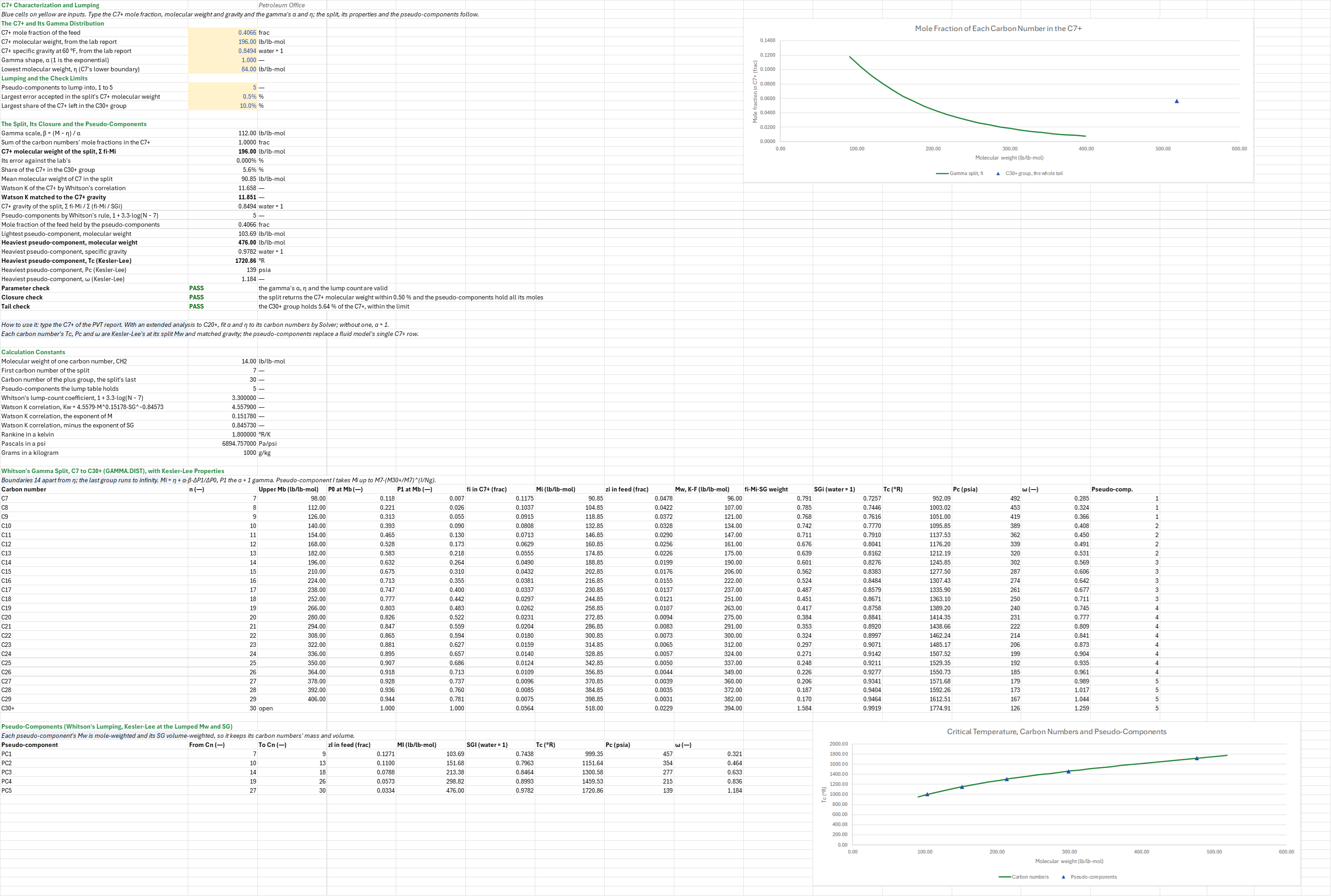
How do you turn a lab report's single C7+ fraction into the few pseudo-components an equation of state can carry? You enter the C7+ mole fraction, molecular weight and gravity, the shape and origin of Whitson's gamma distribution, and the number of pseudo-components. You read off each carbon number from C7 to C29 and a C30+ group with its mole fraction, molecular weight, gravity, Tc, Pc and acentric factor, and the lumped pseudo-components ready for an EoS model.
Parameters:
- The C7+: its mole fraction of the feed
ECP_ZPlus, molecular weightECP_PlusMwand specific gravityECP_PlusSG, from the lab report - The gamma distribution: the shape
ECP_Alpha(α; 1 is the exponential) and the originECP_Eta(η, the lowest molecular weight, C7's lower boundary) - Lumping: the number of pseudo-components
ECP_Ng, 1 to 5 (Whitson's rule gives 5 for a split to C30+) - Limits: the largest error accepted in the split's C7+ molecular weight
ECP_MwTol(0.5 %), and the largest share of the C7+ left in the C30+ groupECP_TailMax(10 %)
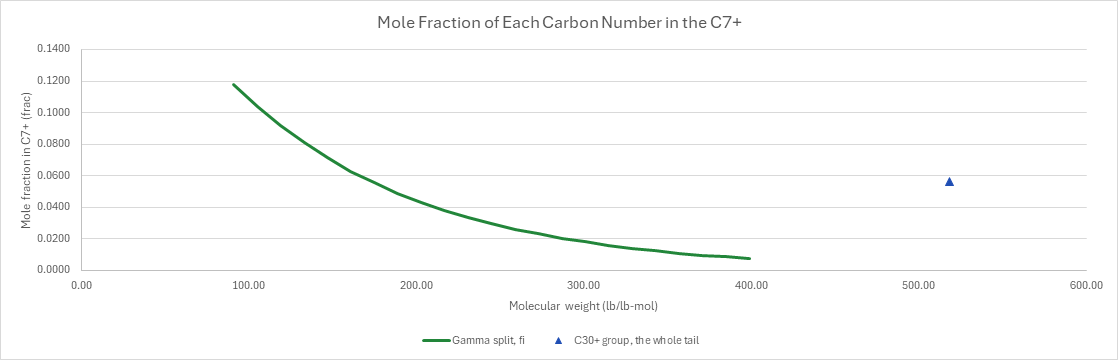
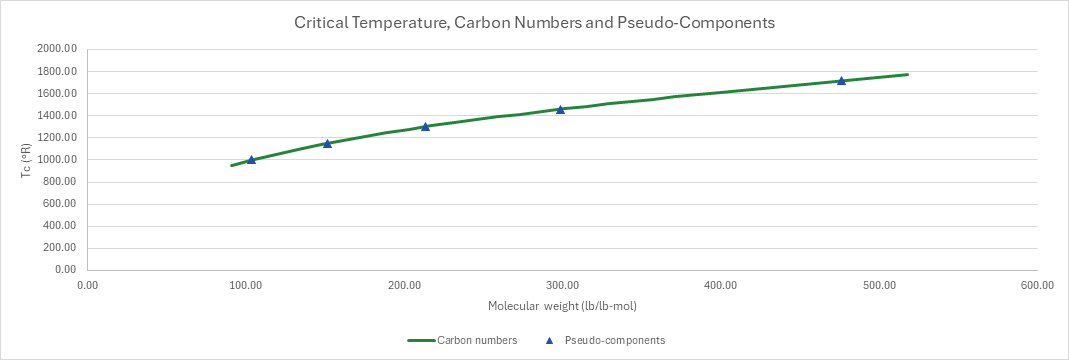
How to use it: Type the C7+ mole fraction, molecular weight and gravity from the PVT report. With an extended analysis (C7 to C20+ by simulated distillation or gas chromatography), fit α and η to its carbon-number mole fractions by Solver, minimising the squared misfit of the split's fi against the measured ones, and keep the C7+ molecular weight fixed. Without one, α = 1 is Whitson's choice for a black oil; a gas condensate is often nearer 0.5 to 1 and a heavy oil above 1. Check that the split returns the lab's C7+ molecular weight and that the C30+ group holds a small share. Carry the pseudo-components' molecular weights, gravities, Tc, Pc, ω and feed mole fractions into an EoS model as rows of their own, in place of the single C7+ the EoS Fluid Model sheet carries, then tune them against the PVT report. One chart draws the distribution and the other the critical temperature of the carbon numbers and the pseudo-components.
Method: Gamma split. The molecular weight of the plus fraction follows p(M) = (M − η)^(α−1)·exp(−(M − η)/β) / (β^α·Γ(α)), with β = (M7+ − η)/α so the mean is M7+. The upper boundary of carbon number n is Mb = η + 14·(n − 6); the C30+ group runs to infinity. With P0 the cumulative gamma, GAMMA.DIST(Mb − η, α, β, TRUE) in Excel, and P1 the same for α + 1, each carbon number's mole fraction in the C7+ is fi = ΔP0 across its boundaries and its mean molecular weight Mi = η + α·β·ΔP1/ΔP0 (Whitson, 1983). So Σ fi·Mi returns M7+ exactly, and zi = z7+·fi.
Gravities. Whitson's Watson-K relation Kw = 4.5579·M^0.15178·SG^−0.84573 is held at one Kw for the whole plus fraction, so SGi = (4.5579·Mi^0.15178 / Kw)^(1/0.84573). Kw is solved in closed form so the split's volume-weighted gravity, Σ fi·Mi / Σ (fi·Mi/SGi), is the C7+ gravity; the correlation's own Kw for the C7+ is shown beside it.
Properties. Tc, Pc and ω of each carbon number are Kesler-Lee's at Mi and SGi, converted to °R and psia. Katz and Firoozabadi's tabulated molecular weight of carbon number n, the generalised value the split replaces, stands beside the split's.
Lumping. Whitson's rule suggests Ng = 1 + 3.3·log10(N − 7) groups for a split to N. Group I takes the carbon numbers up to MI = M7·(MN+/M7)^(I/Ng), with M7 and MN+ the split's first and last mean molecular weights. A pseudo-component's mole fraction is the sum of its carbon numbers', its molecular weight mole-weighted and its gravity volume-weighted (Σ z·M / Σ (z·M/SG)), so it keeps their mass and volume; Tc, Pc and ω are Kesler-Lee's at that molecular weight and gravity.
Checks. The parameters are rejected for α of 0 or less, η at or above M7+, a C7+ mole fraction outside 0 to 1, or a lump count that isn't a whole number from 1 to 5. The closure check holds the split's C7+ molecular weight within the tolerance of the lab's, and the pseudo-components to the C7+'s moles. The tail check flags a C30+ group holding more than its limit of the C7+.
Example: The defaults are the EoS family's reference fluid: the Big Butte crude of Ahmed's Reservoir Engineering Handbook (Tables 3-1 to 3-6), whose C7+ is 40.66 mol % of the feed, molecular weight 196 and specific gravity 0.8494. It is split with α = 1 from η = 84, so C7 runs from 84 to 98, C8 from 98 to 112, and so on. This is the EoS Fluid Model sheet's single C7+, split.
With α = 1 and η = 84, β is 112 and the split falls off exponentially: C7 holds 11.75 % of the C7+ at a mean molecular weight of 90.85, against Katz and Firoozabadi's 96 for C7, and the C30+ group 5.64 % at 518. The split returns 196 for the C7+ and a fraction sum of 1. Whitson's correlation puts the C7+ at Kw = 11.658; the Kw that returns its 0.8494 gravity is 11.851, which takes C7's gravity to 0.7257 and its Kesler-Lee Tc to 952.1 °R. Whitson's rule gives 5 pseudo-components. The lightest (C7 to C9) is 12.71 mol % of the feed at a molecular weight of 103.69. The heaviest (C27 to C30+) is 3.34 mol % at 476.0, gravity 0.9782, Tc 1,720.9 °R, Pc 139.5 psia and ω 1.184.
Functions used
PO.EoS.SCN.Props(CN)
Returns Katz-Firoozabadi SCN properties (Tc, Pc, omega, Mw) as a row array. Carbon number range: 6-45.
PO.EoS.Pseudo.Props(Mw, SG, [method])
Returns pseudo-component Tc [K], Pc [Pa], omega and Mw [kg/mol] of a petroleum cut from its Mw [g/mol] and specific gravity by Riazi-Daubert (1987), Kesler-Lee (1976) or Twu (1984), as a row of 4 cells in the layout of PO.EoS.Component.Props.
Names (53)
| Name | Refers to | Comment |
|---|---|---|
ECP_ZPlus |
$B$4 |
C7+ mole fraction of the feed, frac |
ECP_PlusMw |
$B$5 |
C7+ molecular weight, from the lab report, lb/lb-mol |
ECP_PlusSG |
$B$6 |
C7+ specific gravity at 60 °F, from the lab report, water = 1 |
ECP_Alpha |
$B$7 |
Gamma shape, α (1 is the exponential) |
ECP_Eta |
$B$8 |
Lowest molecular weight, η (C7's lower boundary), lb/lb-mol |
ECP_Ng |
$B$10 |
Pseudo-components to lump into, 1 to 5 |
ECP_MwTol |
$B$11 |
Largest error accepted in the split's C7+ molecular weight, % |
ECP_TailMax |
$B$12 |
Largest share of the C7+ left in the C30+ group, % |
ECP_Inputs |
$B$4:$B$12 |
The C7+ mole fraction, molecular weight and gravity, the gamma's shape α and origin η, the pseudo-components to lump into, and the closure and tail limits |
ECP_Beta |
$B$15 |
Gamma scale, β = (M − η) / α, lb/lb-mol |
ECP_SumF |
$B$16 |
Sum of the carbon numbers' mole fractions in the C7+, frac |
ECP_MwSplit |
$B$17 |
C7+ molecular weight of the split, Σ fi·Mi, lb/lb-mol |
ECP_MwErr |
$B$18 |
Its error against the lab's, % |
ECP_Tail |
$B$19 |
Share of the C7+ in the C30+ group, % |
ECP_C7Mw |
$B$20 |
Mean molecular weight of C7 in the split, lb/lb-mol |
ECP_KwCorr |
$B$21 |
Watson K of the C7+ by Whitson's correlation |
ECP_Kw |
$B$22 |
Watson K matched to the C7+ gravity |
ECP_SGSplit |
$B$23 |
C7+ gravity of the split, Σ fi·Mi / Σ (fi·Mi / SGi), water = 1 |
ECP_NgRule |
$B$24 |
Pseudo-components by Whitson's rule, 1 + 3.3·log(N − 7) |
ECP_LumpZ |
$B$25 |
Mole fraction of the feed held by the pseudo-components, frac |
ECP_LightMw |
$B$26 |
Lightest pseudo-component, molecular weight, lb/lb-mol |
ECP_HeavyMw |
$B$27 |
Heaviest pseudo-component, molecular weight, lb/lb-mol |
ECP_HeavySG |
$B$28 |
Heaviest pseudo-component, specific gravity, water = 1 |
ECP_HeavyTc |
$B$29 |
Heaviest pseudo-component, Tc (Kesler-Lee), °R |
ECP_HeavyPc |
$B$30 |
Heaviest pseudo-component, Pc (Kesler-Lee), psia |
ECP_HeavyOmega |
$B$31 |
Heaviest pseudo-component, ω (Kesler-Lee) |
ECP_ParamCheck |
$B$32 |
Parameter check verdict |
ECP_ParamCheckNote |
$C$32 |
Parameter check comment |
ECP_ClosureCheck |
$B$33 |
Closure check verdict |
ECP_ClosureCheckNote |
$C$33 |
Closure check comment |
ECP_TailCheck |
$B$34 |
Tail check verdict |
ECP_TailCheckNote |
$C$34 |
Tail check comment |
ECP_Results |
$B$15:$B$34 |
β, the split's mole-fraction sum, C7+ MW and its error, the C30+ share, C7's mean MW, Watson K by correlation and matched, the split's gravity, Whitson's lump count, moles lumped, the lightest and heaviest pseudo-components, three checks |
ECP_Step |
$B$40 |
Molecular weight of one carbon number, CH2, lb/lb-mol |
ECP_First |
$B$41 |
First carbon number of the split |
ECP_N |
$B$42 |
Carbon number of the plus group, the split's last |
ECP_MaxNg |
$B$43 |
Pseudo-components the lump table holds |
ECP_Rule |
$B$44 |
Whitson's lump-count coefficient, 1 + 3.3·log(N − 7) |
ECP_KwA |
$B$45 |
Watson K correlation, Kw = 4.5579·M^0.15178·SG^−0.84573 |
ECP_KwB |
$B$46 |
Watson K correlation, the exponent of M |
ECP_KwC |
$B$47 |
Watson K correlation, minus the exponent of SG |
ECP_RK |
$B$48 |
Rankine in a kelvin, °R/K |
ECP_PaPsi |
$B$49 |
Pascals in a psi, Pa/psi |
ECP_Gkg |
$B$50 |
Grams in a kilogram, g/kg |
ECP_Split |
$A$55:$O$78 |
Each carbon number's upper boundary, cumulative gamma P0 and P1, mole fraction in the C7+ and the feed, mean and Katz-Firoozabadi molecular weight, gravity, Kesler-Lee Tc, Pc and ω, and its pseudo-component |
ECP_CN |
$B$55:$B$78 |
Carbon numbers |
ECP_F |
$F$55:$F$78 |
Mole fraction of each carbon number in the C7+ |
ECP_Mi |
$G$55:$G$78 |
Mean molecular weight of each carbon number, Whitson |
ECP_Zi |
$H$55:$H$78 |
Mole fraction of each carbon number in the feed |
ECP_W |
$J$55:$J$78 |
Gravity weight fi·Mi·(KwA·Mi^KwB)^(-1/KwC) of each carbon number |
ECP_SGi |
$K$55:$K$78 |
Specific gravity of each carbon number at the matched Watson K |
ECP_Grp |
$O$55:$O$78 |
Pseudo-component each carbon number lumps into |
ECP_Pseudo |
$A$83:$I$87 |
Each pseudo-component's carbon-number range, feed mole fraction, molecular weight, gravity, and Kesler-Lee Tc, Pc and ω |
Details
| Inserts | 87 rows × 15 columns |
| Category | Equation of State |
| For agents and tools | Descriptor (.md) |