Unit Conversion in Petroleum Office
Unit conversion in Petroleum Office is based on the PO.UnitConverter() Excel function, which is part of the add-in function library.
=PO.UnitConverter(Value, UnitFrom, UnitTo)
It has the following parameters:
- Value - value you need to convert
- UnitFrom - source unit abbreviation
- UnitTo - target unit abbreviation
Unit Converter Pane
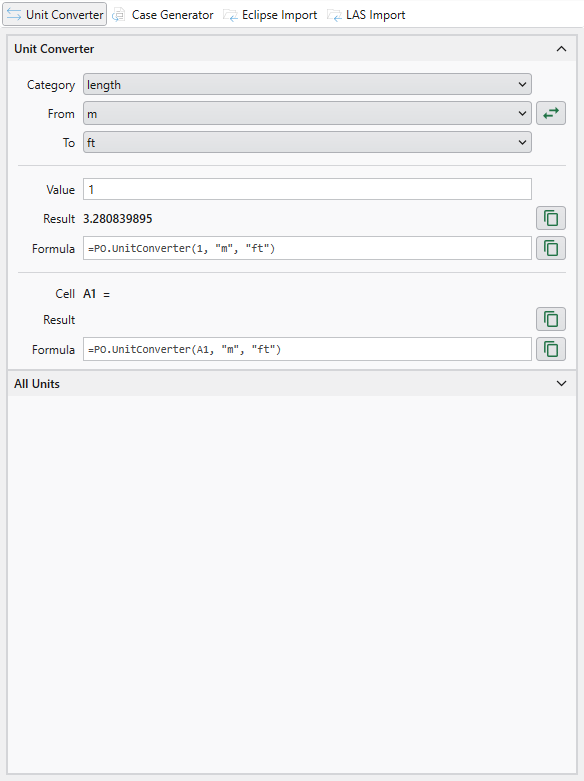
The Petroleum Office ribbon includes a Unit Converter button in the Tools group that opens a dedicated task pane for quick conversions without writing formulas:
- Select the Category (e.g., Pressure, Temperature, Length)
- Choose the From unit
- Choose the To unit
- Type a value and read the result, or copy the matching
=PO.UnitConverter(...)formula into a cell
This lets you browse all registered units organized by category and quickly find the abbreviation you need.
If you work in SI throughout, converting on every call gets tedious. The lambda catalog provides SI-unit versions of the functions that do the conversion for you.
Units
PO.UnitConverter() accepts registered units — abbreviations the add-in holds in its catalogue. If a unit is in the catalogue it converts; if it is not, the formula returns an error. There is no syntax for building one.
The catalogue has 1,500+ entries covering pressure, temperature, length, area, volume, flow rates, density, viscosity, permeability, and many more petroleum engineering categories. The Unit Converter pane is the quickest way to find the abbreviation you want.
=PO.UnitConverter(14.7, "psi", "kPa")     → 101.35
=PO.UnitConverter(60, "degF", "degC")     → 15.56
=PO.UnitConverter(1000, "bbl/d", "m3/d")  → 158.99
Units that carry a multiplier
Some entries include a multiplier as part of the abbreviation, written with a space — 1000 bbl/d, 1E6 ft3, 1/32 in. These are catalogue entries in their own right, not something the function assembles: 1000 bbl/d converts because the catalogue contains that row, in the same way bbl/d does.
=PO.UnitConverter(1, "1000 bbl/d", "bbl/d")  → 1000
=PO.UnitConverter(1, "1E6 ft3/d", "ft3/d")   → 1000000
=PO.UnitConverter(1, "1/32 in", "in")        → 0.03125
The last one is the familiar choke size. Because these are rows rather than a pattern, the multiplier cannot be varied freely — 1000 ft is in the catalogue and 640 acre is not. Browse the pane, or the unit reference, to see which forms exist for the quantity you are working with.
Unit expressions have been removed
Earlier versions accepted expressions that combined registered units with * and ^, such as ft^2, ft*lbf or psi*ft. These no longer resolve and a formula using one returns an error.
The reason is that composition could not be made reliable. Deciding what an arbitrary combination meant produced silently wrong answers often enough — deg read as deci-exagram, g/cc as gram-per-centicoulomb — that the safer behaviour is to accept only what the catalogue holds and reject the rest, rather than guess.
If a workbook contains one of these, replace it with the registered unit for the same quantity:
| Expression | Use instead |
|---|---|
ft^2 |
ft2 |
m^3 |
m3 |
ft*lbf |
lbf.ft |
psi*ft |
lbf.ft/in2 |
If the pane offers nothing for the quantity you need, the unit is genuinely missing from the catalogue rather than merely spelled differently; please get in touch so it can be added.